The 24-Month Exit Planning Preparation Blueprint
Two founders. Same product category. Same $5 million in trailing revenue. Same 22% net margin on the books. Both decide to sell within the same calendar year.
11 min read · 27 October 2025
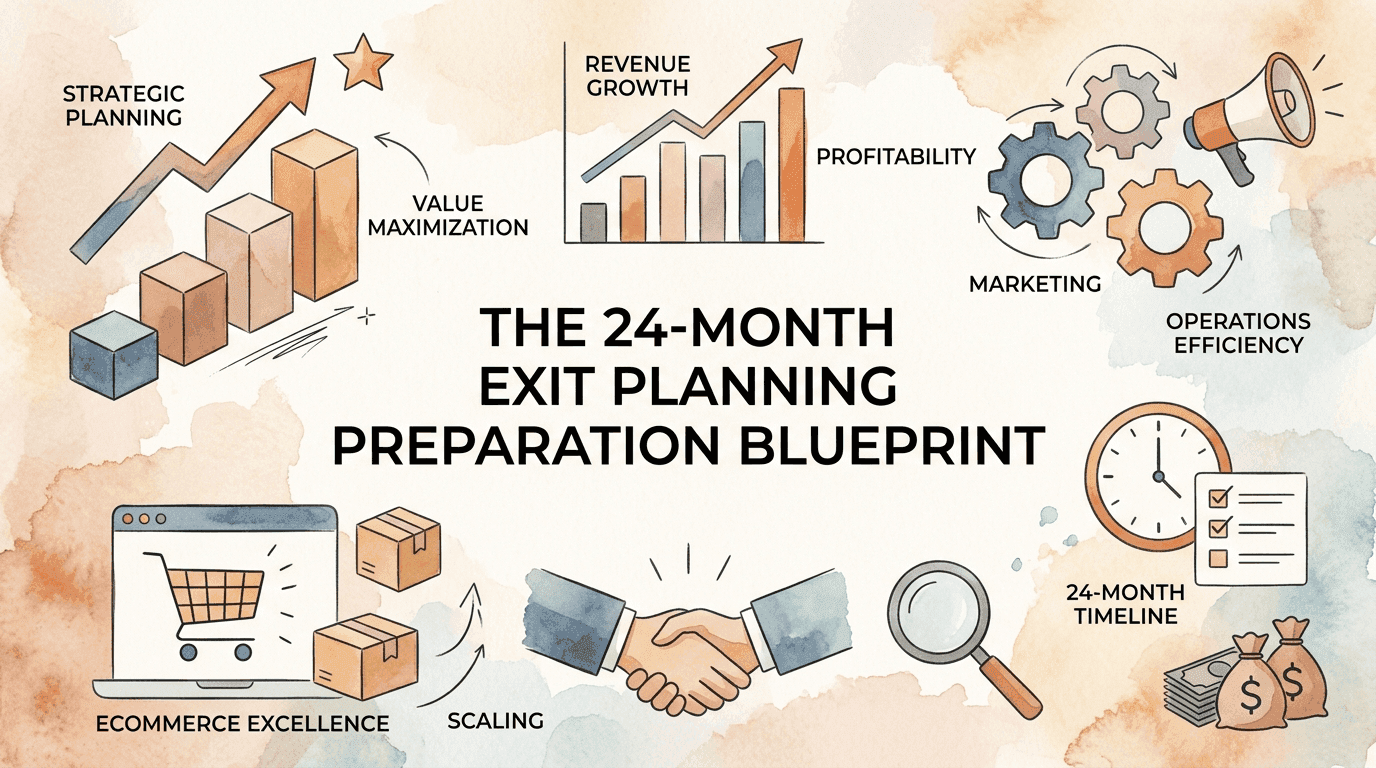
The 24-Month Exit Planning Preparation Blueprint
Two founders. Same product category. Same $5 million in trailing revenue. Same 22% net margin on the books. Both decide to sell within the same calendar year.
One walks away with an enterprise value of $14.4 million on a 3.6x SDE multiple, a clean 80% cash close, and a 12-month earn-out tied to revenue growth he is confident he can hit. The other accepts $7.8 million on a 2.0x multiple, with 35% held back in earn-out triggers that require him to retain the top three accounts and continue running the business himself for two years. Same revenue. Same margin. Almost double the price.
The difference between them was 24 months of structural preparation, started before either of them had told anyone they were thinking about selling. This is the gap that brokers will not tell you about until you have already wasted it.
The Six-Month Sprint That Halves Your Multiple
Founder B did everything his broker told him to do. He spent six months "preparing the business for sale." He cleaned up his Xero file, separated personal expenses from the P&L, wrote a 30-page CIM, and built a virtual data room with three years of financials, ad spend reports, and supplier contracts. The broker called it textbook prep.
Six months is what most ecommerce founders give themselves. The pattern is consistent across Empire Flippers marketplace data, Quiet Light articles on broker engagements, and the operator interviews behind Value Builder research. The founder decides to sell, calls a broker, and starts a 90 to 180 day sprint to package whatever business they currently have. The broker's incentive is to get the business listed, because brokers are paid on close, not on multiple.
The problem is that the variables that move the multiple are not the ones a six-month sprint can fix.
A clean Xero file does not change the fact that 70% of revenue runs through one channel. A polished CIM does not change the fact that the founder approves every PO over $5,000 and personally manages the top three retail accounts. A well-organised data room does not change the fact that contribution margin has bounced between 28% and 41% over the last 12 months because the founder keeps running unplanned promotions to hit revenue targets. These are structural facts about the business. They show up in due diligence. They get priced in.
The Exit Planning Institute State of Owner Readiness research surfaces the same gap, year after year, across thousands of business owners. Most owners enter a sale process believing their business is worth a number based on revenue and EBITDA. The eventual close price is materially lower because diligence surfaces concentration risk, owner dependency, and earnings volatility that the seller had normalised but the buyer had not. The gap is not bad luck. It is the absence of structural preparation that should have started 18 to 24 months earlier.
Brokers do not lead with this advice because they cannot get paid on it. There is no fee for telling a founder to come back in two years. The result is a generation of operators who learn the hard way that the six-month sprint is a polish job, not a value-creation project.
Why the Math Doesn't Work: The Multiple Is Built, Not Negotiated
Founder A's $14.4 million close was not a negotiating victory. It was the output of three structural conditions that took 24 months to build, and a fourth that took the full window to mature.
The first was channel concentration. When Founder A started prep, Amazon was 71% of revenue, with the balance split across DTC and a handful of wholesale accounts. By month 24, Amazon was 49%, DTC had grown from 18% to 32%, and a deliberately built wholesale channel held the rest. A buyer underwriting that revenue mix sees three independent demand engines. A buyer underwriting Founder B's 70% Amazon dependency sees a single platform-risk exposure that could collapse the deal if Amazon suspends the listing in year one.
The second was owner role. Founder A hired a general manager in month 4, a hire he had resisted for two years because "no one would care about the business as much as I do." By month 18, the GM ran the weekly ops meeting, owned the supplier relationships, and signed every PO under $50,000. By month 24, Founder A had not been in the warehouse for six months. A buyer could see, on the org chart and in the ops calendar, a business that did not require Founder A to function. Founder B was still personally managing the top three retail buyers and had a phone-tree relationship with his contract manufacturer. The multiple difference was not punishment. It was math.
FE International broker analysis on owner-dependency reduction makes this concrete: businesses with documented operations teams and reduced founder involvement consistently achieve higher multiples than equivalent-revenue businesses where the founder is the operations layer. The gap can sit anywhere from 0.5x to 2.0x of SDE depending on category, and the larger gaps appear in physical product businesses where supplier relationships, retail accounts, and inventory decisions all flow through the founder.
The third was margin stability. Founder A's monthly contribution margin sat in a band of 36% to 39% across the 12 months before listing. Founder B's bounced from 26% to 44% across the same period because of unplanned discounting, a failed product launch, and an inventory write-down that hit one quarter. A buyer pricing predictable cash generation pays a premium for the narrow band. A buyer looking at a wide band assumes the worst quarter is the real run-rate and prices the deal off that quarter.
Add it up. Channel concentration, owner role, margin stability. Three structural variables, each worth 0.3x to 0.6x on the SDE multiple, and none of them moveable in a six-month sprint.
Bain consumer exits commentary on consumer-brand M&A reaches the same conclusion through a different lens. Premium multiples in consumer goods exits cluster around businesses with diversified revenue, professional management, and stable contribution margin. The brands that command premium multiples are not the brands with the best founder pitch. They are the brands that look like de-risked operating companies before the founder ever picks up the phone to a broker.
The Exit Readiness Blueprint
I call this The Exit Readiness Blueprint. It is a four-pillar structural project that runs over 24 months and treats sale preparation as a value-creation programme, not a polish job.
The four pillars are owner dependency, channel concentration, contribution-margin stability, and legal-financial hygiene. Each pillar maps to a specific risk a buyer will price during diligence. Each pillar has measurable targets a founder can track monthly. The Exit Readiness Blueprint forces the founder to run the business for the next 24 months as if every decision will be inspected by a buyer's diligence team, because it will be.
Pillar one is owner dependency. The target state is a business where a buyer can substitute the founder out within 90 days of close without operational degradation. This means a general manager owns the weekly operating cadence, supplier relationships are held by named team members and documented in a relationship register, the founder is not the named contact on any major customer account, and decision authority below $50,000 sits outside the founder. The Value Builder System work by John Warrillow has codified this through eight drivers; the one that moves the multiple most for a $5 million ecommerce brand is the hub-and-spoke risk, where every spoke runs through the founder.
Pillar two is channel concentration. The target state is no single channel above 50% of revenue, with at least two of the remaining channels each at 15% or more. For most ecommerce brands in the $1M to $10M band, this means deliberately growing DTC or wholesale to break an Amazon-heavy mix, or building a meaningful Amazon presence to break a DTC-only mix. The pillar is not just about the absolute percentages. It is about the demonstrated demand independence the founder can show across the trailing 12 months at listing.
Pillar three is contribution-margin stability. The target state is a 12-month rolling contribution margin band that does not exceed plus or minus 4 points of the median. A 38% median sitting in a 34% to 42% band is acceptable. A 38% median sitting in a 24% to 48% band gets priced down. The work to compress the band is operational, not financial: planned promotional cadence, fewer reactive discounts, supplier contracts that cap input cost volatility, and SKU-level discipline that exits products with structurally weak margin.
Pillar four is legal and financial hygiene. The target state is a business a buyer's diligence team can verify in 30 days without finding a surprise. This means three years of clean financials, a cap table that requires no explanation, registered IP, written supplier contracts, written employment agreements for every team member including the founder, and a documented inventory accounting method that has not changed in 24 months. HBR exit research has documented the deal-killing effect of diligence surprises: a single material discrepancy can cut 0.5x to 1.5x off the multiple or kill the deal entirely, even when the underlying business is sound.
The Exit Readiness Blueprint is not a pitch deck. It is a structural change programme. The founder who runs it will look up at month 24 and find that the business is more valuable to operate, regardless of whether they sell. That is the test of the framework. If it does not make the business better even without a sale, it is not exit prep, it is sale theatre.
Execution: Day 0 to Day 720
Months 1 to 6 are the baseline phase. The first 30 days are spent producing the readiness scorecard: current channel mix by revenue and contribution margin, current owner role mapped against the four-pillar test, 12-month contribution margin volatility, and a diligence pre-mortem that lists every item a buyer would flag. The scorecard becomes the project tracker for the next 23 months.
Day 30 to 90 is the GM hire. This is the single most leveraged decision in the blueprint. A general manager hired on month 4 has 20 months to take ownership of operations before a buyer needs to see them functioning independently. A GM hired on month 20 is a resume line, not a structural change. Compensation should sit at market for an Australian operations manager in physical products, typically $140,000 to $180,000 base plus a sale-success bonus that vests on close. The bonus matters because it gives the GM a reason to stay through the diligence and earn-out period.
Day 90 to 180 is supplier and customer relationship migration. Every supplier and every retail account currently held by the founder gets a named team-member contact added to the relationship. Quarterly business reviews start running with the team-member as the lead, with the founder dropping back to "available if needed." This is operationally painful, and the founder will want to skip it. Skipping it costs 0.3x to 0.5x of multiple at close.
Months 7 to 18 is the dependency-reduction phase. By month 12, the GM owns the weekly ops cadence and the founder does not attend. By month 15, the channel concentration project has shipped: deliberate spend redirected to under-built channels, hired or contracted talent for the new channels, and quarterly revenue reports showing the mix shift. By month 18, the contribution-margin stabilisation work is in its second cycle: SKU exits completed, supplier contracts renegotiated where needed, promotional calendar locked 90 days in advance.
The diligence pre-mortem runs in parallel. Each month, one item from the original list gets closed: a contract gets written, an entity gets cleaned up, an inventory method gets audited, an employment agreement gets signed. By month 18, the diligence list should be at zero open items. This is the structural work that turns a business from "auditable in 90 days with discovery risk" into "verifiable in 30 days with no surprises."
Months 19 to 24 is the listing-prep phase. Broker selection is a 60-day project, not a 30-day call. The founder interviews three brokers, gets letters of intent on indicative valuation ranges and process structure, and selects on a combination of category fit, deal size fit, and references from operators who closed in the last 18 months. Quiet Light articles and other broker content can help shortlist, but the references conversation is the test that matters most.
The CIM and data room come together in months 22 and 23. Because the underlying business has been built for diligence over 18 months, the CIM is a description, not a sales pitch. The founder does not need to spin a story about future potential. The trailing 24 months of operational improvement is the story.
Listing happens at month 24. A founder who has run the blueprint enters the process with documented improvements, a GM in seat, a diversified channel mix, stable margins, and a clean diligence file. The buyer pool gets larger. The bidding gets more competitive. The multiple lifts.
From Founder-Trapped to Founder-Independent
A six-month sprint sells whatever business the founder happens to be running on the day they call the broker. A 24-month blueprint sells a structurally better business than the one the founder started with.
The North Star metric for The Exit Readiness Blueprint is what I call the substitution test. At any point in the 24-month run, ask the question: if I were hit by a bus tomorrow, what would my GM and team need to keep this business operating at current performance for 90 days? Month 1, the answer is "everything I do, none of it documented." Month 24, the answer should be "the keys to the office and the supplier list, both of which they already have." The substitution test is the operating measure of the blueprint, and it is the same lens a buyer's diligence team will run on month 25.
Run the substitution test monthly from month 4 onwards. Score each pillar from 0 to 4. Plot the trend. If a pillar is not moving, the work in that pillar is not happening, and no amount of CIM polish will fix it at month 24.
The founders who exit at premium multiples are not the ones with the best decks. They are the ones who quietly rebuilt the business between months minus-24 and zero, then ran a process where the structural facts did the negotiating for them.
If you are within 12 months of wanting to sell, you have already lost some of the multiple. The work that follows is partial recovery. If you are 24 months out, you have the full window. Use it.
For the operating cadence that supports the blueprint, see our monthly reporting template. For the valuation mechanics that decide where structural improvements show up at close, see business valuation guide. For the diligence-readiness work that runs alongside the blueprint, see diligence checklist.
The 24-month window is not a luxury. It is the difference between selling a business and selling a job.
Unit Economics Calculator
Contribution margin per order after COGS, shipping and fees — the number scaling actually depends on.
Business Valuation for eCommerce: Beyond the Flat Multiple
Exit Strategy Planning for Ecommerce
The Financial Due Diligence Checklist Buyers Actually Read
Due Diligence Process Management Without The Scramble
Exit Strategy Planning for eCommerce: Building a Business Worth Buying
Omnichannel Strategy for Consumer Goods That Survives Year One
Newsletter
The Uncommon Insights Letter
Practical FMCG & eCommerce growth playbooks — margins, retention and scaling tactics, straight to your inbox.
Turn financial planning into profit you can see
Get a hands-on operator to turn the frameworks above into results — book a free audit call.