How Gamification Drives Brand Co-Creation
Gamification turns customers into active partners, using points, leaderboards and challenges to create ideas, increase engagement and build loyalty.
24 January 2026
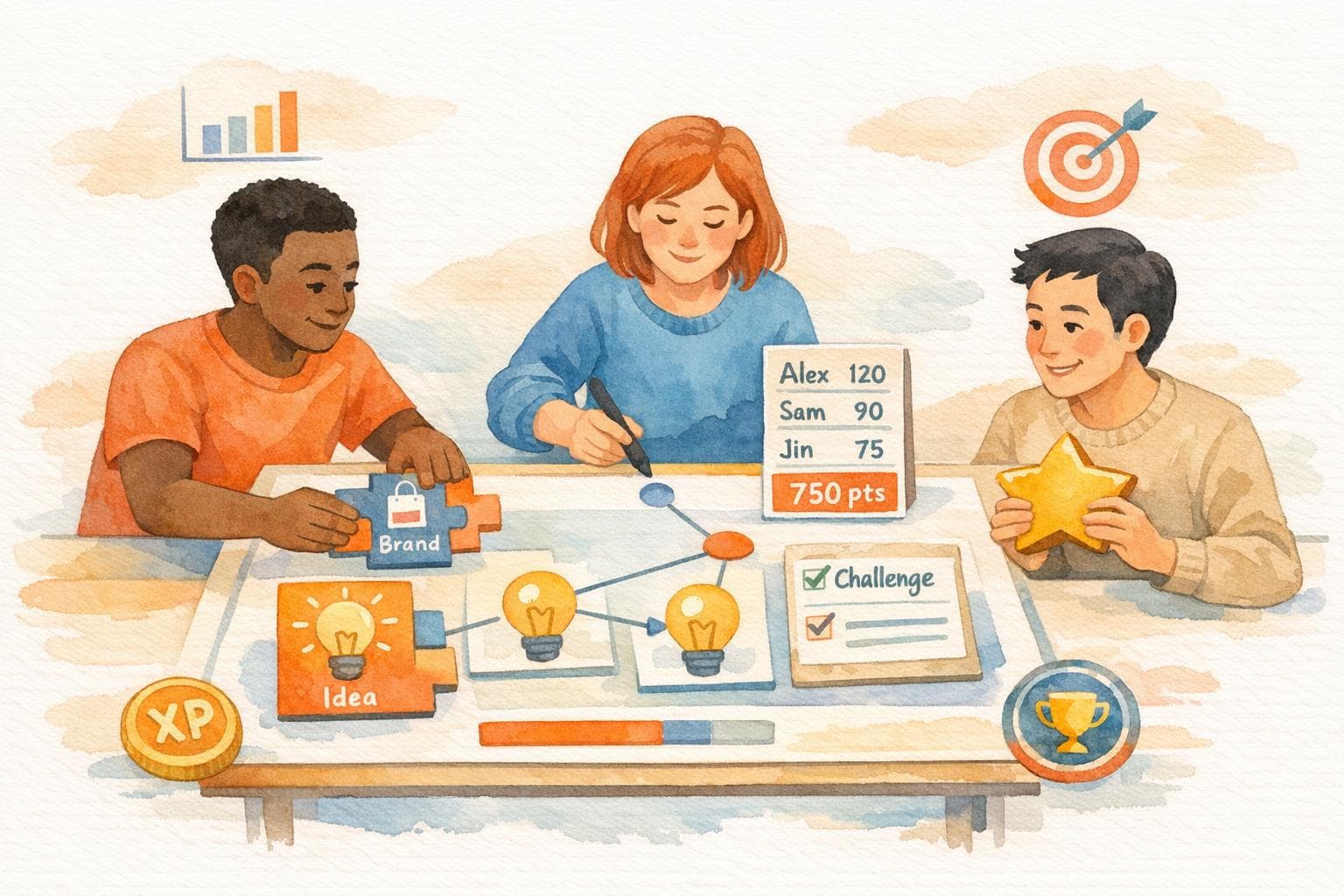
Gamification uses game-like elements - points, badges, leaderboards - to engage users and turn them into active participants. It works by tapping into motivations like achievement, competition, and social connection. When applied to brand co-creation, it encourages customers to contribute ideas, feedback, and advocacy, strengthening their connection to the brand.
Key takeaways:
- Points and Badges: Reward milestones, boosting engagement and loyalty. Examples: Nike Running Club, Xiaomi Community.
- Leaderboards: Promote friendly competition and community involvement, increasing spending by engaged users.
- Challenges and Quests: Inspire creativity through clear goals. Example: Heineken’s “Ideas Brewery” led to innovative recycling ideas.
Gamification is most effective when aligned with clear goals, tailored to the audience, and supported by well-designed rewards. For example, Mastercard’s gamified loyalty program increased app engagement by 60% and doubled active users. Integrating these strategies into digital platforms and encouraging social sharing can amplify results. Measuring success through metrics like user participation and purchase behaviour ensures continuous improvement.
Gamification transforms passive customers into active collaborators, driving innovation and loyalty.
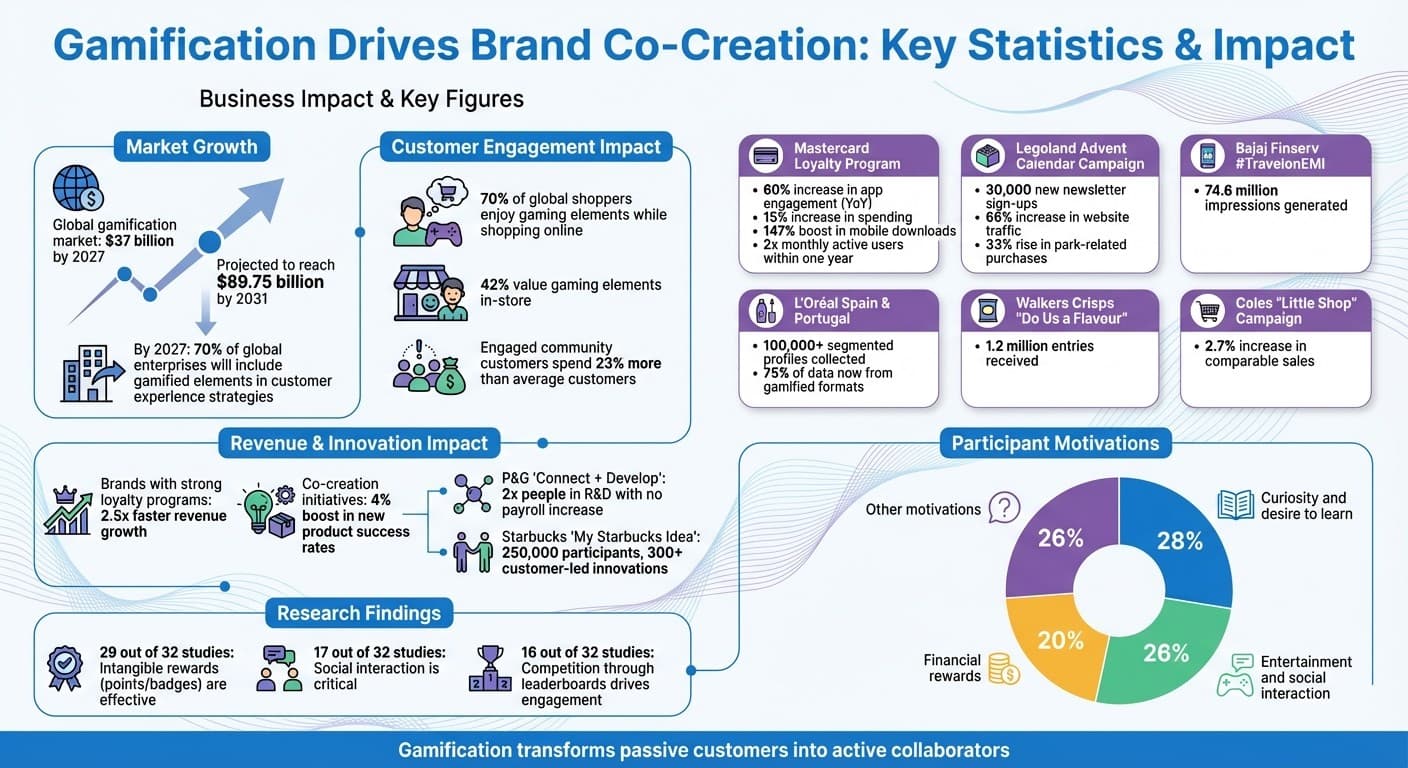
Gamification Impact on Brand Engagement and Revenue Statistics
GAMIFICATION FOR BRAND VALUE CO-CREATION
Core Game Mechanics That Drive Co-Creation
Building on the earlier discussion about gamification's role in engagement, let's delve into the mechanics that empower customers to become active collaborators. By incorporating the right elements - points and badges, leaderboards, and challenges - you can turn passive consumers into enthusiastic co-creators. These mechanics not only provide psychological rewards but also offer tangible recognition, creating a strong foundation for collaboration.
Points and Badges
Points and badges are more than just digital tokens - they represent progress and achievements. They act as motivators by rewarding milestones and encouraging participation. Take Xiaomi's Community platform as an example. Users earn points by completing tasks, which they can redeem for rewards or use in lucky draws. This system not only incentivises engagement but also drives valuable feedback on products and ideas.
Psychologically, these rewards tap into theories like Incentive Theory and Self-Determination Theory, fulfilling our need for competence and acknowledgment. In fact, 29 out of 32 studies on brand value co-creation highlight the effectiveness of intangible rewards like points and badges. The sense of accomplishment they trigger can significantly strengthen brand loyalty. Nike Running Club (NRC) uses a similar approach, awarding virtual badges when users log their runs or complete challenges, keeping users engaged. Meanwhile, Cainiao's Home platform rewards customers for participating in recycling initiatives, such as courier packaging and waste management, with points and badges.
Even small gestures, like awarding points for answering a single survey question, can provide consistent, positive reinforcement. Tiered loyalty programs that let users climb status levels and unlock perks like early product access can further enhance engagement. As one community platform insightfully notes:
"At our core, all of us get a little rush when we're told we did a good job - and it makes us want to accomplish more, and help others succeed, too".
Leaderboards and Community Engagement
Leaderboards introduce an element of friendly competition, highlighting top contributors and appealing to our desire for recognition and status. But their real strength lies in fostering a sense of community. Customers who feel engaged in a community tend to spend 23% more and contribute more to a brand's revenue compared to average customers.
Social interaction plays a critical role in co-creation, as evidenced by its presence in 17 out of 32 co-creation studies. Competition through leaderboards appeared in 16 of those studies, showcasing their dual value: they provide enjoyment while also encouraging knowledge sharing and networking. Peer validation - through likes, comments, and feedback - further enhances the quality of contributions.
Effective leaderboards reward meaningful participation rather than just competition. For instance, creating multiple leaderboards for categories like "Most Helpful", "Top Innovator", or "Community Champion" allows diverse contributors to shine. Additional ranking systems can also recognise long-term advocates who might serve as mentors or thought leaders. As another customer platform aptly puts it:
"Rewards must be given to recognize the contribution and valuable social behavior - it could be reputation scores, badges, or anything else".
Challenges and Quests
Challenges encourage creativity by setting clear, measurable goals with specific rules and deadlines, creating a sense of urgency. Quests expand on this idea by introducing multi-step journeys where participants must complete several milestones to earn rewards or unlock new features. Progress bars and other visual indicators help maintain motivation.
Heineken's "Ideas Brewery" platform is a great example. Launched in 2012, it invited users to propose sustainable packaging ideas. One German participant won $10,000 for creating the "Heineken-o-Mat", a device that gamified recycling. Walkers Crisps also ran a "Do Us a Flavour" challenge, inviting the public to create new crisp flavours, which resulted in 1.2 million entries and significant audience involvement in product development.
Interestingly, financial rewards aren't the primary motivator for most participants. Only 20% are driven by monetary incentives, while curiosity and the desire to learn motivate 28%, and 26% are drawn by entertainment and social interaction. Designing challenges that let customers take on roles like creative directors or collaborators can elevate the quality of contributions. Segmenting participants based on their skills - such as targeting retired professionals for technical challenges - can also yield better results. Building communities where members validate and refine each other's ideas further improves outcomes.
These mechanics form the backbone of a gamified co-creation strategy, offering a structured yet engaging way to involve customers in meaningful collaboration.
How to Implement Gamification for Brand Co-Creation
Gamification works best when it’s aligned with your business goals and what your audience actually wants. A structured strategy makes sure your efforts hit the mark, encouraging meaningful collaboration with your customers. Here’s how to make it happen.
Set Clear Objectives
Start by defining what you want to achieve. Are you aiming for word-of-mouth buzz, valuable customer insights, peer support, or fresh ideas from your audience? Each objective calls for different game mechanics. For instance, FMCG brands often run seasonal campaigns - think Advent calendars to re-engage lapsed customers or product launch countdowns with interactive quizzes to build excitement.
Take Legoland as an example. They ran an Advent Calendar campaign to bring back inactive subscribers, and it worked wonders: 30,000 new newsletter sign-ups, a 66% uptick in website traffic compared to the previous year, and a 33% rise in park-related purchases. The takeaway? Clear objectives make it easier to design campaigns that are both effective and measurable.
Customise Game Mechanics for Your Audience
To really connect with your audience, match the game mechanics to their motivations. Use established player type models to guide you. For instance, "Free Spirits" enjoy customisation and exploration, while "Achievers" are all about earning points and badges. For eCommerce brands, this might mean creating personality quizzes or "swipe-to-like" games that gather data in a fun and transparent way.
A great example is L'Oréal Spain and Portugal, which used gamified campaigns to collect over 100,000 segmented profiles across 20 brands. Now, 75% of their data comes from these interactive formats rather than old-school methods. Transparency is crucial here - clearly defined rules and progression paths help build trust and ensure users feel the system is fair. Also, balance is key: if the challenge is too hard, users get frustrated; if it’s too easy, they lose interest.
Design Reward Systems
Once you’ve set objectives and tailored mechanics, it’s time to focus on rewards. A well-thought-out reward system keeps people engaged over the long term. Tiered rewards work well - combine intangible perks like badges or status with tangible rewards such as early access, discounts, or exclusive previews. Research shows that intangible rewards appeared in 29 out of 32 co-creation studies, proving their appeal. To maintain interest, pair a big prize with smaller, more attainable rewards.
Consider Mastercard’s November 2023 campaign with a Southeast Asian retailer. They revamped their loyalty programme into a gamified lifestyle platform, featuring a gamification board that brought together 2,000 brands. The results? A 60% year-on-year jump in app engagement, a 15% increase in spending, a 147% boost in mobile downloads, and double the number of monthly active users within a year. The key insight? Winning - even a small reward - feels more satisfying than simply receiving something. As Playable puts it:
"The size and value of a prize is less important than winning".
Finally, make sure every interaction ends with a clear next step - whether it’s a store locator, a meeting request, or a product link. This keeps your customers engaged and moving through your ecosystem.
Embedding Gamification into Digital Platforms
Integrating gamification into digital platforms can encourage customers to actively engage with your brand. The idea is to meet them where they already spend their time - whether that's on websites, mobile apps, or social media - and make their participation feel natural. Research indicates that 70% of global shoppers enjoy gaming elements while shopping online, and 42% value them in-store.
To make this work, consider modular systems that allow gamified features to be added easily. For FMCG brands, this could involve placing QR codes on product packaging that lead customers to digital "play hubs", where they can join competitions or unlock rewards. For eCommerce businesses, simple additions like a spin-to-win feature at checkout can help reduce cart abandonment. Even without a technical team, tools like Shopify plugins or platforms like BRAME and Qualifio make these features accessible.
Since many customers use smartphones to browse during breaks or while shopping in-store, mobile optimisation is crucial. Features like progress bars, instant notifications, or live leaderboards can create a more engaging experience. These elements tap into the "Zeigarnik Effect", a psychological phenomenon where people feel compelled to finish what they've started. As Nina Jonker-Volker, Vice President for Asia Pacific at commercetools, explains:
"Composable commerce empowers retailers to build tailored and flexible gamification experiences that adapt to ever-changing consumer demands".
Integrating gamification into digital platforms not only enhances user engagement but also sets the stage for greater social interaction and brand reach.
Social Sharing and Viral Participation
When customers share achievements like high scores, quiz results, or user-generated content, they’re essentially promoting your brand for you. The key is to make sharing feel like an enjoyable, rewarding experience rather than a chore. Features that encourage users to post photos of themselves using your products or share their scores on leaderboards can amplify your reach. Branded hashtags also work well, offering users social recognition as a motivator.
For example, Bajaj Finserv's #TravelonEMI campaign used a gamified microsite with jigsaw puzzles and trivia to generate an impressive 74.6 million impressions. Similarly, Wendy's "Cyber Search" scavenger hunt in 2020 engaged users across Twitter, Twitch, and Spotify, encouraging them to find hidden codes for gift card prizes. This approach successfully drove multi-platform engagement.
The psychology here is straightforward: people are driven by altruism, reciprocity, and competition. Rewarding users for inviting friends or sharing content taps into these motivations. For instance, a "refer-a-friend" feature with a scratch card reward can not only lower your customer acquisition costs but also create a sense of community.
Omnichannel Integration
Gamification becomes even more powerful when it connects online and offline experiences, creating a seamless journey for customers. By merging digital interactivity with physical touchpoints, brands can encourage deeper participation in their ecosystem. For FMCG brands, this might involve offering mobile game vouchers redeemable in-store or creating physical collectibles that spark online trading communities.
A standout example is Coles' "Little Shop" campaign from 2018–2019. Customers received miniature replicas of popular products for every $30 spent, which led to a 2.7% increase in comparable sales. Many customers even traded these items in Facebook groups, turning shopping into a game and fostering a sense of community around the brand.
For eCommerce, omnichannel integration could involve allowing points earned through digital challenges to be redeemed for offline rewards like fuel vouchers or in-store discounts. Kmart Australia took this concept further with augmented reality (AR) in its mobile app, allowing customers to visualise furniture in their homes before purchasing. This "try-before-you-buy" feature boosted both customer confidence and engagement.
To tie everything together, use APIs to link gamified elements across platforms, enabling real-time tracking of rewards in retail apps. When executed well, omnichannel gamification transforms customers into active participants in your brand's story.
Measuring and Improving Gamification Strategies
Once you've launched your gamified co-creation features, the real work begins - tracking and refining. Without measurable data, it’s impossible to evaluate success. Keep an eye on engagement metrics like review submissions, content shares, and forum activity levels. Behavioural and financial indicators, such as the time between purchases, purchase frequency, and total spending, are equally important to monitor.
For FMCG and eCommerce brands, it’s not just about quantity but quality. Metrics like the number of votes on customer proposals, the volume of live data shared, and the helpfulness ratings of user-submitted reviews offer a deeper understanding of customer engagement. A standout example comes from a gamified campaign that successfully gathered over 100,000 segmented customer profiles, significantly improving CRM personalisation efforts.
Key Performance Metrics
The metrics you prioritise should reflect your specific goals. If building a strong community is your focus, track how effectively users resolve technical issues for one another - reducing the need for your support team. For brands aiming to boost long-term loyalty, customer surveys can measure shifts in brand attitude and overall brand equity. The global gamification market, projected to hit $37 billion by 2027 and $89.75 billion by 2031, underscores the growing importance of fine-tuning these metrics.
Not all gamified actions produce the same outcomes. A study involving 4,896 users revealed that while actions like newsletter sign-ups and product reviews can shorten the time between purchases, they don’t always increase overall revenue. On the other hand, socially engaging actions - like content sharing and liking - are linked to higher purchase frequency and greater spending. Nike provides a great example with their Running Club and Training Club apps, which use badges, milestones, and challenges to encourage competition. By closely tracking these engagement metrics, Nike has built a thriving community where users co-create value by sharing achievements and participating in global challenges.
To truly understand the financial impact of your gamification efforts, consider using Propensity Score Matching (PSM). This method compares the spending behaviour of users who engage with your gamification features against a similar group of non-participants, helping you pinpoint the actual effect of your strategy.
With these metrics in hand, you can refine your approach through testing.
A/B Testing and Iteration
Metrics are only as useful as the actions they inspire. A/B testing lets you tweak game mechanics and assess their individual effects. For instance, you could test whether achievement-based features like points and badges create more emotional engagement than narrative-driven elements like avatars or storylines. Different mechanics influence different types of engagement, so it’s worth isolating their impact.
However, proceed with caution. A field study found that gamified wish lists could backfire, reducing purchase frequency and spending when users added items just to earn rewards rather than out of genuine interest. This highlights why constant iteration, based on real-world data, is essential. Starbucks exemplifies this with their Rewards program, which uses a point-based "Stars" system. By tracking metrics like purchase frequency and redemption rates, Starbucks fine-tunes the program to encourage customers to redeem points, boosting retention.
When testing, ensure your features address core psychological needs: competence, autonomy, and relatedness. These are key to sustaining long-term engagement. Watch out for potential pitfalls, such as "social comparison stress" caused by overly competitive leaderboards, and make sure your interface is user-friendly and visually appealing. Integrating gamification data with your CRM system can also enhance segmentation and enable personalised follow-up campaigns.
As Helena Nobre from the University of Aveiro aptly puts it:
"Gamification can be seen as an innovative branding tool to promote consumer interaction and participation in brand co-creation experiences, all of which is essential to managing brand-based innovation".
Conclusion
Gamification offers a powerful way to transform customers from passive participants into active contributors. By incorporating game mechanics - like points, badges, and challenges - you can encourage customers to share their insights, support others, advocate for your brand, and even contribute to product innovation. In fact, brands with strong loyalty programmes see their revenue grow 2.5 times faster than competitors, while co-creation initiatives have been shown to boost the success rate of new products by 4%.
The key lies in fostering emotional connections through recognition, social interaction, and a sense of belonging. Take Procter & Gamble's "Connect + Develop" platform, for example - it doubled the number of people involved in R&D without increasing payroll costs. Similarly, Starbucks’ "My Starbucks Idea" attracted 250,000 participants, resulting in over 300 customer-led innovations. These examples highlight how gamification can fuel both loyalty and innovation.
To maximise its potential, think of gamification as an ongoing strategy rather than a one-time campaign. Leverage real-time data to fine-tune your approach, balancing intangible rewards like recognition and status with tangible incentives such as discounts or prizes. Focus on building social dynamics that nurture a sense of community. With Gartner projecting that by 2027, 70% of global enterprises will include gamified elements in their customer experience strategies, now is the perfect time to integrate co-creation into your brand’s DNA.
Gamification doesn’t just engage customers - it turns them into partners, propelling your brand to new heights.
FAQs
How can gamification encourage customers to co-create with your brand?
Gamification invites customers to become part of your brand's journey by turning interactions into something enjoyable and rewarding. By weaving in elements like challenges, points, rewards, and leaderboards, brands can encourage customers to engage more actively and even share their ideas.
This strategy doesn’t just create a sense of fun - it helps build a stronger community around your brand. Plus, it offers a chance to better understand what your customers want. When people feel involved and appreciated, they’re more likely to stick around and even advocate for your brand. Gamification shifts customers from being passive onlookers to active participants, creating genuine connections and lasting engagement.
What game mechanics are most effective for building brand loyalty?
The most effective game mechanics for building brand loyalty are those that keep users engaged, reward their actions, and give them a sense of accomplishment. Some of the most popular tactics include points, badges, leaderboards, and progress bars. Points encourage specific behaviours, while progress bars provide a visual nudge, motivating users to hit milestones or complete tasks. Badges and leaderboards cater to our natural love for recognition and competition, encouraging people to interact with the brand more frequently.
Adding storytelling elements can take this to the next level by creating emotional connections. A good story makes brand interactions stick in people's minds and adds meaning to the experience. When used thoughtfully, these mechanics create a fun, game-like environment that keeps customers engaged and loyal. The key is to ensure the approach fits your brand’s personality and remains straightforward and rewarding for users.
How can businesses evaluate the effectiveness of their gamification strategies?
Businesses can gauge how well their gamification strategies are working by keeping an eye on key engagement metrics and customer behaviours that show active involvement with their brand. This could mean looking at how many people participate in gamified activities, how much user-generated content is being created, and the extent of social interactions that highlight emotional and social connections.
To dig deeper, customer loyalty and advocacy can be measured through surveys that explore trust, affection for the brand, and willingness to recommend it to others. Sentiment analysis of reviews or social media chatter can also shed light on how gamification is shaping brand perception. By blending these numbers-driven insights with qualitative feedback, businesses can get a clearer picture of how well their gamification efforts are driving engagement and collaboration.
Related Blog Posts
Ultimate Guide to Gamification for Brand Co-Creation
Case Study: Gamification in FMCG Brand Co-Creation
Your Gamification Is Just Gimmicks - Why Points and Badges Don't Drive Retention
How to Use Social Media for Product Co-Creation
Create Your Customers: A Proven Framework
Future of Crowdsourcing in eCommerce Innovation
Newsletter
The Uncommon Insights Letter
Practical FMCG & eCommerce growth playbooks — margins, retention and scaling tactics, straight to your inbox.
Turn these ideas into profit you can see
Get a hands-on operator to turn the frameworks above into results — book a free audit call.