Your Content Marketing Stops at the Sale - That's Why Your Customers Don't Come Back
Open any content marketing playbook and you'll find the same obsession: acquisition. How to attract new visitors. How to convert browsers into buyers. How to rank for keywords that drive first-time purchases.
It's all about the first sale.
But here's what the playbooks ignore: the average ecommer...
12 min read · 19 March 2026
- The Acquisition Obsession: Content Marketing's Biggest Blind Spot
- The Real ROI of Retention Content
- The Retention Content Architecture: Content That Keeps Customers
- Phase 1: Auditing Your Current State (Days 1-30)
- Phase 2: Building the Foundation (Days 31-90)
- Phase 3: Scaling the Architecture (Day 91+)
- Measurement: Content-Attributed Retention
- The Strategic Shift
The Acquisition Obsession: Content Marketing's Biggest Blind Spot
Open any content marketing playbook and you'll find the same obsession: acquisition. How to attract new visitors. How to convert browsers into buyers. How to rank for keywords that drive first-time purchases.
It's all about the first sale.
But here's what the playbooks ignore: the average ecommerce retention rate is just 28%. That means for every 100 customers you acquire with your beautifully optimized content, only 28 will ever come back.
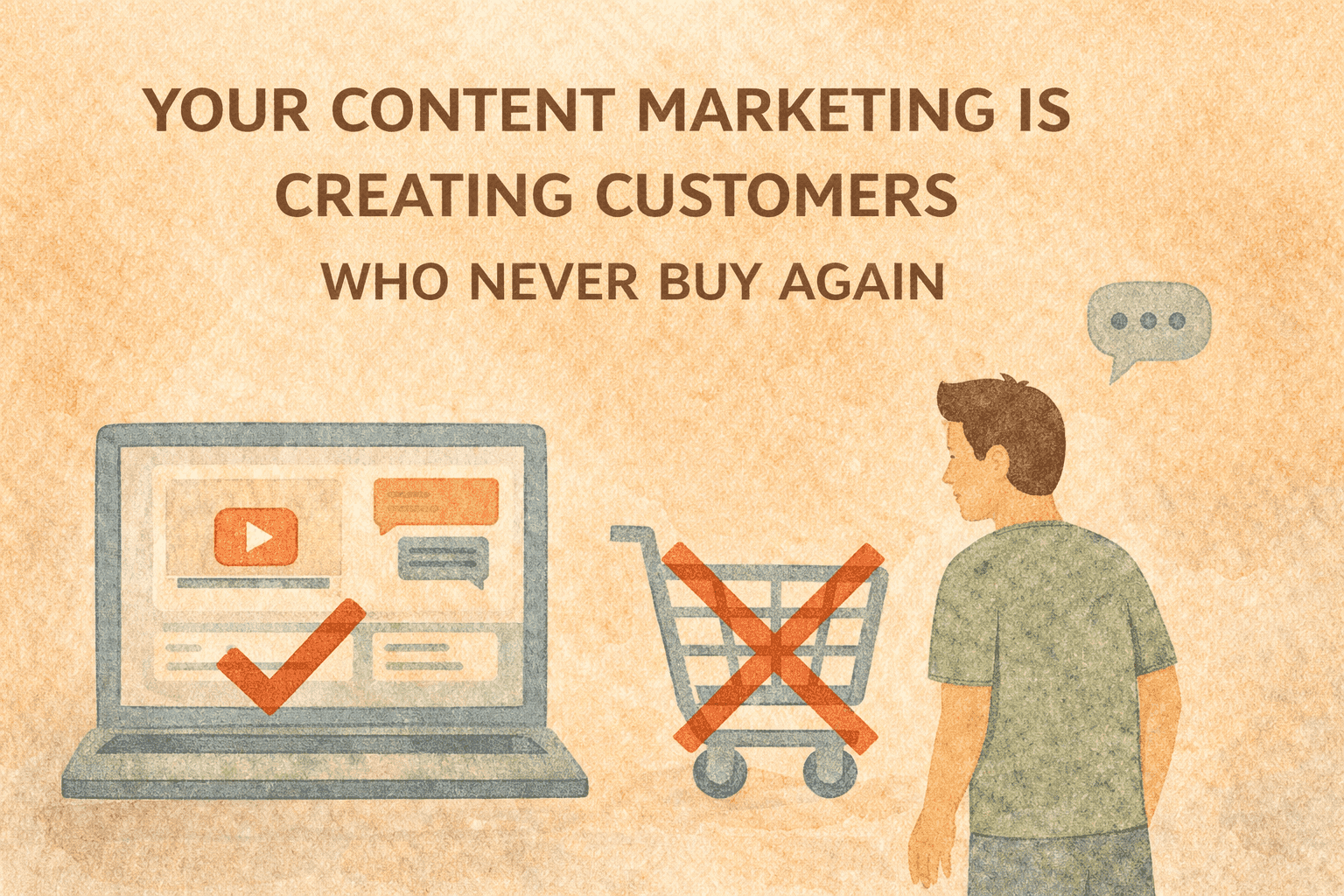
Your content worked perfectly to get the first sale. Then it abandoned those customers entirely.
This isn't a content problem in isolation - it's a strategic failure. Retention-focused customers are 67% more loyal and show 36% higher retention rates. The economics of retention dramatically outperform acquisition.
Yet only 19% of the marketing budget goes to retention. The overwhelming majority goes to acquiring customers who will buy once and disappear.
Your content strategy reflects this imbalance. How much of your content calendar serves existing customers vs. attracting new ones? If you're honest, it's probably 90/10 in favor of acquisition - maybe worse.
This is negligent resource allocation. You're spending the majority of your content budget on the lowest-value activity while ignoring the highest-value opportunity sitting in your customer database.
The Post-Purchase Content Void
Map your customer journey content and you'll likely find a pattern:
Pre-Purchase Content (Abundant)
- Blog posts answering buyer questions
- Comparison guides and reviews
- Product education content
- Category landing pages
- Social proof and testimonials
Purchase Content (Adequate)
- Product pages
- Checkout optimization
- Transaction confirmations
Post-Purchase Content (Almost Nothing)
- Maybe an order confirmation email
- Perhaps a review request
- Probably nothing else
The moment a customer buys, your content strategy goes silent. You worked so hard to earn their attention and convert their interest - then immediately stopped communicating anything of value.
Is it any wonder they don't come back?
Content marketing costs 62% less than traditional advertising. But that efficiency is calculated on acquisition. What's the efficiency of content that drives repeat purchases from an existing customer base? Almost nobody measures it - because almost nobody creates content for that purpose.
The Three Failure Modes of Acquisition-Only Content
The Ghosting Problem. Customers receive valuable, helpful content before they buy. Then nothing. The relationship that content built evaporates. When they need your product category again, they've forgotten you exist.
The Promotional Pivot. The only post-purchase content customers receive is promotional - discount codes, sale announcements, new product pushes. This isn't content marketing. It's advertising delivered via email. Customers trained to expect helpful content now receive only sales pitches. Unsubscribes follow.
The Generic Trap. If post-purchase content exists at all, it's generic - the same blog content sent to customers regardless of what they bought, how often they've purchased, or where they are in their customer lifecycle. This content demonstrates zero understanding of the customer, reinforcing that the relationship is purely transactional.
82% of B2C marketers plan retention content. Interest is not execution. The gap between intention and action in retention content is vast.
The Real ROI of Retention Content
Before we discuss strategy, let's establish why retention content deserves investment.
The Efficiency Argument
Marketing ROI averages 3:1 for most brands. But that ROI calculation typically looks at acquisition efficiency - cost per lead, cost per first sale.
The retention efficiency calculation is different and better.
Consider: you've already acquired a customer. The acquisition cost is sunk. Any additional purchases from that customer have near-zero acquisition cost. Content that drives repeat purchases is mathematically more efficient than content that drives first purchases - because the expensive part (customer acquisition) is already done.
If a blog post drives 100 first-time purchases at a $20 CAC, you've spent $2,000 in total acquisition costs.
If a retention email series drives 100 repeat purchases from existing customers, your incremental acquisition cost is essentially zero. The only cost is content creation and delivery - a fraction of the acquisition cost.
Email generates $36 in ROI for every dollar spent. That ROI is so high partly because email skews toward existing customers. Content delivered to people who already know and trust you converts at dramatically higher rates than content delivered to strangers.
The Lifetime Value Argument
A 5% increase in retention drives 25-95% profit growth. This isn't theoretical - it's the compound effect of:
- More total purchases over time
- Higher average order values from experienced customers
- Lower service costs (familiar customers need less support)
- Referrals generated by loyal customers
Retention content is the mechanism that drives this compounding. Without ongoing content engagement, customers drift away. With it, they stay connected and keep purchasing.
The Competitive Moat Argument
Anyone can outspend you on acquisition content. A competitor with deeper pockets can produce more blog posts, run more ads, and capture more first-time buyers.
But retention content builds relationships that can't be purchased. A customer who's been receiving valuable content from you for two years has a relationship depth that a competitor can't replicate with a bigger blog budget. That relationship is a moat - defensible and accumulating value over time.
Loyal customers buy more frequently and spend more per transaction. This loyalty doesn't emerge from a single blog post - it's built through sustained content engagement over time.
The Retention Content Architecture: Content That Keeps Customers
Stop thinking about content as a funnel that ends at purchase. Start thinking about content as an ongoing relationship that deepens over time.
The Retention Content Architecture (RCA) has four layers, each serving a different purpose in the customer lifecycle.
Layer 1: Activation Content
Activation content serves customers immediately after purchase. Its purpose: ensure they get value from what they bought and feel confident they made the right decision.
Content Types:
Product Success Content
- How to get the most from your purchase
- Common mistakes to avoid
- Setup guides and tutorials
- Quick-start resources
Decision Validation Content
- "Here's why you made a great choice"
- Customer stories from others who bought the same product
- Unexpected benefits they might not have discovered
Anticipation Content
- What to expect next
- How the product will evolve with use
- Future possibilities unlocked by this purchase
Activation content addresses post-purchase anxiety - the moment of doubt where customers wonder if they made the right choice. 93% of consumers read reviews before purchasing, showing they seek validation. Great activation content is a form of service - proactively answering questions before they're asked.
Timing:
- Immediate (confirmation email): Brief acknowledgment and "what's next"
- Day 1-3: Product success content
- Day 7-14: Decision validation content
- Day 14-30: Anticipation content
Critical Principle: Activation content should be 100% helpful and 0% promotional. You just asked this customer for money. Don't immediately ask for more. Earn their trust first by delivering value.
Layer 2: Education Content
Education content serves customers after they've activated. Its purpose: help them become more sophisticated users of your product category - positioning your brand as an ongoing resource.
Content Types:
Skill Development Content
- Advanced techniques for power users
- Expertise building in your category
- "Level up" content that grows with the customer
Context Content
- Industry or category trends
- How your product category fits into their life
- Broader knowledge that makes product use more meaningful
Problem-Solution Content
- Addressing challenges that arise with extended use
- Seasonal or situational adaptations
- Edge cases and advanced applications
Education content builds relationships by delivering ongoing value independent of transactions. 71% of content marketers plan to increase content production, but that growth should extend to retention, not just acquisition.
Timing:
Education content follows a regular cadence - weekly or bi-weekly - calibrated to customer engagement. More engaged customers receive more content. Less engaged customers receive less (to avoid overwhelming them into unsubscribing).
Critical Principle: Education content should make customers better at something they care about - not just better at using your products. The difference is subtle but important. "How to use Feature X" is product documentation. "How to achieve Outcome Y (using Feature X among other tools)" is education.
Layer 3: Engagement Content
Engagement content creates interaction points between purchases. Its purpose: maintain active connection so your brand remains top-of-mind when purchase decisions arise.
Content Types:
Interactive Content
- Quizzes and assessments
- Challenges and prompts
- User-generated content invitations
Community Content
- Spotlights on other customers
- User stories and case studies
- Community discussions and questions
Behind-the-Scenes Content
- How products are made
- Team stories and culture
- Brand values and initiatives
Interactive content generates 53% more engagement than static content. For retention purposes, engagement is the point - you're maintaining the relationship between transactions.
Timing:
Engagement content fills the gaps between other content types. It should feel spontaneous rather than scheduled - though it's actually carefully planned to maintain connection without overwhelming.
Critical Principle: Engagement content should create two-way interaction. One-way broadcasts maintain awareness but don't build relationships. Content that invites response - comments, shares, submissions, participation - builds the reciprocity that deepens loyalty.
Layer 4: Advancement Content
Advancement content serves your best customers. Its purpose: recognize their status, offer exclusive value, and create pathways to deeper engagement with your brand.
Content Types:
Exclusive Access Content
- Early previews of new products
- Behind-the-curtain information
- VIP-only resources and tools
Recognition Content
- Milestone acknowledgments
- Status celebrations
- Customer appreciation features
Co-Creation Content
- Product feedback opportunities
- Beta testing invitations
- Input on future direction
VIP content generates 60% more engagement than standard content. Advancement content is personalization at its highest level - treating best customers as partners rather than transactions.
Timing:
Advancement content is triggered by customer status - purchase frequency, lifetime value, engagement level. It's earned access rather than calendar-based delivery.
Critical Principle: Advancement content should feel genuinely exclusive. If your "VIP content" is just relabeled regular content, customers will notice. The exclusivity must be real - information or access that non-VIP customers genuinely can't get.
Phase 1: Auditing Your Current State (Days 1-30)
Before building new content infrastructure, understand what exists.
Week 1-2: Content Inventory
Map every piece of content a customer encounters through their lifecycle:
Pre-Purchase Content
- How much content exists?
- What topics does it cover?
- How recently was it updated?
Purchase Content
- Transaction emails and confirmations
- Order status communications
- Delivery notifications
Post-Purchase Content
- Review request timing and frequency
- Any educational follow-up?
- Cross-sell/upsell communications
- Newsletter content (if any)
Most brands discover massive imbalances - hundreds of pre-purchase content pieces, almost nothing post-purchase. Document the gap explicitly.
Week 3: Customer Journey Gaps
Interview 10-15 existing customers about their content experience:
- What content did they find helpful before purchasing?
- What did they wish they'd received after purchasing?
- What questions did they have that weren't answered?
- What content would have made them more confident in their purchase?
- What would make them feel more connected to your brand?
These conversations reveal content gaps that analytics can't show. 74% of marketers use personalization, but effective personalization requires understanding what customers actually want, not just what you think they want.
Week 4: Resource Assessment
Determine what resources you can reallocate to retention content:
- What percentage of content creation capacity currently goes to acquisition?
- What's the minimum viable retention content program?
- Who owns post-purchase customer communication?
- What technology exists for delivering retention content?
Be realistic. You can't build a full RCA infrastructure overnight. Start with the highest-impact layer and expand over time.
Phase 2: Building the Foundation (Days 31-90)
Start with Activation Content - it's the highest-leverage layer because it addresses customers at their moment of maximum attention (right after purchase).
Activation Content Development
Product-Specific Success Content
For each major product or product category, create:
- Quick-start guide (what to do immediately)
- First-week success plan (what to accomplish early)
- Common pitfalls guide (what to avoid)
- FAQ addressing post-purchase questions
This content should be specific to what the customer bought - not generic guides that apply to everything. 66% of B2B marketers create content for specific buyer personas. Apply this principle even more aggressively to retention content.
Decision Validation Content
Create content that reinforces purchase decisions:
- "Why customers love [product]" featuring real testimonials
- Before/after stories showing outcomes
- Comparison content showing how your product outperforms alternatives
- Expert endorsements or validation
Delivery Mechanism
Build automated email sequences triggered by purchase:
- Email 1 (immediate): Order confirmation with "what's next" preview
- Email 2 (day 2-3): Product success guide
- Email 3 (day 5-7): Decision validation content
- Email 4 (day 10-14): Check-in with support resources
37% of all email revenue comes from automated sequences. Activation sequences can capture a portion of this high-converting automated email opportunity. See our guide on retention automation workflows for building comprehensive lifecycle sequences.
Education Content Foundation
While building activation content, begin planning education content:
- Identify 10-12 topics that help customers become more sophisticated in your category
- Map these topics to customer lifecycle stages
- Plan content formats (articles, videos, interactive tools)
- Create an editorial calendar for ongoing production
Education content takes longer to build but creates the most durable value. 73% of B2B marketers say content marketing increases engagement. For retention, education content that builds genuine expertise creates the same effect - customers who've learned from you trust you for future purchases.
Phase 3: Scaling the Architecture (Day 91+)
With activation content operational, expand to the remaining layers.
Education Content Deployment
Launch a regular education content cadence:
Monthly Themes: Each month focuses on a specific topic relevant to customer needs. All education content that month supports the theme.
Content Mix:
- 1 long-form piece (comprehensive guide, in-depth article)
- 2-3 short-form pieces (quick tips, focused advice)
- 1 interactive element (quiz, assessment, challenge)
Personalization Layer: Segment education content by:
- Purchase history (what they bought)
- Lifecycle stage (how long they've been a customer)
- Engagement level (how actively they consume content)
Personalized content drives 760% more engagement than generic content. This principle applies to all retention content - generic broadcasts underperform personalized delivery.
Engagement Content Integration
Add engagement touchpoints between education content:
Monthly Engagement Calendar:
- Week 1: Education content
- Week 2: Engagement prompt (question, challenge, invitation)
- Week 3: Education content
- Week 4: Community spotlight or behind-the-scenes
The key is rhythm - predictable enough that customers know what to expect, varied enough that they stay interested.
Advancement Content Activation
For customers who reach VIP thresholds, create exclusive content tracks:
VIP Tier Triggers:
- Lifetime value threshold (e.g., $500+)
- Purchase frequency threshold (e.g., 3+ purchases)
- Engagement threshold (e.g., 80%+ email open rate)
VIP Content Offerings:
- Quarterly exclusive insights not available to general customers
- Early access to new product information (2+ weeks before public)
- Input opportunities on product direction
- Recognition in customer spotlights
83% of consumers prefer brands that offer exclusive experiences. Advancement content functions as a content-based loyalty program - exclusive value that rewards continued engagement.
Measurement: Content-Attributed Retention
Traditional content metrics (pageviews, time on page, shares) don't capture retention value. Build measurement systems that connect content consumption to retention outcomes.
Core Retention Content Metrics
Content-Engaged Retention Rate: Compare retention rates between customers who engage with post-purchase content vs. those who don't.
Formula: (Repeat purchasers who engaged with content / Total content-engaged customers) vs. (Repeat purchasers who didn't engage / Total non-engaged customers)
A significant gap indicates content is driving retention. No gap indicates content isn't working.
Content-to-Second-Purchase Time: Measure the average time from first purchase to second purchase for content-engaged vs. non-engaged customers.
Shorter time-to-second-purchase for content-engaged customers indicates content is accelerating repeat buying.
Content-Attributed LTV: Track lifetime value differential between content-engaged and non-engaged customer cohorts over time.
Growing LTV differential indicates content is driving long-term value creation.
The North Star: Content ROI on Retention
CROI-R = (Additional LTV from Content-Engaged Customers - Content Creation and Delivery Costs) / Content Creation and Delivery Costs
This metric measures the return specifically on retention content investment. Unlike acquisition content ROI (which includes high acquisition costs), retention content ROI should be dramatically higher because customer acquisition is already complete.
68% of businesses use AI for content creation. AI can help scale retention content production - but only if the strategy directs that production toward retention rather than more acquisition content.
The Strategic Shift
Content marketing has been acquisition-obsessed because acquisition is easier to measure and faster to show results. A blog post that drives first-time purchases produces immediate, visible ROI.
Retention content works differently. The ROI accumulates over time as customers who stay engaged become progressively more valuable. It's harder to measure and slower to prove.
But the math is clear: repeat visitors convert 3x better than first-time visitors. Content that serves those repeat customers operates at dramatically higher efficiency than content that attracts strangers.
The Retention Content Architecture requires: 1. Activation Content that ensures customers get value from their purchase 2. Education Content that builds ongoing expertise and connection 3. Engagement Content that maintains active relationship between purchases 4. Advancement Content that rewards and deepens loyalty for best customers
Most brands won't make this shift. They'll continue pouring resources into acquisition content while wondering why customers don't come back.
Your customers aren't disloyal by nature. They're neglected by design. You stopped talking to them the moment they bought.
Fix the content, fix the retention.
It's that simple - and that difficult.
CAC : LTV Calculator
Lifetime value, payback and the ratio that decides whether you can afford to grow.
Your Video Strategy Stops at Conversion - Here's How Video Drives Repeat Purchases
Your Customers Don't Know How to Use Your Products - And It's Costing You Retention
Your Email Automation Is Stuck on Welcome Flows - Here's the Full Lifecycle System
Your Welcome Email Is Leaving Money on the Table - The First 30 Days That Determine Lifetime Value
The $29 Problem: Why Your CLV Model Is Bleeding Money (And the Cohort Economics Protocol to Fix It)
How to Map DTC Customer Touchpoints
Newsletter
The Uncommon Insights Letter
Practical FMCG & eCommerce growth playbooks — margins, retention and scaling tactics, straight to your inbox.
Turn customer retention into profit you can see
Get a hands-on operator to turn the frameworks above into results — book a free audit call.