Lease vs Buy Decision Framework for Scaling DTC Brands
Most operators between $1M and $10M in revenue make their largest capital decisions on a single sheet of paper their accountant prepared. Lease payments on the left, purchase price plus depreciation on the right, a payback period at the bottom.
11 min read · 16 June 2025
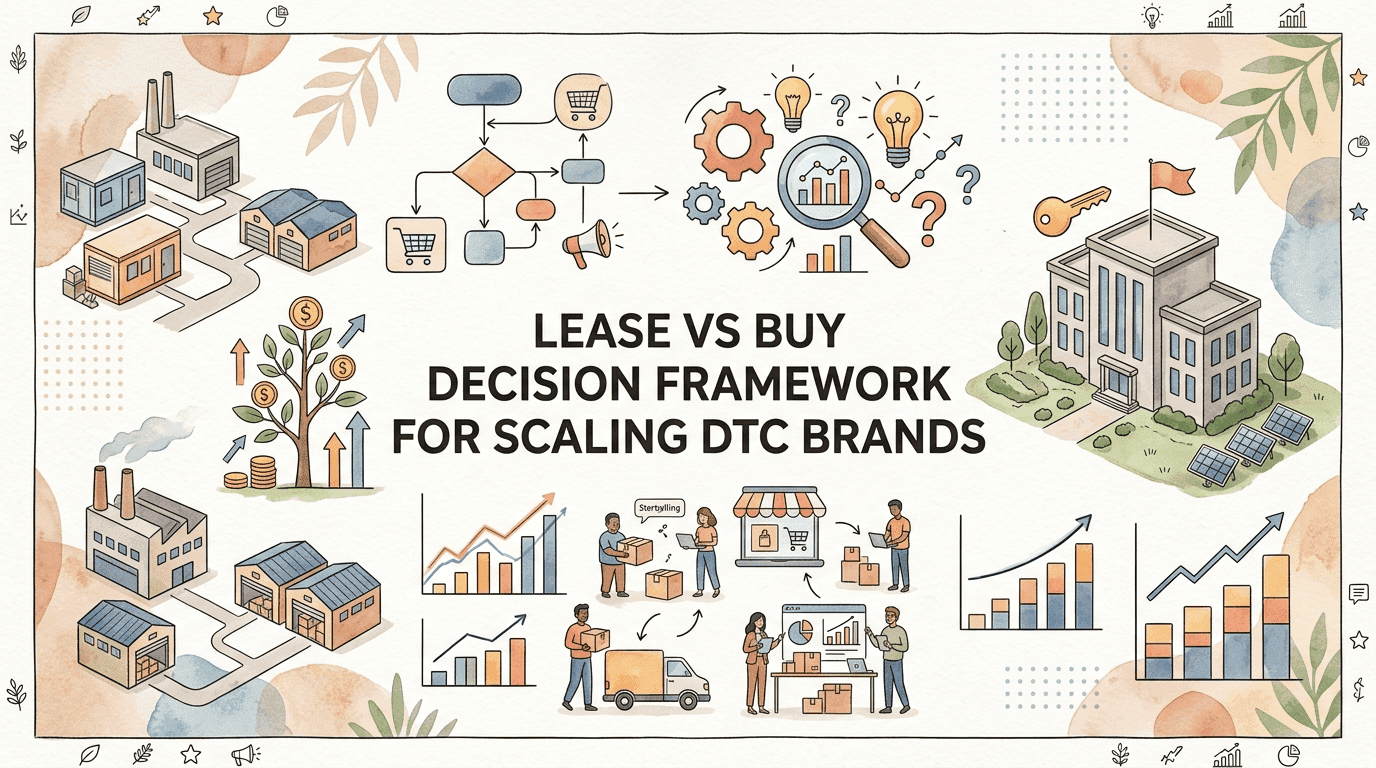
Lease vs Buy Decision Framework for Scaling DTC Brands
Most operators between $1M and $10M in revenue make their largest capital decisions on a single sheet of paper their accountant prepared. Lease payments on the left, purchase price plus depreciation on the right, a payback period at the bottom. The cheaper number wins. That spreadsheet has killed more growing brands than slow inventory turns, and the failure mode is hiding inside tax assumptions you have not questioned in five years.
The Tax Shield Mirage
Walk into any Australian DTC brand doing $4M in revenue and ask why they bought their forklift, their packaging line, or their warehouse racking. You will get the same answer most of the time. The accountant ran the numbers, the depreciation deduction made it cheaper than leasing, and the tax saving funded the purchase. The ATO depreciation rules are written exactly to bias that decision: instant asset write-off, accelerated depreciation, and small business pool concessions all push capital toward owned equipment. The US version, IRS Section 179, is even more aggressive, letting operators write off the full purchase price of qualifying assets in the year of acquisition.
The math looks clean. The math is incomplete.
What the spreadsheet rarely models is the cash drag. A $120K packaging line bought outright with a $30K tax saving still consumes $90K of working capital that walks out of your bank account on day one. That capital is now permanently illiquid. If your business hits a 60-day payment delay from a major retailer in month four, that $90K is the difference between paying suppliers and skipping a production run. The tax shield does not show up on your bank statement when the supplier sends a final notice.
The second blind spot is obsolescence. Industry data published by the Equipment Leasing Foundation tracks how operators repeatedly retire equipment well before its theoretical useful life because their business outgrows the asset, the SKU mix shifts, or the workflow changes. The forklift you bought because the depreciation curve looked good ends up mothballed when you outgrow your warehouse two years in. The packaging line you bought because it would pay back in 36 months becomes a stranded asset when your category mix shifts. The buy decision quietly assumes the future will look like the present. That assumption is the most expensive line item on the page.
The third blind spot is option value. When you lease, you are paying for the right to walk away. That option has economic value, especially in a business doing $1M to $10M where the next two years of demand are genuinely uncertain. Conventional NPV analysis prices that option at zero. It is rarely zero.
Here is the harder truth. The buy-versus-lease question is not really about cost. It is about which version of your business you are betting on. The standard NPV spreadsheet the Investopedia lease vs buy primer teaches operators to build is a tool for stable, predictable businesses. You are not a stable, predictable business. You are a brand that just hit $4M and is going to either double or halve in the next 24 months, and you do not yet know which.
The Capital Option Blueprint
I call this The Capital Option Blueprint. It is the framework I use with operators who keep getting trapped in capital decisions that look good on the tax return and feel terrible on the bank statement. The Capital Option Blueprint replaces the single-cost comparison with a three-axis evaluation that maps the decision against the actual shape of your business risk.
The three axes are forecast confidence, working-capital drag, and walk-away option value.
Forecast confidence asks how certain you are about the next 24 to 36 months of demand for the use case the asset serves. A brand running on the same SKU mix for five years has high forecast confidence on packaging line capacity. A brand that just launched its third category has near-zero confidence on warehouse pick-and-pack throughput. The Blueprint says the buy decision is only defensible when forecast confidence is high enough that you can underwrite the asset's full economic life.
Working-capital drag is the cash a purchase consumes that would otherwise sit in inventory, marketing, or a buffer against retailer payment delays. For physical product brands operating on 90-to-120 day cash cycles, every $50K tied up in equipment is $50K that cannot finance a production run. A purchase that looks like an 18-month payback in isolation looks like a stockout when you place it next to your seasonal cash curve.
Walk-away option value is the dollar cost of being locked into the wrong asset. Equipment financing terms tracked by the Equipment Leasing Foundation show that the typical lease structure includes early-buyout provisions, end-of-term renewal options, and step-up replacement clauses. Buying foregoes all of that. The Capital Option Blueprint forces operators to put a number on the cost of being wrong, then compare it to the tax shield they keep using as the sole justification for ownership.
I have run this framework across operators in apparel, supplements, consumables, and home goods. The pattern is consistent. It flips a meaningful share of buy decisions to leases and a smaller number of lease decisions to outright purchase, because it surfaces a category of asset operators had been treating as forever-leased without realising the lifetime cost was triple the purchase price.
The point of the Blueprint is not that leasing is better than buying. The point is that the right answer depends on three variables most operators never put on the page.
Phase 1: Audit Your Hidden Lease Portfolio (Days 1-30)
Start by listing every recurring contract that is functionally a lease. This is where most operators discover the first surprise. Your forklift loan is on the list. So is your warehouse rack rental. So is your 3PL contract, your Shopify app subscriptions, your label printer service agreement, and the per-pallet storage fee at your overflow facility. The Shopify on 3PL choice enterprise guide lays out 3PL contracting as a recurring-payment decision that operators rarely model the way they model equipment leases, which is exactly why it slips out of the capital conversation.
Build a spreadsheet with seven columns for each contract: asset or service, monthly payment, contract end date, early-exit penalty, replacement lead time, alternative providers, and forecast-confidence score from one to five. The forecast-confidence score is the key. It asks whether the use case the contract serves is something you are confident you will still need 24 months from now in the same form.
Most operators spend two days on this and find a meaningful chunk of annual recurring spend that nobody had ever analysed against the buy alternative. Some of it should stay leased because forecast confidence is low. Some should not, because you have been paying premium per-unit rates on something you have used at constant volume for three years.
Walk through every line item with two questions. First, is this asset or service something you would buy outright today if you had the cash? Second, what does it cost you each month to retain the option to walk away? If the answer to the first is yes and the answer to the second is more than 15% of the underlying asset's purchase price annualised, you are paying too much for optionality you do not need. If the answer to the first is no, leasing is correct and the conversation ends.
The output of Phase 1 is a one-page lease portfolio map. Use a 2x2 grid with forecast confidence on one axis and working-capital drag on the other. Items in the high-confidence, low-drag quadrant are buy candidates. Items in the low-confidence, high-drag quadrant should stay leased. Items in the high-confidence, high-drag quadrant are usually candidates for finance leases or specialist asset financing structured to preserve cash. Items in the low-confidence, low-drag quadrant can be left alone.
A useful gut-check on the map: run the audit twice, once with your CFO or bookkeeper and once with your operations lead. They will flag different forecast-confidence ratings on the same line items because they have different views of how the business will look in 24 months. The disagreements are signal. Where finance is bullish on a piece of equipment but operations is not, you have either a planning misalignment or an asset that should be leased until the disagreement resolves. I have not run this audit with an operator yet where the two leaders rated every line item identically. The gap is usually 20% to 30% of contracts.
A worked example helps. A $4.5M Australian skincare brand I worked with audited 41 recurring contracts and found nine where the forecast-confidence rating was three or higher and the per-month cost was greater than 1% of the underlying asset's purchase price. Six of those should have been bought outright two years prior. Three were too late to flip because the supplier's lease terms locked them in. The capitalised cost of the missed buy decisions was just over $180K against a working-capital base of $1.1M.
Run this audit before you commit a single dollar to new capital. It will reshape your capital request before it goes near a board paper. The same working-capital lens that supports the rest of this series sets the cash drag baseline this audit reads from, so do not start the audit until your cash conversion cycle is documented.
Phase 2: CapEx Governance (Month 2-6)
Once the existing portfolio is mapped, the second phase is governance for new capital decisions. The goal is to stop relitigating the same lease-versus-buy debate every time finance brings a quote to the table. You want a written rule that says when the Blueprint must be applied and what the answer triggers.
Pick a CapEx threshold. For brands doing $1M to $5M, I usually set the threshold at $25K of cumulative committed capital across any single asset or service category. For brands above $5M, the threshold rises to $75K. Below the threshold, finance can transact without running the Blueprint. Above the threshold, the Blueprint is mandatory, the output goes into the finance pack, and the decision logs forecast confidence, working-capital drag, and walk-away value as numerical inputs.
Document the policy in a one-page Capital Governance Note. It should specify the threshold, the three-axis scoring rubric, the decision approver, and the review cadence. Rotate the review every quarter so assumptions on forecast confidence are not allowed to age past 90 days. Brands that skip the rotation end up with a Blueprint that says the right thing for last year's business and the wrong thing for this year's. Finance leaders writing for CFO.com on capital decisions consistently flag governance lag as the silent killer of capital discipline at growth-stage businesses.
Within governance, the second discipline is variance review. Every quarter, pull the asset register and the lease portfolio map, then compare actual usage to the forecast-confidence rating you assigned 90 days ago. If a piece of owned equipment is at 40% of forecast utilisation, flag it. If a leased contract is at 110% of forecast, ask whether you should be buying. The point is to catch drift before it becomes a write-down. For larger CapEx pieces above $100K, the deeper ROI stress-test playbook layers on top of the Blueprint and adds scenario stress-testing.
The third discipline is reserve allocation. The Blueprint forces capital decisions to be priced against the cash buffer they consume. Set a written rule for minimum cash on hand expressed in months of operating expense, and treat the Blueprint as a check against that floor. A buy decision that pushes you below the floor is a no, irrespective of the depreciation profile. This connects directly to the broader capital allocation discipline and the habit of pre-committing capital to buckets rather than spending it on the loudest internal voice.
There is one common operator error worth flagging. Brands routinely treat finance leases as a back-door route to ownership, especially for equipment with a $1 buyout at end of term. The Blueprint says that is fine when forecast confidence is high and walk-away value is low. It is a trap when forecast confidence is medium and the lease is structured with no exit before the buyout date. You end up paying interest for 36 months on the privilege of buying an asset you no longer want. Read every lease for the early-exit clause, not the buyout clause.
Phase 2 is not glamorous. It is paperwork, a weekly habit, and a policy nobody outside finance will read. It is also the difference between capital discipline that compounds over five years and a series of one-off decisions that look defensible in isolation and ruinous in aggregate.
The Cash Coverage Ratio
The North Star metric the Capital Option Blueprint produces is the Cash Coverage Ratio, expressed as months of operating expense remaining if every committed lease and finance payment continued to be paid out and no new revenue arrived for the period. Most operators have never calculated it. Most of those who have calculate it once, when they raise capital, and then forget about it.
Run the Cash Coverage Ratio monthly. The formula is simple: total cash on hand plus undrawn lines of credit, divided by monthly operating expense including all lease and finance commitments. Below three months, a buy decision is almost never the right answer because you cannot afford the cash drag. Between three and six months, the Blueprint applies and the three-axis scoring decides. Above six months, you have the runway to absorb a buy decision provided forecast confidence is high.
The point of the Cash Coverage Ratio is to make capital decisions visible against the only constraint that actually matters at $1M to $10M, which is whether the business survives the next downturn or stockout. The tax shield is irrelevant if the cash buffer is gone.
I have watched brands hit $5M with a healthy P&L and a Cash Coverage Ratio under two months, and I have watched them fold inside 12 months of getting there. The cause was almost always a series of buy decisions that looked correct in isolation, made when the depreciation conversation crowded out the cash conversation. The Capital Option Blueprint exists to prevent that exact failure mode.
The next time finance brings you a one-page lease-versus-buy comparison with the depreciation deduction at the bottom, ask three questions before you sign. What is your forecast confidence on this use case over 24 months? What does this commitment do to your Cash Coverage Ratio? What is the cost of being locked into this asset if you are wrong? If the spreadsheet does not answer those questions, the spreadsheet is not the framework. It is just a sales document for the buy decision.
Unit Economics Calculator
Contribution margin per order after COGS, shipping and fees — the number scaling actually depends on.
The Banking Relationship Management Playbook for DTC Brands
Funding Strategy Debt vs Equity Analysis for DTC Founders
Working Capital Optimization Framework Most Operators Skip
Cash Management Strategies That Fund Self-Financed Growth
The SKU Rationalization Framework That Survives Q2
AI for Supply Chain Optimization for $1M-$10M Brands
Newsletter
The Uncommon Insights Letter
Practical FMCG & eCommerce growth playbooks — margins, retention and scaling tactics, straight to your inbox.
Turn financial planning into profit you can see
Get a hands-on operator to turn the frameworks above into results — book a free audit call.