Why Cross-Channel Attribution Challenges Break Your Budget
Pull four numbers from last month. Meta-reported revenue. Google Ads-reported revenue. TikTok-reported revenue. Klaviyo-attributed revenue. Add them together. Now pull your net Shopify revenue for the same 30-day window.
11 min read · 10 July 2025
Why Cross-Channel Attribution Challenges Break Your Budget
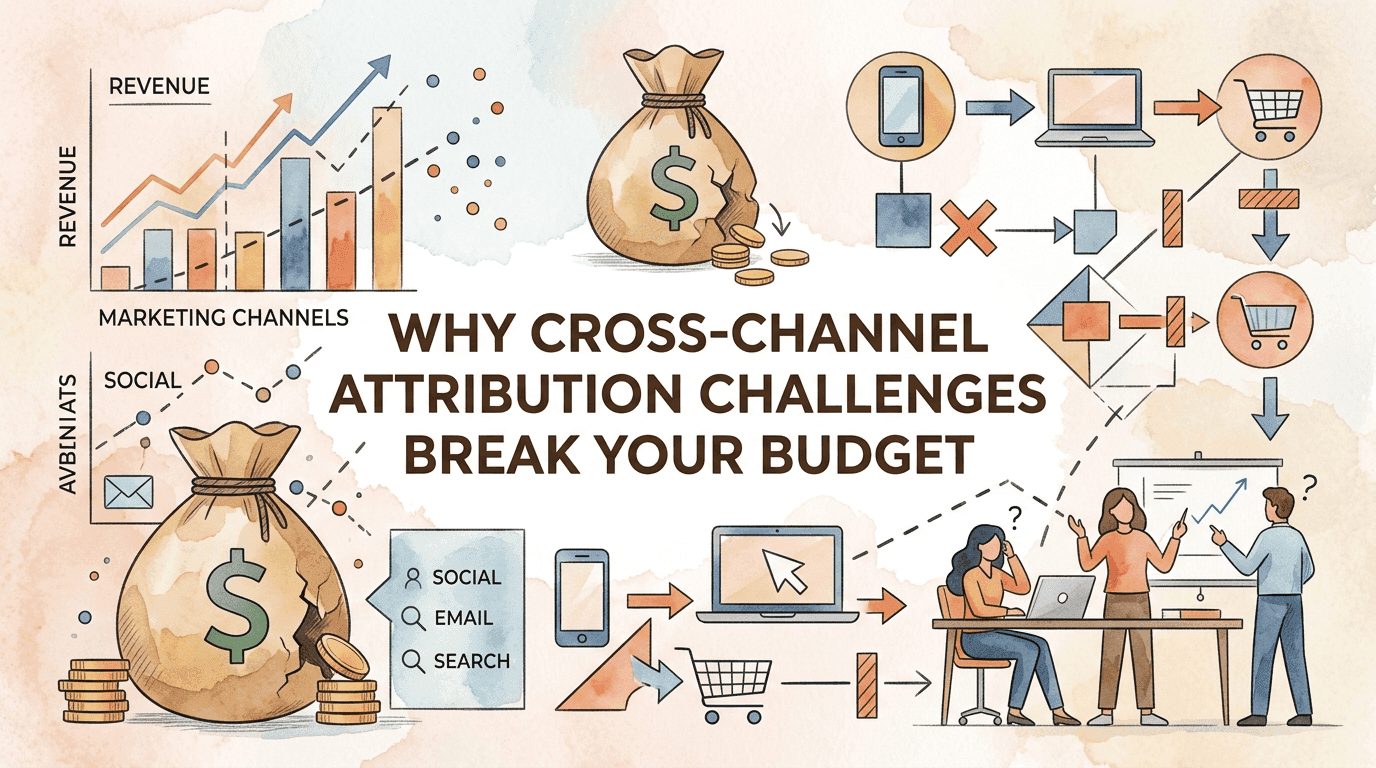
Pull four numbers from last month. Meta-reported revenue. Google Ads-reported revenue. TikTok-reported revenue. Klaviyo-attributed revenue. Add them together. Now pull your net Shopify revenue for the same 30-day window. For almost every brand doing between $1M and $10M in annual sales, the first number will exceed the second by 23-50%. That gap is not rounding error. It is the entire reason your marketing budget allocation is wrong.
The $500,000 Ghost: Why Four Platforms Report More Revenue Than Shopify Ships
Meta, Google, and TikTok each claim credit for the same conversion because every walled garden counts in its own favor. Measured's audit across multiple DTC brands found that platform overestimation averages 23-31%, and that was before consent-mode modelling became standard across Europe and California. When a customer sees a Meta retargeting ad, clicks a Google branded search result, opens a Klaviyo abandoned-cart email, and finally converts, each platform records a full conversion in its own dashboard. No native tool deduplicates against actual Shopify orders.
The problem compounds because the modern shopper journey now spans five to nine touchpoints. Triple Whale's data across thousands of Shopify stores shows 73% of shoppers use multiple channels before buying. On a $3M brand spending 30% on paid media, that means roughly $900,000 in marketing is being evaluated against inflated conversion counts every quarter. If the over-count is 25%, you are reallocating based on $225,000 worth of phantom credit. The channels the walled-garden view over-values keep getting more budget. The channels that actually drive incremental revenue keep getting starved.
The common response, which is wrong, is to pick the most optimistic number and defend it. I have watched operators justify a 30% month-on-month Meta ROAS drop by saying "Google ROAS came up, so it all evens out." That is not how net revenue works. Either the dollars shipped from Shopify or they did not. Summing platform claims and calling the total blended ROAS is a bookkeeping fiction.
Walled-garden reporting analysis walks through the structural reason for this. Each platform tunes its own bidding algorithm against its own attribution window. Meta will call a conversion view-through if the user saw an ad in the last seven days. Google Ads will also claim that same conversion as last-click if the user later touched a Performance Max placement. Both are correct inside their own system. Both are wrong when you stack them next to Shopify's revenue ledger.
The sting of recognition most operators feel reading this is that they already knew the numbers did not add up. They just never reconciled them because no platform asks you to. Every dashboard is built to answer a single question: "how is my spend on this platform performing according to this platform." That is a different question from "how is my spend across channels performing against real orders." The second question is the only one that decides next quarter's budget.
Introducing The Cross-Platform Reconciliation Protocol
The Cross-Platform Reconciliation Protocol replaces face-value platform reporting with a three-phase system anchored to a single revenue source of truth. The protocol does not ask you to trust any single attribution vendor. It asks you to treat Shopify as the denominator and every platform number as a claim that must be reconciled against it.
The three phases are a reconciliation audit, a deduplication layer, and a weekly reconciliation cadence. Each phase has a specific output: the audit produces an over-count percentage, the deduplication layer produces a single blended ROAS number, and the cadence produces a weekly variance report that triggers budget action instead of passive dashboard watching.
I have deployed this protocol across a dozen brands between $1M and $15M in the last two years. The average reconciliation audit returns a 28% over-count on the first pass. The first brand I ran it with, a Sydney-based homewares retailer, discovered its Meta ROAS was not 4.2 as reported, but 2.7 once deduplicated against Shopify. Their Google Brand campaign was not cannibalising itself; it was being credited twice. Klaviyo was claiming 14% of revenue that had already been claimed by paid search.
The protocol borrows its core logic from Rockerbox's unified measurement methodology, which combines multi-touch attribution, marketing mix modelling, and incrementality testing inside a single layer. The difference is that the protocol is buildable by a two-person marketing team using spreadsheets and a single server-side endpoint. It does not require a data science function or a six-figure vendor contract to get to version one.
Why a protocol and not a tool. Tools change. Platforms change their attribution models. Meta has rewritten its view-through window three times since 2020. Google sunset rule-based attribution in September 2023. What stays constant is the arithmetic: the sum of every platform-attributed dollar must reconcile against the real order ledger. If it does not reconcile, the gap is the subject of the next budget meeting.
Phase 1: The Reconciliation Audit (Days 1 to 14)
The first two weeks are spent proving the gap exists for your specific brand. This is not about building systems. It is about getting four numbers into a single spreadsheet and computing one KPI: the over-count percentage.
Pull the last completed calendar month. From Meta Ads Manager, export Purchase Value at the account level. From Google Ads, export Conversion Value. From TikTok Ads Manager, export Complete Payment Value. From Klaviyo, export attributed revenue, using the 5-day post-click, 1-day post-open window. Put each of these numbers in column B of a spreadsheet. Column A holds the platform name.
Row 6 of the spreadsheet is the sum. Call it "Platform-reported revenue."
Row 7 is the number from Shopify Analytics for the same date range, filtered to gross sales minus refunds. Call it "Actual net revenue."
Row 8 is the over-count percentage: Row 6 minus Row 7, divided by Row 7. For most brands this number will land between 25% and 40%. If it lands below 15%, one of your pixels is broken. If it lands above 50%, your email platform is double-counting. Either way, you have found the problem within two hours.
The spreadsheet itself is the first deliverable. It becomes the artefact every future meeting references. When the paid social manager asks for a bigger budget based on a Meta ROAS number, the response is "that number is part of the over-count set; show me the reconciled version." Cross-channel failure modes from Cometly lists seventeen specific reasons platform-reported numbers diverge from real orders. Most brands are suffering from four or five of them simultaneously.
Run the audit again for the prior month, and the month before that. You should see the over-count percentage hold roughly steady across time. If it jumps by more than 10 points between months, the attribution pipeline itself is unstable and that becomes its own investigation.
Close Phase 1 with a one-page summary for the leadership team. Over-count percentage, top three over-counting channels, and the dollar value of misallocated spend at the current ratio. For a $3M brand, that dollar value is almost always between $80,000 and $200,000 in a single quarter.
A secondary output of Phase 1 is a channel-level contribution table. For every platform in the spreadsheet, compute what percentage of the reconciled Shopify revenue that platform actually claims. Meta might claim 140% of what Shopify shows for a given month; Google might claim 90%; Klaviyo might claim 60%; TikTok might claim 45%. The absolute numbers do not matter yet. What matters is that the paid media lead sees the claim ratios side by side on a single page. That visual is usually the first moment a leadership team accepts that the problem is structural, not a pixel bug on a single platform.
Phase 2: Building the Deduplication Layer (Days 15 to 45)
Weeks three through six are spent closing the gap at the data layer. Phase 1 proved the over-count is real. Phase 2 stops it at the source.
There are three components to the deduplication layer. The first is server-side tracking for every paid channel. The second is a first-party data pipeline from Shopify into whichever warehouse or attribution tool you choose. The third is a reconciliation tool that sits above the platforms and sees each conversion exactly once.
Server-side tracking is now table stakes. Meta's Conversions API, Google's Enhanced Conversions, and TikTok's Events API all send order data directly from your server instead of relying on the browser. This closes the iOS 14.5 data loss, the cookie-deprecation drift, and the ad blocker gap at the same time. Shopify deduplication walkthrough from Analyzify is the most practical guide I have seen. It covers event ID matching, pixel-plus-server deduplication, and the specific Shopify app stack that makes this buildable without a dev team.
The first-party data pipeline is the quiet force multiplier. Shopify has a Bulk Data Export feature that sends order-level data to a warehouse nightly. If you do not have a warehouse, a Google Sheet connector also works. Either way, the goal is that order-level data, with UTM parameters and customer IDs, lives somewhere outside of Shopify Analytics so it can be matched against platform claims.
The reconciliation tool sits on top of all of this. Northbeam, Triple Whale, and Rockerbox each do this job in different ways. Northbeam leans on deterministic click matching. Triple Whale uses post-purchase survey data as a complement. Rockerbox favours the unified measurement approach. The right choice depends on monthly order volume, paid spend level, and whether your team already uses GA4 or a warehouse. Unified measurement breakdown from Improvado gives the clearest view of which tool sits where in the stack.
Expect Phase 2 to take three to four weeks, not three to four days. The work is not complex, but it crosses three teams: marketing operations for the pixels, dev for the server-side endpoint, and finance for the revenue reconciliation logic. Attribution discrepancy analysis documents the specific edge cases, subscription first-order attribution, refunds that the pixel never sees, currency conversion inside Klaviyo, that break deduplication in week three if the build team has not planned for them.
By day 45, the output is a single blended ROAS number. Not four. One. It is the number that goes on the weekly leadership dashboard. It is the number that decides whether paid media spend goes up or down next week.
Phase 3: The Weekly Reconciliation Cadence (Day 46 and Beyond)
Phase 3 is where most brands fail, because building the system is engineering and running it is behaviour change. The weekly reconciliation cadence is a thirty-minute meeting every Monday morning with three people in the room: the paid media lead, the finance lead, and the growth lead who owns the reconciled ROAS number.
The meeting has a fixed agenda. First, review last week's reconciled blended ROAS against the four-week rolling average. If the variance is less than 5%, spend decisions stay where they were. If the variance is 5% to 15%, the growth lead investigates and reports back within 48 hours. If the variance exceeds 15%, budgets freeze until the cause is identified.
Second, review the platform-claimed ROAS versus reconciled ROAS by channel. This is the over-count variance tracker. If Meta's platform-claimed number diverges from reconciled by more than 10 points for two weeks running, the pixel or Conversions API setup needs a diagnostic. Cometly's cadence guidance is the best reference on why weekly is the right frequency: daily is noise, monthly is too late.
Third, review the allocation decision. Which channel gets more budget next week. Which channel gets pulled back. The answer is always driven by reconciled contribution, not platform-reported ROAS. I have watched brands run this cadence for six months and shift 30% of paid spend into channels the old attribution view had under-credited, almost always a combination of retained-customer email, upper-funnel YouTube, and affiliate.
The cadence also protects against vendor lock-in. When a new attribution tool pitches you on upgrading, the first question is "what reconciled ROAS number does your methodology produce against Shopify for last month." If they cannot answer in a single number, they are not solving the reconciliation problem; they are adding another source of discrepancy on top of it.
Close each weekly meeting with one written decision in the shared document: the blended ROAS this week, the action taken, and the owner. Over time this document becomes the best internal training artefact for how the brand actually evaluates paid media. New hires read it instead of a playbook.
The New North Star Metric: Reconciled Blended ROAS
After running The Cross-Platform Reconciliation Protocol for one full quarter, the brand should have abandoned three metrics: Meta ROAS, Google Ads ROAS, and platform-summed blended ROAS. The only metric that survives is Reconciled Blended ROAS: total paid media spend divided by reconciled Shopify revenue attributed to paid channels in the same period.
Reconciled Blended ROAS is the North Star because it is the only number that cannot be inflated by any single platform's reporting choices. It respects the fact that every walled garden is structurally incentivised to claim more credit. It respects the fact that the customer journey crosses channels. And it respects the fact that the Shopify order ledger is the only ledger that says whether a dollar actually landed.
For a $3M brand, the shift typically looks like this. Pre-protocol reported blended ROAS: 3.8. Pre-protocol assumed incremental revenue: $1.8M. Post-protocol reconciled blended ROAS: 2.6. Post-protocol measured incremental revenue: $1.2M. The brand looks less profitable on paper, but spends the next quarter acting on real numbers. The usual result is a 15-25% reallocation of paid budget into channels the walled-garden view was starving, and a four to seven point lift in reconciled ROAS within two quarters. The walled-garden hidden cost framing is the best way to sell this to a board: the inflated numbers are not free, they buy you misallocated spend at the cost of real growth.
The Cross-Platform Reconciliation Protocol is not a marketing activation. It is a budget defence system. The platforms will keep claiming conversions they did not uniquely drive. The job is to catch the claims against the revenue ledger every week, every month, every quarter. If you run this discipline, cross-channel attribution challenges stop being a mystery you argue about in quarterly reviews and start being a variance you manage on Monday mornings.
The brands that win the next decade of paid media will not be the ones with the biggest ad budgets or the fanciest creative teams. They will be the ones who can answer a single question accurately: which dollar of spend produced which dollar of real revenue. Every other measurement system in this category is trying to approximate that question through modelling. The reconciliation protocol answers it with arithmetic. That is why it works on a two-person team, and it is why it keeps working when the next platform attribution update lands and breaks every dashboard built on top of it.
Breakeven ROAS Calculator
The exact ad return you need to break even — and the one you need to actually profit.
The Attribution Technology Stack Blueprint for DTC Brands
Analytics Reporting Stack Setup: Decisions Over Dashboards
The Multi-Touch Attribution Implementation Guide for Physical Product Brands
A Complete Facebook Pixel Optimization Guide for Physical Brands
Social Media on Shopify: A Catalog Sync and CAPI Guide
How Conversion Path Analysis Exposes Your Hidden Revenue
Newsletter
The Uncommon Insights Letter
Practical FMCG & eCommerce growth playbooks — margins, retention and scaling tactics, straight to your inbox.
Turn marketing attribution into profit you can see
Get a hands-on operator to turn the frameworks above into results — book a free audit call.