Your Birthday Emails Are Lazy Revenue Theater - Here's What Actually Works
Here's what most ecommerce brands do for birthday campaigns: they collect a birth date during signup, set up a single automated email that fires on the day, slap a generic "15% off for your special day!" message on it, and call it a retention strategy. Then they point to the statistics to justify...
12 min read · 26 April 2026
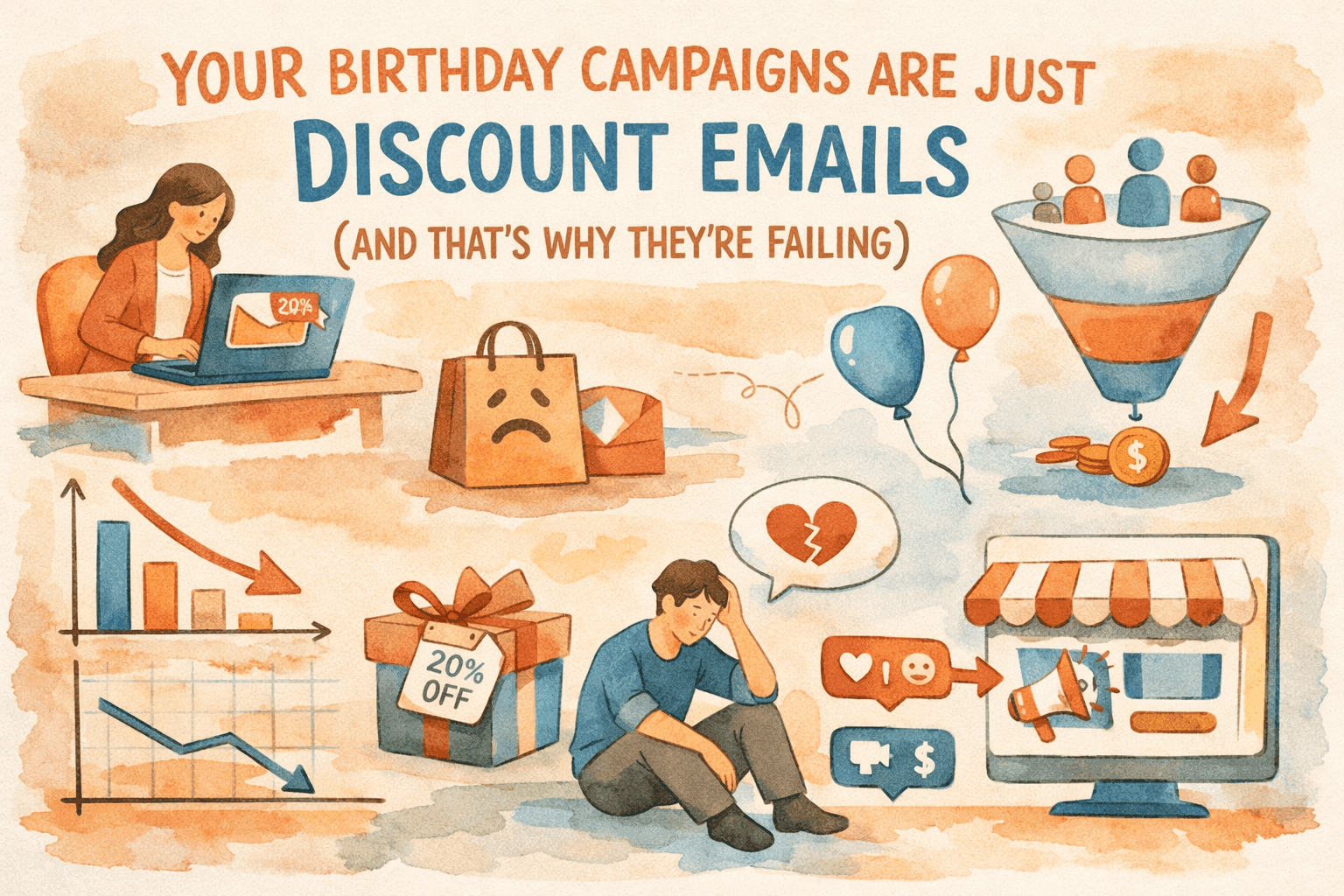
- The 15% Off Trap: Why Your Birthday Campaign Is Training Customers to Wait
- The Real Math Behind Milestone Campaigns
- The Milestone Revenue Engine: A Framework That Actually Builds Loyalty
- Phase 1: The 30-Day Milestone Audit and Restructure
- Phase 2: Building the Full Milestone Infrastructure (Days 31-90)
- Phase 3: Scaling and Sophistication (Day 91+)
- The New North Star: Milestone Revenue Per Customer
- The Uncomfortable Conclusion
The 15% Off Trap: Why Your Birthday Campaign Is Training Customers to Wait
Here's what most ecommerce brands do for birthday campaigns: they collect a birth date during signup, set up a single automated email that fires on the day, slap a generic "15% off for your special day!" message on it, and call it a retention strategy.
Then they point to the statistics to justify this approach. Birthday campaigns generate 179% more engagement than regular emails. Automated birthday emails achieve 24.43% open rates. The numbers look impressive.
But those numbers are hiding something important.
They're measuring performance against your worst emails - the bulk promotional blasts that nobody asked for. Beating a 0.09% conversion rate isn't an achievement. It's a low bar cleared by the mere fact that you addressed someone by name and acknowledged they exist.
The real question isn't whether birthday emails perform better than generic campaigns. It's whether your birthday campaign is building actual loyalty or simply training customers to expect a discount once a year - and ignore you the other 364 days.
Let me be direct: most birthday campaigns are margin erosion disguised as relationship building.
You're giving away 10-20% to customers who probably would have purchased anyway. You're conditioning them to wait for their birthday discount before buying. You're creating a transactional moment when you could be creating an emotional one.
53% of consumers say they like birthday emails. But "liking" an email and becoming a more loyal customer are different things. The former is a sentiment. The latter is a behavior change.
Here's the uncomfortable truth: your birthday campaign probably isn't changing behavior. It's just subsidizing purchases that were already going to happen.
The Three Failure Modes of Calendar-Triggered Campaigns
The Discount Reflex. Customer has a birthday. Brand sends discount. Customer uses discount (or doesn't). Relationship unchanged. This is the default mode - and it's negligent because it treats a genuine relationship-building opportunity as a coupon delivery mechanism.
The One-and-Done. A single email on the actual birthday. No lead-up. No follow-up. No consideration of whether the customer even opened it. Your biggest personalization moment of the year gets one shot, competing with every other brand sending the same generic message on the same day.
The Data Void. You collected a birth date at signup. Maybe a purchase anniversary if your system calculates it. Nothing else. No relationship milestones. No behavioral patterns. No context that would make your message actually feel personal rather than algorithmically generated.
80% of retail brands use birthday campaigns. But retention isn't driven by emails themselves - it's driven by what those emails make customers feel and do. A discount coupon on an arbitrary date does neither particularly well.
The Real Math Behind Milestone Campaigns
Before we fix your birthday strategy, let's understand what's actually happening financially.
Consider a typical scenario: You have 10,000 customers with birthdays distributed throughout the year. You send a "20% off for your birthday" email to each one. Let's say 25% open it (generous, given average open rates). The goal of retention isn't to give away margin - it's to accelerate that spending curve. Birthday discounts, done wrong, actually flatten it by teaching customers to time their purchases around promotional moments. Properly executed milestone campaigns drive 36% higher retention.
The Hidden Cost of Generic Personalization
There's another cost that doesn't show up in your campaign metrics: the opportunity cost of lazy personalization.
71% of consumers expect personalized experiences. But personalization isn't inserting a first name and a birth date. It's demonstrating that you actually know something meaningful about this customer.
When you send "Happy Birthday, Sarah! Here's 15% off!" you're not being personal. You're being marginally less generic. Sarah knows you don't actually know her. She knows this email went to everyone with a birthday that day. The "personalization" is transparent - and transparency here breeds cynicism, not connection.
What if, instead, your birthday message acknowledged Sarah's actual relationship with your brand? Her favorite product category. Her purchase history. The problem she first came to you to solve. That's personalization that demonstrates genuine attention - not algorithmic box-checking.
Personalized emails achieve 3x higher conversion rates. But "personalized" doesn't mean "includes birth date." It means "demonstrates understanding of this specific individual."
The Milestone Revenue Engine: A Framework That Actually Builds Loyalty
Stop thinking about birthday campaigns. Start thinking about milestone architecture.
The Milestone Revenue Engine (MRE) reframes calendar-triggered communications from discount delivery to relationship documentation. Instead of asking "what can we give away?" it asks "what can we acknowledge, celebrate, and reinforce?"
The framework has four components:
Component One: Milestone Mapping
Most brands have exactly two milestones in their system: birthday and maybe purchase anniversary. This is pathetically insufficient.
A proper milestone map includes:
Calendar Milestones
- Birthday (the obvious one)
- Customer anniversary (first purchase date)
- Subscription anniversary (for recurring customers)
- Seasonal personal dates (if collected - wedding anniversary, child's birthday, etc.)
Behavioral Milestones
- First repeat purchase
- Category exploration (first purchase in a new category)
- Spending thresholds crossed ($500 lifetime, $1,000 lifetime, etc.)
- Engagement anniversaries (one year since signup, first review left, etc.)
Relationship Milestones
- Referral milestones (first successful referral, fifth referral, etc.)
- Loyalty tier upgrades
- Community participation markers
The more milestones you map, the more opportunities you have to acknowledge your relationship in ways that feel genuine rather than manufactured.
37% of all email revenue comes from automated sequences. That efficiency comes from relevance and timing. Milestone emails have both - if you're tracking the right milestones.
Component Two: The Acknowledgment-First Approach
Here's the radical shift: lead with acknowledgment, not offers.
A traditional birthday email says: "Happy Birthday! Here's 15% off."
An acknowledgment-first email says: "It's been 3 years since you first trusted us with your skincare. In that time, you've tried 12 different products, found your perfect routine (we remember that breakthrough when you discovered the Vitamin C serum worked for you), and become one of our most valued customers. Your birthday seems like a good day to say: thank you for being part of this."
See the difference? The first is a transaction. The second is a relationship moment.
Does the second email include an offer? It can. But the offer isn't the point - it's the bonus. The point is demonstrating that you actually see this customer as an individual with a history, not a data point with a discount code.
Anniversary emails generate 3 cents per email in revenue. But that's averaging across all anniversary emails, good and bad. The best-performing milestone campaigns aren't winning on the discount - they're winning on the relationship documentation.
Component Three: The Sequence, Not the Single Send
One birthday email is a notification. A birthday sequence is a campaign.
The MRE approach structures milestone communications as sequences:
Pre-Milestone (7 days before) Build anticipation. Acknowledge the upcoming date. Plant the seed of what's coming without revealing everything. This isn't "your discount is coming!" - it's "we're thinking about you as your special day approaches."
Milestone Day The main communication. Acknowledgment-first, offer-second. Make them feel seen, not sold to.
Post-Milestone (3 days after) Follow up for those who haven't engaged. But don't just resend the same message - add new information or a different angle. "We noticed you haven't claimed your birthday gift - we wanted to make sure it didn't slip through the cracks while you were celebrating."
Extended Window (if unused) For high-value customers, extend the offer with a personal touch. "We know birthdays get busy. Your gift is still waiting."
Welcome emails achieve 21.3% open rates. Birthday sequences can approach those numbers - if they're structured as genuine campaigns rather than single-shot discount blasts.
Component Four: The Gift Hierarchy
Stop defaulting to percentage discounts. They're lazy and they erode margin.
The MRE gift hierarchy prioritizes relationship-building over transaction-driving:
Tier 1: Exclusive Access Early access to new products. First look at upcoming collections. Invitation to limited events. These cost you almost nothing but signal that this customer is special.
Tier 2: Value-Add Gifts Free product samples. Bonus items with purchase. Complimentary upgrades. These have a cost but often have perceived value exceeding that cost.
Tier 3: Service Enhancements Free shipping. Extended returns. Priority support. These improve the customer experience without directly subsidizing price.
Tier 4: Monetary Discounts Percentage off. Dollar amount off. Only after the above options have been exhausted or aren't appropriate.
One study shows that welcome emails with gifts outperform discount-only emails. The principle applies to retention: gifts often outperform discounts because they feel special rather than transactional.
Phase 1: The 30-Day Milestone Audit and Restructure
You can't build a Milestone Revenue Engine without knowing what milestones you can actually track. Here's how to start.
Week 1-2: Data Archaeology
Dig into your existing systems and answer these questions:
What customer data are you currently collecting?
- Birth date (and what percentage of customers have provided it?)
- First purchase date
- Subscription start date
- Any other date-based fields?
What behavioral data can you derive?
- Repeat purchase dates and frequency
- Category purchase history
- Spending total by customer
- Engagement metrics (email opens, site visits, etc.)
What's technically feasible?
- Can your email platform segment by calculated dates (e.g., "first purchase anniversary coming up")?
- Can you trigger automation based on behavioral thresholds?
- Can you dynamically populate email content with relationship history?
Most brands discover they have far more milestone potential than they're using. The data exists - it's just not being activated.
Week 3: Milestone Prioritization
You can't implement everything at once. Prioritize milestones by:
Reach - How many customers will qualify for this milestone annually?
Data Availability - Do you already have the data, or would you need to collect it?
Emotional Resonance - How meaningful is this milestone to the customer?
Implementation Complexity - How hard is it to set up the automation?
For most brands, the priority order is: 1. Birthday (high reach, data available, high resonance, easy to implement) 2. Customer anniversary (medium reach for established brands, data available, high resonance, easy to implement) 3. First repeat purchase (medium reach, data available, high resonance, medium complexity) 4. Spending threshold milestones (variable reach, data available, medium resonance, medium complexity)
Week 4: Restructure Your Birthday Campaign
Transform your existing birthday email into an MRE-compliant sequence:
Replace the discount-first message with an acknowledgment-first message. Write copy that demonstrates you know something about this customer beyond their birth date.
Add the pre-birthday touchpoint. Even a simple "your birthday's coming up - we're planning something special" creates anticipation and primes engagement.
Add the follow-up sequence. Don't let unopened emails be the end of the story.
Reconsider your offer. Can you shift from percentage discount to exclusive access, gift with purchase, or service enhancement?
Phase 2: Building the Full Milestone Infrastructure (Days 31-90)
With your birthday campaign restructured, expand to additional milestones.
Customer Anniversary Implementation
Customer anniversaries are arguably more valuable than birthdays because they celebrate the relationship, not just the person. The anniversary of someone's first purchase is a chance to acknowledge the journey you've been on together.
Data Required: First purchase date by customer
Message Framework:
- Acknowledge the duration of the relationship
- Reference specific purchases or interactions where possible
- Express genuine gratitude (not just "we appreciate your business")
- Include a gift that feels appropriate to the relationship length
Sequence Structure:
- Pre-anniversary: "This month marks X years since you became a customer..."
- Anniversary day: Full acknowledgment message with gift
- Post-anniversary follow-up (if needed)
Repeat customers generate 40% more revenue than first-time buyers. Customer anniversaries are an opportunity to accelerate that spending growth by explicitly acknowledging and celebrating the relationship depth.
Behavioral Milestone Implementation
These are more complex but often more powerful because they're tied to actual behavior rather than arbitrary calendar dates.
First Repeat Purchase Milestone
This is huge. The transition from one-time buyer to repeat customer is the most important conversion in retention. Acknowledge it.
- Trigger: Second purchase completed
- Message: Acknowledge the return, express what it means, reinforce the decision
- Gift: Consider something that rewards the behavior and encourages the third purchase
Spending Threshold Milestones
When a customer crosses a significant lifetime spending threshold, acknowledge it.
- Triggers: $250, $500, $1,000 lifetime spend (adjust to your price points)
- Message: Acknowledge their investment in your products, share what that level of support enables
- Gift: Tier the gift to the spending level - higher thresholds get more significant acknowledgment
Exploration Milestones
When a customer tries a new product category for the first time, they're expanding their relationship with you.
- Trigger: First purchase in a product category
- Message: Acknowledge the exploration, offer guidance for getting the most from the new category
- Gift: Consider a sample of a complementary product in that category
Measurement Framework
For each milestone campaign, track:
Engagement Metrics
- Open rate (compare to your overall average)
- Click-through rate
- Conversion rate
Revenue Metrics
- Revenue per recipient
- Average order value (compared to non-milestone purchases)
- Incremental revenue (requires a holdout test to measure properly)
Relationship Metrics
- Repeat purchase rate in 90 days following milestone
- Lifetime value trajectory (are milestone-engaged customers more valuable?)
- Churn rate comparison
80% of businesses see improved retention from milestone campaigns. Your milestone campaigns should demonstrate this lift. If they're not outperforming generic campaigns by a significant margin, something's wrong with execution.
Phase 3: Scaling and Sophistication (Day 91+)
Once your core milestones are performing, add sophistication.
Personalization Depth
Move beyond basic personalization to genuine relationship documentation:
Purchase History Integration Reference specific past purchases in milestone messages. "Since you discovered our coffee subscription last March, you've received 47 bags of beans from us..."
Preference Recognition Acknowledge known preferences. "We know you prefer unscented products, so we've included a sample from our new fragrance-free line..."
Behavioral Patterns Recognize patterns in how they shop. "You've become one of our most reliable seasonal shoppers - we always know to look for you when the new fall collection drops..."
This level of personalization requires data infrastructure, but the payoff is substantial. Generic birthday emails compete with everyone else's generic birthday emails. Deeply personalized milestone communications stand alone.
Milestone Stacking
What happens when multiple milestones coincide? A customer whose birthday falls near their purchase anniversary creates an opportunity for amplified celebration.
Build logic to detect milestone proximity and create combined communications that acknowledge both without diluting either.
Predictive Milestone Triggers
Advanced programs use predictive analytics to trigger milestone-style communications based on behavioral signals:
- Customer showing signs of churn? Trigger an appreciation message
- Customer browsing significantly more than usual? Trigger an engagement acknowledgment
- Customer approaching a spending threshold? Prime them with a preview of what's coming
These aren't traditional milestones, but they use the same acknowledgment-first framework to drive relationship outcomes.
The New North Star: Milestone Revenue Per Customer
Stop measuring your birthday campaign by open rates and discount redemption. Those metrics encourage the wrong behaviors.
The new north star metric is Milestone Revenue Per Customer (MRPC):
MRPC = (Total Revenue from Milestone-Engaged Customers in 12 Months - Revenue from Non-Milestone-Engaged Comparable Cohort) / Number of Milestone-Engaged Customers
This measures what actually matters: whether customers who engage with your milestone communications become more valuable than those who don't.
If your birthday campaign has high open rates but doesn't lift MRPC, you're doing something wrong. You're entertaining customers, not retaining them.
If your birthday campaign has modest open rates but significantly lifts MRPC, you're doing something right. You're building relationships that translate to revenue.
Companies see 25-95% profit growth from 5% retention improvement. Your milestone campaigns should be measurably contributing to that retention improvement - not just generating nice-looking email metrics that don't move the business needle.
The Uncomfortable Conclusion
Birthday and anniversary campaigns are easy to implement badly and hard to implement well.
The bad version - a single automated email with a generic discount - is better than nothing. It will generate some revenue. It will hit email benchmarks. It will check a box in your retention strategy.
But "better than nothing" is a pathetic standard for what could be your most powerful relationship-building opportunity of the year.
The Milestone Revenue Engine requires more work:
- Mapping milestones beyond the obvious
- Writing copy that demonstrates genuine knowledge of each customer
- Structuring sequences rather than single sends
- Choosing gifts that build relationships rather than erode margin
- Measuring outcomes that matter rather than metrics that flatter
Most brands won't do this work. They'll continue sending "Happy Birthday! Here's 15% off!" and wondering why their retention metrics stay flat.
Which is exactly why the brands that do implement MRE properly will build customer relationships their competitors can't replicate.
The choice is yours: revenue theater or relationship building.
One makes your email reports look good. The other actually grows your business.
CAC : LTV Calculator
Lifetime value, payback and the ratio that decides whether you can afford to grow.
You're Missing the Moments That Matter - Why Milestone Marketing Drives Loyalty
Your Welcome Email Is Leaving Money on the Table - The First 30 Days That Determine Lifetime Value
Your Email Automation Is Stuck on Welcome Flows - Here's the Full Lifecycle System
Your Content Marketing Stops at the Sale - That's Why Your Customers Don't Come Back
The $29 Problem: Why Your CLV Model Is Bleeding Money (And the Cohort Economics Protocol to Fix It)
How Behavioral Data Improves Funnel Personalization
Newsletter
The Uncommon Insights Letter
Practical FMCG & eCommerce growth playbooks — margins, retention and scaling tactics, straight to your inbox.
Turn customer retention into profit you can see
Get a hands-on operator to turn the frameworks above into results — book a free audit call.