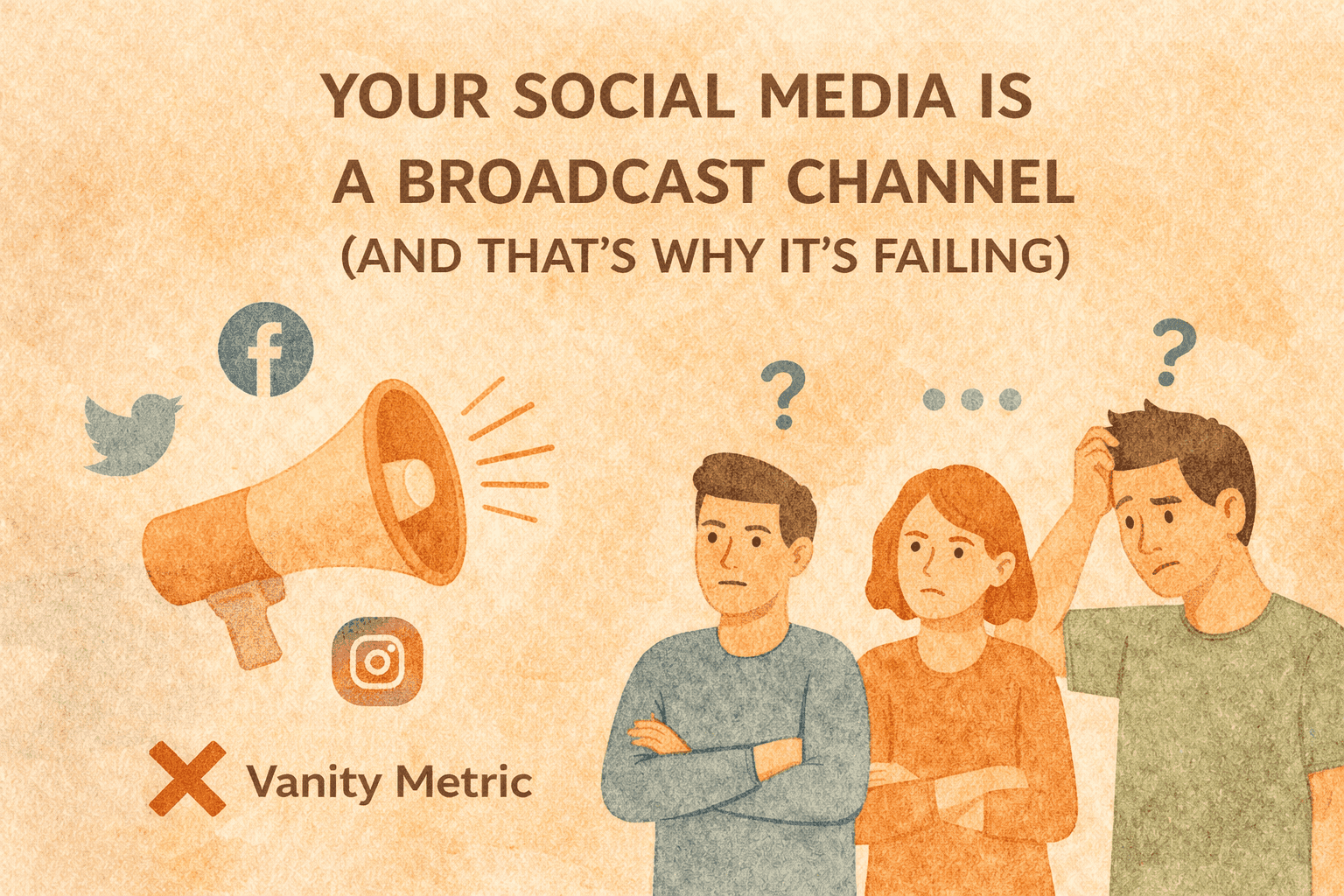
Your Social Media Is a Broadcast Channel (And That's Why It's Failing Retention)
63% of marketers use social media for retention-but average engagement rates are just 2.8%. The channel is built for conversation, yet brands use it for megaphone marketing. Learn the "Social Relationship Framework" that turns followers into customers and one-time buyers into repeat purchasers through community, not campaigns.
11 min read · 17 October 2025
The Follower Illusion
You have 50,000 followers. Your last post reached 2,000 of them. 150 engaged. 3 clicked through to your store.
Those numbers aren't anomalous-they're average. And they reveal the fundamental problem with social media "marketing" for ecommerce: you're broadcasting to an audience that increasingly doesn't receive, doesn't engage, and doesn't convert.
The average engagement rate is 2.8%. That means 97.2% of the people who technically see your content don't interact with it. They scroll past. They ignore. They've been trained by years of brand content to treat your posts like digital wallpaper-present but invisible.
63% of marketers use social media for retention. But "effective" is doing heavy lifting in that statistic. Most brands measure social success by reach and impressions-vanity metrics that tell you nothing about whether existing customers are becoming more loyal or whether one-time buyers are becoming repeat purchasers.
Social media wasn't built for broadcasting. It was built for conversation, connection, and community. When brands use it as a one-way promotional channel, they're fighting the platform's fundamental design-and losing.
---
Why Broadcast Social Fails Retention
Broadcast social media-the "post and pray" approach-fails retention for three structural reasons:
Algorithmic Punishment
Social algorithms prioritize engagement. Content that generates comments, shares, and saves gets shown to more people. Content that gets scrolled past gets buried.
Brand broadcast content (product announcements, sale alerts, promotional posts) generates low engagement because it's designed to inform, not interact. The algorithm notices. It shows your next post to fewer people. The cycle continues until your 50,000 followers become 500 actual viewers.
Meanwhile, content that invites participation-questions, debates, user showcases, behind-the-scenes vulnerability-generates the engagement algorithms reward. But most brands don't create this content because it doesn't directly promote products.
Relationship Decay
A customer who follows your brand on social media has expressed interest. They want to hear from you. But after 50 posts that look like advertisements, 50 posts that ask nothing of them, 50 posts that treat them as eyeballs rather than humans-they mentally check out. The follow remains. The relationship dies.
Socially engaged customers generate 40% more revenue than unengaged customers. The data proves that social engagement-actual two-way interaction-drives spending. But most brands invest in posting, not responding. They create content but don't create conversation.
Platform Mismatch
Social platforms are designed for human connection. People log in to see what friends are doing, engage with communities that share their interests, discover content that entertains or inspires.
Brand broadcast content interrupts this flow. It says "we exist and we want your money" in a space where users came for connection. The interruption isn't just ineffective-it's actively annoying, training customers to tune out your presence.
---
The Social Relationship Framework
The Social Relationship Framework reorients social media from broadcast channel to relationship platform. Instead of measuring reach and impressions, it measures relationship depth. Instead of posting content, it facilitates conversation.
Pillar 1: Respond Before You Post
Most brands have the social equation backwards: create content first, respond to engagement second (if at all). The framework inverts this.
Every day, before creating new content:
- Respond to every comment on recent posts (not with emoji-with actual responses)
- Reply to every DM within 24 hours
- Engage with content from customers who've tagged the brand
- Comment meaningfully on posts from community members
This "respond first" discipline ensures the brand shows up as a conversation partner, not a broadcaster. It also generates signals the algorithm rewards-accounts that respond see higher distribution on their own content.
46% of users expect brands to respond within an hour. Response isn't optional courtesy-it's retention strategy.
Pillar 2: Ask More Than Tell
Broadcast content tells: "New product available." "Sale starts Friday." "Check out our latest collection."
Relationship content asks: "What color would you wear this with?" "What's your biggest challenge with [product category]?" "Show us how you style this."
Questions invite participation. Participation creates investment. Investment deepens relationship.
For every three posts, at least one should be primarily a question-not rhetorical, but genuine. Questions where you actually read and respond to answers. Questions that treat followers as sources of insight, not just recipients of messages.
Pillar 3: Feature Your Customers
User-generated content isn't just free marketing-it's relationship-building. When you share a customer's photo, you're saying "you matter to us." The featured customer feels valued. Other customers see that engagement is rewarded.
Feature cadence: At minimum, 25% of feed posts should showcase customers. Not polished influencer content-real customers with real imperfect photos showing real use of your products.
Tag the customers you feature. Comment on their original posts. DM them to thank them. Turn the feature into a touchpoint, not just content.
Pillar 4: Create Conversation Spaces
Individual posts generate individual engagements. Conversation spaces-groups, regular live sessions, community hashtags-create ongoing relationship.
Options by platform:
- Facebook Groups centered on product category or customer interest
- Instagram Broadcast Channels for behind-the-scenes access
- TikTok series that invite ongoing participation
- Discord communities for engaged customers
These spaces shift the relationship from brand → customer broadcast to customer ↔ customer ↔ brand dialogue. Community members develop relationships with each other, not just with the brand. Those relationships create switching costs that pure product loyalty can't match.
---
Engagement Metrics That Actually Matter
Standard social metrics (reach, impressions, follower count) measure broadcast effectiveness. Retention-focused metrics measure relationship depth.
Primary Metrics:
Conversation Rate: Comments per post divided by followers. This measures whether content generates dialogue, not just consumption. Target: Above 0.5% for Instagram, above 0.1% for Facebook.
Response Rate and Time: What percentage of comments and DMs receive responses, and how quickly? Target: 100% response rate within 24 hours for DMs, 48 hours for comments.
Share/Save Rate: Saves and shares indicate content worth returning to or worth spreading. These actions predict relationship depth better than likes. Target: Save rate above 2% on Instagram.
Customer Content Rate: How often do customers create content featuring your products? Measured by hashtag usage, tags, or manual tracking. Rising customer content indicates rising engagement.
Secondary Metrics:
Social-Attributed Repeat Purchases: Among customers who engage on social, what's their repeat purchase rate vs. non-engaged customers? This directly measures social's retention impact.
Community Growth Rate: For dedicated community spaces (groups, channels), what's the growth and engagement trajectory? Healthy communities grow through member invitation, not just brand promotion.
Sentiment Trend: Are comments becoming more positive, negative, or neutral over time? Sentiment shift indicates relationship trajectory.
Metrics to Deprioritize:
Follower Count: Vanity metric that doesn't predict purchasing behavior. A brand with 10,000 engaged followers outperforms a brand with 100,000 passive ones.
Reach/Impressions: Measures potential exposure, not actual engagement. A post that reaches 50,000 and converts none isn't successful.
Post Frequency: More posts doesn't mean better engagement. Quality and relevance matter more than volume.
---
Platform-Specific Retention Strategies
Each platform has different engagement dynamics. Retention strategy must adapt.
Instagram:
Primary retention levers:
- Stories for daily, casual engagement (polls, questions, behind-the-scenes)
- Reels for discovery and personality
- Feed posts for polished brand content and customer features
- DMs for direct relationship building
Instagram engagement rates average 1-3% for brands. The platform rewards visual creativity and genuine connection. Avoid overly polished, catalog-style content-users scroll past it.
Retention tactics:
- Story polls asking for product preferences before launches
- Reels showing product creation process or team personalities
- Customer feature carousels with genuine appreciation
- DM response within hours, not days
TikTok:
Primary retention levers:
- Short-form video showing brand personality
- Trend participation that feels authentic
- Comment engagement (TikTok rewards reply videos)
- Community building through consistent series
TikTok campaigns can reach 10x your follower count when content is engaging. The platform's algorithm can surface content to massive audiences regardless of follower count-but only if content is genuinely engaging.
Retention tactics:
- Behind-the-scenes content showing real operations
- Customer story features as video testimonials
- Reply videos responding to customer comments
- Consistent content series that create appointment viewing
Facebook:
Primary retention levers:
- Groups for community building
- Events for real and virtual gatherings
- Messenger for customer service
- Feed for announcements (but expect low organic reach)
Facebook's organic reach for brand pages is notoriously low. The platform is most valuable for its Groups feature, which creates owned community spaces.
Retention tactics:
- Private group for VIP customers with exclusive access
- Regular live Q&A sessions with founders or product teams
- Messenger-based customer service with quick response times
- Facebook Shop integration for seamless social-to-purchase journey
---
The Customer Journey on Social
Social media plays different roles at different customer journey stages. Retention strategy must address each stage.
Awareness (Non-Customers):
Goal: Generate interest without overt selling. Content: Entertaining, educational, or inspiring content that showcases brand personality without hard promotion. Engagement: Respond to comments from non-followers; participate in relevant conversations.
Consideration (Interested Non-Customers):
Goal: Build trust and demonstrate value. Content: Social proof (customer testimonials, UGC), product education, behind-the-scenes authenticity. Engagement: Answer product questions in comments; DM with helpful information; connect to customer service.
First Purchase (New Customers):
Goal: Confirm purchase decision and set expectations. Content: Order confirmation and delivery updates via DM; welcome to community spaces. Engagement: Check in post-delivery; invite review and feedback; feature customer if they post.
Retention (Existing Customers):
Goal: Deepen relationship and encourage repeat purchase. Content: New product announcements to engaged followers; exclusive offers for social community; customer features and celebrations. Engagement: Proactive outreach for product advice; loyalty program updates; birthday and anniversary recognition.
Advocacy (Loyal Customers):
Goal: Activate word-of-mouth and referral. Content: Referral program promotion; customer ambassador spotlights; community celebrations. Engagement: VIP access to new products; personal relationship with brand team; involvement in product development.
The mistake most brands make: treating all followers the same regardless of relationship stage. New followers need different content than five-year customers. Social strategy must segment.
---
Community vs. Audience
The most important distinction in social retention: are you building an audience or a community?
Audience Characteristics:
- One-way relationship (brand → followers)
- Passive consumption of content
- No relationship between members
- Easily replaceable (any brand could substitute)
- Measured by follower count
Community Characteristics:
- Multi-directional relationships (brand ↔ members ↔ each other)
- Active participation and contribution
- Member-to-member connections
- Sticky through social bonds
- Measured by engagement depth
91% of respondents say community drives loyalty. But using social media for marketing is not the same as building community on social media. The former is broadcasting. The latter is relationship-building.
Community-building tactics:
- Create spaces for member interaction (groups, forums, chats)
- Facilitate member-to-member introductions
- Celebrate member achievements unrelated to purchases
- Involve community in product decisions
- Host virtual or physical gatherings
Brands with true communities see retention benefits that pure audiences cannot match. Community members don't just buy from you-they belong with you. Belonging creates switching costs that product quality and price cannot overcome.
---
Social Customer Service as Retention
Social media is increasingly where customers seek support. How you respond affects retention more than how you post.
Half of customers expect responses within an hour. Social customers expect fast responses-within hours, not days. Missing this expectation damages the relationship.
Social Service Standards:
Response Time:
- DMs: Within 4 hours during business hours, within 12 hours outside
- Comments (questions/complaints): Within 24 hours
- Mentions: Within 48 hours
Response Quality:
- Personalized (use customer's name, reference their specific issue)
- Solution-oriented (don't just apologize, fix the problem)
- Empathetic (acknowledge frustration before pivoting to resolution)
- Brand-voiced (consistent with overall brand personality)
Public vs. Private:
- Acknowledge publicly, resolve privately when issue is complex
- Public resolution when the answer helps others
- Never argue publicly; take escalation to DM immediately
Escalation Path:
- Social team should have authority to resolve common issues
- Clear path to customer service for complex problems
- VIP customer flags for priority handling
Socially engaged customers generate 40% more revenue than unengaged customers. Social customer service isn't overhead-it's revenue generation through retention.
---
The Content Calendar Reset
Most social content calendars are built around brand priorities: product launches, campaigns, holidays. Retention-focused calendars are built around relationship priorities.
Old Calendar Logic:
Monday: New product post Wednesday: Promotional post Friday: Weekend sale post
New Calendar Logic:
Monday: Customer feature (relationship-building) Tuesday: Question post (engagement-generating) Wednesday: Behind-the-scenes (authenticity) Thursday: Educational content (value-providing) Friday: Community celebration (connection)
Promotional content (sales, new products) should be exception, not default. Maximum 20% of content should be directly promotional. The rest should build relationship that makes promotional content welcome when it appears.
Responsive Calendar:
The best social strategies leave room for responsive content:
- Trending topics that align with brand
- Real-time response to customer content
- Current events relevant to community
- Spontaneous behind-the-scenes moments
Overly rigid calendars produce content that feels corporate and disconnected. Leave 30% of calendar flexible for responsive opportunities.
---
Measuring Social's Retention Impact
The ultimate question: does social media engagement actually improve retention?
Attribution Approach:
1. Segment by social engagement:
- Non-followers (no social relationship)
- Passive followers (follow but don't engage)
- Engaged followers (like, comment, share regularly)
- Community members (active in groups, respond to DMs)
2. Compare retention metrics:
- Repeat purchase rate by segment
- Average order value by segment
- Customer lifetime value by segment
- Churn rate by segment
3. Control for other factors:
- Purchase frequency
- First-order value
- Acquisition source
- Time as customer
If engaged social followers retain at higher rates than passive followers (controlling for other factors), social engagement drives retention. If not, your social strategy isn't working-regardless of reach and impressions.
Expected Results:
Healthy social retention programs show:
- Engaged followers retain 20-40% better than non-followers
- Community members retain 40-60% better than passive followers
- Social-engaged customers have 15-25% higher LTV
If your numbers are lower, social content isn't building relationship-it's just adding noise.
---
The 90-Day Social Transformation
Days 1-30: Foundation Reset
Week 1: Audit
- Calculate current engagement rate by content type
- Map response time for comments and DMs
- Survey customers about social content preferences
Week 2: Response system
- Implement "respond first" daily discipline
- Set up notifications for mentions and tags
- Create response templates for common questions
Weeks 3-4: Content pivot
- Reduce promotional content to 20% maximum
- Create question-based content templates
- Begin regular customer feature process
Days 31-60: Community Building
Weeks 5-6: Conversation spaces
- Launch or revitalize Facebook Group or equivalent
- Create Instagram broadcast channel for VIPs
- Develop regular live session schedule
Weeks 7-8: Customer activation
- Create UGC campaign with clear participation mechanism
- Develop customer ambassador identification process
- Build system for featuring customer content
Days 61-90: Measurement and Optimization
Weeks 9-10: Attribution setup
- Segment customers by social engagement level
- Build retention comparison dashboards
- Create social-attributed purchase tracking
Weeks 11-12: Iteration
- Review content performance by type
- Analyze community engagement patterns
- Refine strategy based on retention data
---
Beyond the Feed
Social media for retention isn't about what you post. It's about how you connect. Every comment ignored is a relationship damaged. Every question unanswered is trust eroded. Every broadcast without conversation is an opportunity wasted.
The brands winning at social retention aren't the ones with the best content-they're the ones with the best conversations. They show up not to promote, but to participate. They ask as often as they tell. They feature customers more than they feature products.
Social commerce will reach $1.2 trillion by 2030. The channel is growing in importance. But importance without effectiveness is just wasted investment.
Stop broadcasting. Start conversing. Your followers are waiting to be treated like people, not pixels. The ones you connect with will buy again. The ones you broadcast at will scroll past.
The algorithm knows the difference. So do your customers.
CAC : LTV Calculator
Lifetime value, payback and the ratio that decides whether you can afford to grow.
How to Use Social Media for Product Co-Creation
Your Reviews Are Buried on Product Pages - Here's How to Turn Them Into a Retention Engine
Your Customers Are Creating Content You're Not Using - The Retention Power of UGC
Your "Brand Community" Is a Ghost Town - And It's Costing You More Than You Think
Your Video Strategy Stops at Conversion - Here's How Video Drives Repeat Purchases
10 Metrics to Track Scaled Influencer Campaigns
Newsletter
The Uncommon Insights Letter
Practical FMCG & eCommerce growth playbooks — margins, retention and scaling tactics, straight to your inbox.
Turn customer retention into profit you can see
Get a hands-on operator to turn the frameworks above into results — book a free audit call.