The CAC Payback Period Trap: Why 12-Month Payback Is Killing Your Cash Flow
A 12-month CAC payback ties up cash for eCommerce and FMCG brands. Target a 3–6 month payback with channel audits, retention and upsells to preserve cash flow.
9 February 2026
- Why the 12-Month CAC Payback Period Fails
- How the 12-Month Payback Model Hurts Your Cash Flow
- Here's how you are miscalculating CAC payback | Eric Andrews Clips
- Better Payback Periods for Growth
- How to Improve CAC Payback with Practical Frameworks
- Conclusion: Matching CAC Payback with Growth Goals
- FAQs
- Related Blog Posts
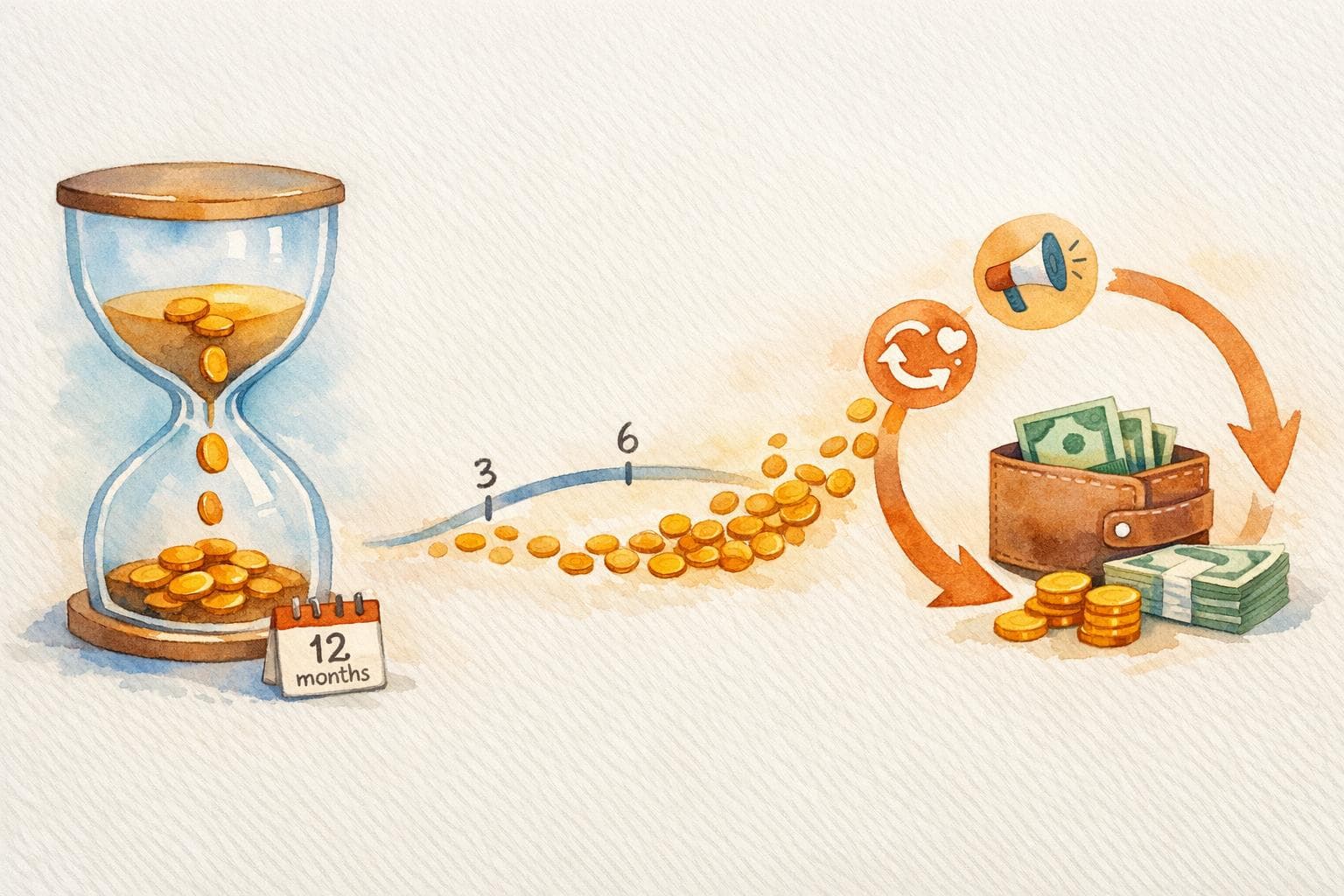
A 12-month CAC payback period might work for SaaS companies, but for eCommerce and FMCG businesses, it’s a cash flow nightmare. Here’s why:
- Cash flow strain: Waiting a year to recover customer acquisition costs ties up funds that could be used for inventory, marketing, or growth.
- High risk: In industries with low margins and high churn, customers may stop buying before you break even.
- Economic pressures: Rising ad costs, marketplace fees, and returns further extend payback periods.
The solution? Target a 3–6 month CAC payback period. This allows faster reinvestment, reduces financial risk, and supports efficient growth. Strategies like analysing payback by channel, encouraging repeat purchases, and using upsells can help shorten the cycle.
Key takeaway: A shorter payback period strengthens cash flow and keeps your business scalable without relying on external funding.
Why the 12-Month CAC Payback Period Fails
What Is CAC Payback and Why It Matters
CAC payback measures how long it takes to recoup the money spent acquiring a customer. The formula is simple: divide your total sales and marketing expenses by the number of new customers gained to calculate your Customer Acquisition Cost (CAC). Then, figure out how many months of profit it takes to recover that amount.
Here’s the catch: you need to use gross profit, not revenue. That means subtracting costs like goods sold (COGS), shipping, fulfilment, and payment processing fees. For Australian eCommerce brands, ignoring these variable costs - Stripe and Shopify fees alone can eat up 5–10% of revenue - can lead to overly rosy projections.
Now, let’s dive into why using a fixed 12-month payback period often creates cash flow issues.
Problems with the 12-Month Payback Period
While CAC payback is a vital metric, the standard 12-month model often falls short for FMCG and eCommerce businesses. Unlike SaaS companies, which benefit from predictable recurring revenue, these industries face cash flow challenges that the 12-month benchmark exacerbates. Delayed payback ties up capital, making it harder to reinvest quickly and obscuring underperforming acquisition channels. Some channels may stretch payback far beyond 12 months, creating hidden financial stress.
"A payback period over 12 months can put significant strain on cash flow... It means your capital is tied up for over a year before it generates a return."
- Glencoyne Guide
For mid-sized Australian brands earning $1–$10 million annually, this delay can be especially risky. Data shows that companies with sub-6-month payback periods are twice as likely to be considered "efficient growth" businesses by venture capitalists. The 12-month standard simply doesn’t support the faster reinvestment cycles needed to thrive in competitive markets.
Economic Pressures Making It Worse
Economic factors are piling on additional challenges. Rising advertising costs are pushing CAC higher, particularly during Australia’s Q4 holiday season when competition for ad space intensifies. A fixed 12-month payback period in this environment means your cash stays tied up even longer.
Marketplace fees add another complication. Amazon, for instance, charges referral fees around 15%, and its storage and fulfilment costs can slash contribution margins by 50–70% compared to direct-to-consumer sales. If you calculate payback using blended metrics, you might underestimate how long it actually takes to recover costs from marketplace sales.
High churn rates make matters even worse. In FMCG, where brand loyalty is often inconsistent, customers may not make repeat purchases within 12 months. This turns them into a permanent cost rather than a profitable investment.
"Relying on a single, blended payback metric across all your sales channels obscures the truth... It masks which channels are generating cash and which are draining it."
- Glencoyne
These growing economic pressures highlight the need for more flexible payback strategies that align with the realities of scaling a business.
How the 12-Month Payback Model Hurts Your Cash Flow
Cash Flow Delays and Capital Limits
Waiting 12 months to recover customer acquisition costs (CAC) ties up capital that could otherwise fuel key areas like inventory, product development, or acquiring more customers. Every dollar spent on marketing remains a sunk cost during this period, blocking its reinvestment into growth efforts or operational needs.
This prolonged cycle often forces businesses to depend on external funding sources like inventory financing, bank loans, or investor backing just to keep up with marketing and growth. For Australian eCommerce brands operating on slim profit margins, this reliance can create a precarious financial position. The inability to quickly use earned revenue highlights not just cash flow constraints but also deeper operational inefficiencies.
Now, compare this to businesses with shorter payback periods. Companies that recover their CAC in under three months can reinvest that cash into marketing almost immediately, creating a self-sustaining growth loop. On the other hand, a 12-month delay leaves businesses with two options: slow down growth or take on debt.
Unit Economics Problems in eCommerce
The issues with a 12-month payback model go beyond delayed cash flow - it can also skew unit economics. Many Australian eCommerce businesses miscalculate key metrics, either underestimating customer churn or overestimating future customer spending. If customers stop purchasing before the 12-month mark, the business never recoups the initial acquisition cost.
This risk is particularly prominent in fast-moving consumer goods (FMCG), where customer loyalty can be unpredictable. Unlike SaaS companies with predictable subscription revenue, eCommerce businesses rely on customers choosing to return. Misjudging churn rates or failing to account for a lag of at least 30 days between marketing spend and revenue can create an overly optimistic payback outlook. Returns further complicate this equation, often extending the actual payback period well beyond initial projections. These flawed metrics can lead to significant cash flow challenges, as seen in real-world examples.
Real Examples of Cash Flow Strain
The financial strain caused by the 12-month payback model is evident in real-world cases. Take Temple & Webster, for instance. Between FY23 and FY24, the company increased its marketing and advertising spend by 62%, jumping from $48.1 million to $77.9 million. However, this aggressive spending translated to only a 26% revenue increase, from $393.5 million to $497.8 million. The slow recovery of customer acquisition costs contributed to a dramatic 78% drop in net profit after tax, which fell from $8.3 million to $1.8 million.
Another example comes from Carla Penn-Kahn, founder of Profit Peak. Between 2019 and 2023, her customer acquisition costs doubled, rising from $20–$25 to $40–$50. With an average order value of $150, the extended time required to recover these costs made scaling through advertising unsustainable. She remarked: "The unit economics of customer acquisition versus all the other business outlay no longer work".
Here's how you are miscalculating CAC payback | Eric Andrews Clips
Better Payback Periods for Growth
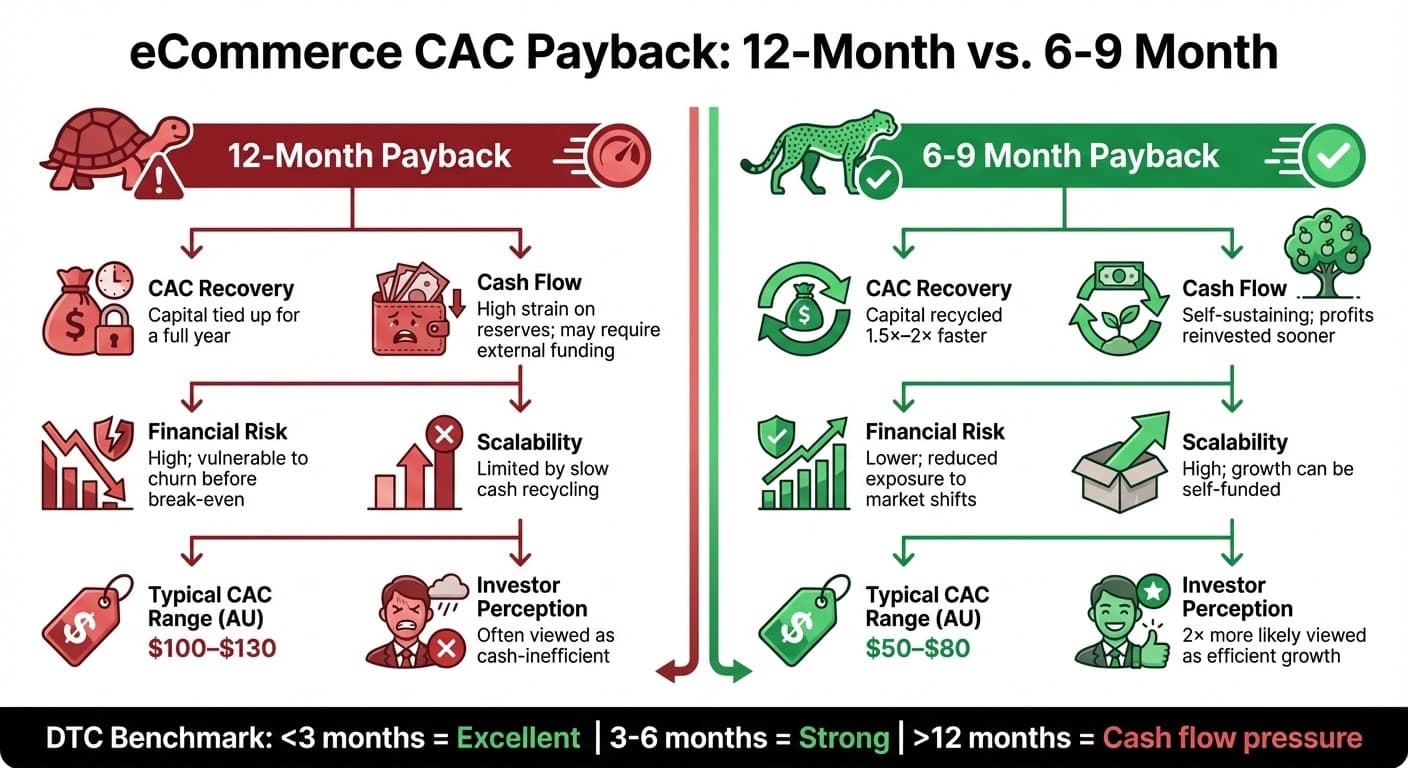
12-Month vs 6-9 Month CAC Payback Period Comparison for eCommerce
Benefits of Shorter Payback Periods
Aligning your CAC (Customer Acquisition Cost) payback period with growth goals is key to maintaining strong cash flow and enabling sustainable expansion. By shortening your CAC payback period to 6–9 months, you can significantly improve operational efficiency. Instead of waiting an entire year to recover acquisition costs, you’ll be recycling capital 1.5×–2× faster. This means you can reinvest those funds into marketing, inventory, or other growth areas almost immediately [5,12]. This creates a "growth flywheel", where profits from customers fund the next wave of acquisitions - without relying on external funding or loans [5,11].
A shorter payback period also reduces financial risk. Rather than being exposed to a full year of churn or market fluctuations, your risk is limited to just 6–9 months [1,13]. For Australian eCommerce brands dealing with rising ad costs and unpredictable consumer behaviour, this shorter window provides much-needed flexibility. In fact, companies with CAC payback periods of less than 6 months are 2× more likely to be seen as "efficient growth" businesses by venture capitalists.
This approach also enhances operational agility, allowing you to scale ad spend, enter new markets, or test products without draining your cash reserves [1,5]. As Ecommerce Optimizers highlight:
"A 2–3 month payback lets you reinvest aggressively. A 12-month payback puts enormous pressure on retention and capital reserves."
The following comparison highlights the clear advantages of shifting from a 12-month model to a 6–9 month payback period.
Comparison: 12-Month vs. 6–9 Month Payback
| Metric | 12‑Month Payback | 6–9 Month Payback |
|---|---|---|
| CAC Recovery | Capital tied up for a full year | Capital recycled faster |
| Cash Flow Outcome | High strain on reserves; may require external funding | Self‑sustaining; profits reinvested sooner |
| Financial Risk | High; vulnerable to churn before break‑even | Lower; reduced exposure to market shifts |
| Scalability | Limited by slow cash recycling | High; growth can be self‑funded |
| Typical CAC Range (AU) | $100–$130 | $50–$80 |
| Investor Perception | Often viewed as cash‑inefficient | Viewed as efficient growth |
For direct-to-consumer (DTC) brands, a payback period of less than 3 months is considered excellent, while 3–6 months is seen as a strong benchmark [5,8]. Anything beyond 12 months, however, places significant pressure on cash flow and limits growth opportunities.
These numbers underline the importance of adopting marketing strategies that accelerate payback.
Channels and Methods for Faster Payback
Certain marketing channels - like SEO, organic content, and influencer partnerships - tend to deliver lower CAC and faster recovery compared to paid social campaigns targeting lookalike audiences. A great example comes from the skincare brand Bambu Earth. By introducing a personalised skincare quiz and pairing it with targeted email campaigns, they achieved $742,000 in sales with a 20% net profit margin.
To further reduce your payback period, focus on encouraging a second purchase within the first 30 days. Automated email and SMS sequences are effective tools for bringing customers back quickly. Additionally, post-purchase upsells - offering complementary products immediately after checkout - can boost your average order value and shorten the time it takes to break even. Strategies like bundling, cross-sells, and premium product recommendations can also increase gross margins per order, reducing the months needed to recover CAC [5,11].
It’s crucial to move beyond blended metrics when tracking payback periods. Analyse payback times by acquisition channel - such as Meta versus Google or DTC versus marketplaces - to pinpoint which channels deliver the fastest returns, not just the lowest CAC. As Glencoyne explains:
"Relying on a single, blended payback metric across all your sales channels obscures the truth... It masks which channels are generating cash and which are draining it."
How to Improve CAC Payback with Practical Frameworks
These strategies tackle cash flow challenges by speeding up the recovery of acquisition costs.
Step 1: Calculate Your Current CAC and LTV
Start by calculating your Customer Acquisition Cost (CAC) and Lifetime Value (LTV) using precise sales and marketing data. For Australian eCommerce and FMCG businesses, it’s recommended to apply a 30-day lag to your sales and marketing expenses. This approach aligns your ad spend with the revenue generated within the same 30-day window, offering a clearer picture of cost recovery.
Instead of relying on simple LTV averages, use cohort analysis to track monthly retention. Break it down into "survivors × ARPU (Average Revenue Per User) × Gross Margin %" to understand how early retention improvements can significantly reduce your payback period. Segment your customers by acquisition channel - whether it’s Meta, Google, email campaigns, or influencer partnerships. This segmentation highlights which channels deliver the quickest returns and where cash flow is delayed.
Once you’ve segmented your CAC and LTV data, evaluate the efficiency of each acquisition channel.
Step 2: Review Marketing and Acquisition Channels
With segmented CAC and LTV data in hand, audit your marketing channels. Avoid blended metrics that can obscure underperforming channels. Analyse each separately - whether it’s direct-to-consumer (DTC) platforms, marketplaces like Amazon, or wholesale - to identify areas draining cash. Reallocate your budget to channels where the marginal CAC aligns with your target payback period, ideally within 6–12 months. Shift spending away from channels with payback periods exceeding 12 months toward those achieving faster returns (under 3 months is considered "Excellent").
For instance, if Meta campaigns are taking 14 months to break even, but your email marketing recovers costs in just 4 months, adjust your budget accordingly. This doesn’t mean abandoning paid social altogether - it’s about striking the right balance to prioritise channels that keep cash flowing efficiently.
Once you’ve optimised your channel mix, focus on strategies to retain customers and drive repeat purchases for quicker cost recovery.
Step 3: Use Retention and Upsell Tactics
Retention and upselling are key to further reducing your CAC payback period. Use cohort performance data to test and refine automated email and SMS sequences, identifying the messages that drive repeat purchases most effectively.
Post-purchase upsells can be a game-changer. Offering complementary products or premium upgrades immediately after checkout accelerates cost recovery. Similarly, introducing subscription models or bundling products can increase upfront revenue, helping you break even faster. Conduct A/B testing on different bundle combinations to find those that maximise Average Order Value (AOV) and minimise payback time.
Keep an eye on churn data to identify where customers are dropping off. Implement targeted retention strategies before they reach these critical points. Businesses with CAC payback periods under 6 months are 2× more likely to be seen as "efficient growth" companies by venture capitalists.
Conclusion: Matching CAC Payback with Growth Goals
A 12-month CAC payback period can be a serious obstacle for scaling, especially for Australian eCommerce and FMCG businesses operating on tight margins. Waiting an entire year to recover customer acquisition costs ties up cash that could otherwise be reinvested into new growth opportunities, leaving businesses vulnerable to cash flow challenges.
Shifting to shorter payback periods - ideally between 3 and 6 months - provides the flexibility to reinvest sooner, enabling one marketing dollar to drive multiple growth cycles in a year. Many successful DTC brands achieve sub-6-month paybacks, making them twice as likely to be recognised as "efficient growth" businesses by investors. Faster payback periods also reduce reliance on external funding, giving businesses more control over their cash flow and scalability.
Instead of relying on extended payback windows that strain resources, focus on strategies that accelerate recovery. A 2–3 month payback period can support aggressive growth goals, while a 12-month cycle often puts unnecessary pressure on working capital.
To align your CAC payback with your growth objectives, apply actionable steps like accurate CAC/LTV calculations, detailed channel audits, and effective retention strategies. Improving gross margins through better pricing models or product bundling, as well as offering prepaid annual plans, can also drastically reduce your payback period - even to zero days in some cases.
Ultimately, your CAC payback period should reflect your growth ambitions and available resources. If you’re aiming for rapid, self-funded expansion, targeting a 3 to 6-month payback is a practical and effective goal. Faster recovery not only strengthens cash flow but also sets the stage for sustainable growth.
FAQs
Why can a 12-month CAC payback period harm your eCommerce business?
A 12-month CAC (Customer Acquisition Cost) payback period can put eCommerce businesses in a tough spot. Why? Because it takes an entire year to recover the money spent on acquiring customers, which keeps your cash flow under strain for far too long. This becomes even trickier if your business encounters issues like high churn rates or sudden market disruptions.
On top of that, longer payback periods can hold you back from reinvesting in key areas like marketing campaigns or inventory expansion. This lack of flexibility can slow down growth and make it harder to build a stable financial foundation. To keep things on track, it’s worth exploring ways to shorten your payback period. Aligning these strategies with both your cash flow and business goals can make a big difference.
How does a shorter CAC payback period help improve cash flow?
A shorter CAC payback period means you can recover the money spent on acquiring customers faster. This quick recovery boosts cash flow, making it easier to reinvest in your business. It helps improve liquidity, reduces financial pressure, and supports steady growth.
By speeding up the return on investment for customer acquisition, a shorter payback period lowers the risk of cash flow problems. This added financial flexibility allows your business to scale more easily and adjust to shifting market conditions. For Australian businesses, this can be especially important for managing seasonal fluctuations and ensuring smooth operations year-round.
How can businesses shorten their CAC payback period to 3–6 months?
To achieve a CAC (Customer Acquisition Cost) payback period of 3–6 months, businesses need to focus on both efficiency and revenue growth. Start by fine-tuning your marketing and sales strategies. This could include leaning into organic growth channels, introducing referral programs, and running targeted advertising campaigns that bring in high-value customers at a lower cost. On top of that, boosting the average order value (AOV) and encouraging repeat purchases can help recover acquisition costs more quickly.
Retention plays a key role too. Consider implementing loyalty programs and personalised marketing efforts to increase customer lifetime value (LTV). This ensures customers return and spend more over time, contributing to stronger profits. At the same time, maintaining healthy gross margins is critical. By aligning your products or services with what customers truly need, you can drive consistent profitability, which helps speed up CAC recovery.
When these strategies work together, businesses can not only shorten the payback period but also improve cash flow, setting the stage for steady, long-term growth.
Related Blog Posts
CAC vs. LTV: Subscription ROI Explained
VC Funding Is the New Toxic Debt
The 3:1 LTV:CAC Ratio Lie: Why This 'Golden Rule' Is Destroying Profitable Brands
eCommerce Unit Economics: A Complete Analysis Guide
Unit economics template for DTC brands
CAC Payback Period Calculator [Tool]
Newsletter
The Uncommon Insights Letter
Practical FMCG & eCommerce growth playbooks — margins, retention and scaling tactics, straight to your inbox.
Turn these ideas into profit you can see
Get a hands-on operator to turn the frameworks above into results — book a free audit call.