CAC vs. LTV: Subscription ROI Explained
Subscription businesses fail if CAC exceeds LTV; understand LTV:CAC, reduce churn and optimise channel-level unit economics to secure profitable growth.
24 February 2026
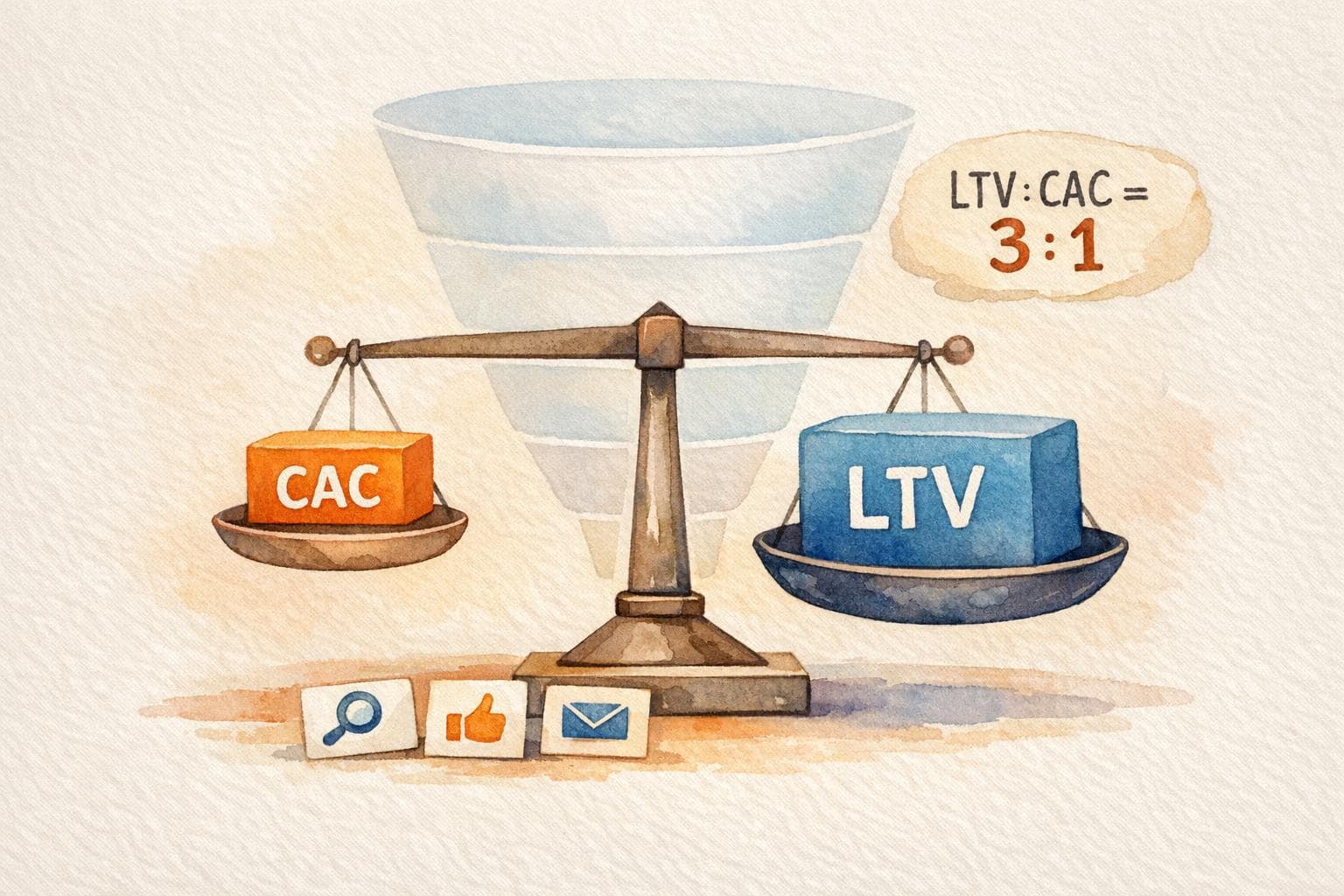
Running a subscription business without understanding Customer Acquisition Cost (CAC) and Lifetime Value (LTV) is risky. These metrics determine if you're earning or losing money per customer. Here's the key takeaway:
- CAC is the cost of acquiring a customer.
- LTV is the total profit a customer generates over their lifetime.
- A healthy LTV:CAC ratio (3:1 or higher) ensures profitability.
In Australia, CAC is 20–35% higher than in the US due to market size and competition. With acquisition costs rising and privacy changes increasing conversion costs, understanding these metrics is critical for success.
This article breaks down CAC, LTV, and their relationship, offering practical tips to improve your subscription ROI.
How to Calculate CAC & LTV | The 2 Key Metrics for Growth
What is Customer Acquisition Cost (CAC)?
Customer Acquisition Cost (CAC) represents the total expense involved in acquiring a single new customer. This includes every dollar spent on sales and marketing efforts, such as Facebook ads, content creation, email campaigns, and agency fees. Calculating CAC accurately is crucial for ensuring sustainable growth in subscription-based businesses.
CAC Definition and Formula
The formula for CAC is simple: divide your total sales and marketing expenses by the number of new customers acquired within a specific timeframe.
CAC = Total Sales & Marketing Costs ÷ Number of New Customers
For example, if you spent A$15,000 on marketing in January and gained 200 new customers, your CAC would be A$75. However, many businesses underestimate their true CAC by leaving out costs like software subscriptions, staff salaries, creative production, discounts, and agency fees. For Australian businesses using platforms like Xero or MYOB, these costs are often recorded under "General Expenses", requiring manual adjustments for an accurate calculation. It's also important to use net amounts (excluding GST) for precise comparisons.
New CAC vs Blended CAC
Not all CAC metrics are created equal. New CAC focuses exclusively on the cost of acquiring first-time customers, giving a clear picture of how much you’re spending to attract new business. On the other hand, Blended CAC averages the cost across all customers, including returning buyers and those acquired through lower-cost channels like email or referrals. This can make your metrics look better than they actually are.
Blended CAC often hides the fact that acquiring a customer through Meta ads might cost A$120, while email subscribers may only cost A$20. As Joel Hauer, Principal Consultant at Uncommon Insights, explains:
"Blended CAC is a vanity metric. Channel-level CAC is where unit economics live or die."
For subscription businesses, new CAC is the more critical metric, as it shows whether your acquisition strategy is genuinely profitable.
CAC Examples in Subscription eCommerce
CAC can vary significantly depending on the channel. Referral programs typically have the lowest CAC, ranging from A$25–A$60. Email marketing is even more cost-effective, at A$20–A$50. Paid social, however, can range from A$45–A$120, depending on the quality of the creative and audience targeting. Influencer partnerships are less predictable, with costs ranging from A$40–A$200.
To get a clearer picture, it's essential to calculate CAC separately for each channel. For instance, branded search may cost around A$30 per customer, while non-branded search can be 3–5 times more expensive. Seasonality also plays a role - many Australian businesses see slower periods, like January, making it helpful to average CAC over 6 or 12 months to account for these fluctuations.
Breaking down CAC by channel helps businesses better understand how to optimise their acquisition strategy and lays the groundwork for analysing how Lifetime Value (LTV) affects overall subscription ROI.
What is Lifetime Value (LTV)?
Lifetime Value (LTV) is a measure of the total revenue or profit a customer contributes over the course of their relationship with your business - from their first purchase to their last interaction. For subscription-based businesses, LTV is an essential metric because it helps determine how much you can afford to spend on acquiring a customer while still staying profitable. Without a clear understanding of LTV, you could end up overspending on customer acquisition without knowing if the revenue they generate will cover the cost.
LTV is closely tied to churn rates. Even small reductions in churn can extend customer relationships and significantly increase revenue over time. To put it into perspective, recurring revenue models have historically grown 3.4 times faster than the S&P 500 over a 12-year period. This highlights why accurately calculating and optimising LTV is so important for long-term success.
LTV Definition and Formula
The formula for calculating subscription LTV is simple: multiply your Average Revenue Per User (ARPU) by your gross margin percentage, then divide by your churn rate.
LTV = (ARPU × Gross Margin) ÷ Churn Rate
Let’s break it down with an example. Imagine an Australian coffee subscription service charges A$45 per month, operates with a 60% gross margin, and has a 4% monthly churn rate. The LTV would be:
(A$45 × 0.60) ÷ 0.04 = A$675
This means each customer contributes A$675 in gross profit over their lifetime. If your Customer Acquisition Cost (CAC) is A$150, you’re left with A$525 in profit per customer - a solid 4.5:1 LTV:CAC ratio.
Top-performing subscription businesses aim for an LTV:CAC ratio of at least 3:1. If your ratio falls below 1:1, it means you’re losing money with every new customer acquired.
Factors That Affect LTV
One of the most critical factors influencing LTV is churn rate. For subscription businesses, reducing churn is key. Offering flexible options - like the ability to skip, pause, or modify deliveries - can help lower active churn by giving customers alternatives to cancelling outright. For example, in 2024, active subscribers in the United States dropped by about 10% year-over-year, underscoring the importance of retention strategies.
Other important factors include recurring revenue and ARPU. Boosting ARPU early in the customer journey - through welcome bundles or cross-sells - can increase gross margin upfront and shorten the time it takes to recover CAC. Offering discounts for annual commitments can also reduce churn and increase LTV by locking customers in for longer periods. Additionally, proactive customer success teams can enhance the overall experience, encourage higher-value purchases, and further improve LTV.
LTV Examples in Subscription eCommerce
Take the example of Zarina Bahadur, founder of 123BabyBox. In 2024, she increased her brand’s LTV by 40% by restructuring subscription tiers. Previously, the brand experienced a steep drop-off after three months. By introducing a one-month box priced at A$59.99 and offering annual plans at A$39.99 per month, the average subscription length grew from five to eight months. This added nearly A$150 in LTV per customer and reduced churn by 18%.
Here’s another scenario: an Australian beauty subscription charges A$38 per month with a 65% gross margin and a 5% monthly churn rate. Using the LTV formula:
(A$38 × 0.65) ÷ 0.05 = A$494
If the CAC is A$120, the LTV:CAC ratio is 4.1:1, which is well above the 3:1 benchmark. However, if churn rises to 8%, the LTV drops to A$309, bringing the ratio down to 2.6:1. This signals an urgent need to address retention strategies.
CAC vs. LTV: Direct Comparison
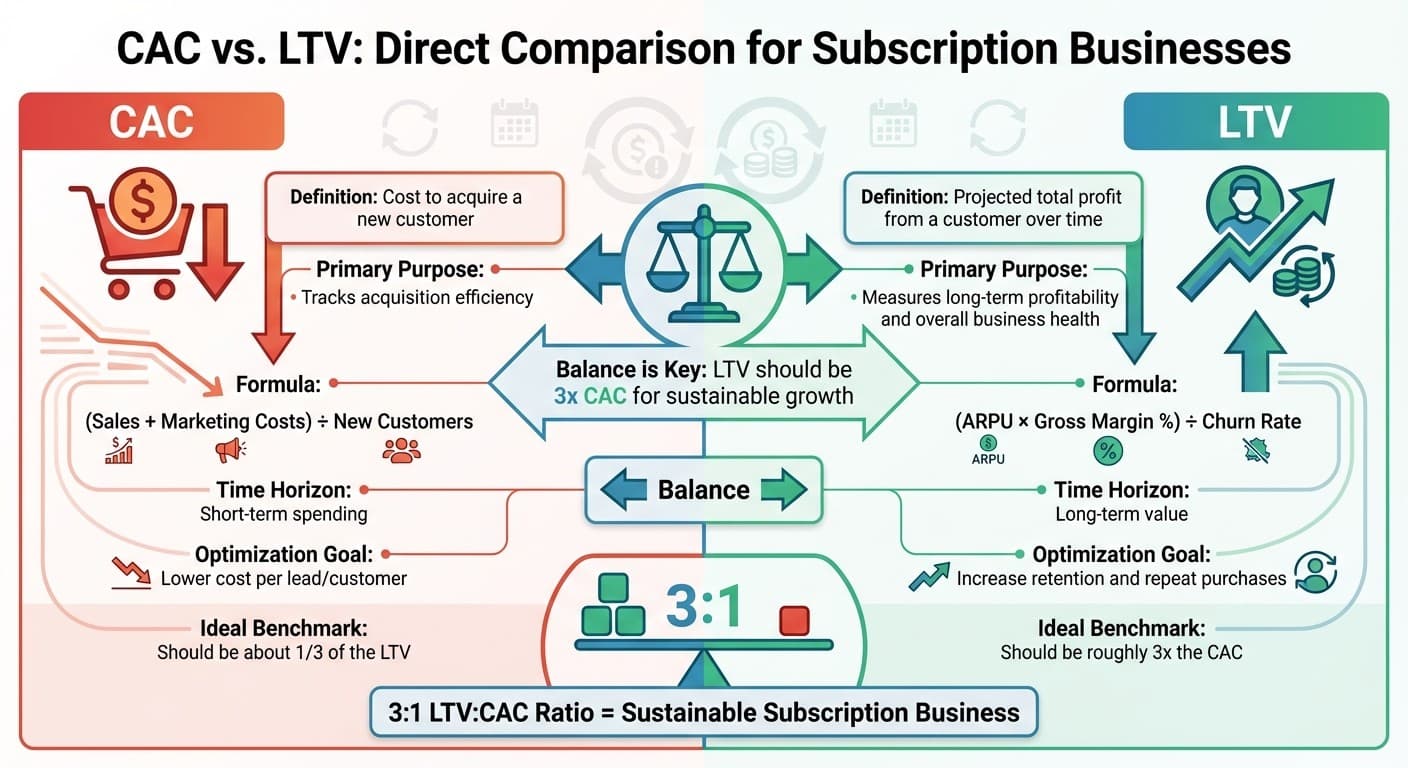
CAC vs LTV Comparison Chart for Subscription Businesses
CAC and LTV are both critical metrics, but they focus on entirely different aspects of a business. CAC (Customer Acquisition Cost) gauges how efficiently you’re spending on sales and marketing to bring in new customers. On the other hand, LTV (Customer Lifetime Value) looks at the bigger picture, estimating the net profit a customer will generate throughout their relationship with your business. In simple terms, CAC is about the upfront investment, while LTV is about the long-term payoff.
Main Differences Between CAC and LTV
Here’s a quick comparison of the two:
| Feature | Customer Acquisition Cost (CAC) | Customer Lifetime Value (LTV) |
|---|---|---|
| Definition | Cost to acquire a new customer | Projected total profit from a customer over time |
| Primary Purpose | Tracks acquisition efficiency | Measures long-term profitability and overall business health |
| Calculation Formula | (Sales + Marketing Costs) ÷ New Customers | (ARPU × Gross Margin %) ÷ Churn Rate |
| Time Horizon | Focuses on short-term spending | Looks at long-term value |
| Optimisation Goal | Lower cost per lead/customer | Increase retention and repeat purchases |
| Ideal Benchmark | Should be about 1/3 of the LTV | Should be roughly 3x the CAC |
For subscription businesses, finding the right balance between these two metrics is often challenging, especially in the early stages when upfront costs can feel overwhelming.
How CAC and LTV Work Together
In subscription models, aligning CAC and LTV is essential for sustainable growth. While CAC tells you how much you’re spending to gain a customer, LTV sets a cap on how much you should spend. Their relationship also determines the CAC payback period - the time it takes to recover your acquisition costs. Successful subscription businesses aim to keep this payback period under six months, as it allows for smoother cash flow and quicker reinvestment.
Improving LTV, often through retention strategies, can make it worthwhile to spend more on acquisition. For instance, if customers stick around longer and spend more, you can justify a higher CAC to capture a larger market share. By analysing the LTV:CAC ratio across different marketing channels, you can pinpoint which ones deliver the best returns. This approach ensures your marketing budget is allocated where it matters most, driving both growth and profitability.
LTV:CAC Ratio for Subscription ROI
Understanding the LTV:CAC Ratio
The LTV:CAC ratio is a simple yet powerful calculation: divide your Customer Lifetime Value (LTV) by your Customer Acquisition Cost (CAC). Often called the 'north star' for subscription businesses, this metric tells you if your acquisition efforts are helping your bottom line - or draining it. A ratio below 1.0 is a major warning sign - it means you're losing money with every new customer you acquire.
Here's a breakdown of what the ratio means and what you can do about it:
| Ratio | Meaning | Recommended Action |
|---|---|---|
| Losing money on every customer; product-market fit may be off | Rethink your marketing or refine your product | |
| 2:1 | Decent base but room for better efficiency | Focus on improving customer experience and value |
| 3:1 | Solid ROI and sustainable growth | Keep fine-tuning your strategies |
| 5:1 | Exceptional growth with strong margins | Invest further in customer acquisition |
When calculating this ratio, use gross contribution (profit) per customer instead of total revenue. This ensures a more accurate picture of your profitability and avoids inflating the numbers. For most businesses, reviewing this metric monthly or quarterly is ideal, especially if you're frequently tweaking your offerings.
This ratio isn't just a number - it’s a critical insight into your business's financial health and growth potential.
Impact on Profitability
The LTV:CAC ratio doesn’t just measure efficiency - it directly affects your operating margins and, ultimately, your profitability. For example, a 2x ratio typically aligns with a 16% operating margin, while improving to 3x can nearly double that to 33%. Push it further to 5x, and you’re looking at long-term margins of about 46%. As Jamie Sullivan and Alex Immerman from Andreessen Horowitz put it:
"Improving your LTV:CAC from 2x to 3x can nearly triple your valuation".
To put this into perspective, in 2023, consumer internet companies with 33% margins (3x ratio) traded at about 5.3x forward gross profit. In contrast, those with 16% margins (2x ratio) traded at just 1.5x forward gross profit.
This ratio also shapes your strategy. A high LTV:CAC ratio means you can afford to spend more on acquisition to grow your market share. On the flip side, a low ratio signals the need to prioritise retention and streamline operations. Monitoring this metric monthly is key to spotting rising acquisition costs or falling retention rates before they impact your profitability. Analysing the ratio by customer cohorts or acquisition channels can also help pinpoint which areas are driving the best returns.
How to Optimise CAC and LTV in Subscription eCommerce
When it comes to subscription eCommerce, keeping your Customer Acquisition Cost (CAC) low while increasing Lifetime Value (LTV) is crucial for profitability. Here's how to tackle both effectively.
Lowering CAC Through Targeted Marketing
Australian subscription businesses face unique hurdles, with CAC often sitting 20–35% higher than in the US due to the smaller market size and concentrated competition. On average, eCommerce CAC in Australia is around A$78, but this varies significantly by industry - electronics can hit A$337, while arts and entertainment may only cost A$21. The challenge is finding the right balance between efficiency and scale.
One key metric to track is the Channel Efficiency Ratio (CER), which divides Channel LTV by Channel CAC, factoring in scalability. Foundation channels like SEO, email marketing, and referrals offer low CACs (A$25–A$80) and high LTVs, though they can be harder to scale quickly. On the other hand, paid social and search channels are more scalable but come with higher CACs (A$45–A$150).
Referral programs and micro-influencer partnerships work particularly well in Australia. These strategies rely on "trust transfer", where customers acquired through these channels are more likely to convert and remain loyal. Additionally, tools like Shop Pay can boost checkout conversion rates by up to 50% compared to guest checkouts, helping to lower CAC without increasing ad spend.
Once CAC is under control, the next step is to focus on maximising LTV.
Increasing LTV Through Retention and Upselling
Reducing acquisition costs is only half the battle; increasing LTV is just as important. A significant portion of subscription cancellations - 14–19% - happens because customers can't skip, pause, or delay orders. Flexibility is key here. For example, when Furtuna Skin introduced frictionless subscription management tools, they managed to cut churn by 50%.
Another effective strategy comes from Compass Coffee, which launched a rotating subscription club. This approach increased average revenue per subscriber by 21% and improved order retention by 49% compared to their standard subscription model. The takeaway? Offering variety and control keeps customers engaged. Allowing product swaps - like changing flavours or scents - can combat "variant fatigue", while prepaid annual subscriptions often double LTV by securing long-term commitments.
To further reduce churn, consider implementing cancellation flows that offer options like pausing subscriptions or providing discounts. As Cameron Austin from eCommerce Fastlane puts it:
"The easier it is for subscribers to skip, pause, or delay orders based on their individual circumstances, the greater the likelihood they'll stay loyal subscribers".
Loyalty rewards also play a big role. Promotions like 15% off every third order or a free gift on the fourth can incentivise customers to stick around longer.
Finally, evaluating your unit economics ensures you're growing sustainably at a per-customer level.
Using Unit Economics for Sustainable Growth
Unit economics helps you understand the profitability of each customer. This is especially important when factoring in the "acquisition tax", which highlights the need to monitor channel-level metrics closely.
For example, organic search typically delivers lower CACs (A$35–A$80) and higher LTVs compared to paid social, which, while scalable, comes with higher costs (A$45–A$120). It’s also worth noting that modern customer journeys are rarely linear. Over-relying on last-click attribution can undervalue top-funnel channels like content marketing and social media.
Conclusion
Key Takeaways on CAC vs. LTV
We've delved into the critical relationship between Customer Acquisition Cost (CAC) and Lifetime Value (LTV) and how it forms the backbone of profitable subscription models. CAC measures what you spend to acquire a customer, while LTV reflects the revenue that customer generates over their time with your business. The real power lies in analysing these two metrics together - particularly at the channel level, rather than relying on generalised averages.
When acquisition strategies are inefficient, profit margins take a hit, making it vital to examine performance at the channel level. A solid LTV:CAC ratio of 2:1 is a sign of healthy growth potential for subscription businesses, whereas a ratio below 1:1 highlights unsustainable spending patterns. Additionally, understanding your Payback Period ensures that acquisition costs are recouped quickly, enabling reinvestment in growth without cash flow issues. These metrics are key to refining your approach and maximising the effectiveness of your marketing investments.
Next Steps for Subscription Businesses
To build on these insights, focus on improving efficiency by doubling down on high-performing channels and reducing acquisition costs. Regularly audit channel-specific LTV:CAC ratios and shift spending away from channels that fall below the 2:1 benchmark. For instance, balance your efforts between foundational, cost-effective channels - like organic search (typically costing A$35–A$80) or email marketing (around A$20–A$50) - and scalable options such as paid social, which often ranges from A$45 to A$120. Redirecting resources to channels with consistent returns can significantly improve profitability.
Uncommon Insights offers expertise in fine-tuning unit economics and designing sustainable customer acquisition strategies for subscription businesses. Whether your challenge is rising CAC or unlocking greater LTV, expert advice can fast-track your journey to profitability. By aligning your strategies for acquisition and retention, you can create a model that drives long-term success.
FAQs
What costs should I include in CAC?
To calculate your Customer Acquisition Cost (CAC) accurately, make sure to include all sales and marketing expenses. This means factoring in advertising spend, content creation costs, sales team salaries, commissions, tools, travel expenses, and any related indirect costs. Including these elements provides a clear picture of what it truly costs to acquire a new customer.
Should I use new CAC or blended CAC?
Choosing between new CAC and blended CAC comes down to what you’re trying to achieve. New CAC zeroes in on the cost of acquiring brand-new customers, making it perfect if your focus is on driving growth. On the other hand, blended CAC takes into account both new and existing customers, giving you a more comprehensive picture of your overall profitability and financial health. Use new CAC to fine-tune growth strategies and blended CAC to gain insights into the bigger financial picture aligned with your goals.
How do I calculate LTV if I’m a new subscription brand?
To figure out Lifetime Value (LTV) as a new subscription brand, begin by estimating the total revenue a customer is likely to bring in during their time with your business. Start with the average revenue per customer and multiply it by how long they’re expected to stay subscribed. Use early customer data or your churn rate to guide these estimates. As you collect more data, revisit and adjust your calculations to keep them as accurate as possible.
Related Blog Posts
Unit Economics Mastery for DTC Brands
Top Metrics for Subscription Platforms
Unit economics template for DTC brands
eCommerce Unit Economics: A Complete Analysis Guide
The CAC Payback Period Trap: Why 12-Month Payback Is Killing Your Cash Flow
Ecommerce Cost Structure: Key Benchmarks
Newsletter
The Uncommon Insights Letter
Practical FMCG & eCommerce growth playbooks — margins, retention and scaling tactics, straight to your inbox.
Turn these ideas into profit you can see
Get a hands-on operator to turn the frameworks above into results — book a free audit call.