The 3:1 LTV:CAC Ratio Lie: Why This 'Golden Rule' Is Destroying Profitable Brands
The 3:1 LTV:CAC benchmark hides true costs and risks cash flow — focus on gross-profit LTV, channel CAC and retention with a shorter payback period.
2 February 2026
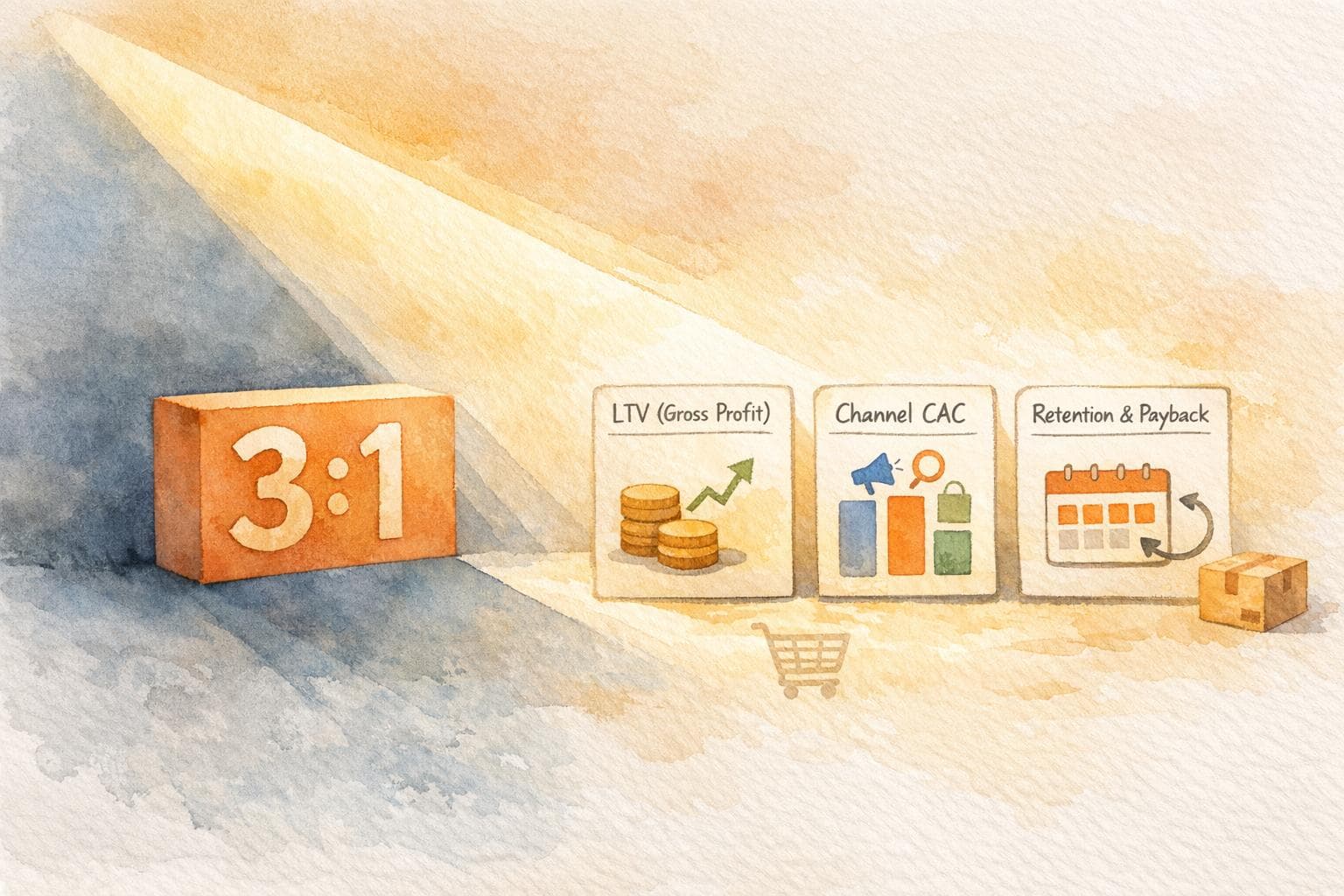
The 3:1 LTV:CAC ratio might be doing your business more harm than good. While it’s often touted as the perfect balance between growth and profitability, this benchmark oversimplifies financial health, ignores critical variables like gross margins and retention data, and can lead to risky decisions that hurt cash flow and long-term success.
Key Problems with the 3:1 Ratio:
- It’s based on estimates: CAC is immediate, but LTV is a projection, making the ratio speculative.
- Hides true costs: It overlooks expenses like COGS, shipping, and fulfilment, distorting profitability.
- Limits growth: Rigidly following this rule can drain cash flow and prioritise short-term gains over sustainable strategies.
- Skews data: Using blended CAC or including repeat customers inflates results, masking actual acquisition costs.
Smarter Approaches:
- Calculate LTV using gross profit, not revenue.
- Break down CAC by channel (e.g., Facebook, Google) instead of blending metrics.
- Focus on retention and improving margins, as these have a bigger impact than lowering CAC.
- Use incrementality testing to identify which marketing efforts truly drive new customers.
- Prioritise a 60-day payback period to ensure faster cash flow.
Brands like Warby Parker and Starbucks succeeded by ignoring the 3:1 rule and focusing on retention, organic growth, and customer loyalty. Meanwhile, companies like Blue Apron saw their valuations plummet by sticking to flawed acquisition strategies.
The takeaway? Don’t rely on rigid benchmarks. Build a financial framework tailored to your business, focusing on profitability and sustainable growth instead of chasing arbitrary ratios.
The Risks of Following the 3:1 LTV:CAC Ratio
It Oversimplifies Profitability
The 3:1 ratio assumes revenue equals profit, but it overlooks key deductions like COGS, shipping, fulfilment, and operating expenses. These omissions can reveal a much smaller - or even negative - contribution margin when compared to the CAC.
Another issue is the "blended CAC" approach, which combines organic and paid metrics. This can obscure the true cost of acquiring new customers. For instance, in their 2021 S-1 filings, both Warby Parker and Figs faced criticism for including repeat customer purchases in their CAC calculations. This artificially lowered their reported CAC to around AU$27, hiding the actual cost of acquiring brand-new customers.
Then there’s the "whale tail" effect. Average LTV can be skewed by the top 5–10% of high spenders. Without these outliers, the ratio often drops to unsustainable levels - sometimes as low as 1.5:1.
By misrepresenting profitability, this metric can also strain liquidity and hinder growth.
It Limits Growth and Experimentation
Beyond miscalculating profits, sticking rigidly to the 3:1 ratio can create cash flow issues. Ara Ohanian, CEO of Aragil, explains:
Allocating budget on a theoretical 12-month LTV against an immediate CAC is effectively gambling on uncertain retention curves.
This highlights the mismatch between CAC, which involves an upfront cash outlay, and LTV, which is a long-term projection. If the payback period exceeds 60–90 days, businesses risk running out of cash - even if, on paper, their growth looks profitable.
This framework can also lead brands to overspend on acquisition, benefiting ad networks rather than improving the bottom line. Worse, focusing too much on lowering CAC can result in attracting lower-quality customers who are less likely to stay loyal. Research shows that boosting customer retention by just 1% can increase a company's value by 3–7%, while a 1% improvement in acquisition cost only impacts value by 0.02–0.3%. This suggests that retention efforts and margin improvements may be far more effective than adhering to a strict 3:1 ratio.
Brands That Succeeded by Ignoring the Ratio
Some brands have shown that moving away from the 3:1 rule can lead to both profitability and sustainable growth.
Take Warby Parker, for example. They achieved a successful retail IPO while keeping LTV:CAC ratios between 2.3x and 3.2x - often below the so-called "golden" 3:1 standard. Instead of fixating on the ratio, they focused on building their brand and leveraging organic traffic, which now makes up nearly 80% of their total visits. This approach allowed them to create a sustainable acquisition strategy that didn’t rely on constant funding.
Starbucks offers another perspective. Rather than obsessing over acquisition costs, they invested in their Rewards programme to nurture high-value customers. Rewards members spend about three times more than non-members, and the programme now accounts for over 50% of all US sales. This focus on retaining and upgrading existing customers highlights the shortcomings of rigidly following the 3:1 ratio.
On the flip side, Blue Apron provides a cautionary tale. In 2018, the company prioritised efficient acquisition while neglecting retention. Professor Daniel McCarthy's analysis revealed that 62% of customers churned within six months. With a CAC of AU$169 and a break-even point requiring over eight months of customer engagement, they lost money on two-thirds of their customers. This contributed to a 95% drop in their market value within two years.
Better Ways to Evaluate LTV and CAC
Adjust the LTV:CAC Ratio for Your Business
When calculating your Lifetime Value (LTV), it's better to base it on gross profit or contribution margin rather than total revenue. As Graham Charlton explains, "LTV must be based on gross margin, not revenue. Lower-margin businesses (fintech, marketplaces, agencies) overvalue LTV". This adjustment ensures your ratio reflects actual profitability rather than inflated expectations.
Also, avoid using a blended Customer Acquisition Cost (CAC) approach. Instead, break it down by acquisition channel - Facebook, Google, organic, email, etc. - to see which channels are genuinely driving profitability. Your target LTV:CAC ratio should align with your business stage and industry. For example:
- Retail brands often target a ratio between 2:1 and 3:1.
- SaaS companies typically aim for 3:1 to 5:1, with top performers exceeding 5:1.
- Competitive or early-stage businesses may operate at a lower ratio, such as 1.5:1 to 2:1, while building market share.
Early-stage companies should prioritise finding product–market fit over obsessing about ratios, whereas scaling businesses can use these metrics to guide decisions on hiring and reinvestment. Tailoring the LTV:CAC ratio to your specific circumstances makes it far more actionable.
Use Incrementality Testing
Incrementality testing is a key tool for identifying which customers are genuinely influenced by your marketing efforts versus those who would have purchased anyway. By comparing a campaign-exposed group with a control group, you can measure the actual lift generated by your efforts. This prevents your marketing team from mistakenly taking credit for organic growth, word-of-mouth, or viral activity that would have happened without ad spend.
Without incrementality testing, you risk artificially lowering CAC by including customers who would have converted on their own. This is especially important in eCommerce, where retention rates generally hover around 30% at best. Overlooking this distinction can lead to a significant overestimation of your acquisition efforts’ value.
Focus on Retention and Margins
Fine-tuning metrics is important, but long-term growth hinges on improving customer value over time. Start by segmenting your customers into cohorts and tracking how their value evolves. This approach highlights which acquisition channels bring in high-value, repeat customers versus one-time buyers.
A great example comes from menswear brand Ministry of Supply. In 2023, they targeted customers who hadn’t made a purchase in over 180 days. Their campaign achieved a 63.36% open rate and generated AU$0.91 in revenue per lapsed customer - all without additional acquisition costs.
Keep in mind the interconnected nature of key metrics, often referred to as the "Five Horsemen" effect. For instance, raising prices to boost LTV might lead to higher churn, while excessive discounting to lower CAC could attract less valuable customers. Balancing these factors is essential for sustainable growth.
The Conventional LTV-to-CAC Ratio is BROKEN
How to Build a Growth Strategy That Works
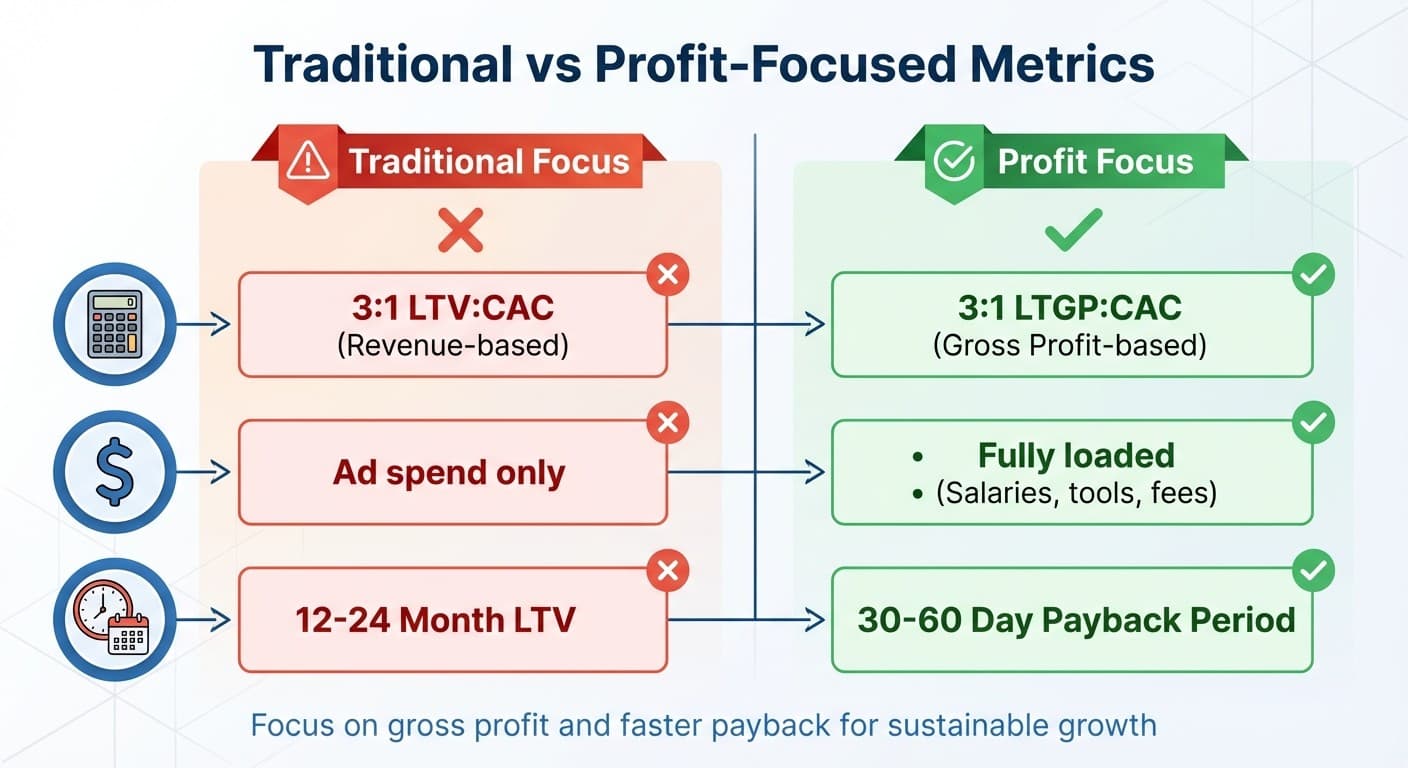
Traditional vs Profit-Focused LTV:CAC Metrics Comparison
Build a Complete Financial Framework
Once you've fine-tuned your LTV (Lifetime Value) and CAC (Customer Acquisition Cost) metrics, it's time to create a financial strategy that gives you the full picture.
Instead of just focusing on revenue, shift your attention to LTGP (Lifetime Gross Profit). This metric factors in your Cost of Goods Sold (COGS), revealing how much money you actually keep after fulfilling orders. When combined with a fully loaded CAC - which includes ad spend, salaries, creative costs, software, and agency fees - you get a realistic snapshot of your profitability.
To strike the right balance, focus on three key areas: Acquisition (lowering CAC), Retention (increasing purchase frequency), and Monetisation (boosting gross profit per order). For instance, if your LTGP is AU$150, aim to keep your CAC under AU$50 to maintain a healthy 3:1 ratio. Also, pay close attention to your payback period, targeting a return within 30–60 days.
| Metric | Traditional Focus | Profit Focus |
|---|---|---|
| Key Ratio | 3:1 LTV:CAC (Revenue-based) | 3:1 LTGP:CAC (Gross Profit-based) |
| CAC Calculation | Ad spend only | Fully loaded (Salaries, tools, fees) |
| Time Horizon | 12-24 Month LTV | 30-60 Day Payback Period |
Use AI for Better Decision-Making
AI tools can revolutionise decision-making by offering hyper-personalised insights. They analyse purchase patterns, browsing behaviour, and engagement history to predict which customers are most likely to convert or churn. This means you can allocate your marketing budget more effectively and direct retention efforts where they’ll make the biggest impact.
Consider this: a 5% increase in retention can boost profits by 25%–95%. AI also helps you move beyond outdated last-click attribution models, identifying the marketing touchpoints that genuinely drive conversions rather than just taking credit for organic purchases.
These insights pave the way for uniting your teams around shared profitability goals.
Align Teams Around Profitability
In many businesses, marketing, finance, and operations teams work independently, each chasing their own targets. Marketing might focus on acquiring new customers, finance on managing cash flow, and operations on inventory issues. This lack of coordination can quickly undermine profitability.
A solution? Use RFM analysis - which segments customers based on Recency, Frequency, and Monetary value - to create a shared framework for prioritising resources. By categorising customers into groups like "Champions" or "At Risk", all teams can work from the same playbook. Set clear goals around a 30-day payback period, ensuring that the gross profit from the first month covers your CAC.
When teams understand that acquiring new customers costs 5 to 25 times more than retaining existing ones, and that repeat customers spend 67% more than new ones, they'll naturally shift their focus toward retention and profitability instead of chasing vanity metrics.
Conclusion
After exploring the risks and alternatives, here are some practical insights for eCommerce leaders looking to refine their strategies.
Key Takeaways for eCommerce Leaders
The widely accepted 3:1 LTV:CAC ratio isn't inherently flawed, but it lacks depth. Calculating LTV based on revenue instead of gross profit, blending organic traffic with paid acquisition costs, or overlooking how quickly your ad spend returns can make this metric unreliable. These gaps can jeopardise your business by leaning on retention curves that may not hold up.
"If you spend £1 to generate £1.20, you're not scaling, you're just surviving." - Graham Charlton, Editor, Vestd
To move forward, consider these three adjustments: evaluate new customer CAC against a 60-day contribution margin, account for the 'whale tail' effect by excluding top spenders from your analysis, and separate paid acquisition metrics from organic growth data.
The Path to Profitable Growth
These lessons provide a roadmap for creating a strategy that prioritises genuine profitability.
Success in 2026 won't come from chasing a magic ratio. Instead, it will hinge on understanding cash flow dynamics and building a business that generates profit quickly enough to fuel its own growth. By shifting from revenue-based LTV to gross profit-based calculations, separating blended CAC into channel-specific metrics, and focusing on 60-day payback periods instead of 12-month projections, you can move from merely breaking even to thriving. This approach underscores a central idea: strategic adaptability, precise data analysis, and fast cash flow are the cornerstones of sustainable growth.
Keep this in mind: improving your LTV:CAC ratio from 2x to 3x can almost triple your company's valuation. But this only works if you're tracking the right metrics. The brands that succeed are those that evolve beyond outdated benchmarks, building robust financial systems that balance acquisition efficiency, retention speed, and monetisation strength.
FAQs
Why is the 3:1 LTV:CAC ratio not always a reliable measure of profitability?
The widely cited 3:1 LTV:CAC ratio is often regarded as a gold standard for business success. However, relying on it too heavily can be misleading. It assumes that customer lifetime value (LTV) and customer acquisition cost (CAC) are fixed and predictable across all industries, which is rarely the reality.
Take FMCG and eCommerce, for example. These sectors deal with complex dynamics like shifting customer behaviours, evolving market trends, and the intricacies of long-term retention strategies. Applying the 3:1 ratio without flexibility can oversimplify these factors, potentially leading to missteps - like overspending on customer acquisition or overlooking high-value customer segments.
Rather than sticking rigidly to this rule, businesses should consider a more customised strategy. A tailored approach that aligns with their specific industry, customer base, and long-term goals will yield better results.
What’s the best way for businesses to calculate LTV and CAC accurately?
To figure out Customer Lifetime Value (LTV) and Customer Acquisition Cost (CAC) with precision, it's essential to dig deeper than the basic formulas and consider the specific dynamics of your business.
LTV represents the total revenue a customer is expected to bring in over their entire relationship with your brand. This calculation should take into account factors like retention rates, profit margins, and how often customers make repeat purchases. On the other hand, CAC is determined by dividing all marketing and sales costs by the number of new customers gained within a particular timeframe.
For more accurate insights, it's a good idea to fine-tune these calculations by considering different customer segments, specific time periods, and real-world data such as attrition rates and purchasing patterns. This customised approach provides a clearer view of your business's profitability, helping you make smarter choices when it comes to marketing budgets and strategies for keeping customers loyal.
How can I improve customer retention instead of focusing on acquisition?
Improving customer retention hinges on creating strong, lasting relationships with your current customers. A key focus should be on boosting customer lifetime value (LTV) by providing personalised experiences, loyalty programs, and customised product recommendations. These efforts can lead to repeat purchases and higher average order values.
Introducing a subscription or membership model can also be a smart move. It not only ensures a steady revenue stream but also strengthens customer engagement. Beyond that, prioritising customer satisfaction is essential. This means delivering top-notch service, tailoring your communication, and responding to customer feedback quickly and effectively. Happy customers are more likely to stick around and even recommend your brand to others.
Retention strategies are often more cost-efficient than acquiring new customers. Plus, they can fuel long-term growth and profitability. By reducing churn and fostering emotional connections, your business can unlock the full potential of its existing customer base.
Related Blog Posts
Unit economics template for DTC brands
eCommerce Unit Economics: A Complete Analysis Guide
CAC vs. LTV: Subscription ROI Explained
The CAC Payback Period Trap: Why 12-Month Payback Is Killing Your Cash Flow
Unit Economics Mastery for DTC Brands
The $29 Problem: Why Your CLV Model Is Bleeding Money (And the Cohort Economics Protocol to Fix It)
Newsletter
The Uncommon Insights Letter
Practical FMCG & eCommerce growth playbooks — margins, retention and scaling tactics, straight to your inbox.
Turn these ideas into profit you can see
Get a hands-on operator to turn the frameworks above into results — book a free audit call.