Google's 10% CPC Increase: What It Actually Means for Your Unit Economics in 2026
A 10% Google CPC rise in 2026 will raise CAC, erode margins and force eCommerce brands to optimise unit economics, diversify channels and focus on retention.
31 January 2026
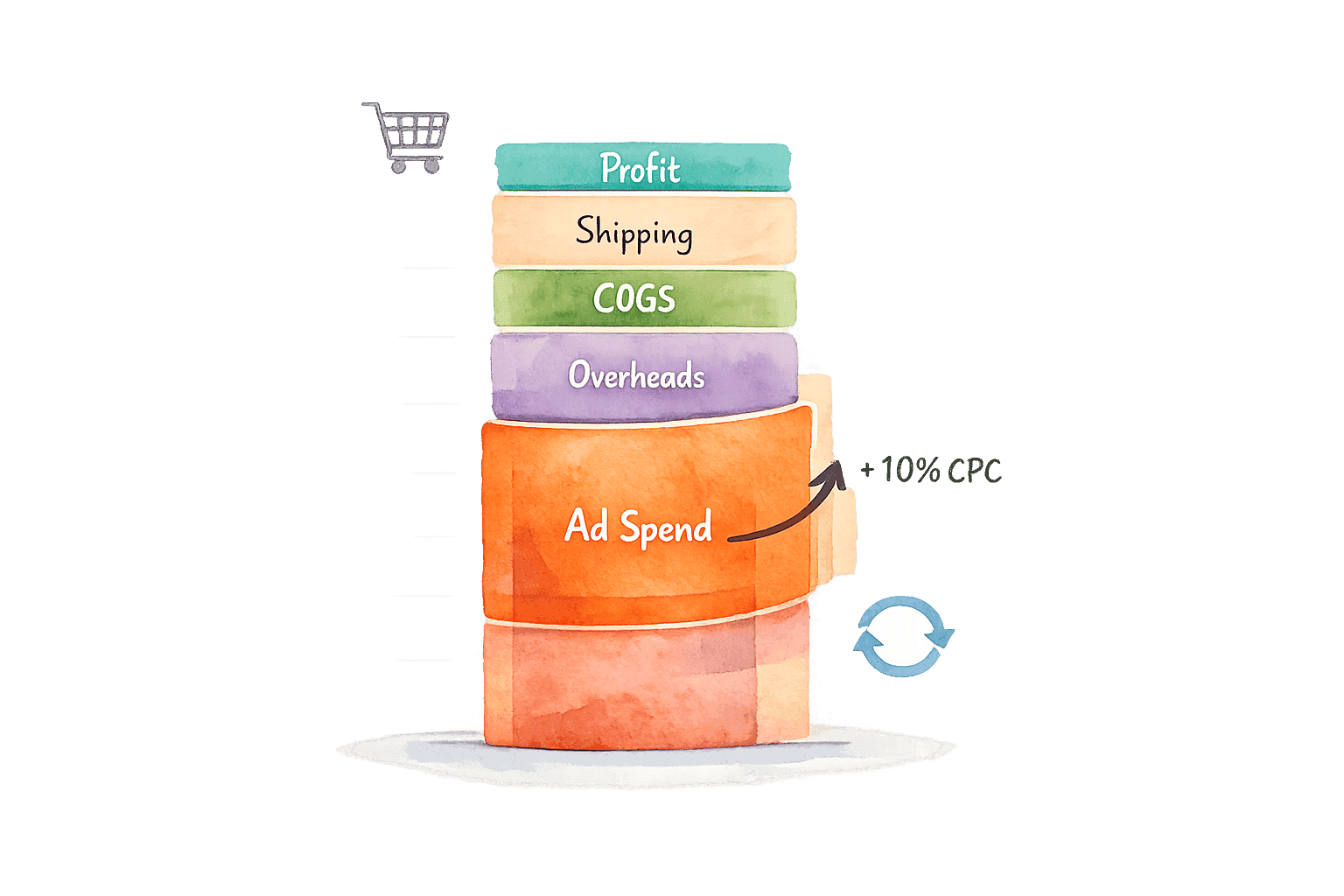
Google Ads costs are rising again, with a 10% increase in Cost-Per-Click (CPC) expected in 2026. For Australian businesses, especially in eCommerce and FMCG, this means higher customer acquisition costs (CAC) and tighter profit margins. Here's what you need to know:
- CPC Trends: CPC rates rose 12.88% in 2025, with some industries like Beauty & Personal Care seeing spikes of over 60%. The average CPC across industries hit A$5.26.
- Impact on Profitability: A 10% CPC hike increases CAC by the same percentage. For example, if your CAC rises from A$120 to A$132, a product with a 60% gross margin could turn from break-even to loss-making.
- Google's Role: The retirement of Enhanced CPC (ECPC) in 2025 leaves advertisers with automated Smart Bidding, which often drives even higher CPCs.
- Key Challenges: Rising CPCs, combined with a drop in organic click-through rates due to AI-driven search results, mean businesses must rely more on paid ads, further increasing costs.
To stay profitable, focus on understanding your unit economics (CAC vs. LTV), improve campaign performance, and diversify ad spend to lower-cost channels like TikTok or Microsoft Advertising. Retention strategies and tools like incrementality testing can also help you balance rising acquisition costs.
Act now to protect your margins in 2026.
📈 Google ADs Costs Keep Going Up In 2026 - What To Do About It! 🔥
How Higher CPC Affects Your Unit Economics
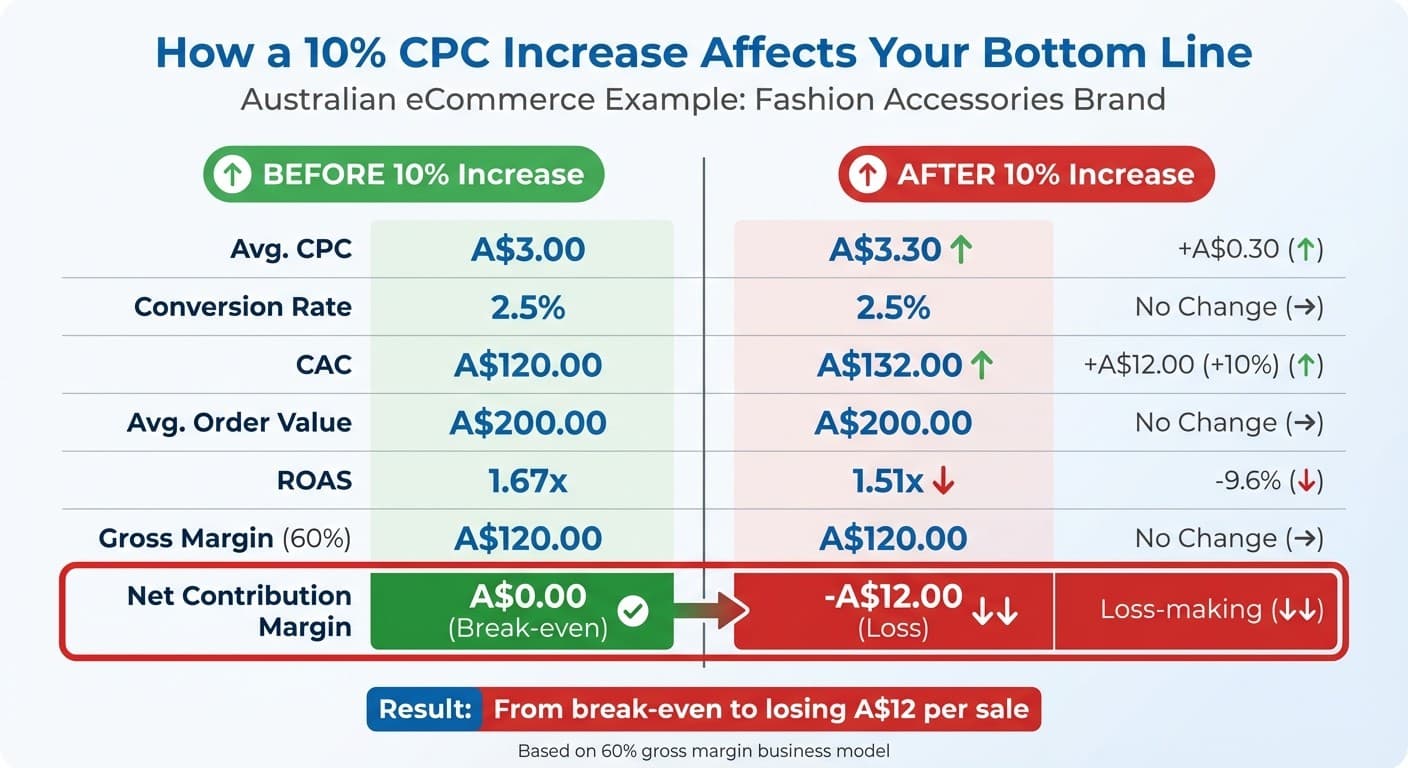
Impact of 10% CPC Increase on eCommerce Unit Economics
When CPC (Cost Per Click) rises by 10%, it can significantly alter your unit economics. For Australian eCommerce brands, especially those operating with slim profit margins, this change can mean the difference between sustainable growth and losing money on every sale.
How CPC Increases Drive Up CAC
Let’s break it down. At A$3.00 per click and a 2.5% conversion rate, your Customer Acquisition Cost (CAC) is A$120.00. But with a 10% CPC increase to A$3.30, your CAC jumps to A$132.00 - an additional A$12.00 per customer.
This poses an immediate challenge for businesses with lower average order values (AOV). For example, if you sell fashion accessories with an A$200.00 AOV and a 60% gross margin, you’d previously break even at A$120.00 CAC. However, after the CPC increase, you’re losing A$12.00 on every sale generated through paid search.
To make matters worse, Smart Bidding strategies can amplify these cost increases. These algorithms aggressively target high-converting queries, which often drives up CPC even further. So, it’s not just inflation in the market causing the rise - it’s also Google’s automated systems pushing for conversions.
What Rising CAC Does to ROAS and Profit Margins
A higher CAC doesn’t just eat into your profits - it can make your advertising efforts unsustainable. Return on Ad Spend (ROAS) is a key metric that shows how much revenue you generate for every dollar spent on ads. When CAC rises but your AOV stays the same, your ROAS inevitably drops.
Here’s an example of how a 10% CPC increase might affect a typical Australian eCommerce business:
| Metric | Before 10% Increase | After 10% Increase | Impact |
|---|---|---|---|
| Avg. CPC | A$3.00 | A$3.30 | +A$0.30 |
| Conversion Rate | 2.5% | 2.5% | No Change |
| CAC | A$120.00 | A$132.00 | +A$12.00 (10%) |
| Avg. Order Value | A$200.00 | A$200.00 | No Change |
| ROAS | 1.67x | 1.51x | -9.6% |
| Gross Margin (60%) | A$120.00 | A$120.00 | No Change |
| Net Contribution Margin | A$0.00 | -A$12.00 | Loss-making |
The net contribution margin, which reflects what’s left after deducting costs like COGS, shipping, returns, and marketing, highlights the real impact. A product that was breaking even at A$120.00 CAC now results in a loss of A$12.00 at A$132.00 CAC. Multiply this across thousands of transactions, and you’re looking at a significant erosion of margins.
This immediate pressure on ROAS feeds into longer-term challenges, particularly when it comes to maintaining a healthy LTV:CAC ratio.
Long-Term Impact on LTV:CAC Ratios
The LTV:CAC ratio measures how much a customer’s lifetime value (LTV) exceeds the cost to acquire them. A healthy ratio is usually 3:1 or higher, meaning each customer should bring in at least three times the acquisition cost. But when CAC rises by 10% and LTV doesn’t increase accordingly, this ratio shrinks, delaying the break-even point for each customer.
For brands relying on subscription or repeat-purchase models, this can strain cash flow. A higher CAC means longer recovery periods, which puts added pressure on finances. The situation worsens when high CPCs push brands to offer aggressive discounts to maintain sales volume. While discounts may boost short-term sales, they often attract bargain shoppers who churn quickly and have low lifetime value - further compressing the LTV:CAC ratio.
In some Australian retail sectors, it now takes up to eight months to break even on a customer. Yet, customers acquired via high-cost search campaigns often churn within just three months. This creates a vicious cycle: you’re paying more to acquire customers who deliver less long-term value. Without a shift in strategy, it becomes increasingly difficult to escape this downward spiral.
How to Offset Rising CPC Costs
When CPCs rise by 10%, simply absorbing the additional expense isn’t a viable option. For Australian eCommerce and FMCG brands, protecting profit margins means acting decisively. Here are some practical strategies to counter these rising costs.
Boost Campaign Performance with Google's AI Tools
Google's Smart Bidding strategies are a powerful way to make every dollar count. By focusing on revenue generation instead of just driving clicks, tools like Target ROAS and Maximise Conversion Value use real-time signals - such as device type, location, and time of day - to adjust bids dynamically for better outcomes.
In 2024, Mitsubishi Motors Canada adopted value-based bidding by linking online metrics to offline sales. Luis Machino, Senior Manager of Digital Marketing & CRM at Mitsubishi Motors Canada, highlighted the impact:
"Innovating on how we bid using conversion values helps us reach customers more effectively and turn potential into actual results."
This shift delivered a 107% improvement in ROAS. For Australian businesses, this strategy is particularly effective if your Search campaigns have at least 15 conversions in the past 30 days.
Another way to lower CPC is by improving Quality Scores. Enhancing keyword relevance and optimising landing pages can cut CPC by as much as 30%. Additionally, setting CPC caps through portfolio bid strategies helps prevent Google's AI from bidding excessively on clicks that don’t align with your goals. Matt Bowen, Director of Enterprise Acquisition & Strategy at Logical Position, explained:
"Google's overconfidence can sometimes lead to extraordinarily high click prices, which don't align with business objectives."
For some businesses, implementing CPC caps has reduced total ad spend by up to 5%.
If these bidding strategies aren’t enough, reallocating your budget to more cost-effective channels is the next logical step.
Shift Budget to Higher-ROAS Channels
When AI-driven strategies can’t fully offset rising CPCs, diversifying your ad spend is critical. Not all platforms carry the same cost. For instance, in 2024, Google’s average CPC reached A$4.66 - a 10% increase from the previous year - prompting many Australian brands to explore alternatives. Platforms like TikTok (A$1.00) and Microsoft Advertising (A$1.54) offer significantly lower CPCs, while Amazon Advertising boasts conversion rates of 9.58–10.33%, which is about seven times higher than typical eCommerce benchmarks.
Even within Google Ads, Performance Max campaigns have shown an average ROAS of 804%. However, these campaigns come with challenges. Sascha Bonomally, General Manager of Growth Operations at Atomic 212, pointed out:
"They want to move as many advertisers to Pmax because there is more inventory they can sell... because they are blending the metrics we don't know how the performance is split."
While this "black box" approach can produce strong results, it may also attract low-quality customers who churn quickly. To avoid this, conduct incrementality testing. By comparing performance with and without specific campaigns, you can determine which channels genuinely drive new sales.
Temple & Webster provides a great example of the benefits of channel diversification. Faced with escalating performance marketing costs, the Australian furniture retailer reallocated over A$10 million towards brand advertising in 2025. This shift allowed them to tap into lower-cost channels and maintain healthier unit economics.
Focus on Retention to Reduce Customer Acquisition Costs
Acquiring new customers is pricey, so focusing on retention can significantly lower costs. By increasing customer lifetime value (LTV), you reduce the pressure to constantly acquire new customers at high CPC rates.
Linking your CRM to Google’s AI through Ads Data Manager allows you to use Conversion Value Rules to prioritise spending on high-value customer segments. Additionally, Google Ads’ New Customer Acquisition goals enable you to adjust bids specifically for new prospects versus returning customers.
These retention-focused strategies help improve overall profitability by reducing customer acquisition costs. Instead of solely focusing on cost per acquisition (CPA), shifting your attention to customer lifetime value (CLV) can lead to more sustainable growth.
How Uncommon Insights Frameworks Help You Adapt

With rising CPCs (cost-per-click) putting pressure on your margins, having a set of structured tools to evaluate every dollar spent is essential. Uncommon Insights has developed three key frameworks tailored for Australian FMCG and eCommerce brands. These tools offer actionable strategies to safeguard profitability in the face of increasing advertising costs.
Unit Economics Analysis Framework
This framework dives deep into how rising CPCs impact your bottom line. It identifies the tipping point where expensive clicks start driving customer churn. It also scrutinises tools like Google's Performance Max to ensure that organic traffic isn't being lumped together with costly, low-margin inventory. By separating these, you can avoid inflated customer acquisition costs and focus on sustainable growth.
AI-Assisted Growth Roadmaps
Uncommon Insights' AI-assisted Growth Roadmaps shift planning from a quarterly to a weekly rhythm. By using real-time forecasting, these roadmaps allow you to adjust ad spend before high CACs (customer acquisition costs) eat into your profits. Instead of chasing clicks, the focus is placed on bidding for conversion value.
This approach is especially critical as Google's AI-driven tools have caused a 20–25% drop in organic click-through rates, increasing reliance on paid search campaigns. Weekly adjustments ensure your budget changes align with profitability goals, helping you stay ahead in the ever-changing digital landscape.
Incrementality Testing Framework
This framework tackles a common challenge in digital advertising: understanding which sales are genuinely new versus those that would have happened anyway. By distinguishing between the two, you can avoid wasting ad spend on conversions that don’t add real value. Sascha Bonomally from Atomic 212 explains it best:
They want to move as many advertisers to Pmax because there is more inventory they can sell... because they are blending the metrics we don't know how the performance is split.
With this tool, your campaigns focus on generating truly profitable, incremental sales. Combined with the other frameworks, it creates a comprehensive strategy for optimising ad spend and protecting your margins. Together, these insights pave the way for smarter, results-driven advertising.
Conclusion: Preparing for CPC Increases in 2026
Key Points for 2026
The anticipated 10% rise in CPCs is part of a consistent five-year trend of increasing search advertising costs. For Australian FMCG and eCommerce brands, this means navigating steeper challenges, as 87% of industries faced CPC hikes during 2024–2025. With an average cost-per-click climbing to A$5.26, many industries have already felt the strain on profit margins.
To stay competitive, businesses must keep a close eye on their unit economics. A healthy LTV:CAC ratio is essential, and this requires frequent, ideally weekly, reviews of ad spend. With Enhanced CPC no longer available, brands must adapt to a fully automated bidding environment. Success hinges on improving Quality Scores, boosting conversion rates, and exploring diverse advertising channels to optimise campaigns.
Given these pressures, taking proactive steps now is crucial to protect your bottom line.
What to Do Next
Start by revisiting your unit economics framework. Analyse your current metrics to pinpoint your break-even ROAS and identify which product lines remain profitable under current CPCs. A 10% increase could push already tight margins into unprofitability, so it’s critical to act early.
Uncommon Insights offers tailored solutions like the Unit Economics Analysis Framework, AI-Assisted Growth Roadmaps, and Incrementality Testing Framework. Designed for Australian FMCG and eCommerce brands with revenues between A$1M and A$10M, these tools provide actionable strategies to help you maintain profitability, even as ad costs rise.
Taking these measures now will position your business for sustainable growth despite the challenges ahead.
FAQs
What strategies can businesses use to manage the impact of a 10% CPC increase on profit margins?
To handle a 10% rise in CPC, businesses need to sharpen their ad strategies and make every dollar count. Start by diving into your campaign data to pinpoint any underperforming keywords or ads. Then, shift your budget towards areas that are delivering better results. Fine-tuning ad targeting and segmenting your audience can also help ensure you're reaching the right people without wasting spend.
On top of that, experiment with different creative approaches and enhance your landing pages to improve conversion rates. When your conversion rates go up, each click becomes more valuable, helping to balance out the higher CPC. Keep a close eye on your return on ad spend (ROAS) and adjust your bids as needed to stay profitable, even as costs fluctuate.
How can businesses improve their ROAS as CPC costs rise?
To keep ROAS strong while tackling rising CPC costs, businesses need to fine-tune their strategies for better efficiency. A good starting point is focusing on long-tail keywords. These tend to have less competition, which can mean lower CPCs and more targeted traffic.
Advanced bidding strategies like target ROAS or maximise conversion value can also make a big difference. These approaches help prioritise high-value conversions, ensuring you’re spending wisely and protecting your bottom line.
Another key move? Use forecasting tools and adjust bids regularly to stay in sync with market trends and seasonal shifts. Keeping a close eye on performance data allows you to set smarter bid limits and manage your budget effectively.
By blending keyword refinement, smart bidding tactics, and constant data analysis, businesses can stay competitive and maintain strong ROAS - even as CPCs climb in 2026.
What does the removal of Enhanced CPC mean for your advertising strategy?
The removal of Enhanced CPC (ECPC) from Google Ads has pushed advertisers to embrace fully automated bidding strategies like Maximise Conversions, Target CPA, or Target ROAS. These strategies rely on Google's machine learning to fine-tune campaign performance, replacing the semi-automated approach that ECPC offered.
This shift means advertisers need to stay on top of campaign performance by actively monitoring results and fine-tuning budgets and targets. With CPC rates anticipated to climb by 10% in 2026, adopting smarter, data-focused bidding strategies is more important than ever. By using forecasting tools and analysing data effectively, businesses can keep their advertising competitive and cost-efficient in an increasingly challenging market.
Related Blog Posts
Customer acquisition cost by channel analysis
Unit economics template for DTC brands
Unit Economics Mastery for DTC Brands
Profitability Is the New Unicorn
eCommerce Unit Economics: A Complete Analysis Guide
Ecommerce Cost Structure: Key Benchmarks
Newsletter
The Uncommon Insights Letter
Practical FMCG & eCommerce growth playbooks — margins, retention and scaling tactics, straight to your inbox.
Turn these ideas into profit you can see
Get a hands-on operator to turn the frameworks above into results — book a free audit call.