Ultimate Guide to Emotional Drivers in eCommerce
How trust, FOMO, belonging and AI-driven sentiment analysis shape online buying, and how to measure and use emotions to build loyalty in eCommerce.
17 January 2026
- 🔥 How Brands Hack Your Emotions to Make You Buy
- What Are Emotional Drivers in eCommerce
- How to Measure and Identify Emotional Signals
- Applying Emotional Drivers to the Customer Journey
- Building Trust as a Core Emotional Driver
- Emotional Loyalty and Retention Strategies
- Implementing Emotional Drivers at Scale
- Conclusion: Using Emotional Connection to Grow Your eCommerce Business
Did you know emotions influence up to 80% of purchasing decisions? Whether it’s trust, nostalgia, or FOMO, emotions drive how and why people shop online. Shoppers who feel emotionally connected to a brand spend more, stay loyal longer, and are 52% more valuable to businesses.
Here’s what you need to know:
- Emotional triggers like trust, belonging, and urgency play a bigger role than price or product features in buying decisions.
- 95% of decisions are subconscious, guided by emotions, not logic.
- Personalisation matters: 71% of consumers want tailored offers that align with their feelings.
- Brands using emotional strategies see higher sales, customer loyalty, and engagement.
This guide explains how to use emotional cues to build trust, reduce friction, and create loyalty programs that connect with your audience. By understanding emotional drivers, you can turn shoppers into long-term advocates.
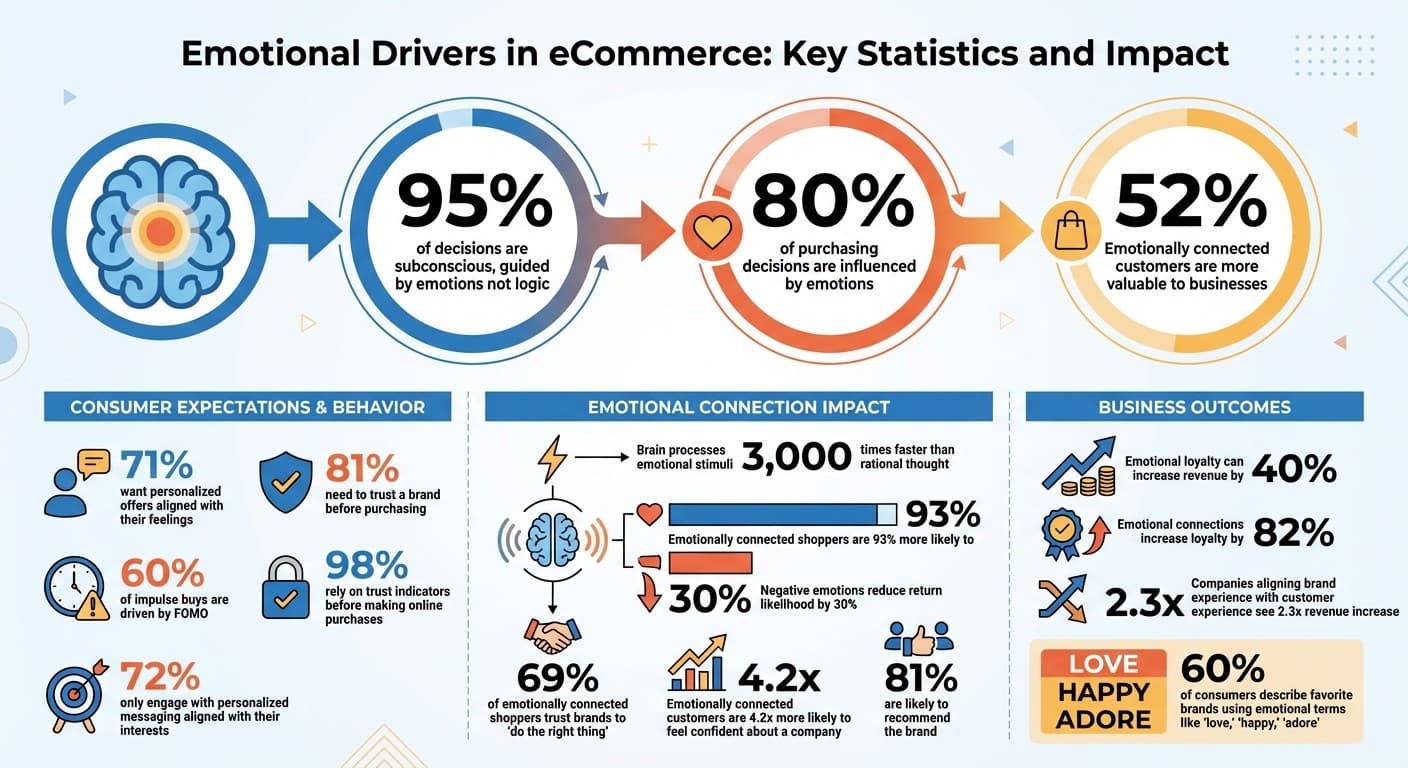
Emotional Drivers in eCommerce: Key Statistics and Impact on Purchase Decisions
🔥 How Brands Hack Your Emotions to Make You Buy
What Are Emotional Drivers in eCommerce
Emotional connection plays a massive role in how people make purchasing decisions, but what exactly fuels these emotional responses?
Emotional drivers are psychological triggers - like trust, belonging, or fear - that subtly influence a shopper’s decisions online. They operate below the surface, shaping behaviours and choices. For instance, a limited-time offer might spark the fear of missing out (FOMO), while buying from a brand that reflects your identity can reinforce self-confidence.
Interestingly, the human brain processes emotional stimuli 3,000 times faster than logical reasoning. This explains why about 95% of purchasing decisions stem from subconscious emotions.
Let’s break down the emotions that guide these snap decisions.
Common Emotional Drivers That Affect Purchases
Different emotions lead to different buying habits. Take trust, for example - 81% of consumers say they need to trust a brand before committing to a purchase. Then there’s belonging, a universal human desire to feel part of a group. This is why social proof, like reviews or community features, is so effective. FOMO creates urgency and accounts for 60% of impulse buys in eCommerce.
Identity affirmation is another key factor. People gravitate towards products that reflect who they are - or who they want to be. A great example is Rocky's Matcha, which ditched conventional green or silver tins in favour of bold blue packaging in 2024–2025. This choice appealed to non-conformists looking for something different. Nostalgia also works wonders. Olipop’s "Soda Story" campaign in 2024–2025 brought back 1990s celebrities, giving their prebiotic soda a nostalgic twist that resonated with childhood memories, while also encouraging social sharing.
Relief is a powerful motivator too. It’s the promise that a product will solve a nagging problem. And then there’s status - shoppers often choose items that signal success or exclusivity, making them feel like part of an elite group.
Here’s a quick look at how these emotional triggers work:
| Emotional Trigger | Buyer Perspective | Activation Tactics |
|---|---|---|
| Safety & Trust | "Will this hurt my reputation or finances?" | Guarantees, proof, specific data |
| Belonging | "Will I look smart to my peers?" | Social proof, community forums, user spotlights |
| Status & Identity | "Does this fit the person I want to be?" | Aspirational branding, exclusive access |
| Relief | "Will this solve the problem I’m tired of?" | Before/after stories, migration plans |
| FOMO | "What do I lose if I delay?" | Scarcity, countdowns, limited drops |
Understanding these triggers gives us a foundation to explore the psychology behind emotional engagement.
The Psychology Behind Emotional Engagement
To understand why emotions dominate shopping decisions, we can turn to the Dual Process Theory. This theory explains that our brains rely on two systems: System One, which is fast, automatic, and emotional, and System Two, which is slower, analytical, and logical. Since System One handles 95% of our daily decisions, shoppers - especially those browsing late at night - are often swayed by emotional cues.
Emotions are also defined by two dimensions: valence (positive or negative) and arousal (active or passive). For example, FOMO is a negative but highly arousing emotion, pushing people to act quickly. In contrast, humour tends to be positive and calming, creating a more relaxed buying experience. By recognising these emotional dynamics, brands can fine-tune their messaging throughout the customer journey.
Interestingly, emotions and logic often work together in what’s known as the rationalisation loop. Shoppers make decisions based on emotional instincts, then use logical arguments - like product specs or reviews - to justify their choice. For instance, Kmart Australia’s 2011 television campaign targeted nine key emotions, leading to a 30% boost in EBIT.
"The human brain processes emotional stimuli 3,000 times faster than rational thought, creating immediate gut reactions that influence purchasing decisions."
– Maxim Atanassov, Founder, Future Ventures
Emotions don’t just drive attention - they enhance memory, shape perceptions of risk, and help align products with the image of who we want to be. This is why emotional engagement isn’t just a marketing trick; it’s a core part of how we, as humans, make decisions.
How to Measure and Identify Emotional Signals
If you want to truly understand how your customers feel, you need to dig deeper than basic satisfaction scores. The real insights lie in analysing both structured and unstructured data - things like survey results, chat logs, call recordings, and even social media mentions. Together, these data points can uncover emotional patterns that customers might not even realise themselves.
Interestingly, emotional scores often trail behind functional metrics like "success" and "effort" by double digits. Yet, for 14 years straight, emotion has been the most reliable predictor of customer loyalty. This is why brands are shifting away from general satisfaction metrics and focusing on specific emotions like gratitude, confidence, and anxiety, which are much better at predicting buying behaviours.
Behavioural Signs of Emotional Drivers
Customers’ online behaviours often serve as real-time indicators of their emotions. For example, rage-clicking - repeatedly clicking on unresponsive elements - signals frustration. Similarly, backtracking through pages or navigating in loops points to confusion. Even how someone types can be revealing: typing in all caps, for instance, is often a sign of anger.
In 2024, a major national bank introduced a virtual assistant capable of recognising 700 different customer intents. When the AI detected sensitive language - like mentions of a bereavement - it immediately connected the customer to a specialised human team. This approach helped the bank achieve the highest satisfaction scores among its national peers.
| Behavioural Signal | Indicated Emotional State | Recommended Action |
|---|---|---|
| Rage-clicking | Frustration/Agitation | Trigger proactive support chat |
| Backtracking/Navigation loops | Confusion | Simplify UI or provide real-time guidance |
| All-caps typing | Anger | Route to senior retention specialist |
| Frequent returns to product page | Interest/Adoration | Send personalised follow-up |
| Quick exits/High bounce | Dissatisfaction | Review page content and friction points |
Pay close attention to moments with a high emotional load, like payment processing or a customer’s first experience with your product. These are the times when emotions are at their peak. For instance, a global payments company studied thousands of customer service calls and found that the final moments of a conversation were the strongest predictor of overall satisfaction. This discovery led them to focus on improving how agents close calls, rather than optimising the entire call experience.
Beyond these direct behaviours, technology is now capable of automatically capturing subtle emotional cues.
Using AI to Analyse Emotional Data
AI tools, powered by Natural Language Processing (NLP), can sift through unsolicited conversational data from chatbots and support calls, identifying sentiments like adoration, agitation, or ambivalence. In contact centres, machine learning algorithms analyse voice patterns to detect stress, such as rising pitch or frequent interruptions - both signs of customer distress.
In 2024, a global fintech company used predictive models to reduce churn by monitoring behavioural indicators like an increase in support tickets, delayed payments, and decreased usage. When four out of six high-risk signals were triggered, the system initiated personalised outreach. This kind of real-time emotional response gave the company a chance to re-engage customers before they fully disengaged.
"Customers may not remember what the quality of your product was, but they will always remember how their customer experience made them feel."
– Bruce Temkin, Customer Experience Expert, Qualtrics
Advanced techniques like eye-tracking, facial coding, and measuring skin conductance can also gauge immediate emotional reactions to website elements. While these methods can be expensive, they uncover subconscious triggers that traditional surveys often miss. The trick is knowing when to use them - reserve human analysis for critical, high-stakes moments, and let AI handle routine, lower-emotion interactions.
Applying Emotional Drivers to the Customer Journey
Once you've identified emotional cues, the next challenge is integrating those insights into the shopping experience. Each stage of the customer journey stirs up distinct emotions. For instance, a first-time visitor exploring your homepage might feel curiosity, while someone encountering issues at checkout could experience frustration or anxiety. By pinpointing these emotional moments and addressing them effectively, you can ease friction and deliver experiences that feel genuinely tailored to the individual. This strategy connects emotional understanding directly to boosting revenue.
Personalising Experiences Based on Emotions
True personalisation involves adapting your messaging, design, and product suggestions in real time, based on the emotional signals you pick up from user behaviour.
For example, if someone lands on your site after searching for "winter blues", you could display a slide-out message acknowledging that search term and suggesting mood-lifting products. This small but thoughtful touch creates an immediate emotional bond.
Take the case of PowerUp Toys, which partnered with the agency GetUpLift to address a high-traffic yet low-conversion issue. Their research revealed two key emotional groups: "DIYers", who enjoy the thrill of discovery, and "Hobbyists", who prefer clear, step-by-step guidance. By shifting their homepage focus from product-oriented messaging ("Easy to Use Infographic Creator") to outcome-focused messaging ("Make Impressive Infographics"), they achieved a 97% sales increase and a tenfold boost in leads.
Instead of only testing superficial elements like button colours, experiment with broader emotional themes. For instance, rather than asking, "Should this button be green or blue?" consider, "Does emphasising 'belonging' resonate more than 'urgency' with this audience?". Since 95% of purchasing decisions are driven by subconscious emotions, speaking to that emotional core is critical.
To create an emotionally engaging experience, consider applying three layers of emotional design throughout the customer journey:
- Visceral design: Instantly grabs attention with visual appeal.
- Behavioural design: Ensures smooth, frustration-free functionality.
- Reflective design: Aligns with the deeper values and aspirations of your audience.
Next, we’ll explore how to minimise friction, ensuring these emotional insights translate into a smoother shopping experience.
Reducing Friction for Frustrated Shoppers
Frustration can severely harm customer loyalty in eCommerce. Shoppers who experience negative emotions are 30% less likely to return, while those who feel a strong positive connection are 93% more likely to repurchase. The difference often comes down to how quickly and effectively you address pain points.
Real-time sentiment analysis can help you spot frustrations as they arise. For instance, monitoring live chat transcripts or reviews can reveal signs of dissatisfaction, such as all-caps messages or repeated complaints about the same issue. When these signals appear, route the customer to senior staff trained to offer tailored solutions.
However, tread carefully when creating urgency. Manipulative tactics can backfire. In June 2025, the US Federal Trade Commission filed a lawsuit against Amazon for allegedly using deceptive "dark patterns" to trick users into signing up for Prime and making cancellation overly complicated. This case underscores the potential legal and reputational risks of exploitative emotional strategies.
Instead, focus on intuitive navigation and quick resolution of issues. If a user’s behaviour - like rage-clicking - suggests frustration with an unresponsive element, trigger a proactive support chat. These timely interventions show customers that you’re genuinely committed to helping, not just selling.
Building Trust as a Core Emotional Driver
Trust isn't just a nice-to-have in e-commerce - it's the bedrock of a shopper's decision to hit "buy" or abandon their cart. A staggering 98% of people rely on trust indicators before making an online purchase, and 97% express concerns about buying from unfamiliar websites. Without trust, even the best product can fall flat.
Building trust happens in three stages. First, establish functional confidence by ensuring your website is professional, fast, and mobile-friendly. Second, provide clear and accessible details like contact information, policies, and transparent pricing. Finally, create an emotional connection by aligning your brand with values your audience cares about.
Once trust is earned, its influence on revenue is undeniable. Shoppers who trust a brand are 4.2 times more likely to feel confident about the company and 3.5 times more likely to make repeat purchases. On the flip side, a lack of trust leads to lost opportunities - 25% of shopping carts are abandoned because customers don’t feel comfortable sharing their personal information.
Transparency in Your Business Practices
Transparency is a powerful tool to ease buyer hesitation and reduce perceived risks. Take EasyStandard, for example. In 2024, they introduced the "Shop Promise", which clearly communicated delivery timelines before purchase. Meeting those expectations 93% of the time not only cut down on "Where's my order?" queries but also strengthened customer trust.
Transparency operates on three key levels:
- Product Transparency: Provide detailed information on materials, specifications, and sourcing.
- Vendor Transparency: Share your company’s values, team details, and physical location.
- Transaction Transparency: Be upfront about pricing, return policies, and shipping timelines.
Consumers also demand assurance about data security - 83% expect their personal information to be protected throughout the buying process. This means trust-building elements like prominently displayed contact details, SSL certificates, and clear privacy policies shouldn’t be hidden. Make it easy for customers to find what they need without digging.
Price transparency is just as critical. Hidden fees at checkout are a notorious deal-breaker. While 79% of shoppers view trust seals as a sign their data is safe, surprise charges can undo that confidence in seconds. Avoid this by clearly displaying all costs, including taxes and fees, well before the final payment stage.
Brands with a social mission can take transparency to the next level. Consider Thankyou, a social enterprise that channels 100% of its profits toward ending global poverty. They even let customers track the impact of their purchases through a unique system. This openness has cultivated a passionate, loyal community.
"Trust is paramount in any relationship, and the bond between a consumer and a brand is no exception. It is cultivated through consistent, honest communication, reliability, and transparency."
– Brand Health
Transparency isn’t just about closing a sale - it’s about laying the groundwork for loyal, lifelong customers.
Using Trust to Build Long-Term Loyalty
Transparent practices are just the start; deep trust transforms one-time shoppers into repeat customers. When buyers feel emotionally connected to a brand, 93% are confident about purchasing again. On the other hand, negative experiences can reduce the likelihood of a repeat purchase by 30%. It all boils down to delivering on promises - consistently.
Technical reliability is a cornerstone of trust. For instance, when Dermalogica switched to Shopify in 2024, they saw a 44% improvement in site speed and a 14% drop in bounce rates. These changes led to a 119% boost in sales and a 45% increase in conversions.
Streamlining the checkout process also reinforces trust by respecting your customers’ time. Everlane is a great example. After integrating Shop Pay, which allows for quick, account-free purchases, they saw 15% of all transactions processed through the tool within 30 days. Conversion rates hit 70% because customers could skip repetitive steps like re-entering payment details.
"Most people want to avoid signing up and giving you their password. We wanted to make it seamless and easy for them to purchase quickly."
– Anna M. Peterson, Product Lead, Everlane
Handling issues with authenticity further strengthens trust. Responding publicly and constructively to negative reviews shows accountability and care, which can improve overall brand perception. In fact, 69% of emotionally connected shoppers trust a brand to "do the right thing".
Even small innovations can reduce customer anxiety and build trust. In 2024, beauty retailer ILIA introduced tools like "find my shade" and "compare shades" to help customers navigate the tricky process of buying cosmetics online. These features reduced their exit rate by 18% and improved bounce rates by 10%.
Trust isn’t just a one-time effort - it’s an ongoing commitment that pays off in loyalty and long-term growth.
Emotional Loyalty and Retention Strategies
When it comes to influencing purchasing decisions, emotional engagement is just the beginning. The real challenge lies in cultivating loyalty that goes beyond transactions. Traditional points-based loyalty programs often fall flat - over 50% of them become inactive. But when brands focus on building emotional loyalty, they can see revenue grow by as much as 40%.
Strengthening emotional connections with customers can increase loyalty by 82% and boost customer value by 52%. Yet, despite this potential, only 62% of consumers feel a meaningful emotional bond with the brands they support. When trust is built through emotional connection, loyalty programs evolve naturally into an extension of the brand's promise.
Designing Loyalty Programs That Create Emotional Bonds
The most effective loyalty programs go beyond discounts and instead evoke feelings like joy, status, and accomplishment. For example, Nike’s membership program creates a sense of community by focusing on fitness goals and athletic aspirations, positioning the brand as a lifestyle partner. Adidas takes a different approach with adiClub, tying sustainability into its rewards system by offering points for recycling old products - a move that resonates with customers' environmental values.
Here are some strategies that help brands create deeper emotional connections:
- Tiered programs: Offering VIP tiers and exclusive benefits gives customers a sense of status and recognition. Early product access and enhanced rewards are just a few ways to meet these needs.
- Gamification: Adding interactive elements like challenges, contests, and badges makes loyalty programs fun and engaging, while also encouraging repeat participation.
- Surprise and delight: Unexpected gestures - like birthday gifts, spontaneous discounts, or surprise upgrades - can create positive emotional experiences by tapping into the principle of reciprocity.
As Monika Motus, a loyalty specialist, explains:
"There is a strong bond between transactional and emotional relationships".
| Program Type | Emotional Focus | Key Features |
|---|---|---|
| Tiered (VIP) | Status & Recognition | Exclusive access, early product drops |
| Value-Based | Altruism & Identity | Charitable donations, sustainability goals |
| Gamified | Joy & Achievement | Challenges, badges, arcade-style games |
| Community | Belonging | Forums, local events, co-creation |
Another emerging trend is the use of zero-party data exchange. Customers willingly share personal details - like birthdays, sizes, and preferences - in return for tailored experiences. This matters because 72% of consumers only engage with personalised messaging that aligns with their interests.
These strategies pave the way for stronger community ties.
Creating a Sense of Community and Belonging
Belonging plays a crucial role in customer engagement. According to Social Identity Theory, people often define themselves through the groups and brands they associate with. When a brand becomes part of a person’s identity, loyalty isn’t just about price - it becomes personal.
Brands can create this sense of belonging by establishing their own communities, such as dedicated forums, in-app groups, or private member spaces. These platforms allow for direct engagement without the distractions of social media algorithms. Customers are drawn to brands that reflect their actual or ideal self-image, fulfilling a need for alignment and self-congruity. A great example is Black Travel Box, which has built a thriving community centred on the identity of Black travellers, fostering a deep sense of connection.
Beyond communities, value-based initiatives also strengthen loyalty. By supporting causes that matter to their audience - whether through charitable contributions or sustainability projects - brands can align themselves with customers’ personal values, creating a deeper connection.
Co-creation opportunities further enhance emotional loyalty. Inviting customers to help shape products or share their stories gives them a sense of ownership and pride, solidifying their emotional investment in the brand.
"Emotional loyalty runs deeper than points and rewards - it means consumers identify with, trust, and see a brand not only as something they consume, but part of who they are."
– Salesforce
This approach is backed by data: 60% of consumers describe their favourite brands using emotional terms like "love", "happy", and "adore". Creating spaces where customers can connect over shared values and lifestyles is key to building lasting, meaningful loyalty.
Implementing Emotional Drivers at Scale
Taking what we know about emotional drivers in the customer journey, the next step is figuring out how to apply these insights across large eCommerce operations. To make this work at scale, a unified, omnichannel data infrastructure is non-negotiable.
The starting point is integrated data systems. To truly tap into emotional drivers, your eCommerce platform, data warehouses, BI tools, and CDPs need to work together seamlessly. This setup ensures that no customer signal - whether it's a survey response, social media feedback, or even unstructured data like chat logs or call transcripts - is overlooked. Without this comprehensive view, you're left with a fragmented understanding of your customers' emotions.
Modern open SaaS platforms with flexible APIs allow businesses to build custom tech stacks that securely transfer data to advanced emotional analysis tools. For instance, platforms like SentiSum can identify frustration or delight in support channels, Okendo AI extracts emotional insights from reviews, and Brandwatch monitors shifts in tone through social listening. When these tools are integrated, you gain the ability to detect emotional cues in real-time and respond swiftly.
Data and System Requirements
Getting the tech setup right goes beyond just purchasing software. It hinges on clean, structured data and systems that communicate effectively with one another. According to Gartner, 65% of B2B businesses will be making data-driven decisions by 2026, and emotional commerce is no exception. Your systems need to capture customer emotions from their first interaction through to post-purchase experiences.
Sentiment analysis tools play a critical role here. Using Natural Language Processing (NLP) and machine learning, these platforms can identify emotions like frustration or appreciation across various customer touchpoints. However, these tools are only as good as the data they work with. To ensure success, your CRM, support platform, and eCommerce system must feed into a centralised analytics hub.
Personalisation engines like Nosto take this further by automating customer experiences based on emotional insights. For example, dynamic web banners, product recommendations, and messaging can adapt in real-time to reflect a customer’s mood or past behaviour. This kind of responsiveness separates brands that merely track emotions from those that act on them.
Before diving into automation, it’s essential to understand the emotional state of your audience. Tools like heat maps and customer interviews can help establish an "arrival emotion" baseline. As Talia Wolf, founder of GetUpLift, explains:
"It's not enough to read a blog post about persuasion... This method leads to marketers making assumptions about their customer versus doing the heavy lifting and digging".
With the right data and systems in place, AI can then amplify your emotional engagement efforts.
Scaling Emotional Engagement with AI
Once your data infrastructure is set, AI becomes the powerhouse for scaling emotional engagement. While 80% of purchase decisions are emotion-driven, only 34% of brands deliver the personalised offers that 71% of consumers expect. AI bridges this gap, ensuring a consistent and empathetic brand voice, even at scale.
For example, tools like Shopify Magic use conversational AI to provide human-like responses in customer interactions, maintaining emotional connection as your business grows. These systems can identify emotional shifts - like a frustrated customer in a chat - and automatically escalate the issue to senior agents with tailored retention offers.
However, ethical considerations are becoming increasingly important. New regulations, such as the EU AI Act (effective February 2025), prohibit AI from using manipulative techniques to influence emotions. To stay compliant, businesses should establish ethics boards or appoint compliance leads to review AI-driven emotional campaigns on a quarterly basis, ensuring transparency.
The challenge lies in balancing automation with authenticity. AI can personalise experiences on a massive scale, but it risks coming off as insincere if not grounded in genuine human insights. Cross-functional alignment is crucial - emotional promises made in marketing must be supported by product design, supply chain operations, and customer service. When done right, companies that align brand experience (BX) with customer experience (CX) report a 2.3x revenue increase compared to focusing on either in isolation.
Conclusion: Using Emotional Connection to Grow Your eCommerce Business
Did you know that 80% of purchase decisions are influenced by emotion? Yet, many eCommerce businesses still focus on logic first. The most successful brands understand that they’re not just selling products - they’re selling the feelings behind them. Whether it’s nostalgia, a sense of belonging, or the urgency of FOMO, these emotional drivers don’t just spark that first “buy now” click. They also lead to repeat purchases, increased spending, and enthusiastic referrals.
To tap into this, map out emotional triggers along your customer journey. Pinpoint areas of frustration - like clunky checkouts or delivery hiccups - and identify moments of joy, such as a seamless unboxing experience or exceptional customer support. These moments matter. Emotionally connected customers spend up to twice as much as disengaged ones, and 81% are likely to recommend your brand. When you align emotional insights with your technical strategy, the results can be game-changing.
Take it a step further by using sentiment analysis tools within your CRM and personalisation software. These tools can help you track shifts in customer sentiment across reviews and social media. But it doesn’t stop there - your supply chain, customer service, and product quality must consistently deliver on the emotional promises your brand makes.
To measure success, focus on metrics like Customer Lifetime Value (CLV), Net Promoter Score (NPS), and Repeat Customer Rate. The numbers speak for themselves: emotionally connected customers are 52% more valuable and boast a 93% repurchase rate.
Building emotional connections isn’t just a nice-to-have - it’s crucial for growth. By staying authentic, investing in strong data systems, and designing every interaction to evoke real emotion, you can turn casual browsers into loyal advocates for your brand.
FAQs
How can I use emotional triggers to build customer loyalty in eCommerce?
Emotional triggers tap into subconscious feelings, forging connections with customers that go beyond just price tags or product features. In fact, research indicates that as much as 95% of buying decisions are influenced by emotions. This makes it clear: how your brand makes people feel can play a massive role in building loyalty.
In Australia, this means tapping into local nuances. Use spelling that feels familiar (like "organise" or "favourite") and highlight relatable benefits, such as "save 5 kg of waste". These small but meaningful touches can make your brand feel more approachable and trustworthy. By consistently creating moments that spark joy, pride, or a sense of security, you can build stronger emotional bonds and encourage customers to return.
To get started, think about the emotions customers associate with your brand at every interaction. Personalise their experience with tailored recommendations, share genuine customer stories, or celebrate milestones - like marking a year of loyalty with a friendly "Thank you, mate!" and a discount. Then, measure how it’s working by tracking repeat-purchase rates or customer sentiment, and fine-tune your approach as you go.
How can I measure how emotionally connected my customers are to my brand?
Measuring how emotionally connected customers feel to your brand is crucial - it shapes loyalty, repeat business, and long-term success. Here are some practical ways to gauge emotional engagement:
- Customer surveys: After a purchase, send out short surveys asking customers how they felt about their experience. Were they happy, excited, or perhaps frustrated? A simple 1–5 rating scale is an easy way to capture this.
- Sentiment analysis: Dive into customer reviews, social media comments, and feedback to assess the emotional tone. Tools powered by natural language processing can help uncover patterns and trends in how people feel about your brand.
- Behavioural metrics: Look at data like how long visitors stay on your website, how far they scroll, and how often they return. Combine these into a Customer Engagement Score (CES) to get a broader sense of how engaged they are.
By blending these approaches, you can better understand your customers’ emotions and use that knowledge to boost satisfaction, retention, and loyalty - key factors for thriving in Australia’s competitive eCommerce space.
What makes emotional personalisation different from traditional marketing?
Emotional personalisation is all about building a connection with customers on a more profound, emotional level. Instead of focusing solely on practical factors like price or product features, it uses insights - often powered by AI - to gauge a shopper's mood, values, or aspirations. The goal? To craft tailored messages that stir emotions like excitement, a sense of belonging, or even security.
Traditional marketing, on the other hand, typically casts a wide net, targeting broad demographics and assuming people make choices based on logic. While this can drive quick sales, it often overlooks the emotional triggers that lead to lasting loyalty. By tapping into these deeper motivations, brands can create experiences that feel personal and meaningful, resonating strongly with Australian shoppers and encouraging them to come back.
Related Blog Posts
Ultimate Guide to Emotional Triggers in Brand Messaging
Create Your Customers: A Proven Framework
Ultimate Guide to Post-Purchase Experience Design
How to Map DTC Customer Touchpoints
How Behavioral Data Improves Funnel Personalization
Ultimate Guide to Social Media Sentiment Monitoring
Newsletter
The Uncommon Insights Letter
Practical FMCG & eCommerce growth playbooks — margins, retention and scaling tactics, straight to your inbox.
Turn these ideas into profit you can see
Get a hands-on operator to turn the frameworks above into results — book a free audit call.