Ultimate Guide to Social Media Sentiment Monitoring
Use AI social listening to monitor sentiment, detect crises, uncover trends and turn emotional insights into business decisions — practical tools and steps for Australian brands.
7 January 2026

Social media sentiment monitoring helps businesses track public opinion by analysing conversations online. Using AI tools, it identifies whether mentions are positive, negative, or neutral and even detects sarcasm or subtle emotional cues. Here's why it's important:
- Customer Expectations: 63% of people expect brands to listen and respond to feedback, with 40% wanting responses within an hour.
- Crisis Management: Tools can alert businesses to spikes in negative sentiment, helping prevent reputation damage.
- Market Insights: Analysing sentiment reveals trends, unmet needs, and opportunities, such as product improvements or new campaigns.
- Data-Driven Decisions: By understanding customer emotions, brands can refine messaging, improve products, and boost customer satisfaction.
Popular tools include Hootsuite (A$99/month), Brand24 (A$119/month), and Awario (A$29/month). Choose tools based on your goals, whether it’s real-time alerts, influencer tracking, or competitor analysis. For Australian brands, localised features like regional data and AU$ metrics are a plus. Start by setting clear goals, monitoring keywords, and integrating sentiment insights into your business strategy.
Benefits of Social Media Sentiment Monitoring
Real-Time Crisis Detection
Social media sentiment monitoring acts like an early warning system, flagging emotional shifts in online conversations before they escalate into full-blown reputation crises. Advanced tools can send automated alerts when negative mentions spike beyond normal levels, giving businesses the chance to respond quickly and minimise potential damage.
This is no small matter - 87% of C-level executives rank reputation risk as their top business concern. With the help of AI-powered tools using natural language processing (NLP), brands can differentiate between everyday complaints and genuine crises. These tools even pick up on subtleties like sarcasm, frustration, or anger. This level of detail allows companies to focus on urgent issues while leaving routine queries for standard workflows.
"Before any PR explosion, there's a whisper of discomfort. Comments that turn brittle, jokes that stop landing, a small cluster of users suddenly colder. Most brands only react when the headline breaks. The good ones notice the tremor - and adjust the tone before the quake." - Zuza Kumorek, Social Media Specialist, Brand24
A great example of this came in May 2024, when Samsung Electronics used real-time sentiment tracking to respond to backlash over Apple's "Crush" iPad Pro ad. The ad, which featured a hydraulic press destroying creative tools, sparked widespread criticism for being "disrespectful to art." Samsung quickly launched its "Uncrush" campaign, showing a creator playing guitar among the debris with the tagline "Creativity cannot be crushed." This clever response not only resonated emotionally with audiences but also positioned Samsung as a champion of creators.
Sentiment scores can provide critical benchmarks for action. For example, scores below 50% often indicate customer experience problems, while those between 0–19% signal a severe crisis that demands immediate attention. By setting up alerts for these thresholds, brands can ensure continuous monitoring without needing manual oversight.
And it’s not just about crisis management - sentiment monitoring can also reveal emerging trends and opportunities.
Finding Trends and Opportunities
Monitoring sentiment offers valuable insights into unmet customer needs and market gaps. For instance, by tracking discussions around terms like "plant-based meat" in the fast-moving consumer goods (FMCG) sector, Australian brands can identify preferences related to taste, texture, or packaging that existing products fail to meet.
Sometimes, customer behaviour highlights unexpected opportunities. If users frequently mention adding a specific condiment to meals or using a product in a unique way, these trends could inspire new product lines or targeted campaigns. Similarly, keeping an eye on how competitors are perceived can uncover weaknesses, such as poor customer service or flawed products, allowing your brand to step in as the better option.
Social media also plays a major role in influencing impulse purchases and emotionally charged decisions. Sentiment analysis can help identify micro-influencers or brand advocates with dedicated, niche followings in Australia - an asset in a market where 71% of consumers prefer to support brands they perceive as genuine.
Even neutral mentions shouldn’t be overlooked. These represent untapped potential - users who could become advocates with a little engagement. Additionally, monitoring your share of voice against competitors can reveal when they’re gaining momentum, giving you the chance to adjust your strategy accordingly.
These insights don’t just highlight trends - they form the basis for smarter, data-driven decisions.
Making Data-Driven Decisions
Sentiment analysis goes beyond surface-level metrics like follower counts, offering a deeper understanding of the emotional factors that drive customer behaviour. This is crucial, considering that 70% of purchase decisions are made based on emotions rather than logic.
Aspect-based sentiment analysis takes this a step further by breaking down feedback into specific areas - like battery life, sizing, taste, or packaging - giving product teams clear priorities for improvement.
It also improves operational efficiency. Sentiment data can automatically route customer mentions to the right departments, whether it’s technical support for bug reports or sales for purchase inquiries. This reduces internal confusion and speeds up response times.
"Social media sentiment analysis translates social media behavior into actionable business data, helping brands make informed decisions to evolve continuously." - Sprout Social
For Australian eCommerce brands, having clear protocols for different sentiment levels is essential. Highly negative posts should be escalated immediately, while neutral feedback can be handled by standard customer service teams. Positive mentions? A simple automated thank-you goes a long way. Comparing your sentiment score to industry benchmarks can also help determine whether flat results reflect broader market trends or specific issues with your brand.
Ultimately, sentiment analysis is more than just a reporting tool - it’s strategic intelligence. With 63% of consumers believing companies need to improve how they listen to feedback, acting on sentiment insights can give your brand a real competitive edge.
How to Use Sentiment Analysis to Drive Business and Social Strategy
Tools for Social Media Sentiment Monitoring
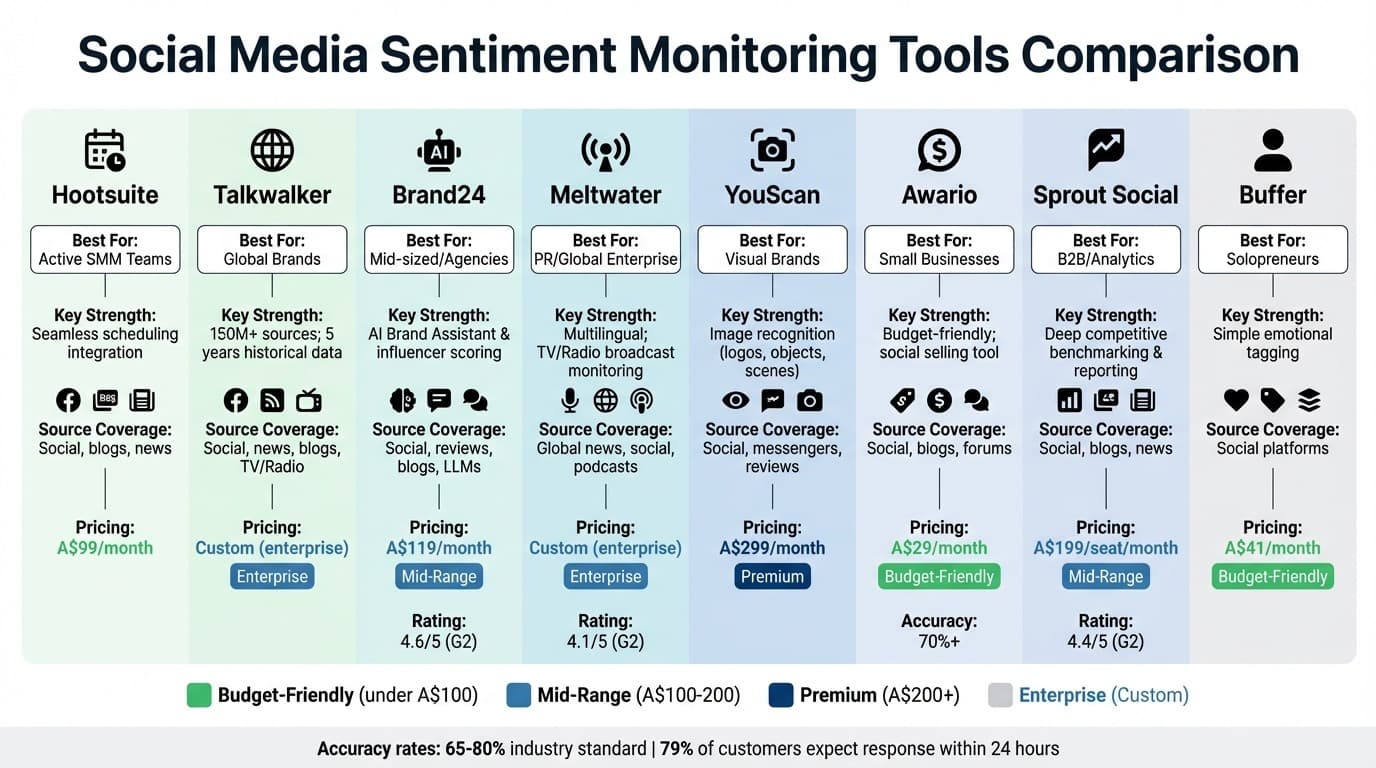
Social Media Sentiment Monitoring Tools Comparison Chart
Popular Sentiment Monitoring Tools
Sentiment monitoring tools tap into AI, machine learning (ML), and natural language processing (NLP) to sift through millions of conversations on social media, blogs, news sites, and review platforms. Beyond just counting mentions, these tools dig deeper, analysing the emotional tone behind words to classify feedback as positive, negative, or neutral.
Modern tools often blend rule-based systems with supervised ML models to improve accuracy. Platforms like YouScan and Talkwalker even incorporate visual sentiment analysis, using image and video recognition to identify brand logos and scenes, even when text data is missing.
For teams already using social media management platforms, Hootsuite offers a seamless integration of sentiment analysis. It provides features like sentiment-over-time graphs and alerts for unusual spikes in activity. Professional plans start at A$99/month.
Brand24 caters to mid-sized businesses and agencies with its AI-powered Brand Assistant, which combines monitoring data with conversational insights. It also evaluates influencer impact, helping brands pinpoint key industry voices. Pricing starts at A$119/month for individual plans, with Pro plans at A$239/month. It boasts a 4.6/5 rating on G2 from 306 reviews.
Talkwalker stands out for its extensive data coverage, pulling insights from over 150 million sources, including 30+ social platforms, blogs, news sites, and even TV and radio broadcasts. It offers up to five years of historical data, making it ideal for tracking long-term trends. Pricing is customised, targeting global brands with enterprise budgets.
For large enterprises and PR professionals, Meltwater offers multilingual support and traditional media monitoring alongside social listening. It tracks global news, podcasts, and broadcast media but may feel complex for smaller teams. It holds a 4.1/5 rating on G2 from 2,923 reviews.
Sprout Social is a go-to for B2B brands seeking competitive benchmarking and in-depth analytics. Plans start at approximately A$199 per user per month (billed annually), and the platform has earned a 4.4/5 rating on G2 from 6,178 reviews.
For smaller businesses, Awario provides budget-friendly options, starting at A$29/month. Its "Leads" feature is particularly useful, helping teams identify purchase-intent conversations on platforms like Reddit and forums. Another affordable choice is Buffer, with Solo plans at A$41/month and Pro plans at A$83/month, though its sentiment analysis is relatively basic.
Specialising in visual content, YouScan uses image recognition to detect logos, objects, and scenes in photos and videos, making it a favourite for FMCG and fashion brands. Plans start at A$299/month (billed annually).
Most tools achieve sentiment accuracy rates between 65% and 80%, with Awario reporting just over 70%. These features provide a solid foundation for comparing platforms.
Tool Comparison by Features
Finding the right tool depends on your business needs, budget, and goals. Here's a breakdown of key platforms:
| Tool | Best For | Key Strength | Source Coverage | Pricing |
|---|---|---|---|---|
| Hootsuite | Active SMM Teams | Seamless scheduling integration | Social, blogs, news | A$99/month |
| Talkwalker | Global Brands | 150M+ sources; 5 years historical data | Social, news, blogs, TV/Radio | Custom (enterprise) |
| Brand24 | Mid-sized/Agencies | AI Brand Assistant & influencer scoring | Social, reviews, blogs, LLMs | A$119/month |
| Meltwater | PR/Global Enterprise | Multilingual; TV/Radio broadcast monitoring | Global news, social, podcasts | Custom (enterprise) |
| YouScan | Visual Brands | Image recognition (logos, objects, scenes) | Social, messengers, reviews | A$299/month |
| Awario | Small Businesses | Budget-friendly; social selling tool | Social, blogs, forums | A$29/month |
| Sprout Social | B2B/Analytics | Deep competitive benchmarking & reporting | Social, blogs, news | A$199/seat/month |
| Buffer | Solopreneurs | Simple emotional tagging | Social platforms | A$41/month |
For Australian businesses, tools with multilingual support are particularly important, given the country's diverse population. Monitoring local news sites, forums, and regional social conversations is also essential, not just global platforms. Given that 79% of customers expect a response to social media complaints within 24 hours, real-time crisis alerts are critical.
Integration with other platforms can streamline workflows. Tools that connect with CRMs like Salesforce or communication tools like Slack reduce manual data entry and enhance efficiency. High-end platforms like Brandwatch and Meltwater often come with custom pricing, but they deliver deep customisation and omnichannel monitoring.
These tools not only deliver detailed sentiment metrics but also support strategies like real-time crisis management and trend analysis.
How to Choose the Right Tool
Start by defining your goals. Are you tracking mentions, analysing competitors, identifying influencers, or managing crises? Each objective requires specific features. For crisis management, focus on tools with real-time alerts and accurate sentiment analysis. If competitor analysis is your priority, platforms like Sprout Social with strong benchmarking dashboards are ideal.
Data coverage is another critical factor. Ensure the platform supports your target regions and languages. For example, Brandwatch processes over 500 million posts daily to identify relevant conversations.
AI capabilities and sentiment accuracy vary widely. Look for tools that can interpret nuances like sarcasm, humour, and emotional undertones (e.g., joy, anger, frustration) using NLP and machine learning. During free trials, test the tool's ability to handle your industry-specific language and tone.
Your budget and scalability needs should align with your business size. Smaller teams may benefit from affordable, intuitive tools like Awario or Buffer, while larger enterprises might require the advanced data visualisation and multilingual features of Meltwater or Brandwatch. Avoid committing to long-term contracts until you're confident the tool meets your needs.
"Check out your competitors' sentiments and gather a baseline." - Ruth Kim, Social Media Consultant
To measure progress, use the Net Sentiment formula: (Positive Mentions - Negative Mentions) / (Positive Mentions + Negative Mentions). This provides a score between -1 and 1, helping you track sentiment trends over time. Compare your brand's sentiment to industry averages and competitors to gauge the overall mood of your market. To manage potential PR crises, prioritise high-impact negative mentions from accounts with significant follower counts.
How to Implement Sentiment Monitoring
Setting Up Your Monitoring System
Start by establishing clear, measurable goals. For instance, you might aim to cut customer response times to under an hour or improve positive sentiment by 10% by the end of Q1.
Next, create a targeted keyword list. Include your brand name, product names, slogans, key individuals, industry-related terms, and competitors. To refine your results, use Boolean logic with operators like AND, OR, and NOT. For example, a search such as "brand name AND complaint NOT spam" can help you focus on genuine customer concerns while filtering out irrelevant noise.
Set up dashboards to track mentions across platforms like social media, forums (e.g., Reddit, Quora), review sites, and news outlets. Configure virality alerts to notify you of sudden spikes in mentions or a surge in negative sentiment. These alerts can serve as an early warning system for potential PR crises.
Choose tools equipped with Natural Language Understanding (NLU) to interpret sarcasm, emotional context, and regional nuances. This goes beyond simple positive or negative classifications. With social media platforms generating massive volumes of data - like 500 million posts daily on X and 95 million on Instagram - these tools help manage the flood of information. Finally, establish clear response protocols so your teams know how and when to act on different types of sentiment.
Laying this groundwork ensures your monitoring system aligns with your broader business strategy.
Connecting Insights to Business Strategy
Once your monitoring system is in place, share its insights across teams like product development, customer service, and risk management. A great example is Ferrara Candy Company, which in 2021 spotted a social media request from singer Halsey for a custom Trolli flavour. Acting on this generated over A$2 million in earned media value.
"Monitoring finds symptoms; listening finds causes." - Dan Neely
Integrate sentiment monitoring tools with internal databases like CRM systems and product analytics. This allows you to link emotional data to actual customer behaviours and purchase patterns. For Australian businesses, this is especially important, as 80.5% of shoppers rely on consumer-focused content when making buying decisions.
Focus on aspect-based analysis to pinpoint specific pain points rather than relying on general sentiment. For instance, instead of simply noting that customers are unhappy, identify whether the issues stem from a product feature or a specific service interaction. Since emotional factors influence 70% of customer purchase decisions, understanding these triggers helps prioritise what needs fixing first.
Use your monitoring system both reactively and proactively. Reactively, address individual complaints in real-time. Proactively, identify market trends and gaps to inform long-term strategies. Companies that leverage real-time customer feedback are 30% more likely to see improvements in customer satisfaction.
Measuring Results and Improving Over Time
To measure success, track metrics across four categories:
- Brand health: Metrics like Share of Voice and Net Sentiment Score.
- Engagement: Includes sentiment tone, share velocity, and click-through rates.
- Customer experience: Metrics like first response time, resolution rate, and CSAT.
- Conversion: Examples include social referral traffic and cost per lead.
Quantify mentions using a simple scale (e.g., +1 for positive, 0 for neutral, -1 for negative) to monitor sentiment trends. Set KPIs that align with your goals, such as improving CSAT scores, increasing Share of Voice, or reducing churn. A sentiment score above 80% signals strong brand health, while scores below 50% indicate urgent action is needed. Regularly compare these KPIs against your objectives to ensure your monitoring efforts are delivering measurable results.
"Social media monitoring – and its resulting action – is a game of constant improvement rather than deploying a quick fix in a static environment." - Dave Pabley and Adam Bunker, Qualtrics
Keep your keyword lists and response protocols up to date. While AI tools handle most of the heavy lifting, manual reviews are still essential for high-stakes mentions, as algorithms can misinterpret sarcasm or industry-specific slang. Advanced systems can even use historical sentiment data to predict future challenges, such as negative reactions to price changes or service discontinuations.
Globally, businesses risk losing 6.7% of their revenue - an estimated A$4.6 trillion - due to poor customer experiences. On the flip side, customers who rate their experience 5/5 are more than twice as likely to repurchase, and 80% of satisfied customers tend to spend more.
Getting Started with Sentiment Monitoring
Define Your Goals
Start by pinpointing your objectives. Are you aiming to resolve customer support issues, safeguard your reputation, refine marketing strategies, or keep tabs on competitors? Your goals will shape the metrics you track and the actions you take. These objectives should align with the broader strategies discussed earlier in setting up your monitoring system.
For instance, if customer satisfaction is your focus, keep an eye on CSAT scores and Net Sentiment, which measures the ratio of positive to negative mentions. A good benchmark is maintaining at least a 3:1 positive-to-negative ratio. For reputation management, monitor Share of Voice and look out for sudden spikes in negative sentiment. It's worth noting that 87% of C-level executives consider reputation risk their biggest business concern.
"Look at sentiment, reviews, mentions, and the tone of what's being said. I pay attention to patterns in feedback and how people respond over time. These signals help you understand what's working - and what needs to change!" - Phil Pallen, Brand Strategist
Establish a clear baseline to track meaningful changes, not just regular fluctuations. Identify the social channels your audience actively uses to avoid spreading your resources too thin. Refine your keyword list to include both tagged and untagged mentions - untagged feedback often reveals the most honest opinions.
Once your goals are clear, focus on selecting the tools that best support them.
Select Tools and Set Budgets
The tools you choose will depend on your business size and budget. Built-in tools like Instagram Insights and X Analytics are free but lack advanced features like cross-channel aggregation and detailed sentiment analysis. For smaller budgets, platforms like Mention or X Pro offer basic keyword tracking and alerts. Larger organisations often require enterprise-level platforms with AI-driven analytics and in-depth reporting capabilities.
In Australia, businesses should budget anywhere from AU$1,000 to over AU$10,000, depending on the scale of the project and the number of channels being monitored. When evaluating tools, prioritise features like real-time alerts for sudden spikes in mentions, advanced sentiment categorisation, and seamless integration with your existing CRM or analytics systems.
Take note of contract terms, as many platforms require a 12-month commitment. Also, assess the quality of customer support and training available. With 63% of consumers believing companies need to listen and act on feedback better, tools that capture emotional nuances can help you achieve stronger results. Considering that emotions drive 90% of consumer decisions, choosing the right tools can significantly enhance your ROI.
To further refine your sentiment analysis, consider bringing in expert consultants who can provide deeper insights.
Work with Consultants for Custom Insights
While automated tools are great for handling large volumes of data, human expertise is essential for uncovering subtle insights. Specialist teams can manually search through private Facebook groups, niche forums, and individual profiles - areas that automated systems often miss. They can also customise AI models to recognise Australian English, regional expressions, and industry-specific language.
"The most important skill in communication is hearing what isn't being said." - Preface Social Media
For Australian FMCG and eCommerce businesses, consulting firms like Uncommon Insights offer tailored frameworks to turn raw sentiment data into actionable strategies. These insights can help fine-tune campaign messaging, prioritise product development, and create feedback loops where sentiment trends guide proactive outreach. Consultants can also provide 24/7 monitoring to identify and address reputational risks before they escalate - a critical service for ASX-listed companies managing corporate affairs.
Conclusion
Key Takeaways
Social media sentiment monitoring is about much more than just counting likes or shares - it’s about understanding the emotions that shape every customer interaction. With 70% of purchase decisions influenced by emotions rather than logic, Australian eCommerce businesses that overlook sentiment data risk making decisions in the dark.
When choosing tools, focus on features like real-time alerts, cross-channel data aggregation, and AI-powered analysis that can interpret Australian English and regional nuances. Why? Because 63% of consumers feel companies need to improve how they listen to and act on feedback. Tools that capture emotional subtleties can help you stand out in a competitive market.
The real value of sentiment monitoring lies in integration. Share insights across your organisation - from R&D to customer service - and combine social sentiment data with CRM systems and website analytics. This creates a more complete view of your customer journey. With 81% of consumers admitting to making impulsive purchases influenced by social media, businesses that turn sentiment insights into actionable strategies will pull ahead while competitors lag behind.
These takeaways provide a solid foundation for crafting actionable next steps.
Next Steps
Now’s the time to turn insights into action. Start by defining measurable goals that align with your business priorities - whether it’s improving customer satisfaction, increasing brand visibility, or spotting emerging trends. Establish baseline metrics, set up automated alerts for sentiment shifts, and create response protocols before finalising your tool selection. As highlighted earlier, linking sentiment insights directly to your business strategy is critical.
For Australian FMCG and eCommerce businesses looking for tailored strategies beyond off-the-shelf tools, Uncommon Insights offers expert consulting to bridge the gap. Based in Sydney, our team specialises in integrating sentiment monitoring across departments, customising AI tools for local market needs, and creating feedback loops that turn social sentiment into a competitive advantage. Visit uncommoninsights.com.au to learn how we can help you transform sentiment data into business growth.
FAQs
How do AI tools identify sarcasm in social media sentiment analysis?
AI tools have learned to spot sarcasm by examining patterns in language, tone, and context through advanced machine learning models. These models are trained on specially crafted datasets designed to highlight sarcasm, allowing them to pick up on subtle hints like the clash between positive words and negative contexts or overly exaggerated expressions.
Today’s sentiment analysis tools go even further by factoring in elements like punctuation, emojis, and the overall conversation. This helps them identify when a statement that sounds positive on the surface might actually carry a negative or ironic undertone. For businesses in Australia, this means gaining a clearer picture of public sentiment, enabling them to address customer feedback or social media trends with greater precision.
How does real-time sentiment monitoring help with managing crises effectively?
Real-time sentiment monitoring works like an early alert system, enabling you to spot potential problems before they grow into larger issues. By keeping a close eye on public sentiment as it develops, businesses can rely on data-backed insights to act swiftly and address risks effectively.
Taking this approach helps safeguard your brand’s reputation while keeping you in tune with your audience’s concerns. It builds trust and demonstrates openness, especially when navigating difficult situations.
How can businesses use sentiment analysis to uncover market trends and opportunities?
Sentiment analysis uses AI to sift through social media mentions and determine whether the emotional tone is positive, negative, or neutral. This gives businesses a real-time pulse on how consumers feel about their products, brands, or even broader trends. For example, by scanning thousands of comments, reviews, and posts, companies can spot rising interests - like the buzz around "plant-based meat" - or address recurring concerns, such as complaints about "delivery delays."
Armed with this information, businesses can craft strategies that directly respond to consumer sentiment. Here’s how:
- Introduce products or campaigns that align with positive trends. For instance, if summer-themed chatter spikes in early December, it might be the perfect time to launch related offerings.
- Refine marketing budgets by investing in channels or messages that resonate most positively, ensuring every dollar counts.
- Solve recurring issues by tackling negative feedback, such as introducing gluten-free options to meet unmet demands.
- Monitor competitor sentiment to identify opportunities for differentiation and stay ahead in the market.
Uncommon Insights collaborates with Australian FMCG, e-commerce, and SaaS brands, helping them turn these insights into tailored strategies that reflect local consumer behaviour and preferences.
Related Blog Posts
Top Tools for Analysing Local Consumer Feedback
Checklist for Implementing Sentiment Analysis in eCommerce
How To Build a Social Media ROI Dashboard
Ultimate Guide to Emotional Drivers in eCommerce
The Three Silent Growth Killers in Every Scale-up: What's Really Stopping Your Growth?
How to Map DTC Customer Touchpoints
Newsletter
The Uncommon Insights Letter
Practical FMCG & eCommerce growth playbooks — margins, retention and scaling tactics, straight to your inbox.
Turn these ideas into profit you can see
Get a hands-on operator to turn the frameworks above into results — book a free audit call.