Checklist: Fixed vs Variable Costs for Startups
Separate your startup's fixed, variable and semi-variable costs, calculate break-even and cut expenses to protect cash flow and margins.
7 January 2026
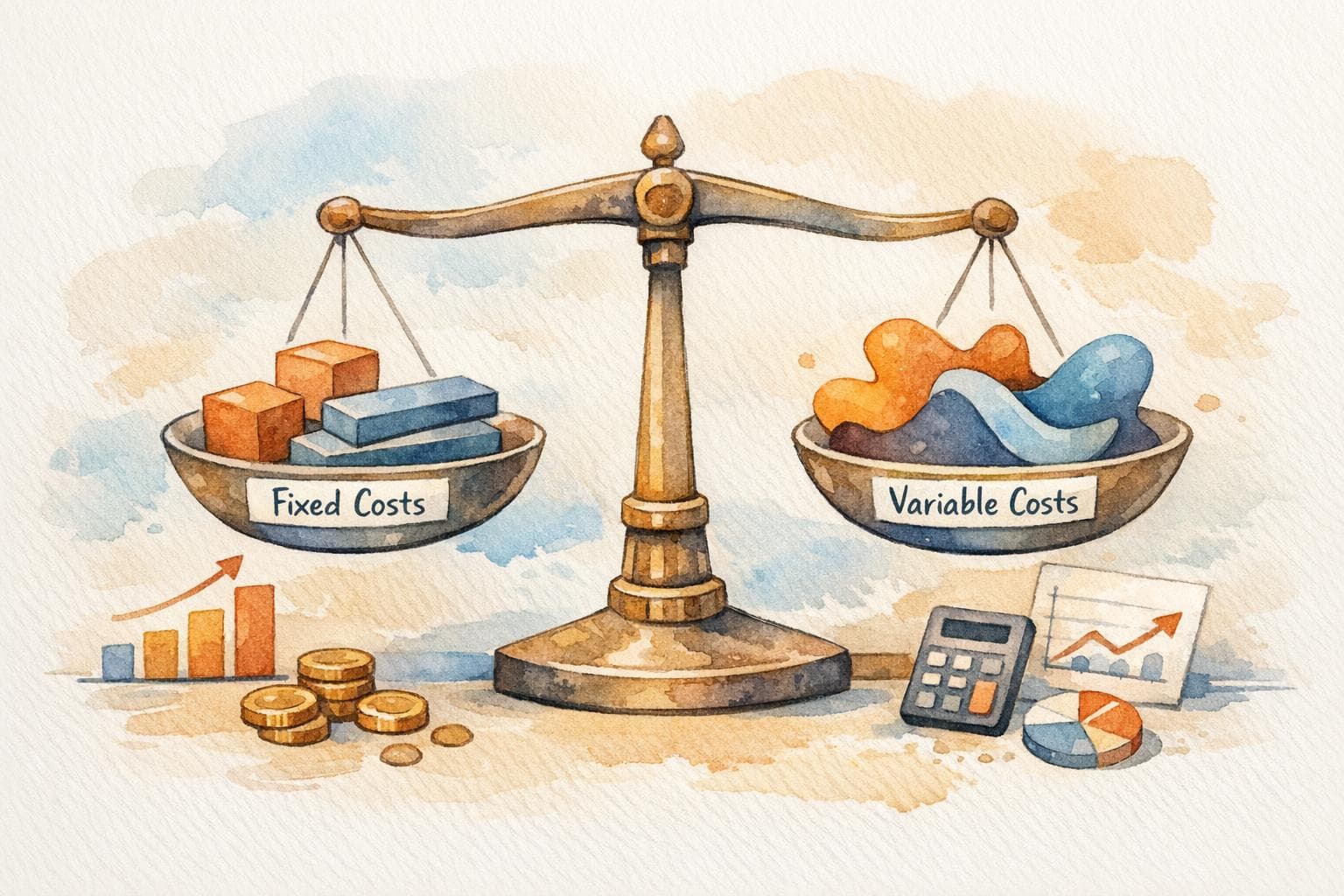
Fixed and variable costs are the foundation of understanding your business expenses. Fixed costs, like rent or salaries, stay the same regardless of sales. Variable costs, such as raw materials or shipping, change based on how much you sell. For startups, especially in FMCG and eCommerce, categorising these costs is vital for managing cash flow, calculating your break-even point, and improving profit margins.
Key Points:
- Fixed Costs: Predictable expenses like rent (e.g., AU$3,000/month), permanent staff salaries, insurance, and software subscriptions (e.g., Shopify AU$42/month).
- Variable Costs: Expenses tied to sales, such as raw materials, shipping, transaction fees, and commissions.
- Semi-Variable Costs: Costs that combine fixed and variable elements, like utility bills or tiered software plans.
- Break-Even Point Formula: Fixed Costs ÷ (Sales Price per Unit – Variable Cost per Unit).
Understanding these categories helps startups optimise budgets, reduce waste, and avoid cash flow problems, which are a leading cause of business failure. Start tracking your costs today to build a stronger financial foundation.
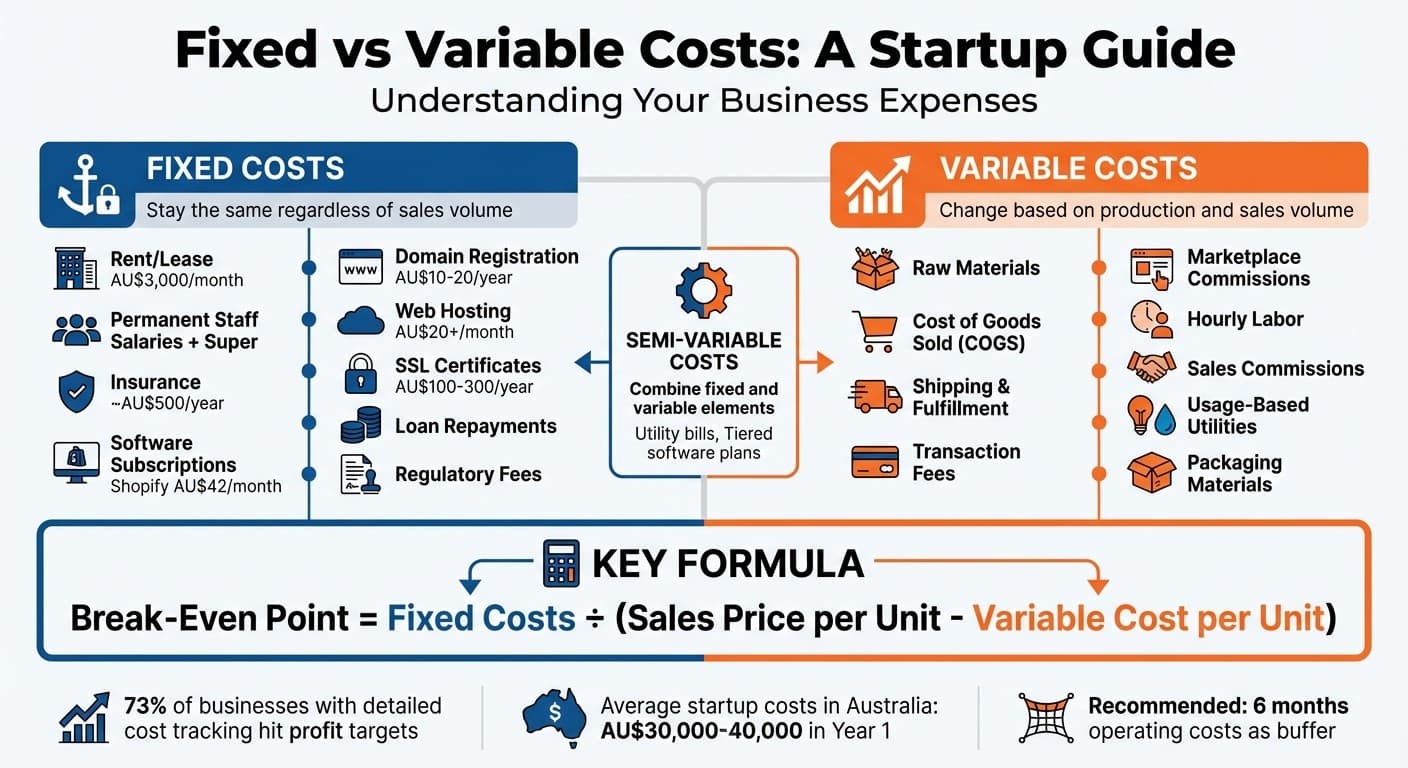
Fixed vs Variable Costs Comparison for Startups
Checklist: Identifying Fixed Costs
Key Fixed Costs for Startups
Fixed costs are those expenses that remain steady, no matter how much you sell. For most startups, rent or lease payments are usually the biggest fixed expense. Whether you're operating out of an office in Sydney’s inner west or a warehouse in Brisbane, this cost doesn’t fluctuate month to month. Other major fixed costs include salaries for permanent staff, along with their superannuation and benefit packages. Don’t forget to account for general liability insurance premiums, which average around AU$500 per year.
Software subscriptions are another area to consider. These can add up quickly, with tools like Shopify Basic costing AU$42 per month, Adobe Commerce exceeding US$22,000 annually, and additional programs like MYOB, Xero, payroll software, CRM platforms, and inventory management systems. Loan repayments also fall into this category, as they are fixed obligations. Additionally, Australian businesses should include regulatory and compliance fees, such as annual business name registrations and industry-specific permits.
"If you have good financials, then you can make good decisions." - Bill Bachand, Founder, Renu Therapy
For eCommerce startups, fixed costs often include platform infrastructure expenses like domain registration (AU$10–$20 annually), web hosting (AU$20+ monthly), and SSL certificates (AU$100–$300 annually). If you’re in the FMCG sector, add facility-related costs like warehouse utilities and leases for production or packaging machinery. Leasing equipment can turn a large upfront cost into a manageable monthly payment, which simplifies cash flow management. To get a clearer picture of your monthly expenses, spread any large, one-off costs across your budget.
One-Off Costs Spread Over Time
One-off expenses can make your budget feel overwhelming, but spreading them out over time can help you better understand your monthly burn rate. For example, incorporation fees in Australia typically range between AU$650 and AU$1,600. Similarly, trademark registration and intellectual property protection are one-time costs that safeguard your brand for the future. If you’re developing a website or app, an MVP for an eCommerce business could cost anywhere from AU$46,500 to AU$155,000. These costs should be depreciated over their useful life rather than being recorded as a single expense.
Legal setup costs, such as drafting contracts, terms, and compliance documents, are also non-recurring investments. Likewise, initial equipment purchases - whether it’s computers, office furniture, or manufacturing machinery - should be depreciated over time. On average, new businesses in Australia spend about AU$30,000–$40,000 on startup costs in their first year. By spreading these out, you’ll get a better sense of your true monthly expenses. To ensure stability, it’s recommended that startups secure enough funding to cover at least six months of operating costs from the outset. This buffer gives you time to establish a revenue stream without the immediate pressure of financial strain.
Checklist: Identifying Variable Costs
Common Variable Costs
Variable costs are those expenses that rise and fall with your production levels and disappear entirely when sales stop. For eCommerce startups, these typically include the cost of goods sold (COGS), merchant fees, and fulfilment costs.
COGS covers everything involved in acquiring or producing your products. This might mean purchasing inventory from suppliers or sourcing raw materials if you're manufacturing your own items. For FMCG businesses, raw materials and ingredients are key. For instance, if you're in the food industry, ingredients like flour, yeast, or packaging materials will vary depending on how many units you produce. Don't forget about landed costs - these are the total expenses to get products delivered to your location, including inbound freight, customs duties, and import taxes. To avoid miscalculating your profit margins, allocate these costs to individual units accurately. Also, steer clear of recording net deposits as revenue, as this can obscure the true impact of fees and shipping costs on your financials.
Another major variable expense is transaction and marketplace fees. These include credit card processing charges, Shopify Payments fees, and commissions from platforms like Amazon or eBay, all of which grow with your sales volume. Always record these as gross expenses rather than deducting them from revenue - this provides a clearer view of your actual costs. Fulfilment costs also fall into this category. Expenses for branded packaging, inserts, shipping carrier fees, and pick-and-pack services increase as you ship more orders. To avoid undercharging for delivery, track your "shipping income" (what you charge customers) separately from your "shipping cost" (what carriers charge you).
Now, let’s explore how labour and usage-based charges affect variable costs.
Labour and Usage-Based Costs
Labour costs can be both fixed and variable, depending on how your workforce is structured. Salaried roles like management and administrative staff fall under fixed costs, but hourly workers, piece-rate labour, and sales commissions are all variable. If you want to make labour costs more flexible, consider a "payment-per-piece" model for production staff, directly tying labour expenses to your output. Similarly, sales commissions and brand ambassador fees will scale alongside performance.
Utility costs are another variable expense tied to your business activity. While there may be a fixed base charge for utilities such as electricity or water, usage-based charges will rise when machinery runs for longer hours or when you're processing more orders. To keep your COGS accurate, conduct quarterly physical inventory counts to account for any losses. Additionally, perform a three-way reconciliation each month: cross-check orders from your eCommerce platform or marketplace with payouts from your payment processor and actual bank deposits. This process helps identify timing discrepancies and hidden fees.
Analysing and Improving Your Cost Structure
How to Perform Cost Analysis
Start by calculating your fixed costs - things like rent, insurance, and salaries. Then, figure out your variable costs by multiplying your unit cost by the output. Once you have these numbers, use the break-even formula:
Fixed Costs ÷ (Sales Price – Variable Cost). This calculation helps you understand how much you need to sell to cover your expenses. (Refer to the Introduction for more details on the formula.)
Another key metric to track is the variable cost ratio, which shows what percentage of every dollar earned goes directly into production. To calculate it, divide total variable costs by net sales and multiply by 100. If this ratio starts climbing while your revenue stays the same, it could mean you're overspending on production. Research shows that businesses with detailed cost tracking are 73% more likely to hit their profit targets. Incorporating these calculations into your quarterly reviews can pave the way for better cost management.
Handling Mixed Costs
Once you’ve sorted your fixed and variable costs, it’s time to tackle mixed costs - those that include both fixed and variable components. A typical example is your utility bill, which might have a fixed connection fee plus a rate based on usage. To break these costs down, use the formula:
Fixed Component + (Variable Rate × Usage).
For instance, if your electricity bill includes a $150 monthly service fee and a $0.25 charge per kilowatt-hour, and you used 800 kWh, your total cost would be:
$150 + (0.25 × 800) = $350.
Understanding how these costs work allows you to monitor thresholds and adjust fixed tiers when possible.
Cost Reduction Strategies
Cutting down on fixed costs can have an immediate impact since these expenses remain constant regardless of revenue. Look for unnecessary expenses - like unused software subscriptions or idle equipment rentals - and eliminate them. For variable costs, focus on renegotiating supplier contracts. Regularly review terms, and consider switching to more affordable materials that maintain quality. Outsourcing specialised tasks is another way to convert fixed costs into variable ones, giving you more flexibility.
Here’s an example: Renegotiating bulk supply contracts or adopting digital tools can reduce overhead by over 10%, which directly improves profit margins.
"Well-trained, experienced employees will likely make fewer mistakes, waste less materials and be more efficient, helping you produce more with fewer resources."
– MYOB
You can also save on utilities by introducing simple automations, like automatic light switches, which can cut lighting costs by 35% to 45%. For workspace savings, consider remote work options or downsizing your office space to lower rent and utility bills. Finally, set firm limits on monthly variable spending to keep costs from outpacing revenue growth. Add a 10% buffer to your break-even calculations to account for unexpected expenses. These strategies are especially helpful for startups aiming to improve cash flow and build a more sustainable business.
How To Determine Startup Fixed And Variable Costs?
Monitoring and Adjusting Costs as You Grow
Keeping a close eye on your expenses and making adjustments as needed is essential when scaling your business. This ongoing process helps maintain financial health and supports sustainable growth.
Tracking Cost Variances
Regularly compare your monthly spending to your budget to spot any discrepancies, especially when variable costs exceed your estimates. This practice can help you identify overspending early and address it before it becomes a bigger issue. Set up a system to review fixed and variable costs side by side, while also separating recurring operating expenses from one-off costs. This distinction can help you determine whether financial shortfalls are due to temporary setbacks or deeper business challenges.
Using cloud-based accounting software can simplify this process. Automated tools not only streamline tracking but also provide timely alerts if you’re overspending on materials, shipping, or other areas. Businesses that adopt advanced cost management systems often see a 23% boost in profitability compared to those that don’t. For example, if your shipping costs suddenly spike, you can quickly renegotiate supplier contracts or tweak production methods to minimise the impact on your cash flow.
Monitoring these variances also equips you to anticipate and prepare for the inevitable cost increases that come with scaling. Identifying these shifts early gives you the opportunity to act before they disrupt your financial stability.
Managing Cost Increases Over Time
Growth often brings higher expenses. Rent might go up, suppliers could adjust their pricing, or software subscriptions may jump to a higher tier once you exceed a user limit. Semi-variable costs, such as software fees, tend to remain constant until you hit a usage threshold. Keeping an eye on these thresholds allows you to plan ahead for potential price increases. Similarly, as your order volumes grow, revisit supplier pricing to negotiate bulk discounts.
For fixed costs like insurance or business loans, consider reviewing refinancing options annually. As your financial position strengthens, you might secure better terms or lower rates. These proactive measures can help you manage cost increases without straining your budget.
Linking Costs to Financial Planning
Effective cost management ties directly into strategic financial planning, which is crucial for sustained growth. Your cost structure forms the backbone of your financial plan. Knowing exactly where your money is going allows you to calculate accurate break-even points, forecast cash flow, and demonstrate financial viability to potential investors.
Conduct quarterly reviews of your cost structure to refine resource allocation and adjust pricing strategies as needed. Use variance analysis to compare actual spending against your budget, recalculating break-even points to understand how changes in costs or pricing affect your business’s stability.
For startups seeking tailored guidance, working with a growth consultancy like Uncommon Insights can be invaluable. Their expertise in unit economics and financial frameworks ensures your cost management strategies align with your industry and growth goals. This approach not only strengthens your financial planning but also supports your broader strategic objectives.
Key Takeaways
Fixed vs Variable Costs Summary
Fixed costs, like rent or salaries, stay constant regardless of how busy your business gets. On the other hand, variable costs, such as raw materials or shipping fees, shift depending on your production volume. Then there are semi-variable costs - things like utilities or tiered software subscriptions - which blend a fixed base rate with charges that increase as usage grows.
Getting a handle on these cost types is crucial for shaping your break-even point, pricing strategy, and overall cash flow. As Josh Krissansen from Finmark explains:
"Understanding which of your expenses are fixed and which are variable is important to setting pricing for your product."
By breaking costs down into these categories, you can lay the groundwork for smarter financial decisions and improved performance.
Next Steps for Startups
Now that you understand the basics, here’s what to do next. Start by calculating your break-even point with this formula: Fixed Costs ÷ (Sales Price per Unit – Variable Cost per Unit). This will show you the number of units you need to sell to cover your costs and start generating profit.
Make it a habit to review your cost structure regularly. Look for inefficiencies and areas where you can cut back. You might even consider turning some fixed costs into variable ones. For example, outsourcing certain tasks or hiring consultants instead of full-time staff can give you more flexibility. Similarly, setting monthly spending limits for variable costs can help protect your margins, especially during periods of rapid growth. After all, cash flow issues remain one of the biggest reasons small businesses struggle to survive.
Getting Expert Help
If you’re looking to fine-tune your approach, bringing in expert advice can make all the difference. Professionals with a deep understanding of unit economics and financial planning can help you optimise your cost structure for long-term growth. Uncommon Insights offers tailored support for startups, especially those in FMCG and eCommerce. Their guidance can help you align your cost management strategies with industry-specific goals and the broader principles outlined in this checklist.
FAQs
How can Australian startups manage cash flow by understanding fixed and variable costs?
Managing cash flow effectively begins with understanding the difference between fixed costs and variable costs. Fixed costs - like office rent, salaried wages, insurance, and software subscriptions - stay the same every month, regardless of how much you sell. For example, knowing your rent is AU$2,500/month allows you to calculate the minimum cash required to keep the business running. It also highlights areas where you might renegotiate long-term expenses to save money.
On the other hand, variable costs - such as raw materials, shipping, commissions, and transaction fees - change based on production or sales levels. Keeping a close eye on these costs compared to revenue helps you protect profit margins and adjust spending when needed. For instance, cutting back on shipping expenses or reducing production during quieter periods can help minimise unnecessary cash outflows.
Here are some practical ways to stay on top of your cash flow:
- Create a monthly cash-flow forecast: Break down fixed and variable costs, and update it as sales projections shift.
- Track variable expenses regularly: Make sure your spending aligns with revenue trends.
- Review fixed costs periodically: Cancel unused subscriptions or renegotiate contracts like leases.
- Spot cash gaps early: If needed, secure short-term financing to cover temporary shortages.
By keeping fixed costs streamlined and ensuring variable expenses match income, Australian startups can better handle fluctuations in revenue. Making this process part of routine financial reviews helps maintain steady cash flow, supporting long-term growth.
How can startups in Australia effectively reduce their fixed and variable costs?
Startups can keep costs under control by handling fixed and variable expenses differently and using specific tactics for each.
For fixed costs like rent, insurance, and software subscriptions, look for ways to cut back on non-essential spending. This might mean negotiating lower rates, opting for month-to-month plans, or switching to more economical choices like co-working spaces or open-source software. Another approach is converting fixed costs into usage-based expenses - think pay-as-you-go cloud hosting - so your spending adjusts naturally with revenue.
When it comes to variable costs, which are often tied to sales (e.g., raw materials, shipping, and commissions), there are plenty of ways to save. You could negotiate bulk discounts, combine shipments to save on logistics, or hire freelancers to keep labour costs flexible. Implementing a just-in-time inventory system can also help by reducing excess stock and cutting down on storage expenses.
To stay on top of it all, use straightforward financial tracking tools to monitor your expenses in real-time. Regularly reviewing your cost structure can uncover inefficiencies and ensure your resources are being channelled into the most profitable areas, helping your startup stay lean and focused on growth.
Why is knowing your break-even point essential for startup success?
Understanding your break-even point is crucial for Australian startups because it pinpoints the sales volume needed to cover all expenses. This is the moment your business transitions from operating at a loss to becoming financially self-sufficient. Knowing this figure helps you set realistic prices, estimate the capital required to keep things running, and communicate clear profit goals to potential investors.
You can calculate your break-even point using this formula:
Break-Even Units = Fixed Costs ÷ (Selling Price – Variable Costs).
This formula allows you to explore different scenarios and see how changes in costs or pricing affect your bottom line. With this knowledge, you can trim unnecessary expenses, manage overheads wisely, and make smarter decisions about scaling or tweaking your business model.
For startups chasing rapid growth, having a clear break-even point is a safeguard against cash-flow problems - a common reason small businesses fail. It sets a tangible financial target, improves budgeting, and keeps you on track toward long-term profitability. Integrating break-even analysis into your strategy not only helps you monitor financial health but also supports steady, sustainable growth.
Related Blog Posts
Unit Economics Checklist: Contribution Margin
eCommerce Financial Planning: Cash Flow to $10M Revenue
Unit Economics Mastery for DTC Brands
Ecommerce Cost Structure: Key Benchmarks
Why Your Break-Even Analysis Is Wrong: The 5 Hidden Costs Killing Your Margins
Unit economics template for DTC brands
Newsletter
The Uncommon Insights Letter
Practical FMCG & eCommerce growth playbooks — margins, retention and scaling tactics, straight to your inbox.
Turn these ideas into profit you can see
Get a hands-on operator to turn the frameworks above into results — book a free audit call.