Bundling Strategy Economics: The AOV Trap That Destroys Margin (And How to Bundle Profitably)
Every ecommerce operator has heard the conventional wisdom: create product bundles to increase average order value. It sounds like a free lunch—combine products, offer a small discount, watch baskets grow.
11 min read · 15 June 2025
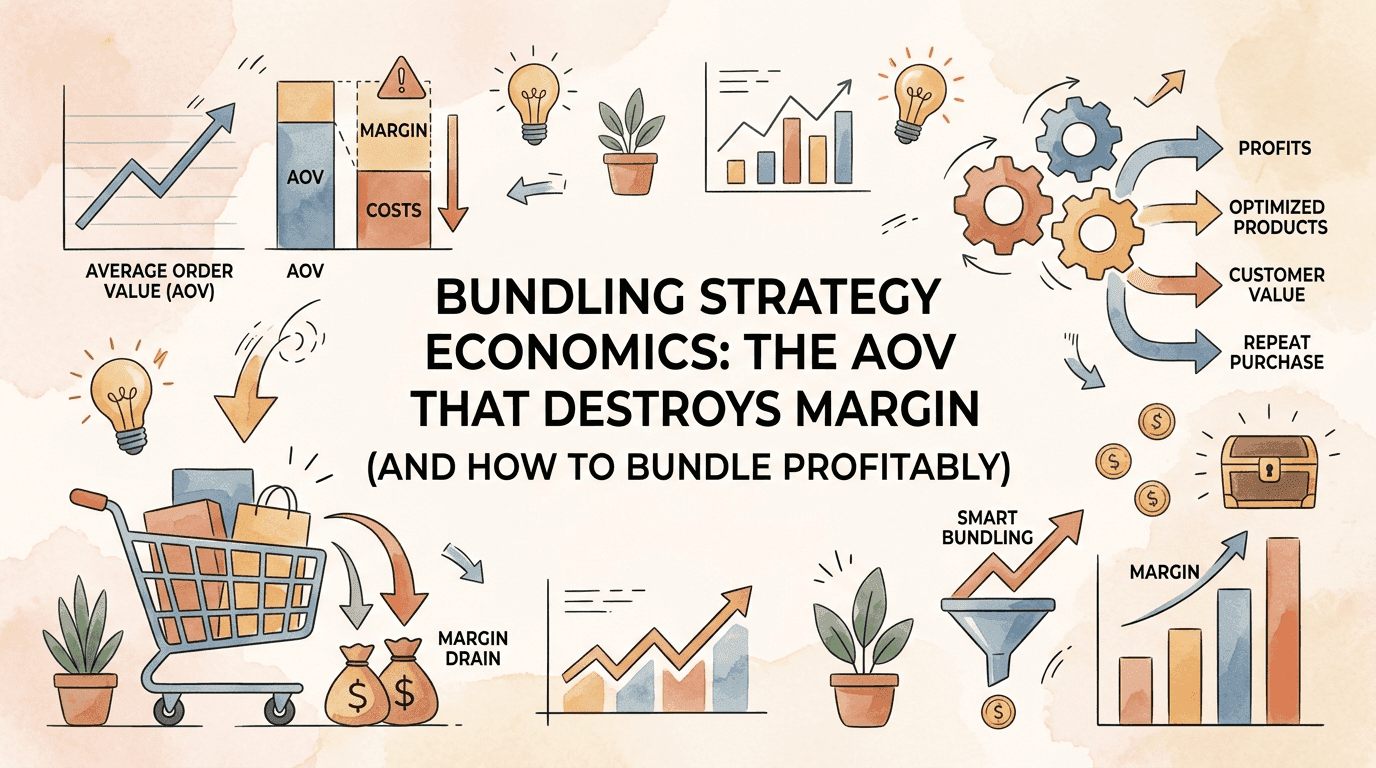
Bundling Strategy Economics: The AOV Trap That Destroys Margin (And How to Bundle Profitably)
Every ecommerce operator has heard the conventional wisdom: create product bundles to increase average order value. It sounds like a free lunch—combine products, offer a small discount, watch baskets grow.
Here's what nobody mentions: most bundles quietly destroy margin while appearing successful. They increase AOV (the metric everyone celebrates) while decreasing contribution profit (the metric that determines whether your business generates cash). It's a classic case of optimizing the wrong number.
Bundles can deliver a 55% AOV lift and an 86% increase in revenue per user when executed with intent. Those numbers sound transformational. But "when executed with intent" is doing enormous work in that sentence. Most bundles aren't executed with intent. They're executed with hope—hope that more revenue per transaction automatically means more profit.
It doesn't. And until you understand the precise economics of how bundling creates or destroys value, you're flying blind with one of your most powerful merchandising tools.
The Bundle Margin Trap
The fundamental mistake most brands make with bundling is treating it as a discounting strategy rather than a margin-blending strategy. They think: "We'll discount the bundle 15%, customers will buy more, everyone wins."
Run the math and a different picture emerges.
Example: The Intuitive Bundle
You sell a skincare set with three products:
- Cleanser: $30 retail, 65% margin ($19.50 contribution)
- Toner: $25 retail, 60% margin ($15.00 contribution)
- Moisturiser: $45 retail, 55% margin ($24.75 contribution)
Total if sold separately: $100, $59.25 contribution (59.25% margin)
You create a bundle at 20% off:
- Bundle price: $80
- Contribution: $80 - (COGS same at $40.75) = $39.25
- Bundle margin: 49%
You've just taken a 10 percentage point hit to margin. If 30% of customers who would have bought individually now buy the bundle instead, you've lost $6 of contribution per converted customer. That's not additional sales—that's cannibalisation with a margin haircut.
The cannibalisation reality:
Most bundles don't purely drive incremental purchases. They shift existing demand to lower-margin configurations. One risk of bundling is cannibalization of existing sales, when existing customers shift to buying a cheaper bundle instead of higher-priced individual items. The bundle replaces purchases that would have happened anyway, just at lower profitability.
This doesn't mean bundles are bad. It means bundles require economic analysis, not instinct. The question isn't "will this bundle sell?"—it's "will this bundle generate more contribution profit than the alternative scenarios?"
The Three Bundle Outcomes
Every bundle strategy produces one of three outcomes:
Outcome 1: Pure cannibalisation (value destruction)
Customers who would have purchased items individually instead purchase the discounted bundle. Revenue increases, margin decreases, contribution profit falls. This is the default outcome when you discount without analysis.
Outcome 2: Partial incrementality (mixed results)
Some incremental customers purchase bundles they wouldn't have otherwise bought. Some existing customers cannibalise individual purchases. Net effect depends on the ratio and respective margins.
Outcome 3: True incrementality (value creation)
Bundles drive purchases from customers who wouldn't have bought otherwise, or convince existing customers to buy additional items they weren't considering. This is the goal—and it requires deliberate construction.
The difference between these outcomes isn't luck. It's strategy. Specifically, it's understanding which products to bundle, how to price them, and how to present them in ways that drive incrementality rather than substitution.
The Bundle Profitability Framework
Profitable bundling requires a systematic approach that treats bundles as economic instruments, not promotional afterthoughts. What follows is the Bundle Profitability Framework—a methodology for designing, pricing, and measuring bundles that actually contribute to margin.
I developed this framework after watching dozens of brands destroy margin with bundles that looked successful. The pattern was always the same: AOV went up, marketing celebrated, and six months later finance asked why profitability had declined despite higher average orders. The disconnect between revenue metrics and profit metrics is where most bundling strategies fail.
Component 1: Bundle Architecture
The products you combine determine whether your bundle can be profitable. There are five architecturally distinct bundle types, each with different economic characteristics:
Hero + Halo Bundles
Combine a high-demand "hero" product with lesser-known "halo" products. The hero drives demand; halos introduce customers to new items they wouldn't have discovered. This architecture drives discovery rather than cannibalisation.
Economic advantage: Halo items often carry better margins. If customers buy halos in future orders, bundle creates long-term value beyond initial transaction.
Starter Kit Bundles
Curated collections for new customers entering a category. Everything needed to get started, priced as a single decision.
Economic advantage: Reduces decision paralysis, lowers return rates (complete solution rather than mismatched components), and establishes purchasing habits that continue.
Replenishment Bundles
Products commonly purchased together for recurring needs. Skincare routines, supplement stacks, pet care combinations.
Economic advantage: High incrementality because customers need all items anyway. Bundle makes purchase convenient rather than discounted.
Slow-Mover + Fast-Mover Bundles
Pair bestsellers with slow-moving inventory that needs turnover. The bestseller creates demand; the slow-mover clears warehouse.
Economic advantage: Converts inventory carrying cost into revenue. Even at reduced margin on the slow-mover, contribution exceeds holding cost.
Cross-Category Bundles
Products from different categories that share usage occasion or customer profile. Gift sets, experience packages, seasonal collections.
Economic advantage: Least likely to cannibalise because customers weren't comparison shopping across categories. High incrementality potential.
Component 2: Margin-Preserving Pricing
Bundle pricing determines whether your architecture delivers value or destroys it. The goal isn't to minimise price—it's to maximise contribution while maintaining conversion.
The baseline calculation:
Step 1: Calculate total COGS across all bundled products
Step 2: Determine target contribution margin (should exceed your category average)
Step 3: Set bundle price that achieves target margin
Example:
Three products with total COGS of $45
Target contribution margin: 55% (your category average)
Required contribution: Price × 0.55
Therefore: Price - $45 = Price × 0.55
Price = $45 / 0.45 = $100
If the unbundled total is $120, you can offer $20 off (16.7% discount) while maintaining target margins. If unbundled total is $110, you can only offer $10 off (9% discount) while maintaining margins.
Pricing guidelines by margin tier:
For brands with margins above 50%, shave 10-20% off the subtotal. For businesses where average margins are 50% or less, a discount rate between 5-10% typically suffices.
These guidelines exist because high-margin products have room to absorb discount impact while remaining profitable. Low-margin products don't—aggressive discounting pushes them underwater.
Component 3: Incrementality Protection
The best bundle architecture and pricing won't help if every sale cannibalises higher-margin individual purchases. Incrementality protection involves structuring when and where bundles appear to maximise new demand rather than redirecting existing demand.
Entry point positioning: Present bundles prominently to new customers, less prominently to returning customers who have demonstrated willingness to purchase at full price. This concentrates bundle benefits on acquisition rather than margin erosion on your existing base.
Checkout-only presentation: Keep bundles off primary category pages. Present as "complete the look" or "frequently bought together" during checkout when purchase intent is established. This captures incremental basket additions rather than replacing primary purchase.
Minimum cart threshold: Offer bundles only to customers whose cart already meets a certain value, ensuring the bundle adds to rather than substitutes for existing intent.
New customer exclusivity: Some brands restrict bundle access to first-time purchasers, using bundles as acquisition tools rather than margin-compressing defaults.
Component 4: Dynamic Bundle Measurement
Static bundle reporting tells you revenue generated. Dynamic measurement tells you whether that revenue was profitable and incremental.
Metrics that matter:
Bundle contribution margin: The bundle's contribution profit divided by revenue. Must exceed your target threshold, or the bundle is destroying value.
Cannibalisation rate: Percentage of bundle purchasers who previously bought (or subsequently buy) included items individually. High rates suggest substitution rather than incrementality.
Incremental units per order: Bundle buyers should purchase more units than non-bundle buyers with similar profiles. If not, the bundle is shuffling existing demand.
Post-bundle individual purchase rate: Do customers exposed to bundles buy individual items later? Healthy bundles drive discovery that continues beyond the bundle purchase.
Return rate comparison: Bundle return rates versus individual product returns. Bundles should reduce returns by providing complete solutions. If they increase returns, something's wrong with the composition.
Australian Bundle Considerations
For Australian ecommerce operators, bundling economics include specific considerations:
Shipping Threshold Alignment
Free shipping thresholds are particularly effective in Australia due to high shipping costs. Bundle pricing should align with (or slightly exceed) free shipping thresholds, making the bundle the obvious path to free shipping.
Example structure:
- Free shipping threshold: $99
- Average AOV: $75
- Bundle price: $109 (positions bundle as the solution to reach free shipping while providing meaningful value above threshold)
This alignment creates psychological win-win: customer gets free shipping plus bundled savings, you get higher AOV with preserved margins.
Dimensional Weight Economics
Australian carriers price increasingly on dimensional weight. Bundles that combine compact, heavy items with bulky, light items can actually improve per-unit shipping economics—the average dimensional weight across bundle components is often better than shipping items separately.
Evaluate bundle compositions not just for margin but for shipping efficiency. A bundle that combines three products into one package that ships cheaper than three individual packages captures operational savings that offset some discount.
Gift-Giving Culture
Australian gift-giving occasions (Christmas in summer, Mother's Day, Father's Day) create natural bundle opportunities. "Gift sets" have high perceived value relative to their component cost because recipients value the curation.
Gift bundles often command pricing premiums rather than discounts. A $100 gift set containing $80 of individual products isn't unusual—the curation, presentation, and "thoughtful gift" positioning add value that customers willingly pay for.
Phase 1: Bundle Audit (Days 1-14)
Before creating new bundles, understand your existing bundle economics.
Week 1: Current state analysis
For every active bundle:
- Calculate contribution margin (not just revenue or gross margin)
- Estimate cannibalisation by analysing whether bundle buyers also purchase components individually
- Compare bundle buyer profiles to non-bundle buyers
- Calculate bundle return rates versus individual product returns
Create a simple bundle health scorecard:
- Contribution margin above target? ✓/✗
- Cannibalisation below 30%? ✓/✗
- Return rate at or below individual products? ✓/✗
- Average units per order higher than non-bundle? ✓/✗
Bundles failing multiple checks need restructuring or elimination.
Week 2: Opportunity identification
Analyse your catalogue for high-incrementality bundle opportunities:
- Which products are frequently purchased together (natural bundle candidates)?
- Which high-margin products would benefit from pairing with discovery items?
- Which slow-moving inventory could be bundled with bestsellers?
- What new customer "starter kit" would reduce decision paralysis?
Prioritise opportunities by potential contribution impact, not revenue impact. A small bundle that generates $50K revenue at 55% margin beats a large bundle generating $100K at 25% margin.
Phase 2: Strategic Bundle Development (Days 15-45)
With audit complete, build or rebuild your bundle portfolio strategically.
Weeks 3-4: Architecture and pricing
For each prioritised bundle opportunity:
- Select bundle architecture (Hero + Halo, Starter Kit, etc.)
- Calculate COGS total across components
- Set target contribution margin (minimum: your category average)
- Derive bundle price that achieves target margin
- Validate price is competitive versus unbundled purchase
- Design incremental positioning strategy (where/when/to whom)
Document assumptions for each bundle. You'll test these assumptions against actual performance.
Weeks 5-6: Pilot launch
Launch new bundles to limited audiences:
- New customers only (cleanest incrementality test)
- Specific traffic sources (avoid contaminating core customer behaviour)
- Time-limited offers (creates urgency without permanent commitment)
Monitor contribution margin in real time. If bundle underperforms margin targets in pilot, adjust pricing before broader launch.
Phase 3: Ongoing Bundle Optimisation (Day 46+)
Bundle economics shift over time. Costs change, customer preferences evolve, competition responds. Ongoing optimisation ensures bundles remain profitable.
Monthly Bundle Review
Contribution margin check: Is each bundle still achieving target margins? Cost increases, discount drift, or mix changes can erode profitability.
Cannibalisation monitoring: Are customers increasingly substituting bundles for individual purchases? Rising cannibalisation suggests over-prominence in merchandising.
Seasonal adjustment: Some bundles perform differently by season. Holiday gift bundles may warrant different pricing than everyday bundles.
Retirement decisions: Bundles that consistently underperform margin targets should be retired, not discounted further. A failing bundle with a bigger discount is a faster path to value destruction.
Quarterly Portfolio Rebalancing
SKU rotation: Refresh bundle compositions with new or seasonal products. Stale bundles lose conversion; refreshed bundles capture renewed attention.
Pricing recalibration: As costs change, recalculate required pricing for target margins. Don't let bundles drift into unprofitability through inertia.
Architecture evolution: Test new bundle types against control. Does a Hero + Halo outperform a Starter Kit? Continuous testing reveals what works for your specific customer base.
The North Star: Bundle Contribution Profit
Through all optimisation activities, one metric anchors every decision: total contribution profit generated by your bundle portfolio.
Not bundle revenue. Not AOV lift. Contribution profit—the actual cash remaining after variable costs.
The calculation:
Bundle Contribution Profit = Σ (Bundle Price - Bundle COGS - Bundle Shipping - Bundle Fees) × Units Sold
Benchmark expectations:
Bundles should generate higher contribution per customer than the alternative scenario of those customers purchasing individual items. If your bundles collectively produce less contribution than the non-bundle alternative, they're destroying value regardless of AOV improvements.
Track this at the portfolio level monthly. Upselling and cross-selling programs lift revenue by 10-30% on average—but those gains only matter if margin travels with them.
The Strategic Bundling Approach
From Tactical Discounting to Strategic Bundling
The difference between bundles that build margin and bundles that destroy it comes down to intent. Tactical bundles start with "how do we move more product?" Strategic bundles start with "how do we capture more contribution profit per customer?"
The strategic approach requires:
- Economic analysis before creation: Model contribution margin before launching any bundle
- Architecture design for incrementality: Structure bundles to add value rather than substitute purchases
- Pricing discipline: Discounts sized to target margins, not competitive pressure
- Measurement beyond AOV: Track contribution, cannibalisation, and incrementality
- Ongoing optimisation: Bundles are living products requiring active management
When you shift from "bundles as promotions" to "bundles as margin instruments," everything changes. You stop chasing AOV and start capturing contribution. You stop hoping bundles work and start knowing which ones generate value.
That's bundling strategy economics. Not the intuitive version that says bigger baskets equal better business—but the rigorous version that treats every bundle as an economic decision with predictable consequences.
Strong bundle pricing isn't about discounting—it's about using data to guide customers toward higher-value, higher-margin purchases. The brands that understand this create bundles that genuinely serve customers while genuinely serving margin. The brands that don't keep celebrating AOV increases while wondering why cash remains tight.
The choice is yours. But the math doesn't lie.
Unit Economics Calculator
Contribution margin per order after COGS, shipping and fees — the number scaling actually depends on.
Upsell and Cross-Sell Economics: Why Most Revenue "Lifts" Are Actually Margin Traps
Average Order Value (AOV) Analysis & Optimization
Top Examples of Bundling in FMCG and eCommerce
Discount Strategy Economics: Protecting Margins While Driving Sales
Discount Strategy Framework for Unit Economics
Unit economics template for DTC brands
Newsletter
The Uncommon Insights Letter
Practical FMCG & eCommerce growth playbooks — margins, retention and scaling tactics, straight to your inbox.
Turn unit economics into profit you can see
Get a hands-on operator to turn the frameworks above into results — book a free audit call.