The SKU Graveyard: Why 80% of Your Catalogue Is Destroying Margin
Every ecommerce business carries a dirty secret buried in their product catalogue: zombies.
9 min read · 30 November 2025
The SKU Graveyard: Why 80% of Your Catalogue Is Destroying Margin
Every ecommerce business carries a dirty secret buried in their product catalogue: zombies.
Zombie SKUs. Products that technically exist—they're listed, they occupy warehouse space, they require photography and descriptions and inventory management—but they barely sell. Or worse, they sell just enough to justify their existence while quietly bleeding cash through storage costs, tied-up capital, and complexity overhead.
Most ecommerce operators dramatically underestimate how many of these zombies they're feeding.
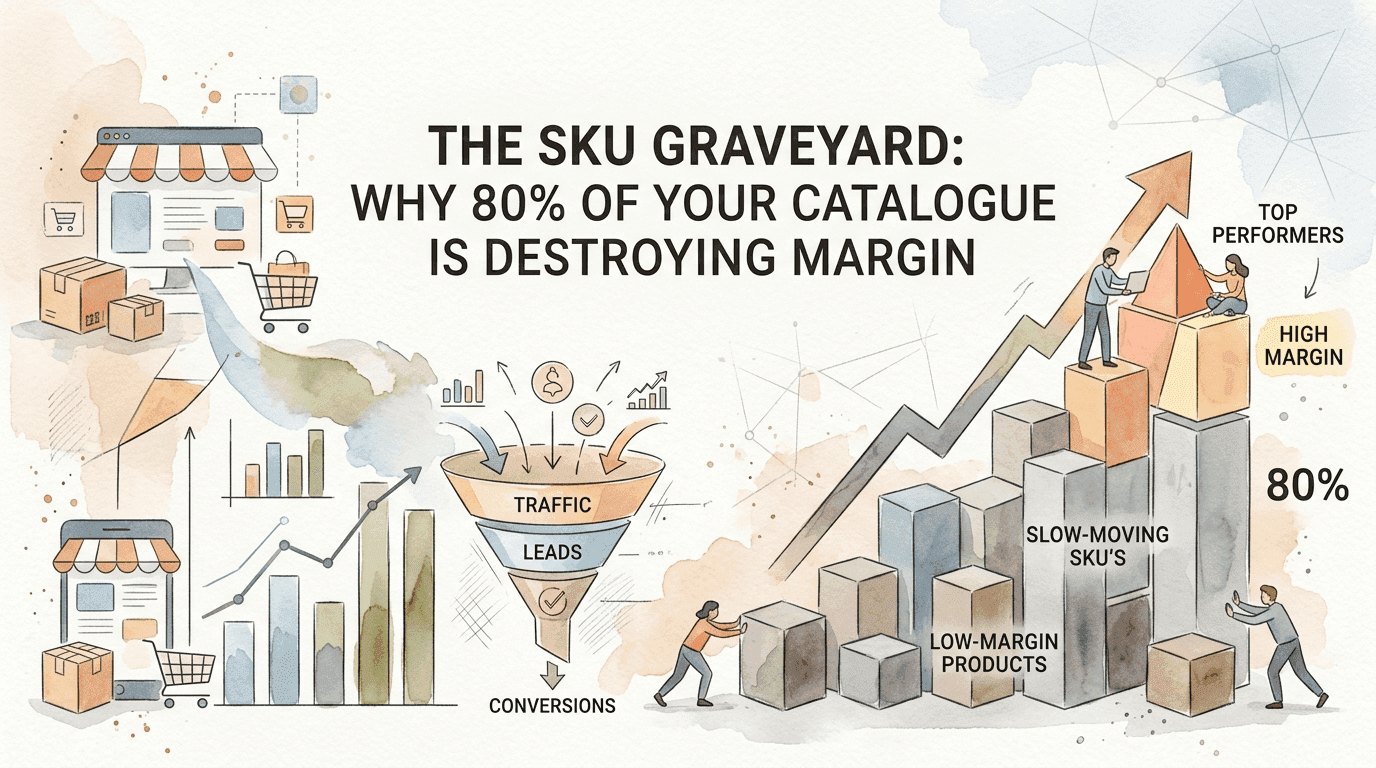
Here's the math that should terrify you: the 80/20 rule suggests that roughly 80% of profits come from just 20% of products sold. Flip that around, and 80% of your SKU count is generating marginal profit at best—and in many cases, actually costing you money when you account for true carrying costs.
This isn't a theoretical concern. Companies undergoing rigorous SKU rationalization boost margins by 25% while accelerating cycle times and improving operational efficiency. That margin improvement doesn't come from selling more. It comes from eliminating the products that drain resources without generating proportionate returns.
For Australian ecommerce businesses operating in the $2M to $5M revenue range, the product mix question isn't academic—it's existential. Your working capital is finite. Your warehouse has costs per square metre. Your team has limited attention. Every dollar and every hour spent on underperforming products is a dollar and hour stolen from your winners.
The Pareto Reality Behind Your Catalogue
The Pareto principle—that roughly 80% of effects come from 20% of causes—appears almost universally in ecommerce when you examine product performance. According to the principle, 20% generates 80% revenue.
But here's what most operators miss: the revenue distribution is actually the flattering version. When you layer in profitability—accounting for true cost of goods, carrying costs, markdown rates, and return rates—the concentration becomes even more extreme.
It's common to find that:
- 15% of SKUs generate 90% of gross profit
- 50% of SKUs generate near-zero or negative profit contribution
- 10-20% of SKUs actively destroy value when fully-loaded costs are applied
The reason this pattern persists is simple: most businesses evaluate products by revenue, not profit contribution. A product generating $50,000 annually looks valuable until you discover it requires $15,000 in safety stock, generates 35% returns, and demands heavy promotional spend to move.
Some SKUs generate sales revenue but lag on profitability. These "loss leaders" create the dangerous illusion of performance while actually subsidising their existence from your profitable products.
Why Catalogues Bloat
Catalogue bloat isn't random—it's the predictable outcome of how ecommerce businesses grow:
The "More Options" Fallacy: Operators believe customers want choice. So they add colours, sizes, and variants. Then similar products at different price points. Then accessories. Each addition seems low-risk individually, but the cumulative complexity compounds.
The Sunk Cost Trap: Products that required investment (photography, listing optimisation, minimum order quantities) feel impossible to kill. The investment is gone regardless, but the psychological burden keeps zombies alive.
The Revenue Distraction: A product generating any revenue gets defended. "It's still selling!" ignores whether that revenue exceeds the true cost of maintaining the SKU.
Supplier Relationships: Maintaining range breadth sometimes serves vendor relationships rather than customer demand. You carry products because your supplier expects it, not because customers want them.
Fear of Missing Out: Competitors carry certain products, so you feel obligated to match. You're optimising for perception of completeness rather than actual profit contribution.
Deloitte's 2024 Consumer Products Industry Outlook notes that companies should cautiously increase portfolio volume and focus on cost and efficiency to achieve profitable growth. The emphasis on "cautiously" reflects hard-won wisdom about the dangers of unchecked SKU proliferation.
The Product Profitability Protocol: A Framework for Rationalisation
Knowing you have a catalogue problem and fixing it are different challenges. Most businesses have tried ad-hoc product culling—discontinuing obvious failures—but haven't implemented systematic analysis.
The Product Profitability Protocol provides a structured approach to identify which products truly drive value versus which consume resources disproportionate to their contribution.
I developed this protocol after watching too many brands make emotional product decisions. Founders keep SKUs they personally love. Marketing protects products they've invested in promoting. The result is catalogue bloat that silently drains resources. This framework forces objective analysis that removes emotion from rationalisation decisions.
Step 1: True Cost Attribution
Before analysing product performance, you need honest cost allocation. Most P&L structures hide true product costs by treating storage, handling, and management as "overhead" rather than attributing them to specific SKUs.
Build a fully-loaded cost model including:
Direct Costs:
- Cost of goods sold (landed cost including freight, duties)
- Payment processing fees
- Pick, pack, and ship costs per unit
- Return processing costs (applied by return rate)
Carrying Costs:
- Storage cost per cubic metre per month × average inventory held
- Insurance allocation
- Cost of capital tied up in inventory (typically 8-12% annually)
- Shrinkage and damage allocation
Demand Generation Costs:
- Marketing spend required to sell this product
- Promotional markdown history
- Photography, content, and listing costs (amortised)
When you apply this fully-loaded cost model, products that looked profitable under simple COGS analysis often flip to marginal or negative contribution.
Step 2: Performance Stratification
With true costs established, stratify your entire catalogue using ABC analysis enhanced with profitability weighting:
A-Grade Products (Stars): Top 15-20% by both revenue AND profit contribution. These are your core catalogue—protect them, never let them stock out, and invest in driving more volume here.
B-Grade Products (Cash Cows): Middle 25-30% by revenue with acceptable margins. Solid contributors but not standouts. Maintain but don't prioritise.
C-Grade Products (Question Marks): Products with potential but inconsistent performance. New additions, seasonal items, or products with specific strategic purposes. These warrant investigation, not automatic culling.
D-Grade Products (Zombies): Bottom 40-50% by contribution with no strategic rationale for retention. Candidates for immediate rationalisation.
If 20% generate 80% of revenue of revenue, those SKUs should be prioritised for continued support, while the remaining 80% may need rationalisation.
Step 3: Strategic Role Assessment
Raw performance data doesn't capture full picture. Some low-volume products serve strategic purposes that justify their presence:
Traffic Drivers: Products that rank well in search and bring new visitors to your site, even if they convert to other purchases.
Bundle Enablers: Products purchased primarily as add-ons that increase AOV and customer satisfaction without standalone sales volume.
Range Credentials: Products that establish category authority (you carry professional-grade options even if hobbyist products dominate sales).
Strategic Exclusives: Products available only through your channel that build customer loyalty and differentiation.
Before culling any D-Grade product, assess whether it serves one of these strategic functions. If it does, quantify the value: "This product generates 500 monthly visitors who convert at 2.5% to other products averaging $85 contribution margin = $1,062.50 monthly strategic value."
Products without performance OR strategic justification are unambiguous rationalisation candidates.
The 60-Day SKU Rationalisation Sprint
Here's your execution playbook for cleaning up your catalogue:
Week 1-2: Data Foundation
Objective: Build the analytical foundation for evidence-based decisions.
- Export complete catalogue with 12-month sales history
- Calculate fully-loaded cost per SKU using the model above
- Compute contribution margin per unit and total contribution per SKU
- Rank all SKUs by contribution margin dollars
- Apply ABC stratification
- Flag any products under review for strategic roles
Deliverable: Complete SKU profitability database with performance stratification.
Week 3-4: Zombie Identification
Objective: Create definitive cull list.
- List all D-Grade products (bottom performers with no strategic rationale)
- Calculate total carrying cost of zombie inventory
- Identify products with negative contribution margin
- Review products with zero sales in past 90 days
- Flag products requiring heavy promotional support to move
- Assess remaining inventory levels for each zombie
Rationalisation triggers:
- Contribution margin below 10% AND bottom 40% by volume
- Zero sales in 90+ days with inventory on hand
- Return rate above 25% OR markdown rate above 30%
- Products requiring >20% of their revenue in marketing spend to sell
Deliverable: Prioritised cull list with inventory disposal recommendations.
Week 5-6: Exit Strategy Execution
Objective: Clear zombie inventory with maximum value recovery.
For products being discontinued:
Option 1: Liquidation
- Bundle with complementary products at breakeven or small loss
- Flash sale to email list (recover something vs. nothing)
- Sell to liquidators at 20-40 cents on the dollar
- Donate for tax benefit where applicable
Option 2: Clearance Pricing
- Set prices to clear within 60-90 days
- Remove from advertising spend immediately
- Deprioritise in on-site merchandising
- Accept margin compression for working capital recovery
Option 3: Return to Supplier
- Negotiate return terms where supplier relationships permit
- Often possible for slow-moving products bought on flexible terms
- May require accepting credits rather than cash
A European retailer case study implementing SKU rationalisation identified 200 items with sporadic demand, reduced operating expenses by €2 million, and identified opportunity to drive €10 million bottom-line impact per facility.
Week 7-8: Resource Reallocation
Objective: Redirect freed resources toward winners.
With zombie inventory cleared:
- Reallocate marketing budget from discontinued products to A-Grade items
- Free warehouse space for deeper stock of top performers
- Redirect content/photography resources to showcase core range
- Simplify supplier relationships where vendor breadth reduced
- Update demand forecasting to exclude discontinued SKUs
Measurement framework:
- Track blended contribution margin pre- vs. post-rationalisation
- Monitor stock-out rate on A-Grade products
- Calculate working capital freed and redeployed
- Document operational simplification (fewer SKUs to manage)
Ongoing Catalogue Governance
SKU rationalisation isn't a one-time project. Without governance, catalogues naturally re-bloat through the same forces that created the original problem.
Implement these ongoing controls:
New Product Gate
Every new SKU addition requires business case approval:
- Projected annual contribution margin
- Minimum viable order quantity analysis
- Cannibalisation assessment (will this steal sales from existing winners?)
- Required marketing investment to launch
- Exit criteria (at what point would we discontinue?)
"We should carry this" isn't sufficient justification. Quantify the expected return.
Quarterly Performance Review
Every 90 days, review:
- Products declining from B-Grade to C-Grade (early warning)
- Products with increasing return rates
- Products requiring promotional dependence
- Products with inventory days above category average
Annual Rationalisation Cycle
Run full Product Profitability Protocol annually:
- Complete re-stratification
- Identify new zombies accumulated since last review
- Assess strategic role validity for retained low-performers
- Plan systematic exit for underperformers
SKU rationalisation helps ecommerce businesses maintain an optimal product mix by identifying and prioritising high-performing SKUs while minimising stockouts, excess inventory, and associated costs.
The Counterintuitive Truth: Less Is More
The instinct toward catalogue expansion feels growth-oriented. More products mean more opportunities to capture sales, right?
The evidence suggests otherwise.
Strategic SKU rationalisation can be a step to broader business improvements. By examining and refining your assortment strategy, you are, by default, shining a light on how well your business manages the most important KPIs: sales, stock, and profit.
Costco exemplifies this principle at scale. They stock around 4,000 fast-moving SKUs per store—dramatically fewer than competitors—yet generate industry-leading revenue per square metre. The constraint forces discipline. Every SKU must earn its place.
The benefits of a smaller assortment include concentrating consumer demand on fewer products, eliminating complexity and cost, and focusing time and resources on products most important to the customer.
For Australian ecommerce businesses, the same logic applies to your virtual shelves and physical warehouse. Every zombie SKU consumes:
- Working capital that could buy more of your winners
- Warehouse space that could improve pick efficiency
- Team attention that could optimise core products
- Website real estate that could showcase top performers
The rationalisation math is straightforward: if you can improve contribution margin by 25% while simultaneously freeing working capital and simplifying operations, the case for fewer SKUs becomes overwhelming.
The New North Star Metric: Catalogue Productivity Index
Stop counting SKUs. Start measuring Catalogue Productivity Index (CPI)—the profit generated per active SKU in your catalogue.
The Calculation:
CPI = Annual Gross Profit / Number of Active SKUsInterpretation:
- CPI > $5,000: Excellent—lean catalogue with strong performers
- CPI $2,000-$5,000: Healthy—reasonable SKU productivity
- CPI $500-$2,000: Marginal—catalogue bloat likely
- CPI < $500: Critical—significant zombie SKU problem
This metric rewards focus over proliferation. Adding a SKU that generates $1,000 in profit but reduces CPI indicates the new product dilutes rather than strengthens your catalogue.
The Catalogue Strategy
Your catalogue isn't a museum. It's not your job to preserve every product you've ever sourced. Your job is to maximise profit from your inventory investment—and that almost always means carrying fewer, better products stocked more deeply.
Start the audit. Identify the zombies. Execute the cull.
Your A-Grade products will thank you with the resources they deserve.
Unit Economics Calculator
Contribution margin per order after COGS, shipping and fees — the number scaling actually depends on.
Inventory Turnover Analysis for Ecommerce
Product Profitability Analysis Template
Inventory Turnover Calculator [Tool]
Contribution Margin Calculator by Product [Tool]
The SKU Rationalization Framework That Survives Q2
The Inventory Paradox: Why Fast-Growing Brands Die With Full Warehouses
Newsletter
The Uncommon Insights Letter
Practical FMCG & eCommerce growth playbooks — margins, retention and scaling tactics, straight to your inbox.
Turn unit economics into profit you can see
Get a hands-on operator to turn the frameworks above into results — book a free audit call.