Your Personalization Is Creepy (And It's Not Working)
41% of customers find retail personalization creepy-and 96% of retailers struggle to execute it effectively. Learn the "Permission-Based Personalization" framework that turns invasive targeting into welcomed relevance, with the data hierarchy that respects privacy while driving conversion.
11 min read · 22 June 2025
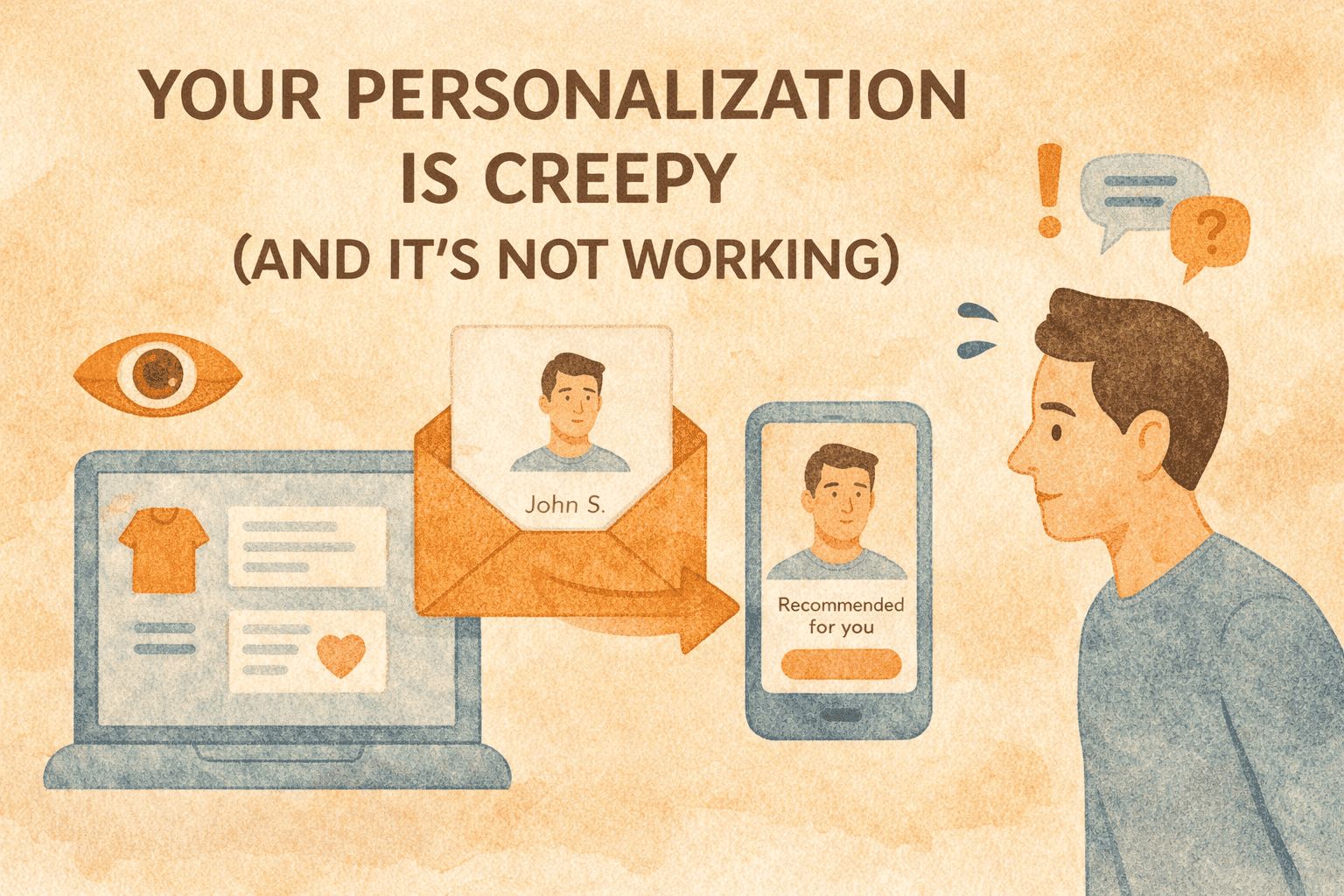
The Uncanny Valley of Retail
You know the feeling. You mention something in conversation-dog food, running shoes, a vacation destination-and within hours, your Instagram feed fills with ads for exactly that thing. Coincidence? Probably not. Creepy? Absolutely.
Now consider: you're doing the same thing to your customers.
41% of consumers find personalization creepy. That's not a fringe reaction. That's nearly half of all consumers telling you that location-triggered messages feel invasive. And if proximity alerts feel creepy, so do retargeting ads that follow customers across the internet, emails referencing products they viewed but didn't buy, and recommendations based on data they don't remember sharing.
The paradox is maddening. 80% more customers buy from personalized experiences. They want personalization. They also find it creepy. They want you to know their preferences. They also don't want to feel watched.
The problem isn't personalization itself-it's how it's executed. Most ecommerce personalization operates in the uncanny valley: sophisticated enough to feel personal, but not thoughtful enough to feel helpful. It reveals what you know about customers without demonstrating why that knowledge benefits them.
85% of companies use personalization, but only 60% of customers find it helpful. That 25-point gap is the difference between your intention and their perception. You think you're being helpful. They think you're being creepy.
---
Why Your Personalization Feels Like Surveillance
Most personalization systems are built backwards. They start with data collection-what can we learn about this customer?-and then figure out how to use that data. The result is personalization that serves the company's need to demonstrate intelligence rather than the customer's need for relevant experiences.
Consider a typical personalization flow: 1. Customer browses product page 2. System captures browse event 3. Customer leaves site 4. Retargeting pixel fires 5. Customer sees ads for that product everywhere 6. Customer feels stalked
The system "worked." Data was captured. Personalization was delivered. But the experience was terrible. The customer didn't feel understood-they felt surveilled.
35% of customers feel uncomfortable with cross-platform tracking. This isn't irrational. They searched on one platform. The ad appeared on another. The only explanation is that data was shared without their explicit awareness. Even if they technically consented (buried in terms of service nobody reads), the experience feels like a violation.
The fundamental error is treating personalization as a targeting mechanism rather than a service mechanism. Targeting asks: "How can we use what we know to get the customer to buy?" Service asks: "How can we use what we know to make the customer's experience better?"
These questions lead to radically different implementations:
Targeting approach: Customer viewed a winter coat. Show them winter coat ads until they buy or die.
Service approach: Customer viewed a winter coat but didn't purchase. Next visit, surface a size guide, customer reviews of that specific coat, and styling suggestions-helping them make a confident decision if they return.
The targeting approach is creepy. The service approach is helpful. Both use the same data. The difference is intent-and customers can feel the difference.
---
The Data Hierarchy: What Customers Actually Accept
Not all personalization data is created equal. Customers have intuitive frameworks for what feels acceptable and what feels invasive. Understanding this hierarchy is essential for personalization that helps rather than horrifies.
Tier 1: Explicit Preferences (Highly Acceptable)
Data the customer knowingly shared specifically for personalization purposes:
- Quiz responses ("What's your skin type?")
- Preference center selections
- Stated interests during account creation
- Feedback on recommendations ("Show me more like this")
This data carries implicit permission. The customer provided it expecting you to use it. Using it feels like fulfilling a promise rather than violating privacy.
Tier 2: Transaction History (Generally Acceptable)
Data generated through direct business interactions:
- Past purchases
- Order history
- Return patterns
- Subscription preferences
Customers understand that companies track purchases. Using this data feels like good memory rather than surveillance. "Based on your previous order..." is relationship continuity, not stalking.
Tier 3: On-Site Behavior (Moderately Acceptable)
Data collected while customers are actively engaged with your properties:
- Pages viewed during current session
- Items added to cart
- Search queries on your site
- Time spent on specific products
This data is generated in context. The customer knows they're on your site, browsing your products. Using it to improve their current experience feels reasonable. Using it to follow them across the internet feels less so.
Tier 4: Cross-Site Tracking (Increasingly Unacceptable)
Data collected beyond your owned properties:
- Third-party cookies
- Retargeting pixels
- Cross-device tracking
- Location data
This is where personalization gets creepy. Using cross-site tracking data causes customer disengagement. The customer didn't give you this data directly. They may not know you have it. When you reveal that you do, trust erodes.
Tier 5: Inferred Personal Details (Highly Unacceptable)
Data derived from analysis rather than direct collection:
- Life events (pregnancy, divorce, job loss)
- Health conditions
- Financial status
- Relationship status
Even if you could accurately infer these details, using them for personalization is almost always a mistake. The famous Target pregnancy prediction story wasn't a success story-it was a cautionary tale about personalization that crosses lines customers didn't know existed.
---
Permission-Based Personalization: A Framework
Permission-Based Personalization (PBP) inverts the traditional approach. Instead of starting with data collection and figuring out how to use it, PBP starts with customer value and works backward to what data enables that value.
The Three Principles:
Principle 1: Transparency Over Inference
Never personalize based on data the customer doesn't know you have. If you can't explain how you know something, don't use it.
Bad: "We noticed you've been researching competitors..." Good: "Based on your wishlist..."
Bad: "Since you're expecting a baby..." Good: "Based on your recent purchase of newborn essentials..."
Transparency doesn't mean disclosing every data point in every interaction. It means that if questioned, you could explain your knowledge without the customer feeling violated.
Principle 2: Value Exchange Over Extraction
Every data request should offer clear value in return. Don't collect data "just in case"-collect data to enable specific, stated benefits.
Bad: "Enter your birthday for our records." Good: "Share your birthday to receive a special gift on your special day."
Bad: "Allow location access." Good: "Allow location access to see what's available for same-day delivery near you."
57% of online shoppers will share data for better experiences. The key word is "exchange." Customers are willing to trade data for value-but they need to see the value first.
Principle 3: Enhancement Over Intrusion
Personalization should make the experience easier, faster, or more relevant-not just more targeted. If personalization primarily benefits your conversion rate rather than customer experience, it's intrusion masquerading as service.
Enhancement: Pre-filling shipping address for returning customers Intrusion: Sending push notifications based on proximity
Enhancement: Showing recently viewed items for easy return Intrusion: Showing recently viewed items in retargeting ads across the internet
Enhancement: Recommending complementary products based on cart contents Intrusion: Recommending products based on data harvested from other sites
---
The Four Personalization Zones
Different touchpoints call for different personalization intensities. Not every interaction needs to be personalized, and over-personalization can feel as off-putting as no personalization at all.
Zone 1: High-Context, High-Personalization
Customer is logged in, actively engaged, with clear intent signals:
- Personalize product recommendations based on browse history
- Surface relevant content based on stated interests
- Pre-fill forms with known information
- Show inventory and delivery options for their location
In this zone, personalization is expected and welcomed. The customer is identified, engaged, and seeking assistance. Use what you know.
Zone 2: Mid-Context, Mid-Personalization
Customer is anonymous or lightly engaged:
- Personalize based on current session behavior only
- Use geographic data for regional relevance
- Surface popular or trending items as social proof
- Recommend based on similar anonymous shoppers
In this zone, light personalization improves experience without crossing privacy boundaries. You're using context, not surveillance.
Zone 3: Low-Context, Low-Personalization
Customer is new, anonymous, with no behavior signals:
- Present best-sellers and popular categories
- Offer easy navigation to major product areas
- Surface seasonal or promotional content
- Focus on brand story and value proposition
In this zone, trying to personalize often backfires. You don't know enough to be helpful, and guessing wrong is worse than not guessing.
Zone 4: Opt-In Personalization
Customer has explicitly requested personalized experience:
- Style quizzes that inform product recommendations
- Preference centers that control content and communication
- Personalized product builders (customize your box, build your bundle)
- Saved preferences for repeat customization
This zone is the highest-value personalization because it's entirely permission-based. The customer invited you to personalize. Use their invitation fully.
---
Building the Permission Stack
The most effective personalization programs build a "permission stack"-layers of explicit customer consent that enable increasingly personal experiences.
Layer 1: Session Consent
When a customer first arrives, acknowledge data use and offer control:
- Clear cookie consent that explains what you track and why
- Option to browse anonymously
- Promise of how data improves their experience
77% of consumers prefer brands that are transparent about data use. Starting with transparency builds trust that enables deeper personalization later.
Layer 2: Account Creation
When a customer creates an account, explicitly request personalization permissions:
- Ask what product categories interest them
- Invite preference selection (size, style, frequency)
- Explain what account data you'll use and how
37% of brands collect preferences during account creation. Account creation is your opportunity to build first-party data with explicit permission.
Layer 3: Preference Center
Give customers ongoing control over their personalization experience:
- Communication preferences (frequency, channels, topics)
- Product recommendations (categories to show/hide)
- Marketing permissions (promotions, new arrivals, sale alerts)
- Data visibility (what you've stored about them)
A robust preference center transforms personalization from something done to customers into something done with customers.
Layer 4: Progressive Profiling
Over time, request additional information in exchange for specific value:
- "Share your birthday for a special gift"
- "Tell us your size for personalized recommendations"
- "Complete this quiz for curated product suggestions"
Each request adds to the permission stack. Each granted permission enables better personalization. The customer builds their own personalization experience through deliberate choices.
---
What to Stop Doing Immediately
Some personalization tactics are so consistently creepy that they should be eliminated regardless of their performance metrics:
Stop: Aggressive Retargeting
Following customers with the same product ad for weeks feels like stalking. half of consumers dodge retargeting. They know what you're doing. They're gaming your retargeting. Stop treating them like they've forgotten-they haven't.
Instead: One reminder email within 24 hours. One retargeting impression within 48 hours. Then move on.
Stop: Hyper-Specific Behavioral Triggers
"We noticed you spent 4 minutes and 32 seconds on the blue dress" reveals surveillance that customers find disturbing. Knowing something and announcing that you know it are different things.
Instead: "You might like these similar styles" without revealing the creepy precision of your tracking.
Stop: Cross-Platform Data Revelation
"Since you visited our store in Denver last weekend..." connects online and offline data in ways that feel invasive. Even if customers know this technically possible, having it revealed is jarring.
Instead: "Available for pickup at your nearest location" without revealing that you know exactly where they've been.
Stop: Life-Event Targeting
Using inferred data about major life events (pregnancy, divorce, health changes, job loss) for personalization is a disaster waiting to happen. The inference might be wrong. Even if right, the personalization feels like an invasion.
Instead: Let customers self-identify for life-event relevant products through opt-in mechanisms.
---
The Personalization Maturity Model
96% of retailers. Most are stuck at early maturity levels, deploying basic tactics without the infrastructure for sophisticated, permission-based approaches.
Level 1: Reactive Personalization
Basic personalization based on obvious signals:
- Showing recently viewed items
- Addressing customers by name in emails
- Geographic adjustments (currency, shipping options)
This level is table stakes. It's expected, not differentiating.
Level 2: Behavioral Personalization
Personalization based on observed on-site behavior:
- Product recommendations based on browse history
- Cart abandonment sequences
- Category affinity targeting
This level can be helpful or creepy depending on execution. Focus on service, not surveillance.
Level 3: Preference-Based Personalization
Personalization based on explicitly stated preferences:
- Quiz-driven recommendations
- Preference center selections
- Saved customizations
This level is where permission-based approaches begin. Personalization feels collaborative rather than imposed.
Level 4: Predictive Personalization
Personalization based on patterns and predictions:
- Next-purchase prediction
- Churn risk intervention
- Lifetime value optimization
This level requires sophisticated data infrastructure and careful ethical guardrails. Predictions should enhance experience, not manipulate behavior.
Level 5: Anticipatory Personalization
Personalization that solves problems before customers articulate them:
- Proactive reorder suggestions based on consumption patterns
- Issue resolution before complaints
- Product updates based on emerging needs
This level is rare and valuable. It requires deep understanding combined with genuine service orientation.
---
Metrics That Matter
Stop measuring personalization by targeting efficiency. Start measuring it by customer experience impact.
Primary Metrics:
Personalization Satisfaction Score: Post-interaction survey asking "Did our recommendations feel relevant and helpful?" Direct measurement of customer perception.
Permission Stack Depth: Average number of explicit permissions granted per customer. Deeper stacks indicate trust and enable better personalization.
Opt-Out Rate: Percentage of customers who disable personalization features. Rising opt-outs indicate you've crossed into creepy territory.
Preference Center Engagement: Percentage of customers who actively manage their preferences. Engagement indicates customers value and trust your personalization.
Secondary Metrics:
Recommendation Adoption Rate: Percentage of personalized recommendations that result in add-to-cart or purchase. High adoption indicates relevance.
Content Personalization CTR: Click-through rate on personalized content versus generic content. But watch for quality-clicks driven by surveillance feel different than clicks driven by relevance.
Time on Site (Personalized vs. Anonymous): Do personalized experiences increase engagement? Or do they make customers want to leave faster?
Metrics to Deprioritize:
Retargeting Conversion Rate: High conversion might indicate effective stalking, not effective personalization. Question whether those conversions are healthy long-term relationships.
Data Collection Volume: More data isn't better if customers didn't knowingly provide it. Focus on permission-based data quality.
Personalization "Coverage": What percentage of site is personalized matters less than whether personalization improves experience.
---
The Privacy-First Future
The regulatory environment is tightening. Third-party cookies are dying. Privacy-conscious consumers are growing, especially in younger demographics. 43% of Baby Boomers want personalized experiences-but even Gen Z expects privacy respect.
Despite privacy constraints, permission-based personalization thrives. That's not a personalization crisis-it's a bad-personalization crisis. Permission-based approaches survive and thrive in privacy-first environments.
61% of high-performing brands prioritize first-party data. First-party data-information customers knowingly provide-is the foundation of sustainable personalization.
The future belongs to brands that can answer this question: "If I showed my customer exactly what I know about them and how I use it, would they feel served or surveilled?"
If the answer is surveilled, your personalization is creepy. Fix it before your customers do it for you-by leaving.
CAC : LTV Calculator
Lifetime value, payback and the ratio that decides whether you can afford to grow.
SMS Marketing Isn't a Channel-It's a Retention Weapon (If You Stop Spamming)
How Behavioral Data Improves Funnel Personalization
Your Push Notifications Are Training Customers to Ignore You
Zero Party Data Retention Strategies That Actually Work
Your Birthday Emails Are Lazy Revenue Theater - Here's What Actually Works
How AI Recommendations Boost Repeat Purchases
Newsletter
The Uncommon Insights Letter
Practical FMCG & eCommerce growth playbooks — margins, retention and scaling tactics, straight to your inbox.
Turn customer retention into profit you can see
Get a hands-on operator to turn the frameworks above into results — book a free audit call.