The Attribution Decay Problem: Why Your Last-Click Model Shows 40% Higher ROAS Than Reality
Last-click attribution overstates ROAS by ~40% by crediting only the final touch and hiding the true value of awareness channels.
5 February 2026
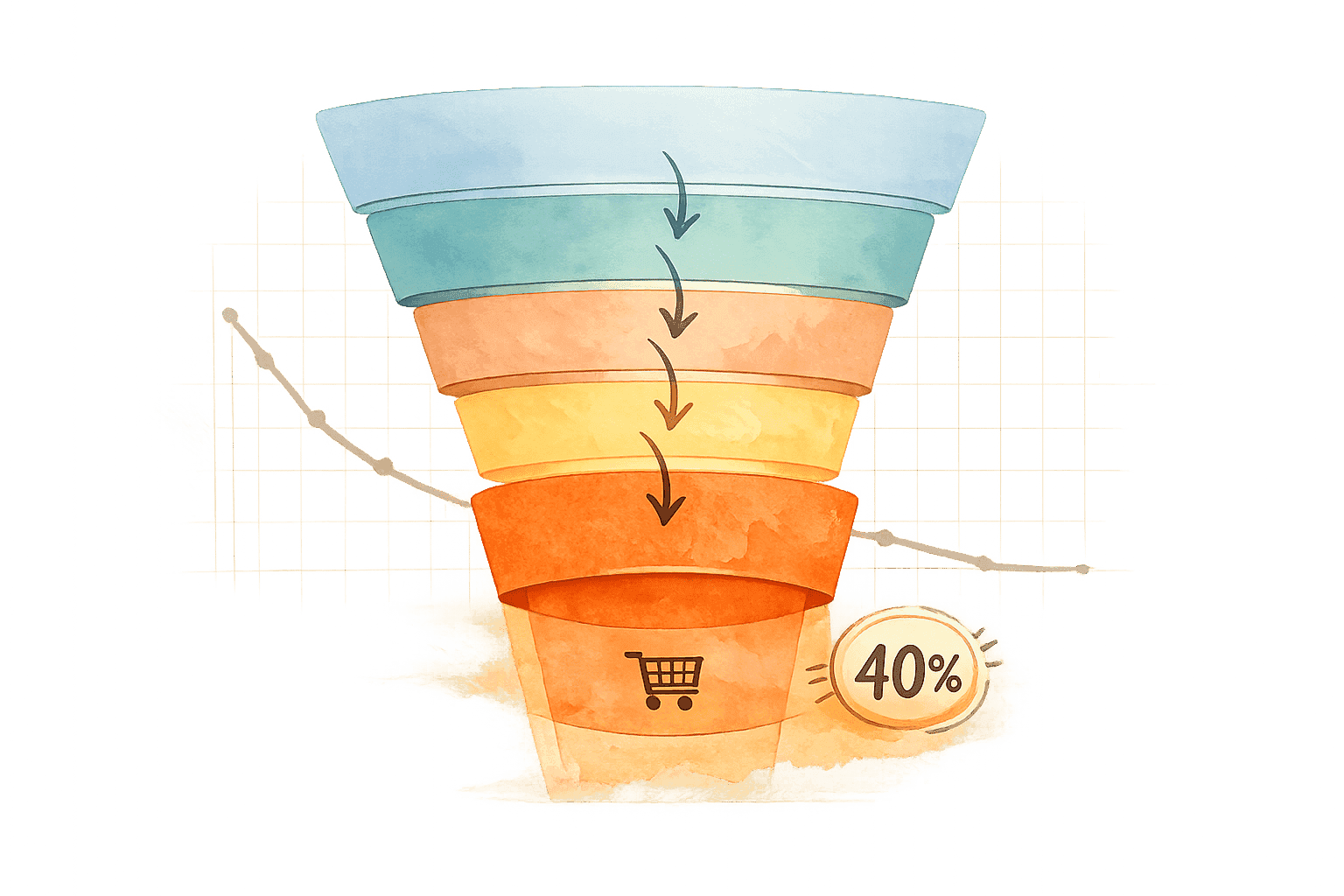
Your last-click attribution model might be lying to you. It can inflate your return on ad spend (ROAS) by as much as 40%, leading you to believe campaigns are more profitable than they actually are. This happens because last-click models give all the credit to the final interaction in a customer’s journey, ignoring earlier touchpoints like social ads, emails, or display campaigns that sparked interest and built intent.
Here’s why this matters:
- Inflated Metrics: Platforms like Google Ads and Meta often over-credit bottom-funnel tactics like branded search and retargeting ads.
- Wasted Budgets: Up to 47% of marketing budgets are misallocated due to flawed attribution models.
- Missed Opportunities: Upper-funnel channels, which drive awareness and demand, are undervalued, leading to a "channel death spiral" when budgets are cut.
The solution? Shift to better attribution models like data-driven attribution (DDA), which uses machine learning to assign credit across all touchpoints. Brands like Geox and Crédit Agricole Italia have already seen improved ROAS and efficiency by adopting this approach.
If you’re relying on last-click attribution, it’s time to rethink your strategy. Run a 90-day comparison between last-click and data-driven models, analyse discrepancies, and adjust your budgets to reflect what’s truly driving revenue. Don’t let misleading metrics cost you money.
Marketing Attribution Tutorial: Everything You Need to Get Started
What Attribution Decay Is and How It Distorts Last-Click Models
Attribution decay happens when earlier customer interactions are overshadowed or ignored, leaving the final touchpoint with all the credit. In this setup, the channel that closes the sale gets 100% of the recognition, while the ones that sparked interest or built intent are left out entirely.
Here’s how it plays out: imagine a customer sees an Instagram ad, reads a blog post, and engages with several marketing emails before finally clicking on a branded search ad to make a purchase. A last-click attribution model would give all the credit for that A$150 sale to the search ad. But in reality, that ad likely captured an already interested buyer rather than creating the demand. This approach overlooks the crucial role of earlier touchpoints in shaping the customer’s journey.
The financial impact of this distortion is hard to ignore. Studies reveal that 47% of marketing budgets are wasted due to poor data visibility and flawed attribution models like last-click. Even worse, 51% of marketing leaders say platform-provided metrics are misleading. These aren’t just minor errors - they’re major misinterpretations of what’s driving revenue.
How Attribution Decay Works
Let’s break it down further. Last-click models follow a simple rule: 100% of the credit for a conversion goes to the final interaction. This system rewards the "closer", while ignoring the "creators" that sparked the initial interest.
"Last click cuts that sequence and rewards only the finisher. The problem is that this simplicity hides reality."
- Gabrielle Thomson, Customer Science
Here’s the kicker: a typical retail customer journey involves an average of 56 touchpoints from introduction to purchase, often across multiple devices. Last-click attribution completely overlooks the other 55. And with privacy changes - like Apple’s AppTrackingTransparency and the decline of third-party cookies - early-stage interactions are becoming harder to track. This makes it seem like conversions happen with fewer touchpoints than they actually do.
Platforms add to the problem with short attribution windows, like a 30-day click or a 7-day view-through window. This allows platforms to claim credit for conversions that may have happened anyway. Take branded search as an example: its true impact often shows an incrementality of just 10–30%, meaning most customers would have converted without the ad. Yet, under last-click attribution, it still gets 100% of the credit.
Examples of Misattributed ROAS in Practice
Real-world examples show how misattribution skews return on ad spend (ROAS).
In November 2025, Billy Footwear shifted to multi-touch attribution using first-party tracking to escape the limitations of last-click reporting. Their analysis revealed that Instagram was crucial for building awareness, while email was being over-credited. By reallocating budgets based on actual influence, the company achieved a 72% year-over-year increase in ad revenue with only a 7% increase in ad spend, improving efficiency by 10.3X.
In another case, Crédit Agricole Italia moved away from a last-click model that favoured Search ads and adopted a data-driven approach incorporating Display ads. Collaborating with Hearts & Science and using Smart Bidding, they discovered Display was driving 85% more conversions than previously assumed. This shift resulted in an 8% boost in incremental conversions and an 8% reduction in cost per lead.
Geox, an Italian footwear brand, also saw a transformation. In August 2021, they consolidated raw social data into Google’s Search Ads 360 to move beyond fragmented datasets. According to Giulio Salvucci, Geox’s Global Digital Business and Innovation Director, this approach illuminated the role of paid social in driving cross-device conversions. The result? A 6% increase in ROAS and a 30% reduction in time spent managing campaigns.
"The social integration provided us with a better picture of cross‐channel marketing data impact and allowed us to open up new audiences across Search and social."
- Giulio Salvucci, Global Digital Business and Innovation Director, Geox
These cases reveal a consistent pattern: channels dismissed as low-performing under last-click attribution were actually driving meaningful results. Misattribution often leads to budget cuts for activities that build awareness, weakening the entire marketing funnel - a phenomenon known as the "Channel Death Spiral".
Why Last-Click Models Inflate ROAS by 40%
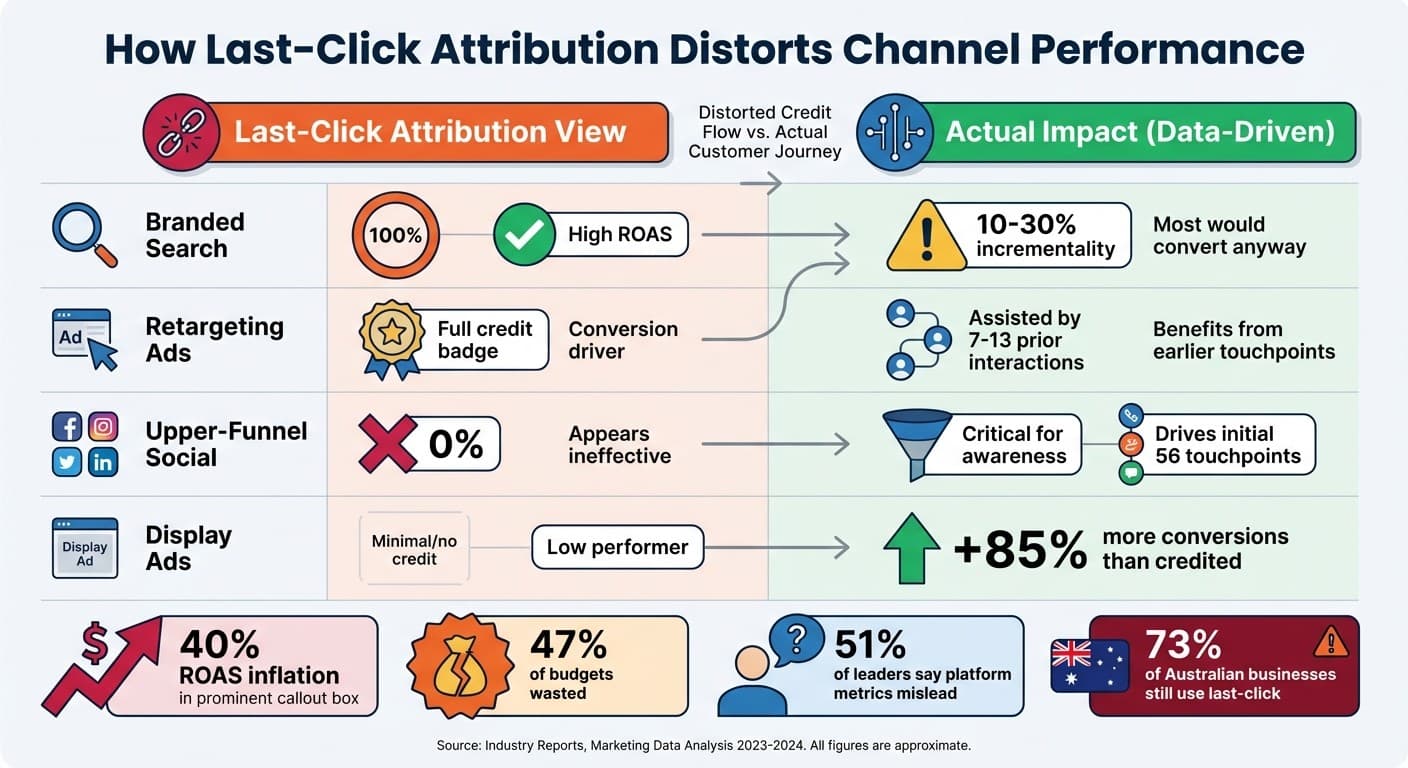
Last-Click vs Data-Driven Attribution: Channel Performance Comparison
Last-click models can inflate ROAS by as much as 40% because they focus solely on the final touchpoint in the customer journey. This approach ignores the 7–13 interactions a customer typically has with a brand before making a purchase. By over-crediting the last interaction, these models create the illusion that bottom-funnel tactics are far more effective than they actually are. This flawed perspective calls for a rethink of how marketing performance is measured.
How Last-Click Models Miss the Mark in Multi-Channel Journeys
The problem with last-click models lies in how they distribute credit. Imagine a customer who sees a Facebook ad, reads a blog post, watches a YouTube video, and then clicks on a retargeting ad to make a purchase. The retargeting ad gets all the credit, even though earlier touchpoints played a crucial role. This misattribution, often called "undeserved credit", makes retargeting ads and branded search campaigns seem more impactful than they truly are.
This pattern is common. As noted earlier, many businesses find their actual ROAS is much lower when they adopt more accurate tracking methods.
The issue has been magnified by privacy changes. Updates like Apple's AppTrackingTransparency and the phasing out of cookies mean that early-stage signals are often lost, leaving only the final conversion pixel to track. This further skews the data, making last-click channels appear disproportionately effective.
Now, let’s look at the numbers behind this overestimation.
Data on ROAS Overestimation
The data paints a troubling picture. Last-click models misattribute 30–50% of marketing credit, yet 73% of Australian businesses still rely on these outdated models despite their flaws. The financial consequences are substantial - 47% of marketing budgets may be wasted due to poor attribution and data visibility.
Here’s how last-click behaviour affects different channels:
| Channel Type | Last-Click Behaviour | Actual Impact | Result |
|---|---|---|---|
| Branded Search | Assigns 100% credit to the final click | Captures existing demand without fully reflecting incremental contributions | Inflates ROAS |
| Retargeting | Receives full credit for conversion | Benefits from earlier touchpoints that generate intent | Overstates impact |
| Upper-Funnel Social | Gets no credit despite driving multiple touchpoints | Plays a critical role in 7–13 interactions leading to conversion | Severely under-credited |
| Display Ads | Often ignored by last-click models | Proper attribution reveals up to 85% more conversions driven by display ads | Misrepresented impact |
The gap between platform-reported data and reality is stark. A staggering 51% of marketing leaders report that platform attribution data is unreliable. Additionally, cross-device tracking often uncovers 15–25% more customer interactions compared to single-device methods.
"Attribution doesn't measure impact, it measures paths and optimising paths is just optimising noise."
- Andie Potter, Marketing Scientist, Mutinex
In short buying cycles with multiple touchpoints, last-click attribution fails to account for the value of assist interactions. This leads to an inflated view of bottom-funnel strategies.
These measurable inaccuracies highlight the need for more effective attribution models.
Alternative Attribution Models That Improve Accuracy
When it comes to understanding the customer journey, sticking to last-click attribution often paints an incomplete picture. Thankfully, alternative models exist that distribute credit across multiple touchpoints, offering a more nuanced view of how different channels work together. These models can help businesses uncover a clearer path to conversion and provide more dependable insights into return on ad spend (ROAS). The key is to select a model that aligns with your business goals and customer journey.
Comparing Attribution Models: Benefits, Drawbacks, and When to Use Each
Different attribution models offer distinct ways of assigning credit to touchpoints. Here’s a breakdown of the most common ones:
- Linear attribution assigns equal credit to all touchpoints. It’s ideal for campaigns where consistent engagement across the customer journey is crucial, such as long sales cycles.
- Time Decay gives more weight to touchpoints closer to the conversion. With a typical "half-life" of seven days, it’s particularly useful for short-term promotions or flash sales.
- Position-Based attribution (also known as U-shaped) splits credit unevenly: 40% goes to both the first and last interactions, while the remaining 20% is shared among the middle touchpoints. This model is great for businesses that want to emphasise both initial brand awareness and final conversion.
However, as of November 2023, Google has phased out several of these rule-based models - including first-click, linear, time-decay, and position-based - shifting its focus to data-driven attribution (DDA) instead.
| Attribution Model | Credit Allocation | Best Use Case | Status |
|---|---|---|---|
| Last-Click | 100% to the final touchpoint | Best for transactional businesses with minimal consideration phase | Still supported |
| Linear | Equal credit to all touchpoints | Ideal for long sales cycles requiring steady engagement | Deprecated by Google |
| Time Decay | More credit closer to conversion (7-day half-life) | Works well for flash sales or short-term promotions | Deprecated by Google |
| Position-Based | 40% first, 40% last, 20% middle | Useful for balancing awareness and closing | Deprecated by Google |
| Data-Driven | Algorithmic credit based on historical impact | Best for complex, multi-channel journeys | Default/Recommended |
These models provide alternatives to last-click attribution, addressing its limitations and offering insights into multi-channel influence.
How Data-Driven Attribution Works
Among the models discussed, data-driven attribution (DDA) stands out as a modern, algorithm-based approach. It uses machine learning to analyse customer paths - both converting and non-converting - assigning credit to touchpoints based on their actual influence. The model employs a counterfactual approach, comparing what happened with what might have occurred, to identify which interactions significantly drive conversions.
"Data-driven attribution models use machine learning and predictive analytics to pinpoint the most influential touchpoints based on customer data... making it the most accurate model."
- Darshil Gandhi, Director, Product Marketing, Amplitude
Take the example of Geox, an Italian footwear brand. By switching to DDA with the help of agency Webranking, Geox integrated raw social data into Search Ads 360, streamlining its cross-channel strategy. The result? A 6% improvement in ROAS and a 30% reduction in campaign management time. Similarly, Crédit Agricole Italia moved from last-click attribution to DDA, uncovering an 85% increase in Display conversions - a figure completely overlooked with their previous approach.
Launching a data-driven attribution model doesn’t require extensive resources. Businesses can implement DDA with as few as 3,000 ad interactions and 300 conversions in a single month. This makes it a practical option even for mid-sized Australian companies aiming to refine their attribution strategies and gain better insights.
How to Implement Better Attribution Models
Shifting from a last-click approach to a more accurate attribution model doesn’t have to mean starting from scratch. The key is to focus on the specific decisions you need to improve - whether that’s reallocating your budget between channels, tweaking creative frequency, or pinpointing the campaigns that actually drive revenue. With this clear purpose, you can dive into campaign analysis, leverage the right tools, and conduct ongoing AI-based audits to refine your strategy.
Analysing Your Marketing Campaigns
Begin by comparing what your marketing platforms report with the actual results in your backend system. If platforms like Google Ads and Meta collectively claim 300% more conversions than your actual sales, it’s a sign of overlapping attribution claims. This happens because each platform uses its own attribution windows and methods, often crediting the same purchase multiple times.
To get a clearer picture, run a comparison test. Use Google Ads or GA4’s model comparison reports to contrast the "Last Click" model with "Data-Driven" or "Linear" models. Pay close attention to campaigns or keywords that show drastic performance differences. For example, if branded search dominates under last-click but shrinks under data-driven attribution, it likely indicates you’re over-investing in bottom-funnel channels and underfunding awareness efforts.
Also, be wary of the "channel death spiral." Cutting budgets for upper-funnel channels like display or social - because they appear low-performing - can lead to a decline in branded search results. This is often a sign that your last-click model is masking the real value of those awareness channels.
Using Tools and Frameworks for Attribution
Once you’ve identified discrepancies in your campaign data, streamline your process using accessible tools and frameworks. You don’t need high-cost enterprise solutions to get started. For example, Google Ads now offers data-driven attribution for accounts with as few as 3,000 ad interactions and 300 conversions over 30 days. For many Australian eCommerce businesses, this is achievable within a month of regular operations.
To create a reliable foundation, build a unified table that combines your daily spend, impressions, clicks, and CRM sales data. This helps you identify discrepancies and avoid double-counting. Strengthen your tracking setup by implementing server-side tagging to combat ad-blocker losses, using consistent event names across platforms, and deploying durable first-party identifiers like hashed emails.
For better budget allocation, consider combining tactical attribution with Media Mix Modelling (MMM). While multi-touch attribution examines individual user paths, MMM uses aggregated data to evaluate channel performance over time, making it resilient to cookie loss. Open-source tools like Robyn (developed by Meta) can simplify MMM diagnostics, allowing you to adopt this approach without needing a dedicated data science team.
Using AI for Ongoing ROAS Audits
Attribution isn’t a one-and-done task. It requires regular updates as customer behaviour and platform algorithms evolve. Rerun your models every quarter with fresh data. AI-driven methods like Markov chain analysis can estimate the incremental impact of each touchpoint by calculating how conversion probabilities shift when certain interactions are removed from the customer journey.
"Audits replace assumptions with evidence. They clarify what drives revenue, what inflates credit, and where to reallocate budget for measurable gain."
- Gabrielle Thomson, Customer Science
Incorporate incrementality tests, such as geographic holdout studies or platform lift experiments, to fine-tune your model weights and resolve attribution disputes. These tests isolate the true impact of specific channels, helping you separate correlation from actual influence. To ease stakeholder concerns, start with a pilot test on a single product line or market before scaling the approach across your entire organisation.
Conclusion
Last-click attribution doesn't just fall short - it actively misleads. Advertising platforms often overstate conversions by up to 300%, and poor data visibility results in 47% of marketing budgets being wasted. That 40% inflation in ROAS? It's not a fluke; it's a systematic issue that rewards "order takers" like branded search while neglecting the awareness channels that actually generate demand.
Switching to data-driven attribution or layered measurement systems isn’t about achieving perfection - it’s about replacing guesswork with evidence. Take Geox, for example: by combining social and search data into a unified model, they boosted ROAS by 6% and reduced campaign management time by 30%. Similarly, Crédit Agricole Italia discovered that Display ads - previously undervalued under last-click - were responsible for an 85% increase in conversions when properly attributed. These examples clearly show how better measurement leads to better business outcomes.
"The outcome is not a perfect model. The outcome is a habit of better decisions shipped on time."
- Gabrielle Thomson, Customer Science
Here’s a practical starting point: run your current last-click reports alongside a data-driven or multi-touch model for 90 days. Use this time to compare results, uncover undervalued channels, reallocate budgets, test incrementality, and validate findings through holdout experiments. The tools are there, the data is within reach, and the longer you rely on last-click, the more expensive it becomes - especially as privacy regulations tighten and customer journeys grow more complex.
Your ROAS isn’t magically 40% higher than reality. It’s time to measure what truly drives revenue.
FAQs
What are the key limitations of last-click attribution models?
Last-click attribution models simplify the customer journey in a way that often misses the bigger picture. By giving all the credit for a conversion to the final interaction before a sale, these models overlook the important role of earlier touchpoints - those moments that guide potential customers along the path to purchase. This narrow focus can lead to an inflated view of the final interaction's impact, with Return on Ad Spend (ROAS) figures exaggerated by as much as 40%.
The problem doesn’t stop there. Modern customer behaviour is anything but straightforward, typically involving multiple channels and touchpoints over an extended period. Last-click models fail to capture this complexity, leading to skewed decision-making and misallocated marketing budgets. Channels that seem effective under this lens may receive undue investment, while those that build long-term growth are undervalued. Relying on last-click attribution means basing strategies on incomplete insights, which can ultimately hurt a business's overall marketing performance.
How does data-driven attribution help optimise marketing budgets?
Data-driven attribution offers a smarter way to allocate your marketing budget by evaluating how each channel influences your overall performance. Unlike last-click models that often place too much emphasis on the final interaction, this method takes the entire customer journey into account. The result? A clearer, more balanced understanding of how different channels contribute to conversions.
With this detailed insight, you can pinpoint which channels and campaigns are delivering the best results. This allows you to confidently shift your budget to where it will have the most impact. The outcome? Better decisions, improved Return on Ad Spend (ROAS), and more effective marketing strategies.
How can I move from a last-click attribution model to a more accurate one?
To move beyond a last-click attribution model, start by examining your current strategy to spot areas where it might be misrepresenting results - like overvaluing your Return on Ad Spend (ROAS). Shifting to models like multi-touch or data-driven attribution can give you a more accurate view of your marketing effectiveness by considering the entire customer journey, not just the final interaction.
Leverage advanced analytics tools to put these models into action and adjust your marketing budget based on insights from all touchpoints. It’s important to regularly revisit and tweak your attribution approach to keep it in sync with changing customer behaviour and market dynamics. This way, you’ll be better equipped to make informed decisions and evaluate performance with greater accuracy.
Related Blog Posts
Why Shopify's AI Traffic Growth Breaks Traditional Attribution Models (And How to Fix Your CAC Calculation)
When to Use Incrementality vs. Attribution
How to Measure ROI for Holiday Campaigns
Why Your Attribution Model Is Burning Marketing Budget
Marketing Attribution Models: Which One Fits Your Store?
Customer Journey Attribution Analysis for Growing Brands
Newsletter
The Uncommon Insights Letter
Practical FMCG & eCommerce growth playbooks — margins, retention and scaling tactics, straight to your inbox.
Turn these ideas into profit you can see
Get a hands-on operator to turn the frameworks above into results — book a free audit call.