When to Use Incrementality vs. Attribution
Learn the differences between incrementality testing and attribution modelling to optimise your marketing strategies and measure impact effectively.
8 November 2025
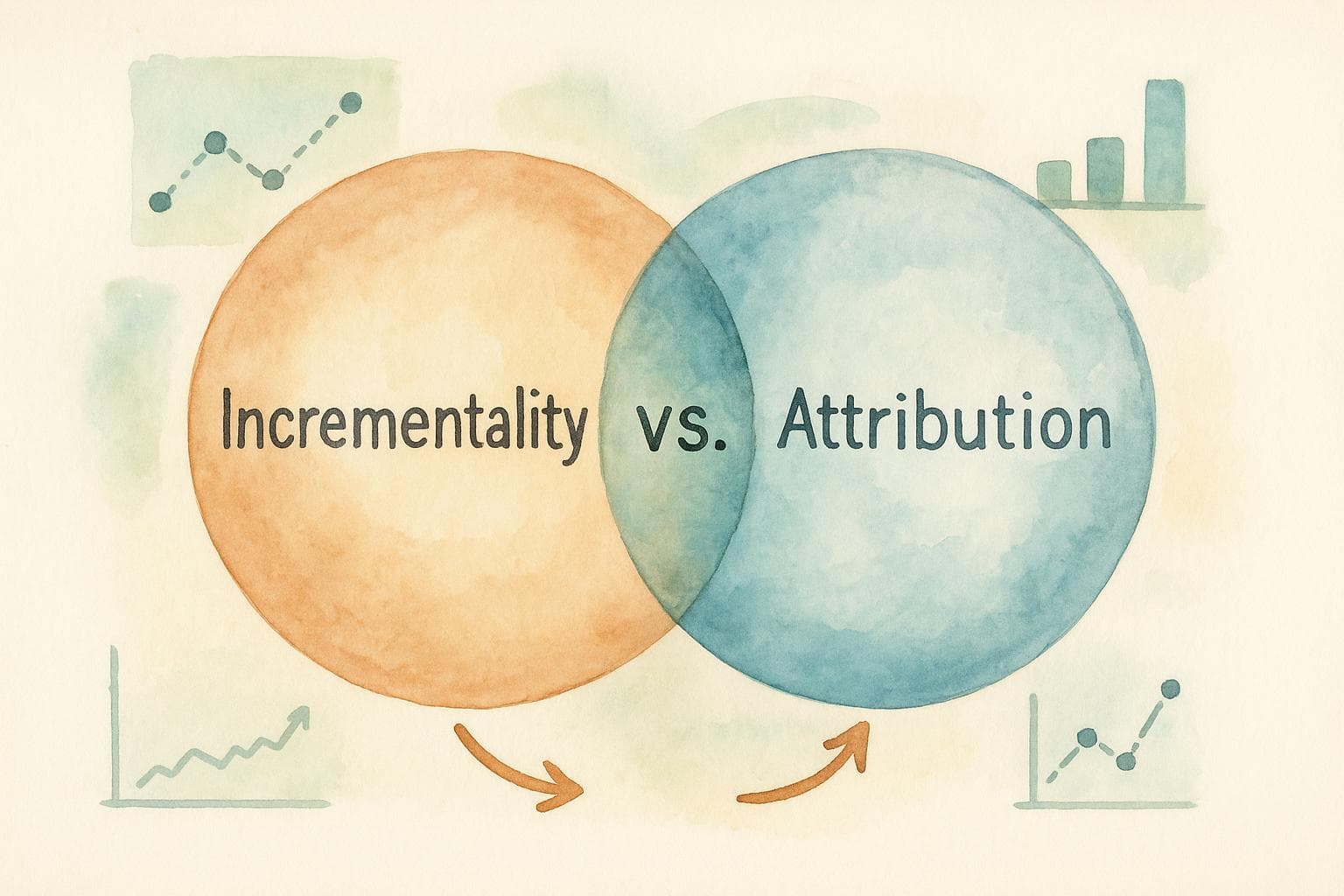
Struggling to measure your marketing's real impact? Here's the key: use incrementality testing to prove if your campaigns drive actual sales and attribution modelling to understand which channels contribute to conversions. Both methods serve different purposes but work best together.
- Incrementality Testing: Measures the true lift caused by your campaigns using controlled experiments. It answers, "Would these sales have happened without this campaign?"
- Attribution Modelling: Spreads credit across touchpoints in the customer journey. It answers, "Which channels helped drive conversions?"
When to Use Each:
- Incrementality: For testing new campaigns, preventing wasted spend, and adapting to privacy changes.
- Attribution: For optimising multi-channel campaigns, managing always-on channels, and tracking funnel contributions.
Quick Tip: Combine both. Use attribution for daily insights and incrementality to validate results periodically. This dual approach ensures smarter decisions while cutting through Australia’s privacy challenges and seasonal complexities.
Incrementality & Attribution
What Are Incrementality and Attribution
For Australian businesses looking to get the most out of their marketing efforts, understanding the distinction between incrementality testing and attribution modelling is key. These two approaches play unique roles in evaluating the performance of campaigns.
What is Incrementality Testing?
Incrementality testing is all about determining whether your marketing activities are driving real results. It measures what additional sales or conversions happened because of a specific marketing effort, rather than just tracking correlations. This is achieved through controlled experiments, where one group is exposed to the marketing activity, and another group serves as a control.
For example, let’s say an eCommerce retailer in Australia launches a paid social campaign targeting customers in New South Wales. Meanwhile, customers in Victoria are left out as the control group. By comparing sales growth in NSW against Victoria - while factoring in local factors like seasonality or public holidays - you can pinpoint the campaign's true impact. The big question incrementality testing answers is: "Would these conversions have happened without this marketing effort?"
This approach is particularly useful for ensuring your marketing budget is being spent on activities that genuinely drive growth, rather than just taking credit for sales that might have happened anyway.
What is Attribution Modelling?
Attribution modelling, on the other hand, focuses on understanding how different marketing touchpoints contribute to a conversion. This approach spreads credit across the various interactions a customer has with your brand during their journey.
There are different types of attribution models. For instance, single-touch models like first-click or last-click give all the credit to one interaction. Multi-touch models, however, distribute credit across several touchpoints. Imagine a customer discovers your brand through organic search, engages with your social media, subscribes to your email list, and finally converts through a paid search ad. Attribution modelling helps you see how much each of these interactions contributed to the final sale.
How Incrementality and Attribution Differ
To make informed decisions in Australia’s competitive market, it’s essential to understand how these two methods differ. The main distinction lies in their purpose and approach. Incrementality testing aims to establish causality using controlled experiments, while attribution modelling uses statistical methods to assign credit across touchpoints.
| Aspect | Incrementality Testing | Attribution Modelling |
|---|---|---|
| Purpose | Measures the causal impact of marketing | Assigns credit for conversions to touchpoints |
| Methodology | Controlled experiments (e.g., A/B testing, geo-testing) | Statistical models (e.g., first-touch, multi-touch) |
| Key Question | "Did marketing cause this result?" | "Which touchpoints contributed to conversion?" |
| Use Case | Proving campaign lift and preventing wasted spend | Optimising channel mix and understanding customer journeys |
| Data Type | Experimental (isolates effects) | Observational (tracks customer behaviour) |
Incrementality testing provides a clear picture of whether a campaign is truly driving results, but it can be resource-intensive to implement. This method has become increasingly relevant as privacy changes have made traditional attribution less reliable. For instance, studies suggest that up to 80% of conversions attributed to paid campaigns might have occurred organically.
Both methods have their place. Attribution modelling helps optimise ongoing campaigns by identifying which channels perform best, while incrementality testing ensures your efforts are driving genuine growth. Together, they offer a clearer picture of how your marketing investments are paying off, helping Australian businesses make smarter, data-driven decisions.
When to Use Incrementality Testing
Incrementality testing plays a key role in determining the real impact of your marketing efforts. For Australian eCommerce businesses, using this method at the right time can be the difference between smart investment and wasted dollars. Here’s when it makes the most sense to dive into incrementality testing.
Testing New Campaigns or Channels
Launching a new marketing campaign or exploring an unfamiliar channel? Incrementality testing is your go-to tool for figuring out whether your efforts are genuinely driving additional sales. Unlike attribution models that only show correlations, this method pinpoints the actual lift your campaign generates.
This is especially important when there’s no historical data to lean on. Without it, you’re left guessing whether a new channel is adding value or just pulling in customers who would’ve converted anyway. For example, an Australian business might test a fresh influencer campaign by targeting New South Wales and Victoria while leaving Queensland as a control group. By comparing results across these states - while accounting for factors like school holidays or local events - you can measure the campaign’s true impact.
Incrementality testing answers the critical question: "Would these sales have happened without this campaign?" This insight is invaluable when deciding whether to scale up spending or continue investing in a new channel. Beyond the initial launch, this method ensures that your ongoing budget is being put to good use, as discussed next.
Preventing Wasted Budget
Nobody wants to pour money into campaigns that don’t deliver. Incrementality testing helps you avoid this by revealing whether your marketing dollars are driving new revenue or just claiming credit for sales that would’ve happened anyway.
"Make every marketing dollar count" - Uncommon Insights
Techniques like holdout tests and ghost ads are particularly effective here. In a holdout test, you withhold your campaign from a random group of customers and compare their behaviour to those who were exposed to it. Ghost ads, on the other hand, simulate ad exposure for a control group, offering precise insights into the real lift your campaign provides.
For many Australian eCommerce businesses, this process often uncovers that 30-50% of conversions attributed by standard models might have occurred without paid media, depending on the channel and the market. These findings are critical when scaling up campaigns, as they ensure you’re not throwing good money after bad.
This approach aligns with what Uncommon Insights calls "Incrementality & Spend Validation" - a shift from gut-based decisions to data-backed strategies. For growing brands, this method helps cut waste and maximise efficiency while staying on track for growth.
Dealing with External Changes
With privacy rules tightening and major platform updates shaking up the digital landscape, incrementality testing has become even more important for Australian marketers. As third-party cookies disappear and tracking tools become less reliable, traditional attribution methods lose accuracy. But incrementality testing remains a steady solution.
This method doesn’t rely on detailed user tracking. Instead, it uses randomised test and control groups to measure outcomes, making it immune to privacy changes and platform restrictions. For instance, when iOS updates limit Facebook’s tracking or Google phases out certain data collection tools, your attribution reports might show a dip. Incrementality testing can help you figure out whether your sales have actually been affected or if it’s just a reporting issue.
For Australian businesses navigating evolving privacy regulations, this approach ensures accurate measurement even as the rules change. It also proves crucial during major disruptions like economic downturns, supply chain challenges, or aggressive competitor actions. In such cases, incrementality testing separates the effects of your marketing from broader market shifts, helping you make smarter decisions in uncertain times.
When to Use Attribution Modelling
While incrementality testing helps determine what works, attribution modelling shines when you need to fine-tune active campaigns and understand how different marketing channels interact. For Australian businesses running multi-channel strategies, attribution becomes an everyday tool for smarter budget allocation and improving campaign outcomes.
Attribution modelling offers near-real-time insights, enabling tactical adjustments and ongoing optimisation. While incrementality testing measures causal impact, attribution provides the insights needed for daily tweaks. This allows for more precise budget distribution and continuous campaign improvements.
Optimising Multi-Channel Campaigns
Attribution modelling is particularly useful for tracking customer journeys that span multiple touchpoints. It helps identify which combinations of channels deliver the best results. This is especially relevant in Australia, where consumers often engage across platforms - discovering products on social media, researching via search engines, and converting through email.
Multi-touch models highlight how different channels contribute to a customer’s journey. For instance, you might find that customers who interact with both email marketing and paid search convert at higher rates than those exposed to just one channel. With this knowledge, you can allocate more resources to these high-performing combinations.
According to a 2023 Nielsen survey, 67% of marketers use attribution modelling to guide their budget decisions across channels. The reason is simple: it takes the guesswork out of marketing and enables data-driven investment decisions.
For Australian eCommerce businesses, especially during peak shopping periods, attribution modelling can uncover which channel pairings work best. This insight can lead to a 30% improvement in marketing ROI compared to relying on last-click models.
The main advantage here is speed and practicality. While incrementality testing may take weeks or even months to deliver results, attribution modelling provides insights in near real-time, enabling you to optimise campaigns continuously.
Managing Always-On Channels
Once cross-channel effectiveness is established, the focus often shifts to always-on channels. These include paid search, social media advertising, and programmatic display - channels that typically run continuously and can’t easily be paused for testing. This is where attribution modelling becomes essential.
Always-on channels require constant monitoring to ensure optimal performance. Attribution modelling provides the insights needed to adjust bids, budgets, and targeting while campaigns are live. For Australian businesses in competitive sectors like retail or financial services, this ability to optimise in real-time can be the difference between profitable campaigns and wasted spending.
By using attribution modelling, you can make daily decisions such as increasing bids for high-performing keywords, pausing underperforming ad groups, or reallocating budgets based on performance trends. This ensures that your campaigns remain efficient and effective.
Top-tier marketers rely on attribution for day-to-day management while using incrementality testing for periodic validation of their overall strategy. This dual approach allows you to make informed tactical decisions daily while confirming the broader effectiveness of your marketing efforts.
Measuring Funnel Contributions
Attribution modelling doesn’t just provide insights across channels - it also helps dissect the customer journey across different stages of the sales funnel. It reveals how various marketing activities contribute to awareness, consideration, and conversion, making it especially valuable for Australian businesses with longer sales cycles or complex decision-making processes.
Upper-funnel activities, such as brand awareness campaigns or content marketing, may not directly lead to immediate sales. However, attribution modelling can show how these efforts influence customers who later convert through lower-funnel channels like paid search or direct website visits.
For example, a Melbourne-based B2B software company might discover through attribution that LinkedIn content marketing significantly impacts customers who later convert via Google Ads. Without this insight, they might undervalue their upper-funnel efforts and over-invest in bottom-funnel activities.
This approach helps justify spending on both brand-building initiatives and conversion-focused tactics. By assigning value to each stage of the funnel - awareness (upper), consideration (mid), and conversion (lower) - you can make better-informed decisions about budget allocation across the entire customer journey.
For Australian FMCG brands, attribution might reveal that TV advertising drives brand awareness, which later leads to conversions through retail partnerships. This insight helps strike the right balance between brand-building efforts and performance marketing. Attribution modelling offers a structured way to measure and optimise these complex, multi-stage customer journeys effectively.
Using Incrementality and Attribution Together
Now that we've looked at incrementality and attribution individually, it's time to see how combining these methods can sharpen your marketing measurement. Attribution provides the operational insights you need for daily adjustments, while incrementality testing ensures those insights reflect genuine causal impact. Together, they create a powerful system for both short-term optimisation and long-term planning - essential for Australian eCommerce businesses navigating privacy restrictions and increasingly complex customer journeys.
Checking Attribution with Incrementality
One of the challenges with attribution models is that they can sometimes overstate the effectiveness of particular channels. Incrementality testing steps in as a reality check, helping you determine whether the conversions attributed to a channel are genuinely caused by your marketing efforts, or if they would have happened anyway due to organic factors or other influences.
For example, imagine a paid social campaign is credited with 500 conversions. Incrementality testing reveals that only 300 of those conversions are truly incremental. In this case, you’d apply a 0.7 correction factor to that channel in future budgeting.
This kind of validation is especially important in Australia, where privacy regulations limit granular tracking. Attribution can show you where conversions are happening, but incrementality testing is the only way to confirm whether your marketing is actually driving those results.
The process involves calibrating your attribution data using coefficients derived from incrementality tests. Let’s say testing shows that paid search is responsible for 70% of the conversions your attribution model credits to it. You’d then apply a 0.7 correction factor to your attribution reports going forward, ensuring that your budget allocations are based on real incremental value rather than inflated figures.
A Step-by-Step Workflow
To get the most out of these methods, use attribution for day-to-day decisions and rely on incrementality testing for periodic validation.
| Step | Activity | Method | Purpose | Australian eCommerce Example |
|---|---|---|---|---|
| 1 | Launch a new campaign | Attribution | Track conversions by channel | Use multi-touch attribution to monitor Facebook, Google Ads, and email performance in AUD |
| 2 | Run incrementality test | Incrementality | Measure true lift | Conduct a geo-holdout test comparing NSW vs VIC to evaluate if paid search drives incremental sales |
| 3 | Compare results | Both | Identify discrepancies | Attribution credits 1,000 sales to paid search; incrementality testing shows only 700 are incremental |
| 4 | Calibrate attribution | Both | Adjust model weights | Apply a 0.7 correction factor to paid search in attribution reports |
| 5 | Optimise budget | Both | Refine spending decisions | Shift budget from over-attributed channels to those with proven incremental impact |
Top marketers combine attribution for performance management with regular incrementality tests - monthly or quarterly - to fine-tune their models and guide strategic budget shifts. This disciplined approach ensures measurement accuracy even as market conditions and consumer behaviours evolve.
Different campaign types require tailored approaches. For example, always-on channels like paid search and email benefit from continuous attribution monitoring, while new campaigns or channels should undergo dedicated incrementality testing before scaling up.
Australian Market Considerations
When applying these methods in Australia, businesses must account for local regulatory and consumer factors. The Privacy Act 1988 and Australian Privacy Principles limit the collection of personally identifiable information, making it harder to use detailed attribution models or run user-level incrementality tests.
These privacy constraints make combining attribution and incrementality testing even more valuable. As third-party cookies become less reliable, incrementality experiments remain effective because they rely on randomised testing and outcome measurement rather than tracking individual users.
To navigate these challenges, Australian businesses can:
- Use aggregated or anonymised data for incrementality experiments.
- Conduct geo-based or time-based tests that comply with privacy laws.
- Ensure transparency and regulatory compliance in all measurement activities.
Local market dynamics also play a role. Australia’s unique seasonality - with key sales events like the End of Financial Year and Boxing Day - requires testing schedules that align with these periods. Regional differences between metro and rural consumers may also call for geo-based experiments to capture varying behaviours.
Australia’s high mobile and digital adoption adds another layer of complexity. Attribution models need to account for cross-device journeys, such as consumers discovering products on social media, researching on desktop, and completing purchases via mobile email - all while adhering to privacy laws.
For Australian FMCG and eCommerce brands, partnering with local experts like Uncommon Insights can provide tailored strategies. These experts understand the technical and regulatory landscape, ensuring your measurement framework is both compliant and effective.
Conclusion: Picking the Right Method for Your Business
Choosing the best measurement method for your business comes down to aligning it with your goals and the resources you have at hand. Each approach serves a unique purpose, and understanding their strengths can help you make smarter decisions.
For businesses running multi-channel campaigns and needing fast, actionable insights, attribution modelling is a solid choice. It helps you allocate budgets effectively and track customer journeys in real time - particularly useful in navigating Australia’s diverse markets. On the other hand, if you’re launching a new campaign or making high-stakes decisions, incrementality testing is invaluable. It shows the true growth driven by your marketing efforts - growth that wouldn’t have happened otherwise. However, keep in mind that attribution is less resource-intensive, while incrementality testing requires more time, data, and analytical expertise.
Many Australian eCommerce and FMCG brands successfully combine these methods. They rely on attribution for day-to-day decisions while using incrementality testing periodically to fine-tune their strategies and adjust budgets. This dual approach is especially effective in Australia, where privacy regulations are tightening and seasonal buying behaviours add extra complexity to measurement.
Starting with attribution can establish a strong foundation. Later, you can introduce incrementality testing to validate larger budget decisions or explore new channels in Australia’s varied geographic markets. Tailoring your approach to factors like privacy laws, seasonal trends, and regional differences is key to staying competitive.
For expert guidance, consider partnering with local specialists like Uncommon Insights. They can help you navigate the Privacy Act 1988 requirements while capturing insights that reflect both metro and rural consumer behaviours.
Ultimately, the right method is the one that delivers the insights your business needs - precisely and in compliance with local regulations.
FAQs
How can Australian businesses balance incrementality testing and attribution modelling while addressing privacy regulations?
Australian businesses can make the most of incrementality testing and attribution modelling by tailoring these strategies to their specific objectives and staying responsive to changing privacy regulations. Incrementality testing evaluates the genuine impact of marketing efforts by isolating variables, while attribution modelling helps identify how each channel contributes to driving conversions.
To keep up with privacy regulations, businesses should prioritise techniques that reduce dependency on personal data, such as using aggregated or anonymised data for analysis. By combining these methods, organisations can uncover actionable insights, maintain compliance with Australian laws, and build stronger trust with their customers.
What’s the difference between single-touch and multi-touch attribution, and when should you use each?
Single-touch attribution gives all the credit for a conversion to just one touchpoint - usually the first or last interaction. It’s straightforward to set up and is ideal for businesses with short customer journeys or when the goal is to emphasise a specific stage in the funnel.
In contrast, multi-touch attribution spreads the credit across several touchpoints, acknowledging the role each one plays in leading to a conversion. This method suits businesses with longer and more complex customer journeys, offering a clearer picture of how various channels contribute to overall success.
If simplicity or quick implementation is what you’re after, single-touch attribution is the way to go. But if you’re looking to understand the full impact of your marketing efforts across the entire customer journey, multi-touch attribution is the better choice.
How can incrementality testing reduce wasted marketing spend in Australia, especially with seasonal and regional differences?
Incrementality testing is a powerful way to ensure your marketing dollars are working hard, especially in a market like Australia, where seasonal shifts and regional tastes can differ widely. It helps you figure out the real contribution of your campaigns - beyond the noise.
By pinpointing the incremental value of your marketing activities, you can sidestep wasting resources on strategies that don’t genuinely move the needle. This approach allows businesses to align their efforts with local market conditions, making sure budgets are focused on areas that actually deliver results.
Related Blog Posts
How to Measure ROI for Holiday Campaigns
How To Measure Content Marketing ROI For eCommerce
How To Build a Social Media ROI Dashboard
Organic Traffic Is a Myth
Lean Teams Scale Faster
How to Map DTC Customer Touchpoints
Newsletter
The Uncommon Insights Letter
Practical FMCG & eCommerce growth playbooks — margins, retention and scaling tactics, straight to your inbox.
Turn these ideas into profit you can see
Get a hands-on operator to turn the frameworks above into results — book a free audit call.