How to Manage Customs for E-commerce
Practical guide to e‑commerce customs: de minimis thresholds, HS codes, required documents, landed costs and 2026 rule changes to avoid fees and delays.
28 February 2026
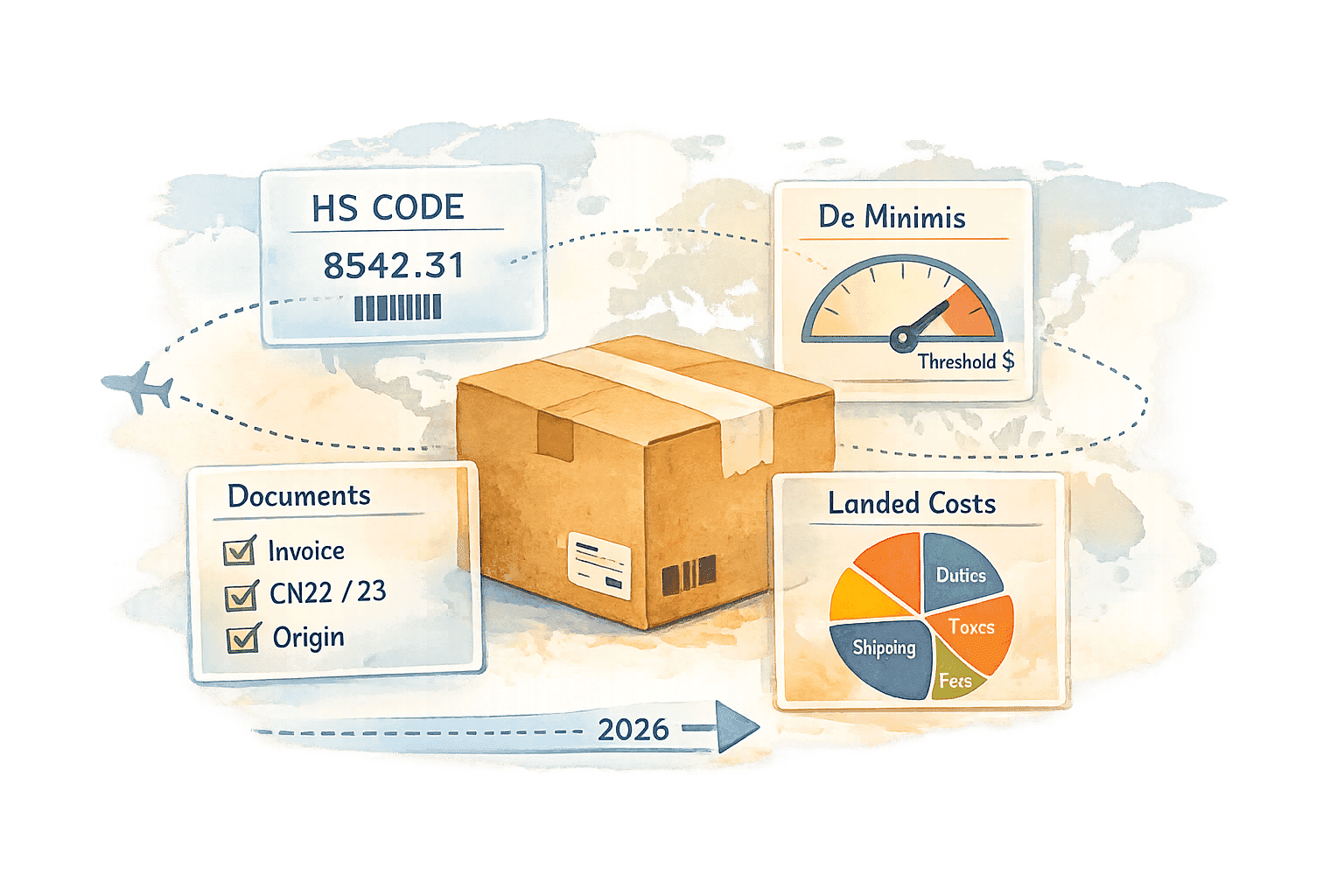
Expanding your e-commerce business internationally? Here's the deal: customs management can make or break your success. Customers hate surprise import fees - 49% refuse delivery, and 75% won't shop again if hit with unexpected charges. Getting customs right not only avoids delays and fines but also keeps your cash flow steady and your customers happy.
Key takeaways:
- De minimis thresholds: Understand the value limits for duty-free imports in each country. For example, Australia allows A$1,000, but the US eliminated its US$800 exemption in August 2025.
- Customs documentation: Accurate paperwork is critical. Get familiar with commercial invoices, HS codes, and certificates of origin.
- Landed costs: Include duties, taxes, shipping, and insurance to avoid underpricing.
- Upcoming changes: New regulations in 2026 (e.g., EU flat customs duty, stricter US surcharges) require updated systems and strategies.
Pro tip: Automate customs processes with tools like Zonos or Shopify integrations to avoid errors and improve efficiency. With the right approach, you can navigate these challenges and grow your global sales.
How to Handle Tax, Duty and Shipping When doing International E-commerce
What Are De Minimis Thresholds?
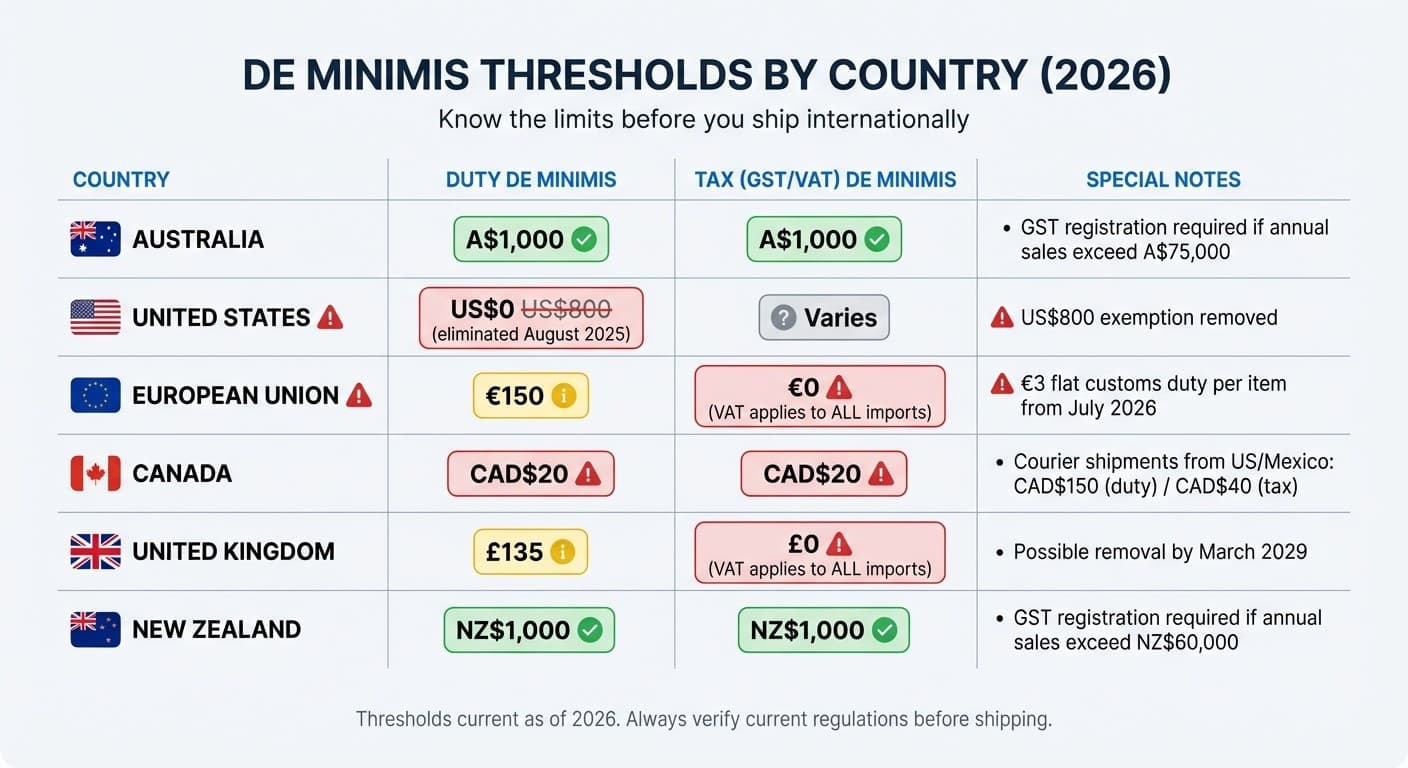
De Minimis Thresholds by Country for E-commerce 2026
A de minimis threshold is the maximum shipment value a country allows to enter without charging customs duties - and sometimes taxes. The term comes from the Latin phrase "de minimis non curat lex", which translates to "the law does not concern itself with trifles". Governments often consider it inefficient to collect taxes on low-value shipments.
If your shipment goes even slightly over this threshold, duties and taxes apply to the entire shipment value. This "all-or-nothing" rule can have a big impact on your pricing strategy and how customers perceive your business.
Benefits of De Minimis for Low-Value Shipments
Shipping under these thresholds helps avoid surprise fees for customers. This is a win-win: your buyers won’t face unexpected charges at delivery, and you’re more likely to keep them coming back. Plus, low-value shipments typically clear customs faster and require less paperwork.
"It's like a customs-free pass for low-value shipments." - Maureen Walsh, Marketing Manager, DCL Logistics
For Australian e-commerce businesses shipping overseas, knowing these thresholds can make or break your international pricing strategy. Keep in mind that many countries have separate thresholds for duties and taxes (like VAT or GST). So, while a shipment might dodge duties, it could still be taxed.
These thresholds vary by country, making it essential to tailor your shipping approach for each market.
De Minimis Thresholds by Country
Thresholds differ widely across major markets. For example, Australia has one of the highest thresholds at A$1,000, while Canada’s is just CAD$20. Meanwhile, the United States removed its US$800 exemption on 29 August 2025, meaning all shipments are now subject to duties or tariffs.
| Market | Duty De Minimis | Tax (VAT/GST) De Minimis | Special Conditions |
|---|---|---|---|
| Australia | A$1,000 | A$1,000 | GST registration required if annual sales exceed A$75,000 |
| United States | US$0 | Varies | US$800 exemption eliminated August 2025 |
| European Union | €150 | €0 | VAT applies to all imports, regardless of value |
| Canada | CAD$20 | CAD$20 | Courier shipments from US/Mexico: CAD$150 (duty) / CAD$40 (tax) |
| United Kingdom | £135 | £0 | VAT applies to all imports |
| New Zealand | NZ$1,000 | NZ$1,000 | GST registration required if annual sales exceed NZ$60,000 |
Knowing these thresholds is essential for managing customs and setting competitive prices in cross-border e-commerce. It’s also important to factor in annual sales thresholds. Even if individual orders are under the de minimis limit, Australian businesses with annual sales exceeding A$75,000 in certain markets must register to collect and remit local taxes at the point of sale. This shifts the tax collection responsibility from customs to the seller.
Required Customs Documentation
Getting customs paperwork right is crucial to avoid delays, fines, or even the destruction of your goods. A single error - like a wrong digit - can lead to major issues. Thankfully, most customs documents follow a standard format globally.
Core Documents for Customs Clearance
The commercial invoice serves as your shipment's passport. It includes details like buyer and seller information, item descriptions, quantities, and values, all of which are necessary for calculating duties and taxes. Typically, it also features a legal declaration, such as: "I hereby certify that the information on this invoice is true and correct and that the contents of this shipment are as stated above".
Alongside the invoice, you'll need a packing list. This document outlines the shipment's contents, including dimensions, weights, and item specifics. For sea freight, a Bill of Lading is required, while air freight needs an Air Waybill. These documents act as proof of shipment and serve as contracts between the shipper and carrier.
Other essential paperwork includes a Certificate of Origin, which confirms where the goods were made - critical for determining duty rates and Free Trade Agreement eligibility. For shipments to the European Union, including an Economic Operators Registration and Identification (EORI) number can help avoid delays. In the US, shipments valued over US$2,500 require an Electronic Export Information (EEI) form.
When shipping to Australia, detailed product descriptions are key to avoiding misclassification. Shipments valued at over A$1,000 may be subject to an Import Processing Charge, which ranges from approximately A$50 to A$152, depending on the transport method and shipment value. Additionally, if your packaging uses timber or bamboo for sea freight, a Packing Declaration may be needed to meet requirements set by the Department of Agriculture, Fisheries and Forestry.
HS Codes and Product Valuation
Accurate documentation is crucial for correct product classification. HS codes (Harmonised System codes) are universal numerical codes used by over 200 countries to classify products and determine tariffs. While the first six digits are globally standardised, some countries extend these codes to 8, 10, or even 12 digits for specific purposes.
Errors in HS code classification can be costly. For example, in March 2024, Ford Motor Company faced US$365 million in charges for misclassifying Transit Connect cargo vans as passenger vehicles. Similarly, the brand Bogg encountered a 30% duty rate increase due to a zinc alloy ring on a keychain being misclassified as stainless steel.
"If you pick the wrong code, you risk overpaying on taxes or facing disputes at customs, potentially causing delays and extra costs." - Interparcel Australia
When valuing goods, include the invoice price. Depending on the destination's regulations, you may need to add freight and insurance costs (CIF) or use the Free On Board (FOB) value. In Australia, duty is typically calculated as a percentage of the FOB value. Keep thorough records of how values are determined, including transaction prices, production costs, and exchange rates, to support your declarations during audits.
For complex items, you can request a binding ruling from customs authorities to secure a classification and avoid future disputes. For instance, in February 2020, Pharm-A-Care Laboratories won a High Court of Australia case that allowed vitamin gummies to be classified as duty-free medicaments instead of food preparations, which would have been subject to duty.
Using Software to Automate Documentation
Manual customs documentation can be overwhelming, especially for high-volume e-commerce. AI-powered tools like Zonos and Interparcel can instantly assign HS codes based on product details. Zonos, for example, processes over 200,000 orders daily using its AI system.
Digital solutions like UPS Paperless Invoice electronically transmit commercial invoices, reducing the risk of misplacing or damaging physical documents. Shipping management platforms, such as Interparcel's Rule Manager, can automate the creation of shipping labels and invoices based on pre-set rules.
For Shopify merchants, integrations like Shopify Managed Markets and Zonos can calculate duties and taxes at checkout while generating compliant customs data. Tools like Matrixify allow bulk updates of HS codes across product catalogues.
"Since implementing Zonos, our customer service complaints have dropped by 70%. Customers now have clear expectations, better tracking visibility, and a smoother shopping experience." - Jaxxon
While AI tools streamline the process, always verify suggested codes using resources like the NZ Tariff Finder, UK Integrated Online Tariff Look Up, or U.S. Schedule B Search Engine. Pre-lodging import declarations - submitting them before goods arrive - can also expedite customs clearance by handling the paperwork while shipments are still in transit. With Australian trade volumes expected to grow by 70% over the next decade, automating documentation is becoming essential for staying competitive.
How to Calculate Duties, Taxes, and Landed Costs
Calculating Duties with HS Codes and Tariff Schedules
Getting the HS code right is the first step in determining duties and ensuring compliance. Once the correct HS code is identified, duties are calculated based on the Customs Value. Many countries use ad valorem duty rates, which are a percentage of the Customs Value (CV). For instance, importing apparel into Australia with a 10% duty rate and a CV of A$5,000 would result in a duty payment of A$500.
Some products, however, may have duties calculated using a combination of a fixed amount per unit and a percentage of the CV. In Australia, duties are assessed on FOB (Free on Board) values, which only include the product cost. In contrast, other countries may use CIF (Cost, Insurance, and Freight), which factors in freight and insurance costs as well.
To find the precise duty rate, you can use resources like the USITC search tool for the United States or Australia's DFAT Free Trade Agreement Portal. Check whether a Free Trade Agreement applies to your goods, as qualifying products can benefit from zero-duty rates based on their origin. For items with mixed materials or complex classifications, you can request a Binding Tariff Advice from customs authorities to secure a definitive classification and avoid disputes later. Remember to convert all values to Australian dollars using the exchange rate on the date your goods were exported.
Once you've established the duty rate, the next step is calculating the full landed cost to understand the total expense involved.
What Landed Costs Include
Landed costs go beyond just duties - they represent the total cost of getting goods to their destination. This includes the product cost, international freight, customs duties, import taxes (like GST or VAT), insurance, customs clearance fees, port handling charges, and final delivery costs.
In Australia, GST is calculated on the Value of Taxable Importation (VoTI). This includes the Customs Value plus duty and transport/insurance costs. For example, if your CV is A$1,000, duty is A$50, and freight is A$100, GST (10%) would be calculated on A$1,150, adding A$115 in tax. Marine cargo insurance typically costs between 0.3% and 0.5% of the shipment value, while customs brokerage fees depend on the complexity of the entry.
"If you're pricing products based only on what your supplier charges, you're likely losing money on every sale without realising it." - Landara Team, Import Operations Experts
Using a Delivered Duty Paid (DDP) model can make a big difference. By collecting all duties and taxes at checkout, businesses can significantly reduce package refusal rates (from 8–15% to under 1%) and cut cart abandonment rates from 55–70% to around 30–40%. Tools like Shopify Markets, Dutify, and LandedCost.io can streamline these calculations using real-time APIs, ensuring customers see the total cost upfront.
Duty Rates for Common Product Categories
Duty rates vary depending on the type of product and destination. In Australia, the general duty rate is 5%, but specific categories have different rates. For example, electronics often fall between 0% and 5%, while clothing and textiles typically range from 5% to 10%. Books are usually duty-free, while items like jewellery, cosmetics, and toys generally incur a 5% duty rate.
| Product Category | Typical Duty Rate (Australia) |
|---|---|
| Electronics | 0% – 5% |
| Clothing and Textiles | 5% – 10% |
| Jewellery | 5% |
| Cosmetics and Perfumes | 5% |
| Toys and Games | 5% |
| Books and Printed Materials | 0% |
Source: FreightAmigo
Misclassifying products can lead to hefty penalties. In 2024, Ford Motor Company was hit with a US$365 million bill for misclassifying Transit Connect cargo vans as passenger vehicles to avoid the higher 25% "chicken tax" applied to light trucks. Similarly, in June 2025, the US Court of Appeals upheld a US$26 million verdict against an importer for filing false declarations to evade nearly 200% antidumping duties on welded outlets from China.
Customs Changes Coming in 2026
Upcoming regulatory changes will significantly alter the landscape for international shipping and customs, impacting how Australian businesses manage imports and exports.
Proposed Changes to De Minimis Thresholds
The days of low-value duty exemptions are coming to an end. In August 2025, the United States eliminated its US$800 de minimis exemption, requiring all commercial shipments to undergo formal customs entry and duty payments. This shift directly affects Australian e-commerce businesses exporting to the US, removing a cost-saving mechanism that previously supported direct-to-consumer shipping.
Adding to this, the US Supreme Court introduced a 15% global surcharge under Section 122 of the Trade Act of 1974 in February 2026. This surcharge, applicable to nearly all imports, raises the average tariff rate to 13.7%. The automated 'Entry Type 86' process has been replaced by the more complex Type 11 (Informal) or Type 01 (Formal) entries, both of which come with mandatory brokerage fees. For instance, a US$15 product could attract fees and surcharges that surpass its actual price.
Thailand followed suit by abolishing its ฿1,500 de minimis threshold in January 2026, making all shipments subject to a 7% VAT. Meanwhile, the UK is actively consulting on removing its £135 de minimis relief, with changes expected no later than March 2029. These developments mean Australian merchants must account for increased landed costs or explore domestic fulfilment options to remain competitive.
These changes underscore the importance of accurate customs documentation and recalibrated duty calculations.
EU VAT Requirements and ICS2 Compliance
From 1 July 2026, the European Union will replace its €150 duty-free threshold with a flat customs duty of €3 per item for parcels valued under €150. This fee, applied through the IOSS mechanism, is charged per tariff classification rather than per parcel. For example, if a shipment includes items classified under different HS codes - such as a shirt, a toy, and a book - the recipient could face multiple €3 charges.
"The €3 fee will be charged per each item in a parcel sent directly from a third country; in practice... it may be charged multiple times." - Mirosław Kłósek, Customs Services Director, Rohlig SUUS Logistics
Additionally, the EU's Import Control System 2 (ICS2) now requires an Entry Summary Declaration (ENS) with precise HS codes, detailed product descriptions, and full sender/recipient details before goods are loaded. From 3 February 2026, ICS2 mandates v3 messaging for all transport modes, including maritime, air, road, and rail. Missing or incorrect data could result in loading blocks or shipment delays. Adding to the complexity, countries like Belgium, France, and Italy may introduce national customs handling fees as early as January 2026.
These changes make it essential for businesses to keep their systems and processes up-to-date.
Staying Updated on Customs Regulations
The EU imported over 5.8 billion small packages in 2025, marking a 26% increase from the previous year. This highlights the growing need for Australian businesses to refine their shipping practices. Ensuring HS codes are current and accurate is critical, especially as the US introduced new HTS subheadings in February 2026, such as 9903.03.01 for the 15% Section 122 surcharge. Using outdated codes could result in automated rejections.
Stay informed by subscribing to updates from Australian freight forwarders who track regulatory changes. Update your ERP and billing systems to capture essential data for every SKU, including exact HTS codes, Country of Origin, and detailed material descriptions. Given that duties on international shipments are generally non-refundable, it’s worth reconsidering 'free returns' policies, as they could become a significant financial burden.
Compliance Strategies and Tools
With the upcoming changes in regulations, having solid compliance strategies in place is crucial for keeping shipping operations efficient and costs manageable. By combining skilled partnerships with automation, businesses can transform customs clearance from a potential obstacle into a strategic advantage.
Working with Experienced Freight Forwarders
Selecting a logistics partner goes beyond just seeking the lowest price. It's about finding expertise that can save you money in the long run. Experienced freight forwarders are well-versed in managing complex documentation and ensuring compliance with Australian Border Force (ABF) and biosecurity regulations. They can also help identify savings opportunities, such as Free Trade Agreement (FTA) concessions and tariff duty drawbacks.
"Strategic business owners know clearance is just one piece of a larger puzzle... the right broker doesn't just handle the paperwork, but instead acts as a strategic partner who spots opportunities." - Nick Ledowsky, CEO and Founder, AMS eGroup
By working with seasoned logistics professionals, businesses can cut customs clearance delays by up to 75%. These partners also provide detailed cost breakdowns upfront, covering freight, duties, GST, and local port charges, which helps prevent unexpected expenses from eating into profit margins. Additionally, they can consolidate shipments from multiple merchants, enabling access to lower shipping rates that smaller businesses might not achieve on their own. To simplify compliance and minimise communication gaps, it’s best to choose partners with in-house licensed customs brokerage rather than relying on third-party arrangements.
Alongside expertise, automation plays a key role in simplifying customs processes.
Automating Customs Declarations
Manual data entry often leads to costly errors. Automation addresses this by seamlessly transferring data from bookings to customs filings, validating it against regulations in real time. Specialised software can auto-fill required templates like the Automated Manifest System (AMS), Importer Security Filing (ISF), and Automated Export System (AES). It also checks HS codes to prevent misclassification issues.
For shipments with perfect documentation, electronic (Green Lane) clearance typically takes 12–24 hours. However, physical (Red Lane) inspections can cause delays of 5–14 days or more. Automation tools, such as platforms that auto-populate commercial invoices from order data, ensure consistency between the packing list, bill of lading, and invoice.
Landed cost calculators and APIs improve transparency by showing total duties and taxes at checkout. This matters because 58% of consumers have encountered unexpected customs charges upon delivery, and 75% of them reconsider future purchases with the same brand after such experiences. Modern compliance tools increasingly use artificial intelligence to detect risks early and ensure documents and tariffs are accurate.
Low-Value Routing vs Shipment Consolidation
Beyond automated declarations, choosing the right shipping strategy is another critical element of compliance and cost efficiency. Businesses can opt for low-value routing or shipment consolidation based on their product mix, order frequency, and customer requirements. Each method comes with its own set of trade-offs regarding speed, cost, and compliance risk.
| Feature | Low-Value Routing (e.g., SAC/De Minimis) | Shipment Consolidation |
|---|---|---|
| Speed | Faster; often cleared within hours via simplified processes. | Slower; requires time to gather enough volume for a single bulk entry. |
| Cost | Higher per-unit shipping cost but avoids duties/taxes if under threshold. | Lower per-unit shipping cost due to bulk rates; duties applied to total value. |
| Risk | Higher risk of individual package flags or "split shipment" scrutiny. | Lower risk of documentation errors if consolidated under a master bill. |
| Documentation | Minimal; often requires only a Self-Assessed Clearance (SAC). | Complex; requires a Master Bill of Lading and multiple House Bills. |
Low-value routing is ideal for direct-to-consumer shipments that fall under the destination country's de minimis threshold (e.g., A$1,000 in Australia). However, customs authorities closely monitor "split shipments", where multiple parcels are sent to the same consignee to avoid thresholds. If flagged, these shipments may be combined, leading to delays, reassessed duties, and potential penalties. Consolidation, while slower, offers cost savings and lowers compliance risks. It does, however, require meticulous alignment of values across invoices and declarations to avoid clearance issues.
Conclusion
Managing customs effectively requires systems that can adjust to changing regulations. Using accurate HS codes and maintaining clear documentation is critical to avoiding costly mistakes. Calculating landed costs upfront is equally important, as unexpected fees can lead to 75% of customers reconsidering their purchases.
The importance of precise documentation has grown with recent regulatory changes, such as the US removing its de minimis exemption and stricter EU pre-arrival data rules. Staying updated through resources like U.S. CBP Alerts and the EU Taxation & Customs Union ensures businesses remain compliant.
Opting for Delivered Duty Paid (DDP) can simplify the customer experience by covering all import fees at checkout, reducing delivery delays and avoiding unexpected charges - something 49% of customers refuse to pay. For example, in January 2026, Made by Mary reported a 90% increase in international orders and a 50% drop in support tickets after adopting prepaid duties through Shopify Managed Markets.
These practices, essential for documentation and duty calculations, extend across all aspects of customs management. Automation and strategic partnerships can turn compliance into a competitive advantage. Automated tools simplify HS code validation and document preparation, while skilled freight forwarders help minimise clearance delays. For Australian importers, working with partners familiar with Australian Border Force regulations and biosecurity requirements is crucial to avoiding expensive setbacks.
Successful cross-border businesses treat customs as a strategic priority rather than an afterthought. Regularly auditing HS codes, validating documentation, and testing new markets with smaller shipments can help businesses adapt to regulatory changes and maintain a resilient supply chain. By focusing on accurate HS codes, automated processes, and strong partnerships - key themes from this guide - you can keep your supply chain steady in the face of evolving regulations.
FAQs
Should I use DDP or let customers pay duties on delivery?
When it comes to international e-commerce, opting for DDP (Delivered Duty Paid) can make a big difference. With DDP, you take care of all customs duties, taxes, and fees upfront. This means your customers enjoy a hassle-free checkout process without the shock of unexpected import costs, which often leads to smoother transactions.
On the flip side, if you choose to let customers pay duties on delivery (DDU/DAP), you risk higher cart abandonment rates. Surprise charges at the delivery stage can discourage buyers from completing their purchases. By using DDP, you create a more transparent and convenient experience, which can lead to happier customers and fewer abandoned carts.
What’s the fastest way to find the right HS code for my products?
The fastest way to pinpoint the right HS code for your products is by using specialised online tools. These tools allow you to enter product descriptions and explore results to find the most accurate classification. Options like DHL’s MyGTS, Shopify, and other HS code finders make the process quicker and more efficient. Leveraging these platforms helps ensure accurate and hassle-free code identification for international shipping.
How do I avoid split-shipment flags when using de minimis shipping?
To sidestep split-shipment flags when dealing with de minimis shipping, make sure each shipment remains under the de minimis threshold of the destination country. Keep a close eye on shipment sizes and values, and where possible, group items into fewer packages to stay within the limits. It's also a good idea to regularly review your shipping practices and tweak them as necessary to align with current thresholds and regulations. By staying ahead of these requirements, you can reduce scrutiny and make cross-border shipping more seamless.
Related Blog Posts
Key Metrics for Evaluating Multi-Modal Logistics Carriers
International Sales Compliance: The Checklist That Keeps You Legal
VAT Management for International Sales: The Margin Shield
The ultimate shopify tech stack for high growth ecommerce stores
GDPR Compliance for eCommerce: Key Steps
Regulatory Compliance Risks in FMCG & eCommerce
Newsletter
The Uncommon Insights Letter
Practical FMCG & eCommerce growth playbooks — margins, retention and scaling tactics, straight to your inbox.
Turn these ideas into profit you can see
Get a hands-on operator to turn the frameworks above into results — book a free audit call.