How to Optimise Post-Purchase Cross-Selling
Increase AOV with timely, personalised post-purchase offers—use basket analysis, one‑click upsells, dynamic recommendations and A/B testing to grow revenue.
22 January 2026
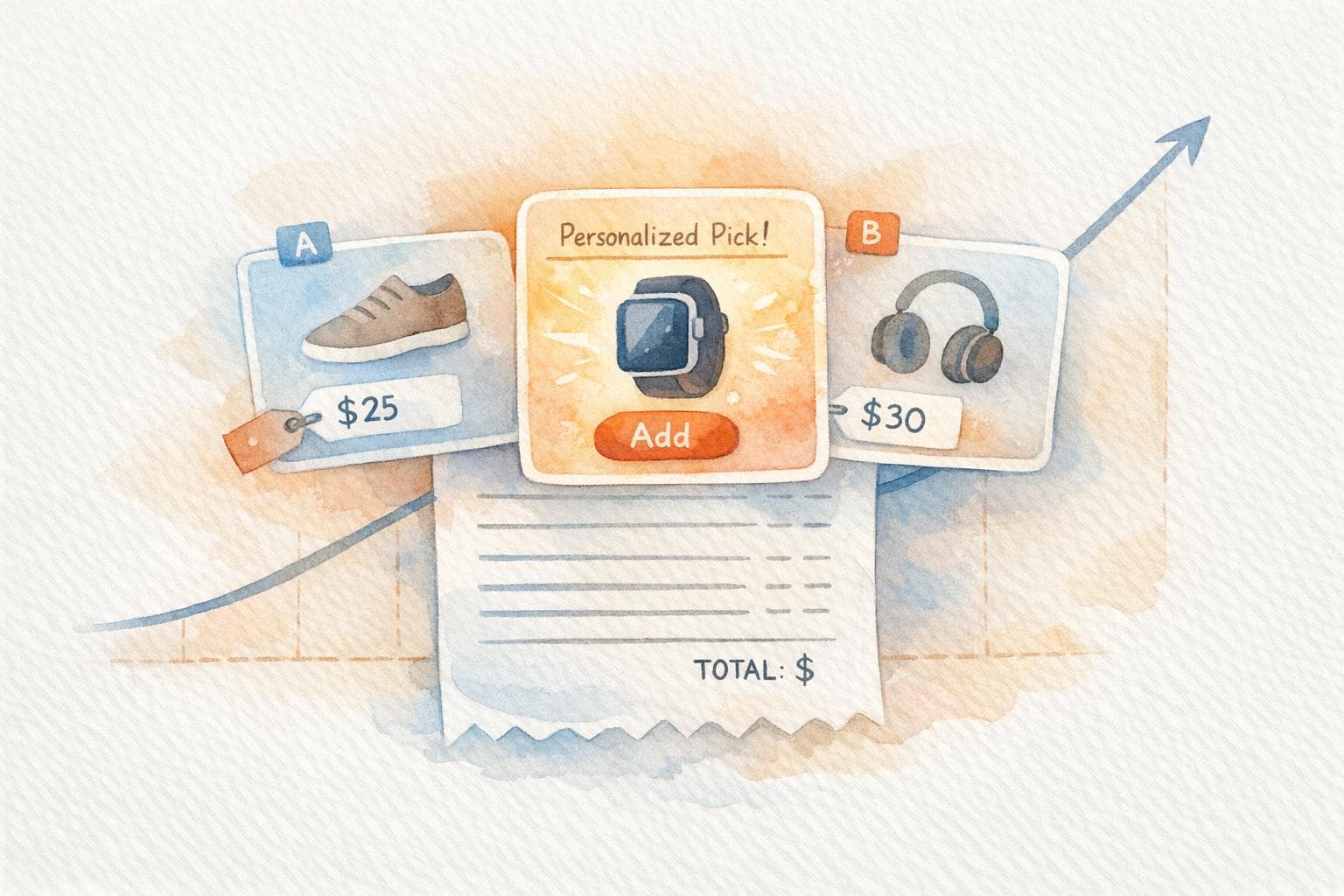
Want to increase your sales without spending more on customer acquisition? Post-purchase cross-selling is the answer. This strategy focuses on suggesting complementary products after a customer completes their purchase, boosting Average Order Value (AOV) by up to 25%. Here’s how it works:
- Timing is key: The best moment to present cross-sell offers is immediately after checkout, when customer intent is at its peak.
- Keep it simple: Limit options to 2–3 relevant items priced at 25% or less of the original purchase.
- Use customer data: Analyse purchase behaviour and segment customers to create tailored offers.
- Leverage tools: Use dynamic recommendation engines to suggest high-performing product pairings in real time.
- Track results: Monitor metrics like AOV, conversion rates, and customer lifetime value to refine your strategies.
Done right, post-purchase cross-selling can increase revenue, improve retention, and maximise your marketing spend. Let’s dive into the details.
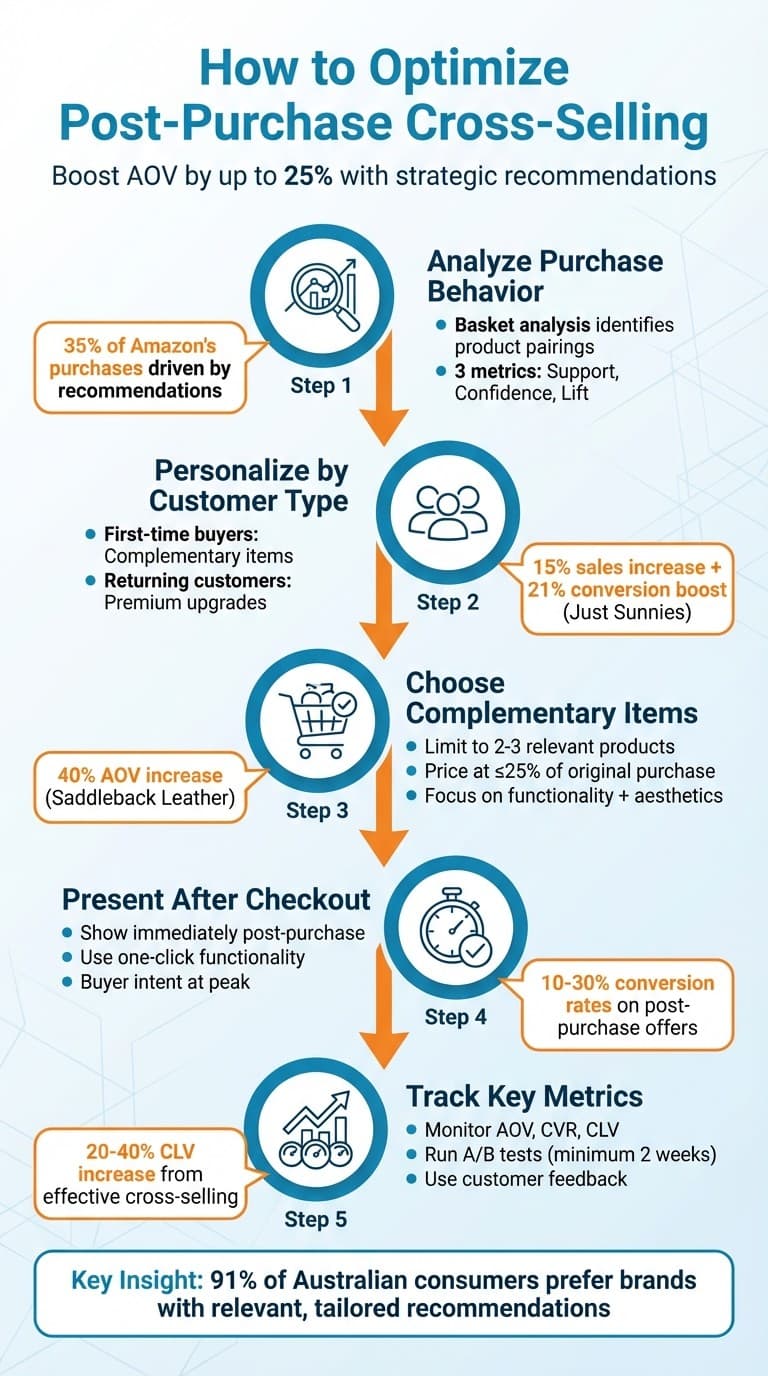
5-Step Post-Purchase Cross-Selling Strategy for eCommerce
Using Customer Data for Cross-Selling
Analysing Purchase Behaviour and Trends
Effective cross-selling starts with understanding what your customers are already buying. This is where basket analysis comes into play. It identifies products often purchased together by applying conditional rules. For instance, if someone buys a bike, they might also need a helmet.
Three key metrics help uncover these patterns:
- Support shows how frequently two items are bought together.
- Confidence predicts the likelihood of purchasing Item B when Item A is already in the cart.
- Lift measures whether the pairing happens more often than by chance.
Australian retailer Barbeques Galore tapped into basket analysis to recommend items commonly bought together, doubling their online sales. This approach relies on data from various sources like point-of-sale (POS) records, online shopping carts, browsing history, and even abandoned carts. It's a strategy that powers 35% of Amazon's purchases and 75% of Netflix's views.
The next step? Segmenting customers to make these insights even more specific.
Segmenting Customers for Personalised Offers
A one-size-fits-all approach rarely works. Segmenting your customers into groups based on their behaviour - such as purchase history, browsing patterns, or lifetime value - lets you create tailored cross-sell offers.
For example:
- First-time buyers may prefer subtle suggestions for complementary products. This builds trust without overwhelming them.
- Returning customers, on the other hand, are often more open to premium upgrades, as they already trust your brand.
Australian eyewear retailer Just Sunnies leveraged Klaviyo to recommend products based on past purchases. This strategy led to a 15% rise in sales and a 21% jump in conversion rates. The trick lies in aligning your strategy with the customer segment. For instance, use a "Completion Strategy" for new buyers by suggesting items that complete their purchase, and an "Evolution Strategy" for loyal customers by offering advanced or upgraded products.
Identifying High-Performing Product Pairings
Once you've segmented your audience, the next step is identifying which product combinations deliver the best results. This involves tracking the attachment rate - the percentage of customers who buy Product A and also add Product B to their purchase. Pair this with margin analysis to ensure the combinations are not just popular but also profitable.
True Alliance, which manages brands like The North Face and Coach in Australia, used basket analysis to pinpoint items frequently bought together across their product range. This data-driven approach led to a 200% year-on-year increase in online sales. By focusing on the top 25% of customers, they identified high-value pairings and trends.
To maximise success, set minimum thresholds for support, confidence, and lift. Then, prioritise high-margin products while excluding items with low inventory. With the right strategy, upselling and cross-selling can boost customer lifetime value by 20% to 40%.
Choosing and Presenting Cross-Sell Products
Selecting Complementary Products
When recommending cross-sell products, focus on items that naturally enhance the primary purchase. Think about functionality - like batteries for gadgets or power cords for printers - and aesthetics, such as a belt to complement jeans or matching cushions for a sofa. These suggestions should feel like a natural extension of the main product.
Price is another important factor. Keep cross-sell items affordable, ideally no more than 25% of the main product's price. For example, accessories priced around A$25 make sense for a A$100 item. Products in the A$5 to A$20 range often work well as impulse buys.
Here’s a real-world example: Saddleback Leather Company simplified its recommendations to focus on logical accessories, leading to a 40% increase in average order value. The key is to ensure every suggestion adds genuine value to the primary purchase.
Once you’ve identified suitable pairings, streamline the options to avoid overwhelming your customers.
Limiting Choices to Avoid Decision Fatigue
Offering too many options can actually hurt sales. When customers are presented with an overload of choices, they often feel paralysed and may decide not to buy anything at all. To combat this, limit cross-sell suggestions to two or three highly relevant items. This approach keeps the decision-making process simple while still offering meaningful choices.
Amazon’s recommendation engine is a great example of this strategy in action. By presenting a focused selection, it accounts for 35% of the company’s total sales. Closer to home, 91% of Australian consumers say they prefer brands that offer tailored, relevant suggestions rather than a flood of random options.
With a concise list of recommendations, the next step is presenting them in a way that grabs attention.
How to Present Cross-Sell Options
The way you showcase cross-sell items can make or break their success. Strategic placement is key. Use "Frequently Bought Together" widgets on product pages, highlight low-cost add-ons in the cart, or offer one-click extras on post-purchase thank-you pages.
"Post-purchase upsells give shoppers the opportunity to add another item to their order without risking the conversion from their initial order."
– Sara Yin, Shopify
Visual appeal also matters. Use clear, attractive images to help customers see how the items work together. Pair this with inviting language like "Complete your setup" or "Don't forget these" instead of aggressive sales tactics. Adding one-click functionality can further boost conversions by eliminating the hassle of re-entering payment details.
For Australian eCommerce businesses, it’s essential to comply with Australian Consumer Law. Avoid using pre-ticked boxes for paid add-ons and always display full prices, including any recurring fees. Transparency builds trust, and 87% of shoppers are willing to pay more for products from brands they trust.
Timing and Incentives for Cross-Selling
When to Present Cross-Sell Offers
The best time to introduce cross-sell offers is right after a purchase is confirmed. At this moment, the buyer's interest and intent are at their peak. One-click post-purchase offers work particularly well here. However, for payment methods like Afterpay, Zip, or Apple Pay, which don’t support one-click functionality, it’s effective to display these offers on the order confirmation page instead.
"The best moment to offer an upsell is immediately after a customer completes their purchase on the order confirmation page. Their buying intent is at its highest, and the core sale is already secure."
– Ben Salomon, Growth Marketing Manager, Yotpo
Post-purchase offers can deliver impressive results. Many merchants report conversion rates between 10% and 15%, with some even hitting 30%. Existing customers are particularly receptive to these offers, with conversion rates ranging from 60% to 70%, compared to just 5% to 20% for new customers.
Once the timing is nailed down, the next focus is creating smart discount and incentive strategies that encourage add-ons without cutting too deeply into profits.
Creating Discount and Incentive Strategies
Incentives can make cross-sell offers more appealing while protecting your margins. A good rule of thumb is the 25% rule: keep cross-sell items priced at no more than 25% of the original order value. For instance, if a customer spends A$100, offering an add-on under A$25 helps avoid overwhelming them with a higher price tag.
Discounts can also play a big role. A minimum discount of 20% on post-purchase offers has been shown to drive strong conversions. Additionally, free shipping thresholds are a proven motivator - 48% of shoppers are more likely to add items to their cart if it qualifies them for free delivery. Progress bars, like a message saying, "Add A$15 more for free shipping," can visually encourage customers to increase their order value.
Beyond discounts, non-physical perks such as priority shipping, extended warranties, or bonus loyalty points offer extra value without impacting product costs. Adding urgency - through countdown timers or labelling offers as limited-time - can also push customers to act quickly.
Personalisation and Dynamic Recommendations
Using Customer Insights for Personalisation
The best cross-sell strategies rely on understanding each customer’s behaviour and preferences. For instance, purchase history can reveal natural pairings - someone who buys a camera is likely to need a memory card or a protective case. Similarly, browsing habits and average order values can help pinpoint the ideal price range for cross-sell offers.
One effective method for segmenting customers is RFM analysis (Recency, Frequency, Monetary). This approach scores shoppers based on how recently and frequently they make purchases and how much they spend. High-value customers, for example, might be more inclined to consider premium add-ons, while newer customers may respond better to affordable options. Interestingly, returning customers are much more likely to convert on additional offers, with a success rate of 60–70%, compared to just 5–20% for new leads.
These insights set the stage for dynamic tools that can adjust recommendations in real time, creating a more tailored shopping experience.
Implementing Dynamic Recommendation Tools
Dynamic recommendation tools take personalisation to the next level by adapting offers in real time, using a mix of advanced algorithms. These tools often combine collaborative filtering - which suggests products based on the buying behaviour of similar customers - with content-based filtering, which matches products based on attributes like category, brand, or price range.
For example, Barbeques Galore used Einstein Product Recommendations, powered by basket analysis, to suggest items frequently bought together while providing live stock updates. This approach helped the company double its online sales.
Machine learning systems also play a significant role here, refining cross-sell strategies with real-time data. For instance, "Bought Together" recommendations are particularly effective on cart pages, while "User Affinity" suggestions - based on individual browsing history - fit seamlessly into "Recommended for You" sections. To ensure these algorithm-driven recommendations align with business objectives, companies can also apply manual rules, such as highlighting high-margin items, prioritising slow-moving inventory, or excluding out-of-stock products.
The impact of these tools is undeniable. Amazon, for instance, credits 35% of its total revenue to its recommendation engine, demonstrating how powerful personalised, dynamic recommendations can be.
Post Purchase Upselling Masterclass
Measuring and Refining Cross-Selling Strategies
Once you’ve set up your cross-selling tactics, the next step is to measure how well they’re working. This helps you fine-tune your approach and keep growing.
Key Metrics to Track
Start by looking at Average Order Value (AOV) - this tells you how much customers spend on average in a single transaction. It’s a great way to see if your cross-sell offers are increasing basket size. Also, monitor your Sales Conversion Rate (CVR), which shows what percentage of customers accept your cross-sell offers out of everyone who sees them.
Another important metric is Customer Lifetime Value (CLV), which measures the total revenue you can expect from a customer over time. Cross-selling done well can boost CLV by 20% to 40%. Keep an eye on your Return and Refund Rate too - if cross-sold items are returned frequently, it might mean your offers aren’t as relevant or useful as they should be. Lastly, track your Net Promoter Score (NPS) to ensure your cross-selling efforts enhance the overall customer experience instead of frustrating shoppers.
Once these metrics are in place, you can start refining your strategies with testing and customer feedback.
A/B Testing and Iterative Improvements
A/B testing is a powerful way to figure out what works and what doesn’t. By testing different variations of your cross-sell approach, you can pinpoint the factors that drive better conversions. For meaningful results, run your tests for at least two weeks and experiment with variables like product placement, messaging, and pricing.
For example, in 2019, the marketing agency Inflow helped a client in the vacations industry improve their cross-sell performance. They tested showing a trip protection offer on both the cart and checkout pages instead of just the cart. This small tweak led to a 3.3% increase in conversion rates and a 4% boost in revenue per user. Similarly, BombTech Golf ran cross-sell tests on their site and saw a 45% jump in website conversion rates, with an increase of over $60 in AOV.
Tools like heatmaps and session recordings can also help you spot where customers drop off during the shopping process, giving you insights into what might need tweaking.
Using Feedback to Improve Customer Experience
Customer feedback is invaluable for refining your cross-selling strategies. Use methods like automated email campaigns, in-email surveys, and post-purchase "thank you" pages to gather direct input. Indirect signals, such as high return rates or frequent customer service inquiries, can also reveal mismatched or ineffective offers.
Adding reviews and star ratings to your recommendation widgets can make a big difference - 66% of shoppers are more likely to buy when they see social proof. Chatbots are another handy tool; they can ask customers if their needs were met and suggest complementary items based on their responses.
For customers who frequently return items or overuse customer service, it might be worth excluding them from certain cross-sell campaigns to protect your profit margins. As small-business strategist Barbara Findlay wisely advises:
"For every minute you spend putting out fires, spend four minutes nurturing your most content and profitable customers".
Key Takeaways
Summary of Best Practices
Post-purchase cross-selling thrives when supported by smart use of data and well-timed offers. Start by reviewing your sales data to pinpoint products that naturally go hand-in-hand, and limit the options to a few highly relevant choices. The sweet spot for presenting these offers is right after checkout - between the payment confirmation and the thank-you page - when customer trust is at its highest.
Using one-click functionality can make a big difference, cutting down friction and boosting conversion rates by 10%-30%. Keep the cross-sell prices proportional, ensuring that the additional items don’t raise the total order value by more than 25%. Techniques like urgency triggers - think countdown timers or limited-time offers - can nudge customers to act quickly. Plus, ensuring your site is mobile-friendly guarantees a seamless shopping experience for those on the go.
Mix algorithm-driven recommendations with practical business strategies. Focus on high-margin items, manage inventory wisely, and align your cross-sell suggestions with what the customer originally purchased. With 91% of shoppers preferring brands that offer relevant recommendations, personalisation isn’t just helpful - it’s essential.
By following these practices, Australian eCommerce businesses can create effective, actionable strategies for growth.
Next Steps for Australian eCommerce Businesses
To put these ideas into action, start by auditing your current performance. Track your average order value (AOV) and conversion rates over a two-week period to establish a baseline. Use your sales data to identify patterns - what products are commonly purchased together - and create targeted cross-sell offers based on these insights.
Introduce one-click post-purchase functionality with the help of specialised tools. For first-time buyers, offer low-risk, complementary items to build trust. Run A/B tests systematically, tweaking one variable at a time, to uncover what resonates most with your audience. Keep a close eye on metrics like AOV, conversion rates, and customer lifetime value. According to Krista Walsh from CartHook, results should start to show within the first month:
"Instead of focusing on driving traffic, new store owners will find faster success by improving the AOV of their existing customers".
With a clear focus on these strategies, Australian eCommerce businesses can achieve measurable improvements in their post-purchase processes.
FAQs
How can I use customer data to improve cross-selling after a purchase?
To boost cross-selling after a purchase, start by diving into customer data to spot patterns and preferences. For instance, pinpointing items frequently purchased together lets you craft personalised recommendations that resonate with your customers.
Use tools like basket analysis and review past purchase histories to suggest complementary products or bundles. Timing plays a crucial role here - sending cross-sell offers soon after the initial purchase, while the customer is still engaged, can make a big difference.
You can also automate this process with behaviour-driven recommendations or dynamic bundles. This not only makes the experience smoother but can also lift the average order value while keeping your customers happy.
What are the best ways to choose and display cross-sell products effectively?
To make cross-selling truly effective, focus on suggesting products that naturally complement the customer’s initial purchase. For instance, if someone buys a coffee machine, recommending premium coffee beans or reusable cups makes the suggestion feel intuitive and useful.
The timing of these recommendations also matters. A great moment to introduce cross-sell options is right after the purchase, while the customer is still engaged and more likely to explore related items. Clearly highlight the benefits of these additional products to spark interest and build trust.
Lastly, ensure these suggestions fit seamlessly into the shopping journey. Personalisation plays a big role here - recommendations tailored to the customer’s preferences can not only boost sales but also enhance their overall experience.
How can I track the effectiveness of my post-purchase cross-selling efforts?
To gauge how effective your post-purchase cross-selling strategies are, keep an eye on a few key metrics that offer valuable insights:
- Average Order Value (AOV): Check if customers are spending more per purchase. This can indicate the success of your cross-sell efforts.
- Conversion Rates: Measure how often customers are saying "yes" to your cross-sell suggestions.
- Revenue Growth: Look at the overall boost in sales that can be directly tied to your cross-selling tactics.
Regularly analysing these metrics helps you pinpoint what’s working, fine-tune your strategy, and get the most out of your post-purchase opportunities. Timing and relevance are everything when it comes to keeping customers engaged.
Related Blog Posts
How AI Recommendations Boost Repeat Purchases
10 A/B Testing Ideas for eCommerce Ads
Create Your Customers: A Proven Framework
How Behavioral Data Improves Funnel Personalization
How to Map DTC Customer Touchpoints
Average Order Value (AOV) Analysis & Optimization
Newsletter
The Uncommon Insights Letter
Practical FMCG & eCommerce growth playbooks — margins, retention and scaling tactics, straight to your inbox.
Turn these ideas into profit you can see
Get a hands-on operator to turn the frameworks above into results — book a free audit call.