7 Ways To Use NPS For Growth
Use NPS to reduce churn, convert passives, amplify referrals and align teams — seven practical ways to turn customer feedback into measurable growth.
21 February 2026

- Customer Satisfaction: What is NPS + How Do You Improve It?
- 1. Review NPS Feedback to Find What Needs Fixing
- 2. Fix Problems Detractors Mention Most Often
- 3. Convert Passives into Promoters with Targeted Campaigns
- 4. Encourage Promoters to Refer More Customers
- 5. Compare Your NPS to Industry Benchmarks
- 6. Tell Customers How You've Acted on Their Feedback
- 7. Use NPS Data Across Marketing, Product, and Support Teams
Net Promoter Score (NPS) isn't just a survey metric - it’s a tool to grow your business by understanding customer loyalty. NPS categorises customers into Promoters (9–10), Passives (7–8), and Detractors (0–6), and helps you identify opportunities to improve and expand. Here’s how you can use NPS to drive results:
- Identify and fix issues Detractors mention to reduce churn and improve satisfaction.
- Convert Passives into Promoters with targeted campaigns and personal outreach.
- Encourage Promoters to refer others by offering incentives and making referral processes seamless.
- Compare your NPS to industry benchmarks to gauge performance and set improvement goals.
- Show customers how you’ve acted on their feedback, building trust and loyalty.
- Share NPS insights across teams to align marketing, product, and support efforts.
Research shows a 7-point NPS increase can lead to a 1% revenue bump, while retaining customers is far more cost-effective than acquiring new ones. By acting on feedback and engaging customers at each stage, businesses can turn loyalty into growth.
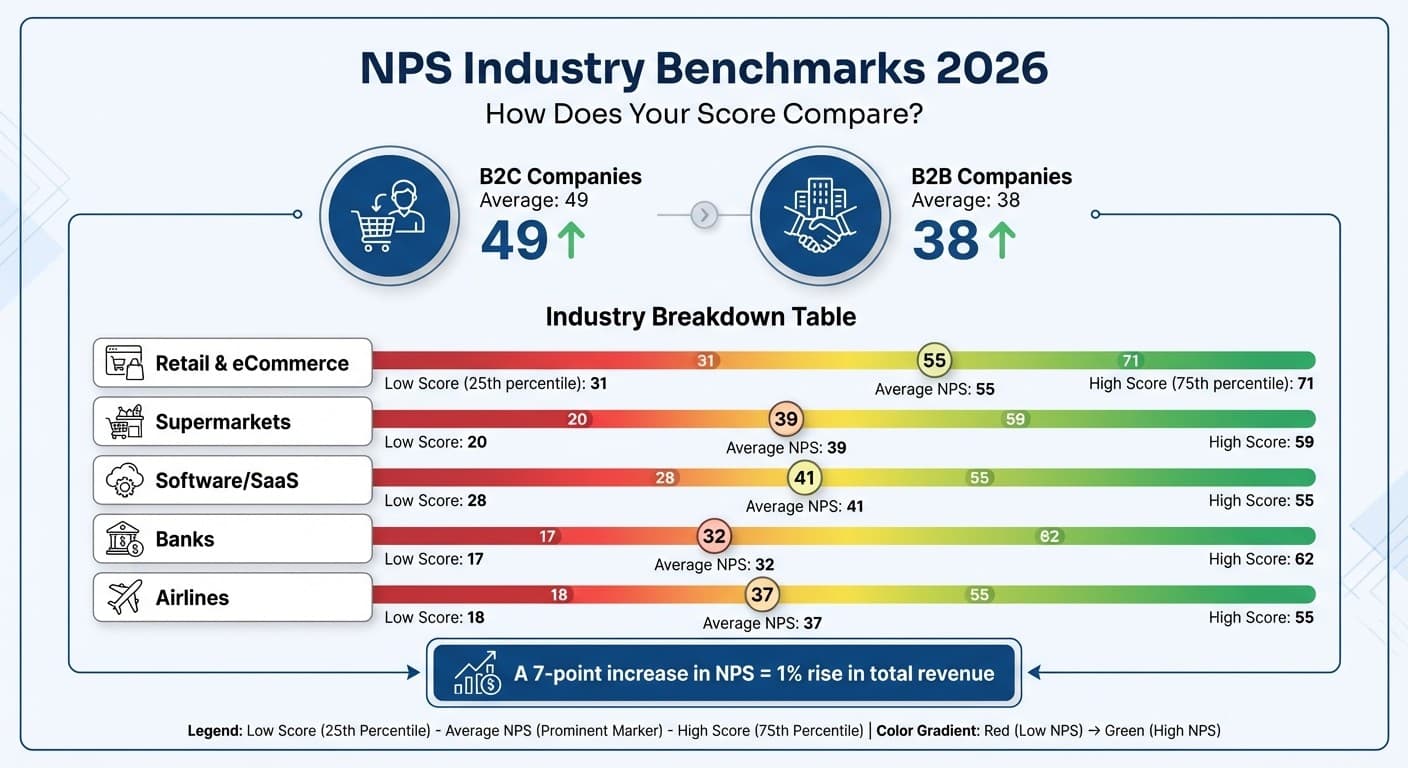
NPS Industry Benchmarks 2026: Average Scores by Sector
Customer Satisfaction: What is NPS + How Do You Improve It?
1. Review NPS Feedback to Find What Needs Fixing
Start by gathering your NPS scores and digging into the accompanying qualitative feedback. This feedback is a goldmine for identifying the friction points that either drive customers away or keep them coming back.
To make sense of the responses, group them into themes like Functionality, Usability, Reliability, and Customer Support. For smaller datasets, manual tagging works well. For larger ones, AI-powered sentiment analysis can save time and uncover patterns quicker. Once the feedback is categorised, you’ll start to see recurring issues. For instance, if a common complaint among detractors is slow delivery times, it’s a clear sign that this area needs attention.
Don’t stop at just what customers say - validate their feedback with behavioural data. Tools like heatmaps and session recordings can help confirm if detractors are, for example, abandoning their carts during checkout or struggling with specific product pages. By combining customer feedback with behavioural data, you can pinpoint exactly where problems lie.
Take it a step further by segmenting your analysis. Break down the data by demographics, geography, or customer lifecycle stage to uncover hidden trends. For instance, a low NPS score might be tied to a particular region, a specific product line, or new customers in their first 30 days. Without segmentation, these patterns can easily get lost in the overall numbers. Keep in mind that only 1 out of 26 unhappy customers will actually complain - the rest simply disengage. This makes it even more critical to dig deep into the data.
Finally, use root cause analysis techniques like The 5 Whys to get to the bottom of recurring complaints. For example, if customers are unhappy with slow service, asking "why" multiple times might reveal issues like understaffing during peak hours or the absence of helpful FAQs. This level of detail can guide you toward targeted and effective solutions.
2. Fix Problems Detractors Mention Most Often
Once you've identified recurring issues, it's time to tackle them head-on by addressing the concerns detractors raise most frequently.
Start by segmenting detractors based on their scores. Customers who rate you between 4 and 6 often highlight specific, actionable problems that can be resolved quickly. On the other hand, ratings between 0 and 3 usually point to deeper, systemic challenges that require more extensive, long-term solutions.
Speed is crucial. Aim to respond to complaints within 24 hours, or even better, within four hours. This not only demonstrates your commitment but also helps minimise the spread of negative feedback. In fact, 46% of customers expect a response within four hours.
When responding, avoid generic apologies. Make your reply personal by addressing the specific issue raised. For instance, if someone mentions a delayed delivery, acknowledge the delay directly and explain what caused it. Equip your frontline teams to take immediate action - whether it’s offering a refund, a discount, or an upgrade. Research shows that 70% of dissatisfied customers are willing to shop with you again if their concerns are resolved promptly. Quick action does more than just repair relationships; it also paves the way for tangible improvements.
Keep track of your progress by monitoring detractor scores over the following 30 days. Companies that resolve issues within 48 hours often see NPS gains of 12–15 points in just one quarter. And, on average, a 7% increase in NPS aligns with a 1% rise in revenue. These are outcomes worth striving for.
3. Convert Passives into Promoters with Targeted Campaigns
To drive growth, focus on turning passively satisfied customers - those who score a 7 or 8 - into enthusiastic promoters. These passives are content enough to stick around but often lack the emotional connection needed to become advocates. It's also more efficient to convert a passive than to win back a detractor. In fact, moving a customer from an 8 to a 9 can have twice the impact on your overall NPS compared to fixing a detractor.
Start by prioritising passives who scored 8, have high lifetime value, or raised issues that are easy to resolve. Use AI tools to group customer feedback into themes - like pricing concerns or service interruptions - and ask a simple yet powerful question: "What would move you one point higher?" This can help uncover specific friction points and break through their neutrality.
Next, learn from your promoters. Study the "happy paths" taken by your most satisfied customers and use targeted in-app messages or personalised emails to guide passives towards these positive experiences. Research shows that 80% of shoppers are more likely to buy from businesses offering tailored experiences, so customisation is key.
Timing and personalisation matter. Respond within 48 hours with a message addressing their specific concerns. Show them their feedback matters by explaining the actions you've taken. This approach can lead to NPS improvements of 12–15 points in just one quarter. Plus, with 86% of customers more likely to stay loyal when they feel emotionally connected to your team, this personal touch can make a huge difference.
Finally, refine your strategy through testing. Segment passives by factors like industry or usage patterns, then A/B test various approaches - such as different email subject lines, in-app messages, or incentives like discount codes or extended trials. Track feature adoption rates and monitor how many passives turn into promoters. Even small tweaks, like adjusting email wording or in-app variations, can lead to measurable gains in NPS and revenue. Once converted, these new promoters can help expand your referral network in the next phase.
4. Encourage Promoters to Refer More Customers
Promoters (those giving scores of 9–10) are a powerhouse for your brand, being four times more likely to recommend you to others. They generate 80–90% of positive word-of-mouth, and with 88% of people trusting recommendations from friends and family, the potential for referrals is immense.
Timing is everything when it comes to asking for referrals. Reach out when customers are most excited - right after they’ve submitted a high NPS score, made a purchase, or had a great support interaction.
Take Casper as an example. They use post-purchase NPS surveys to identify their biggest advocates, offering a A$75 gift card to referrers and a 25% discount to those referred. This strategy brought in a sevenfold return on investment over three years (ending in 2023) compared to other marketing efforts. Casper’s results also reveal a key insight: third-party gift cards work better for high-consideration items like mattresses, while store credit is more effective for products that encourage repeat purchases (think food delivery).
Another smart approach is the two-sided incentive model, like "Give A$20, Get A$20", where both the referrer and their friend benefit. Myles Apparel saw referral conversions double with this tactic, with referrals making up 17% of new customer growth in just one quarter. Honeylove also nailed it with a "Give 20%, Get A$20" offer, paired with a quick prompt on their order confirmation page. This simple tweak led to a 23% boost in the lifetime value of referred customers.
Make your referral requests personal. Tie them to the reason behind the customer’s high NPS score. Automate the process by syncing your NPS tool with your email system so referral invites go out right after a positive score is logged. For extra-influential advocates like bloggers or thought leaders, consider affiliate-style partnerships with commission-based rewards to keep them engaged over the long term.
Don’t forget to track your efforts. Use unique codes or referral links to measure conversions from each promoter. Referred customers typically convert five times faster and have a lifetime value that’s three to four times higher than those acquired through other methods. Keeping a close eye on these numbers ensures your referral program delivers the growth you’re aiming for.
5. Compare Your NPS to Industry Benchmarks
NPS scores only make sense when viewed in context. What’s considered outstanding in one industry might be just average in another. That’s why comparing your NPS to industry benchmarks is crucial - it helps you understand your position in the competitive landscape. Without these benchmarks, it’s impossible to gauge how well you’re actually performing.
Here are some key stats: In 2026, B2C companies average an NPS of 49, while B2B companies come in lower at 38. For retail and eCommerce, the median NPS is 55, with top performers hitting 71 and the 25th percentile at 31. Supermarkets, a prominent FMCG channel, average 39, with scores ranging from 20 to 59. These numbers highlight how much your industry context impacts whether your score is considered strong or weak.
"NPS has evolved from a simple survey question into the gold standard for measuring customer experience. Companies with high NPS scores grow 2.5x faster than competitors." – Mamta Tainwala
Interestingly, a 7-point increase in NPS is linked to a 1% rise in total revenue.
Rather than fixating on your absolute NPS, focus on how you compare to direct competitors. Break your data down by customer segment, product line, or geography to uncover specific areas for improvement. For example, if your eCommerce business scores 45 while the industry median is 55, you’ve identified a clear gap to address. Use your past performance as a benchmark and aim for at least a 5% improvement with each review cycle. Benchmarking doesn’t just show where you stand - it guides where to focus your efforts to enhance customer experience. These comparisons can help set realistic, incremental goals for improving your NPS.
| Industry | Average NPS | Low Score (25th percentile) | High Score (75th percentile) |
|---|---|---|---|
| Retail & eCommerce | 55 | 31 | 71 |
| Supermarkets | 39 | 20 | 59 |
| Software/SaaS | 41 | 28 | 55 |
| Banks | 32 | 17 | 62 |
| Airlines | 37 | 18 | 55 |
6. Tell Customers How You've Acted on Their Feedback
Once you've worked to resolve customer concerns, the next step is to show them what you've done with their feedback. NPS feedback only becomes meaningful when customers see tangible results. Closing the loop - demonstrating how their input has driven change - turns a simple survey into a powerful trust-building moment. When customers see their suggestions being acted on, they feel valued. Research shows that 83% of customers are more loyal to brands that address and resolve their complaints, and 70% are willing to return to a company if their complaint is resolved to their satisfaction.
Quick action is key here. Reaching out to unhappy customers within 24 hours can help prevent churn, while resolving issues within 48 hours can result in a 6-point boost in Net Promoter Score. This kind of prompt response not only strengthens loyalty but also builds trust. Companies that consistently close the loop report three times more promoters in their next survey compared to those that don’t.
"It's not the score that matters; it's what you do with it to make promoters that really counts." – Fred Reichheld, Bain & Company
One way to highlight your responsiveness is through "You Asked, We Listened" campaigns. These can be shared via newsletters or social media to publicly celebrate improvements. For instance, if customers have flagged slow checkout times, you could announce a new one-click checkout feature and credit their feedback. On a more personal level, send tailored emails to individuals, referencing their specific concerns and detailing how you’ve addressed them. Eaton Corporation provides a great example - by introducing a structured "Hot Loop" and "Cold Loop" system in 2023, they cut their feedback response time from four months to just 48 hours. This system enabled case managers to respond within 24 hours and keep cases open until fully resolved.
It’s equally important to thank your promoters. Share their success stories as case studies or invite them to join referral programmes. Studies show that 77% of customers view brands more positively when they actively seek and act on feedback, and customers are 21% more likely to participate in future surveys if they know their previous feedback led to action. By showcasing how customer input drives meaningful improvements, you not only enhance NPS but also foster a cycle of loyalty and growth. When customers see their feedback leading to real change, it strengthens their connection to your brand and supports broader efforts in marketing and product development.
7. Use NPS Data Across Marketing, Product, and Support Teams
When customer feedback is shared across departments, NPS (Net Promoter Score) data becomes a tool for driving meaningful change. Instead of isolating insights within one team, marketing, product, and support teams can collaborate to create a fuller picture of the customer experience.
Marketing teams can use NPS data to identify patterns among high-value customers. For example, "Devoted" customers - those with high NPS scores - can become the focus of loyalty campaigns, while "Exposed" customers - high-value detractors - need immediate attention to prevent revenue loss. If a customer's NPS score suddenly drops, automated "save" campaigns can be triggered using behavioural data, such as reduced purchase frequency. Additionally, analysing what resonates with promoters can help refine messaging for future campaigns [44, 70].
Product teams benefit from digging into the details of NPS feedback. For instance, Henry Schein, a dental practice software company, used role-based segmentation to uncover differences in feedback between practice owners and office managers, leading to targeted product updates. Similarly, Atlassian's Confluence team categorised customer comments into themes. They found that while "Performance" received the most feedback and had a relatively high NPS, "Tables" had fewer mentions but a much lower score. This insight helped the team prioritise improvements to table functionality.
Support teams can also integrate NPS insights into their workflows. By categorising customers based on their NPS sentiment, agents can personalise their approach. For example, Zip Water UK boosted its NPS from +2 to +73 between 2023 and 2024 by focusing on fast response times, quick resolutions, and proactive outreach to address customer concerns. Additionally, recurring issues, like confusing billing pages, can be flagged and addressed as broader system improvements.
When insights from NPS data are shared across teams, the results are transformative. Marketing gains clarity on what drives loyalty, product teams can reduce churn with targeted updates, and support teams can escalate systemic problems for resolution. This collaborative approach not only improves internal processes but also fuels business growth. Consider this: existing customers contribute at least 26% of total revenue, and retaining them is seven times cheaper than acquiring new ones. By breaking down silos, NPS becomes more than a metric - it becomes a strategy for sustainable growth.
Conclusion
The seven strategies outlined earlier illustrate how NPS can directly fuel growth by predicting revenue trends, reducing churn, and encouraging organic expansion. By turning customer feedback into actionable steps, eCommerce businesses can address critical issues, convert passives, engage promoters, benchmark performance, close the loop, and integrate feedback across teams.
Consider this: a 5% increase in customer retention can lead to a 25% to 95% boost in profitability, and improving NPS has been shown to deliver clear revenue gains. Promoters are 4 to 5 times more likely to repurchase and refer others, while loyal customers spend 31% more than new ones over time. Since retaining customers is far more cost-effective than acquiring new ones, the importance of NPS-driven strategies becomes undeniable.
The urgency of acting on customer feedback cannot be overstated. Measurement alone achieves little. As Damian Bennett, Business Director at Perceptive Group, aptly explains:
"The purpose of measuring customer experience is to uncover opportunities for improvement within your organisation. If you choose not to act, you only have 50 per cent of the solution".
Data shows that over one-third of global shoppers will reduce or stop spending with a brand after just one poor interaction. This underscores the dual nature of detractors - they represent both a risk and a chance to improve.
Businesses that succeed are those that act quickly on feedback, encourage promoters to refer others, and share NPS insights across marketing, product, and support teams. When feedback drives action, customer relationships grow stronger, churn decreases, and revenue rises - not through costly acquisition campaigns, but through the compounding effects of loyalty and advocacy. Each of the seven strategies plays a role in embedding customer feedback into daily operations, turning insights into growth.
To maximise the potential of NPS, make it a core part of your company culture and align it with your KPIs to ensure consistent, decisive action.
FAQs
How often should I run an NPS survey?
When it comes to running NPS surveys, the timing often depends on your industry and how frequently you interact with customers. Many businesses stick to a quarterly, biannual, or annual schedule. Among these, quarterly surveys strike a balance by offering regular insights while minimising the risk of survey fatigue.
For transactional surveys, timing is everything. Sending them shortly after a specific interaction - ideally within 0 to 10 days - ensures the experience is still fresh in the customer’s mind. However, it’s crucial not to overdo it. Most companies find that spacing surveys out every 3 to 6 months provides relevant feedback without overwhelming or annoying customers.
What’s the best way to follow up with Detractors fast?
When it comes to addressing NPS Detractors, speed is everything. Acting quickly - whether through automated emails or personalised phone calls - can make a huge difference. Prompt action not only shows customers you care but also helps tackle their concerns before they escalate, reducing the risk of losing them.
Automated workflows are great for collecting extra feedback, giving you more insight into the issue. On the other hand, a direct phone call adds a personal touch, allowing you to resolve problems in a way that feels meaningful to the customer. Combining both approaches can be a game-changer for turning unhappy customers into loyal ones.
How do I turn Promoters into repeat referrals?
To encourage your Promoters to become repeat referrers, start by identifying your most satisfied customers using their NPS (Net Promoter Score) feedback. Once you've pinpointed these happy customers, engage with them directly and make it easy for them to refer others. Offering personalised incentives - like discounts, cashback, or exclusive perks - can motivate them to share their positive experiences.
Building strong relationships is key. Keep communication open and consistent, follow through on your promises, and show genuine appreciation for their support. A simple "thank you" can go a long way in maintaining goodwill. Additionally, make it a habit to close the feedback loop by addressing their input and letting them know how their feedback is being used. This not only strengthens their loyalty but also boosts the chances of them referring others again.
Related Blog Posts
Ultimate Guide to Post-Purchase Experience Design
7 Customer Retention Metrics Every eCommerce Brand Must Track
Subscription Analytics: Metrics That Matter Most
How to Map DTC Customer Touchpoints
Ultimate Guide to Product-Market Fit Surveys
Your Feedback Loop is a Dead End (And How to Open It)
Newsletter
The Uncommon Insights Letter
Practical FMCG & eCommerce growth playbooks — margins, retention and scaling tactics, straight to your inbox.
Turn these ideas into profit you can see
Get a hands-on operator to turn the frameworks above into results — book a free audit call.