Agentic Storefronts vs. Google Ads: Comparing Unit Economics of AI Discovery vs. Paid Search Channels
AI storefronts use pay-after-sale discovery and higher conversion rates but need strong margins; Google Ads charges upfront for clicks and still delivers predictable, high‑intent traffic.
16 February 2026
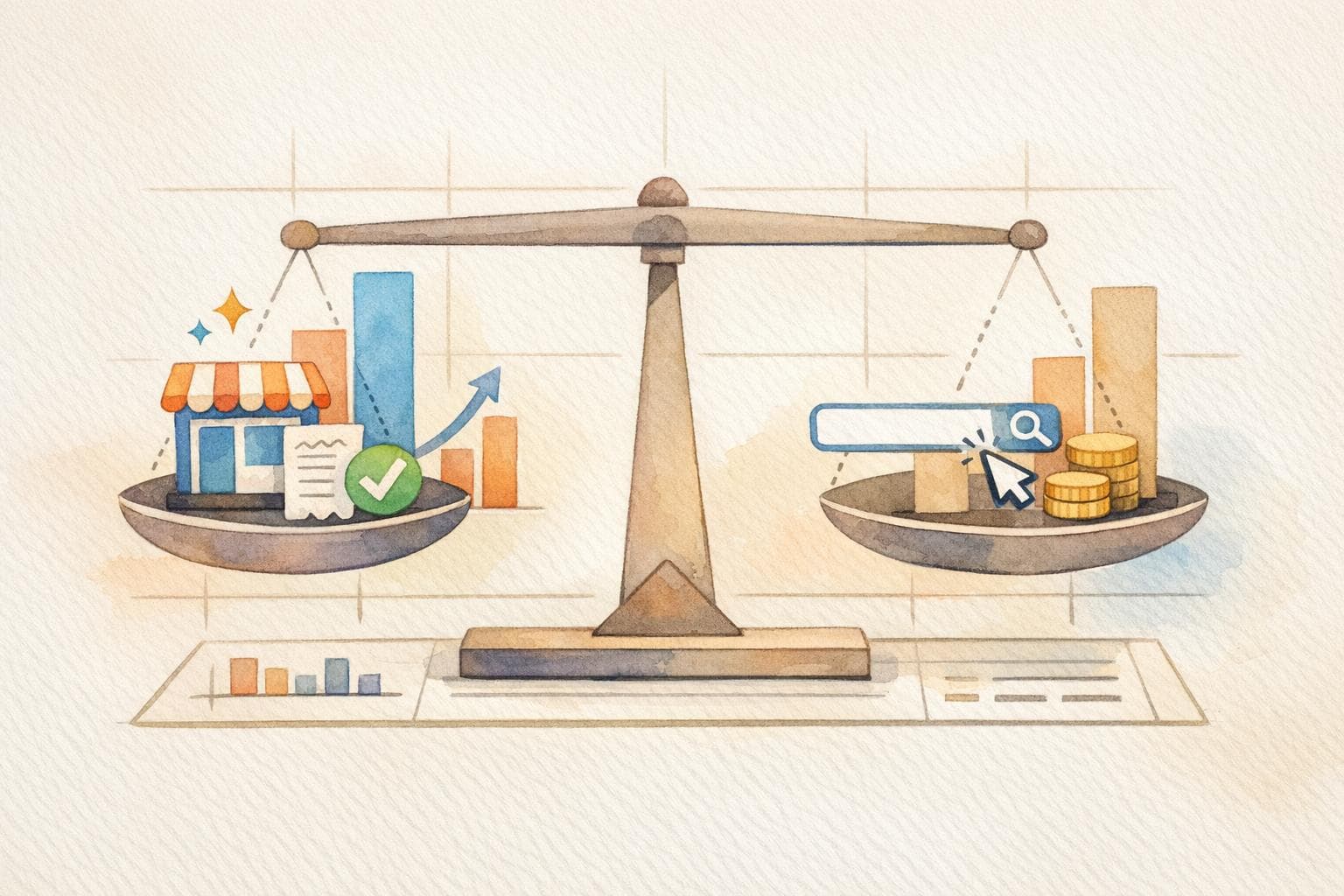
Which is better for Australian eCommerce businesses: Google Ads or agentic storefronts?
Here’s the short answer: Google Ads charges upfront for clicks and works well for high-intent traffic, but rising costs make profitability tough. Agentic storefronts, powered by AI tools like ChatGPT, charge only after sales but require strong margins to absorb transaction fees.
Key takeaways:
- Google Ads: Costs $60–$150 per customer acquisition; good for immediate traffic but has scalability limits and high competition.
- Agentic Storefronts: Charge ~7% per transaction; growing fast but still under 1% of eCommerce revenue. Best for high-margin products and AI-ready businesses.
- Conversion rates: AI-driven traffic converts at 14.2% vs. 2.8% for traditional paid search.
Quick Comparison
| Factor | Google Ads | Agentic Storefronts |
|---|---|---|
| Payment Type | Pay-per-click (PPC) | Post-sale transaction fee |
| Cost Range | $60–$150 per customer | ~7% per transaction |
| Conversion Rate | 2.8% | 14.2% |
| Best For | High-intent traffic | AI-driven product discovery |
| Scalability | Limited by search volume | Scales with AI recommendations |
For established brands, Google Ads offers predictable traffic but at higher costs. Agentic storefronts are better for AI-forward strategies and long-term growth. Most businesses should balance both channels for maximum impact.
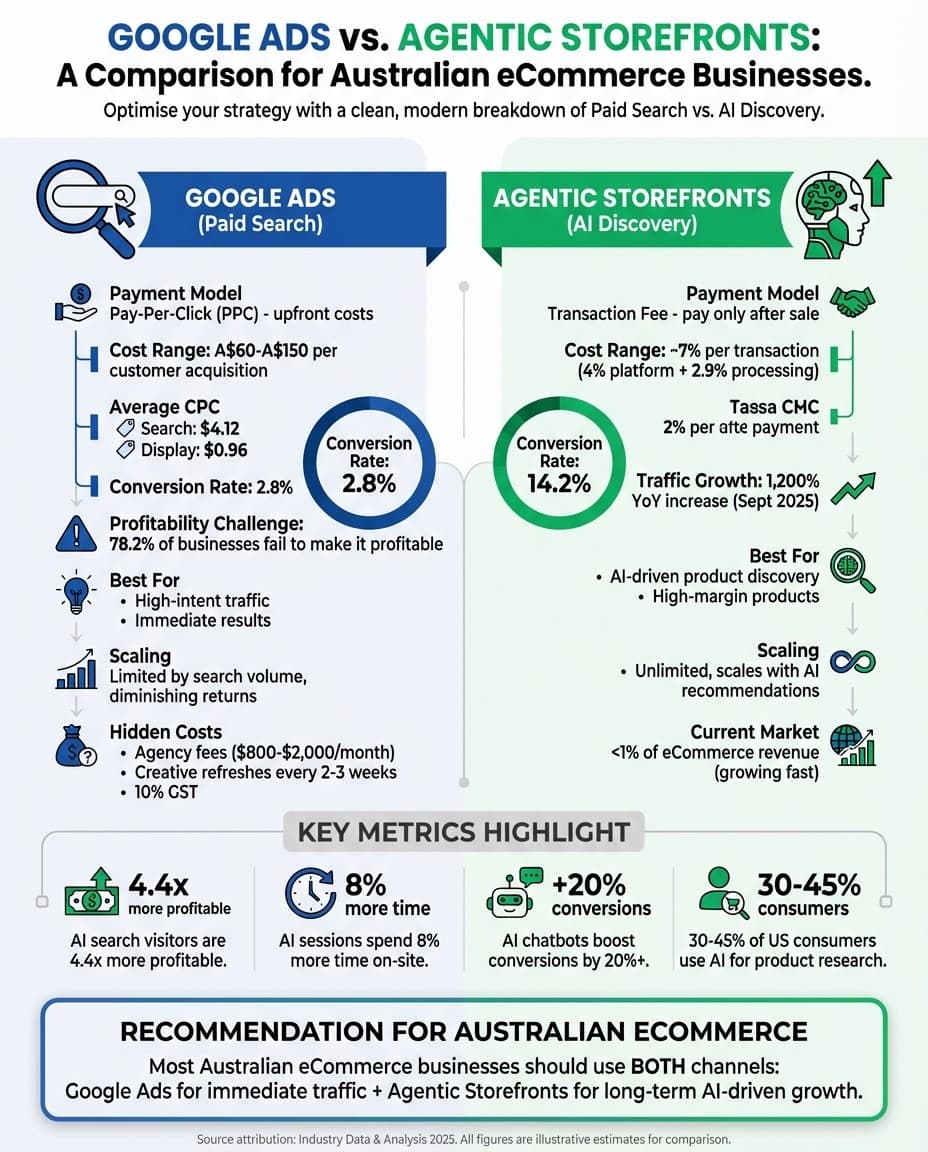
Google Ads vs Agentic Storefronts: Cost and Performance Comparison for Australian eCommerce
Google Ads: Cost Analysis and Performance Metrics
Cost Structure and ROI
Google Ads uses a pay-per-click (PPC) model, where advertisers pay a fee for each click their ad receives. In Australia, the average cost-per-click (CPC) is about $4.12 for Search Ads and $0.96 for Display Ads. These figures can vary significantly depending on the industry. For example, eCommerce businesses typically see CPCs ranging from $0.50–$2.00 for Shopping Ads and $1.00–$5.00 for Search Ads.
However, the cost of clicks is just one part of the equation. Many Australian businesses allocate between $800 and $2,000 each month for campaign management and creative production. On top of that, there’s the 10% GST to consider, as well as the investment in high-converting landing pages and tracking tools like GA4 and server-side analytics.
Profitability is a challenge for many advertisers. A striking 78.2% of businesses fail to make Google Ads profitable. Adding to the difficulty, the average CPC rose by 12.88% year-over-year, reaching $5.26 in 2025. For Australian eCommerce businesses, the average cost-per-acquisition (CPA) is $68.81.
Improving ad relevance can significantly impact costs. A high Quality Score - a metric Google uses to evaluate ad relevance and user experience - can cut CPCs by up to 50%, while poor relevance can drive costs higher.
"Google Ads is probably one of the most measurable marketing channels out there. You can track it all the way to the very last dollar if you've got it set up correctly." – Patrick McKeering, Ads Expert
Interestingly, Google Shopping Ads offer lower CPCs - $0.66 compared to $1.16 for traditional Search Ads. This makes them a more efficient option for businesses focused on product discovery.
Once costs are understood, the next step is examining how these clicks translate into actual sales through the conversion funnel.
Conversion Funnel Performance
Search Ads are particularly effective at capturing high-intent users - those actively searching for solutions. This explains why they achieve 10 times higher click-through rates (CTR) compared to Display Ads.
That said, not all clicks convert equally. Mobile traffic accounts for 53% of total clicks, yet mobile users convert at about half the rate of desktop users when it comes to complex purchases. For eCommerce, the average conversion rate on mobile is 2.20%, whereas desktop users convert at a much higher rate of 10.70%.
Recent privacy updates, such as Apple’s iOS changes, have made tracking conversions more difficult. These updates have driven up conversion costs - up to 200% higher for tracked users - as businesses are forced to make decisions with less complete data.
Performance also varies significantly by product category. For instance:
- Clothing and Apparel: Conversion rate of 2.70%, CPA of $19.29
- Computers and Tech: Conversion rate of 2.20%, CPA of $75.92
Seasonal trends play a big role too. During Black Friday, ad costs typically rise by 26%, but conversions surge by 32.68%.
Scaling Limitations and Budget Requirements
Scaling Google Ads campaigns comes with its own set of challenges. One major limitation is finite search volume. Once you’ve captured a significant share of impressions for your target keywords, increasing your budget often results in diminishing returns. Doubling your ad spend doesn’t necessarily mean doubling your customer base.
In Australia, scaling is even tougher. Customer acquisition costs (CAC) are 20–35% higher than in the US due to the smaller market size and more concentrated competition. To justify professional management, businesses typically need to spend at least $1,500 per month on ads. Spending less can lead to management fees eating into your profits.
Another consideration is ad fatigue. To maintain performance, ads need to be refreshed every 2–3 weeks, which adds to production costs. While branded search terms (e.g., your company name) are cost-effective, they only capture existing demand. Non-branded search terms, which attract new customers, can cost 3–5 times more.
Success in scaling often relies on efficiency. Take Hairstory, a US-based hair care retailer, as an example. By focusing on new customer acquisition goals within Performance Max campaigns, they achieved a 31% increase in return on ad spend (ROAS) and a 545% boost in conversions from new customers in 2023/2024. However, achieving these results requires advanced tracking, rigorous testing, and expertise - resources that can be stretched thin as campaigns grow.
ChatGPT Ads vs Google AI Ads: Where Should Your Budget Go?
Agentic Storefronts: AI-Powered Customer Acquisition
Agentic storefronts are changing the game for customer acquisition by leveraging AI to replace traditional pay-per-click (PPC) methods with a more efficient, results-driven approach.
Cost and Revenue Models
Agentic storefronts flip the script on conventional advertising by charging transaction fees only after a sale is completed. For example, OpenAI applies a 4% fee on Shopify transactions through ChatGPT's "Instant Checkout" feature. Combined with payment processing fees of approximately 2.9%, this totals around 7% - a much leaner cost structure compared to traditional advertising models.
The operational costs are also structured differently. Instead of pouring resources into creating landing pages, designing ad creatives, or managing campaigns, agentic storefronts depend on structured data - like Schema markup, product feeds, and live inventory updates. This means your product catalogue needs to be machine-readable, complete with accurate attributes, detailed descriptions, and FAQs that AI can interpret and present to users.
Other costs include integrating AI tools to manage your brand's "Knowledge Base", training AI agents with specific product data, and maintaining real-time API connections for pricing and stock updates. Unlike Google Ads, where Australian businesses typically face customer acquisition costs of A$60–A$150, agentic storefronts shift expenses to transaction fees - so you only pay when a sale is made.
This transaction-based model not only reduces upfront costs but also aligns spending directly with revenue generation, creating a streamlined and efficient path to conversions.
AI-Driven Conversion Methods
The conversion process in agentic storefronts is a departure from traditional keyword bidding. Instead, products are matched to customer needs through algorithm-driven product matching. These algorithms analyse structured data to align your offerings with user intent. For instance, when a customer asks ChatGPT or Gemini for product recommendations, the AI evaluates options based on attributes like compatibility and use cases to suggest the best fit.
This approach delivers tangible results. AI-powered pre-sale chatbots have been shown to boost conversion rates by over 20%. A notable study revealed that generative AI workflows added approximately $5 in additional annual revenue per customer. Amazon's conversational assistant, Rufus, is projected to increase annual sales by an additional $10 billion.
Unlike traditional paid search methods that require multiple steps, agentic storefronts enable native checkout directly within the AI interface. This seamless process eliminates the friction that often leads to cart abandonment, allowing customers to complete purchases without leaving the conversation.
"AI isn't winning by being clever. It's winning by making ecommerce simple, fast, and easy, and by proving that productivity can rise from the demand side as sharply as the supply." – Andrew Birmingham, Mi3
Google's "Business Agent", launched in January 2026, exemplifies this evolution. Retailers like Lowe's, Michaels, Poshmark, and Reebok use the AI agent within Google Search to answer product questions and facilitate direct purchases - no website redirects required.
Automation and Scaling Capacity
Agentic storefronts also excel at scaling operations. Unlike traditional advertising, there's no limit to search volume or diminishing returns from increased ad spending. AI agents operate across your entire commerce stack - managing product catalogues, inventory, CRM, and logistics autonomously.
The market reflects the growing potential of this model. In 2025, the value of agentic AI in retail was $46.74 billion, with projections reaching $175.11 billion by 2030, driven by a compound annual growth rate of 30.2%. Early adopters report 6–10% revenue increases and up to 40% improvements in order efficiency.
One standout innovation is the Universal Commerce Protocol (UCP), introduced in January 2026. This open standard allows businesses to integrate once and operate seamlessly across multiple AI platforms - such as Gemini, ChatGPT, and Perplexity. With UCP, you maintain a single structured data feed that all AI agents can access, simplifying the process of scaling across channels.
Zalando offers a compelling example. Since October 2024, the retailer has deployed its AI assistant in 25 markets, serving over 2 million customers. This has resulted in a 40% increase in high-value interactions, driven by personalised fashion advice and curated recommendations. The system scales effortlessly as user engagement grows, without requiring additional ad spend or campaign management.
"The choice facing brands is clear: rent agentic capabilities from closed ecosystems, or own them via open, composable frameworks that offer control, adaptability and long-term strategic advantage." – Kasia Ryniak, Upside
Side-by-Side Comparison: Cost and Revenue Analysis
When comparing these channels, the key difference lies in when you pay. With Google Ads, you're charged upfront for every click, regardless of whether it leads to a sale. On the other hand, agentic storefronts, like those powered by AI discovery tools, only incur costs after a sale is made. However, OpenAI applies a combined fee of over 7% per transaction for Shopify checkouts handled via ChatGPT.
Google Ads also comes with recurring costs, such as agency management fees and creative updates every 2–3 weeks. Meanwhile, agentic storefronts face a different challenge: thinner profit margins due to cumulative transaction fees, which can make low-margin products unprofitable.
"Merchants will pay 7%-plus per transaction for these 'agentic commerce' transactions. This doesn't include additional potential tech and other costs." – Emily Pfeiffer, Principal Analyst, Forrester
Understanding the cost structures of each channel is essential when evaluating unit economics.
Comparison Table: Cost Drivers and Revenue Models
| Factor | Google Ads (Paid Search) | Agentic Storefronts (AI Discovery) |
|---|---|---|
| Payment Model | Pay-Per-Click (PPC) | Transaction Fee / Commission (PPS) |
| Upfront Costs | High (creative, setup, agency) | Moderate (feed optimisation, knowledge base) |
| Ongoing Costs | Variable CPC (fluctuates with competition) | Fixed % per sale + payment processing |
| Hidden Costs | Agency fees, creative refreshes | Reduced profit margins from cumulative fees, feed syndication costs |
| Typical Cost Range | A$60–A$150 per customer acquisition | 7%+ per transaction |
| Conversion Rate | 2.8% (traditional search) | 14.2% (AI search traffic) |
| Scaling Economics | Diminishing returns as keywords saturate | Scalable based on AI recommendation logic |
| Control Level | High (you control ad copy and landing pages) | Lower (AI synthesises the recommendation) |
| Best For | Immediate top-funnel scale | High-intent, deep-funnel conversion |
Google Ads demands higher upfront investment, while agentic storefronts shift costs to the post-sale phase, requiring strong profit margins to remain viable.
Interestingly, visitors from AI-powered search engines bring more value. They are 4.4 times more profitable than those from traditional organic search, spend 8% more time on-site, and view 12% more pages.
To gauge overall profitability, businesses must consider all related expenses. For Google Ads, customer acquisition costs typically range between A$60 and A$150, with increasing CPCs as competition grows. Agentic storefronts, on the other hand, transfer costs to post-sale fees, with merchants needing robust margins to absorb the 7%+ transaction fees without eroding profitability.
Choosing the Right Channel for Your Business
Picking the right channel isn't just about performance metrics; it’s about aligning with your business stage and what your product needs. Whether you’re chasing quick cash flow or planning for long-term growth, your choice matters.
Business Stage and Product Category Fit
Google Ads is a go-to for businesses that need instant results. It’s a high-volume channel, but it comes with acquisition costs ranging from A$60 to A$150. If you’re an established retailer with solid margins and a need for predictable traffic, paid search is hard to beat.
For businesses in their early stages or those experimenting, agentic storefronts offer a different kind of opportunity. AI-driven sessions have seen explosive growth, with a median increase of 1,200% year-on-year as of September 2025. While AI search still makes up less than 1% of total eCommerce traffic, its potential lies in positioning early. Between 30% and 45% of US consumers now use generative AI for product research and comparisons, showing how this trend is gaining traction.
The type of product you sell is also a key factor. Everyday items like household goods thrive in AI-driven discovery models, where structured data replaces traditional keyword bidding. On the other hand, categories like fashion and home goods, which often have more complex use cases, benefit from AI agents that can interpret specific attributes like “best for marathon training”. For smaller businesses, a smart move is to allocate 10–15% of the budget to experimental AI channels while keeping 60–70% invested in proven platforms like Google Ads.
Traffic Ownership and Long-Term Control
Google Ads provides "rented" traffic - turn off the budget, and the traffic stops instantly. You control parts of the process, like ad copy and landing pages, but you’re always at the mercy of Google’s algorithms and auction dynamics.
Agentic storefronts offer a mix of opportunities. On-site agents, like Amazon’s Rufus or Home Depot’s Magic Apron, allow businesses to own customer relationships and data. These proprietary assistants bring users into your ecosystem, where you can offer perks like loyalty rewards or exclusive services that third-party agents can’t match.
However, third-party agents like ChatGPT come with risks. Shopping referrals from ChatGPT in the US grew more than sevenfold between 2024 and 2025. The danger here is losing direct relationships with customers, reducing your brand to just a fulfilment provider.
"Agentic AI has the potential to entirely disintermediate multibrand retailers and turn direct-to-consumer brands into indirect ones, becoming next-gen marketplaces that control transactions, compress margins, and capture data." – Bain & Company
To avoid this, businesses need to create a “customer moat.” This can include offering exclusive products, unique services, or experiences that draw customers directly to your platform. Interestingly, consumers currently trust retailer-owned AI agents three times more than third-party options, giving businesses a chance to strengthen their direct relationships.
Resource Requirements and Technical Integration
Google Ads requires a moderate technical setup, including sitewide tracking, enhanced conversion configurations, and maintaining a Merchant Center feed. But don’t underestimate the ongoing creative costs. For example, while a A$50 acquisition cost might seem reasonable, monthly expenses for design, video production, and user-generated content can easily hit A$15,000.
Agentic storefronts, on the other hand, involve more technical work upfront but less direct media spending. Brands must adopt protocols like UCP (Google/Shopify) or ACP (OpenAI/Stripe) to ensure their product data is accessible in AI-powered systems like Gemini or ChatGPT. The focus shifts from traditional SEO to making your data “answerable” by AI agents. This means keeping product feeds updated with consistent GTINs, pricing, and inventory data - Google alone refreshes its Shopping Graph 2 billion times per hour.
"Agents don't browse, they parse. Schema markup, product feeds, inventory signals, trust markers – this is becoming the primary optimisation stack." – Michael Sparkes, Sparro
For smaller businesses, success in agentic commerce requires teamwork across PR, content, and product teams. Budgets also shift, with less emphasis on media spend and more on building data infrastructure and monitoring tools for AI visibility.
A recent example of this shift was seen during the 2025 holiday season when brands like Lowe’s and Reebok launched branded AI shopping assistants directly in Google Search. These integrations handled conversational discovery and transactions, showcasing the technical and collaborative effort needed to make agentic commerce work.
The reality is that most businesses won’t choose one channel over the other - they’ll use both. Google Ads can provide immediate scale, while investments in AI-driven discovery lay the groundwork for future growth. This balance ensures both short-term wins and long-term business value.
Conclusion
Google Ads and agentic storefronts rely on fundamentally different cost structures. Google Ads provides immediate traffic but comes with continuous costs, with acquisition costs typical for Australian businesses. On the other hand, agentic storefronts operate on performance-based fees, offering streamlined checkouts that can boost conversion rates by over 20%.
For established retailers with healthy profit margins, Google Ads is an excellent option to drive high-intent traffic. However, its scalability is often constrained by search volume and growing competition. The rise of AI-powered commerce is reshaping the landscape, favouring businesses that optimise their product feeds and adopt protocols like UCP and ACP. This shift marks a transition from simply "ranking on a page" to "being selected through AI-driven recommendations".
The trade-offs between these models highlight the importance of strategic balance. To thrive, Australian eCommerce businesses should combine the strengths of both channels. Google Ads can deliver immediate results, while investing in agent-ready infrastructure positions businesses for long-term growth in the AI-driven marketplace. This dual approach ensures companies can seize current opportunities while staying prepared for future advancements.
"The actual war isn't about checkout infrastructure. It's about whether AI agents can find your products in the first place." – Mostafa ElBermawy, CEO, Goodie
As discussed earlier, maintaining accurate and high-quality product information is essential for both paid search and agentic commerce. Success ultimately hinges on strong unit economics, supported by clear data and efficient cost structures. Whether it's refining ad campaigns or fine-tuning product feeds, the focus should remain on achieving robust margins and sustainable growth.
FAQs
How do I work out which channel is more profitable for my margins?
To figure out profitability, you need to weigh up the customer acquisition cost (CAC) against the lifetime value (LTV) for each channel. Start by calculating the total CAC, which includes all marketing and sales expenses. Then, check if the LTV is substantially higher than the CAC - this is a key sign of a profitable channel.
Another important factor is the contribution margin, which is the profit left after covering costs. Focus on channels that offer a lower CAC and a higher LTV, as these are likely to bring in the best returns. Keep an eye on these metrics regularly to make sure growth stays on track and budgets are being spent wisely.
What do I need to set up to be discoverable in AI storefronts?
To ensure your website is discoverable in AI storefronts, it’s crucial to make it machine-readable. Start by implementing rich schema markup, such as Product, AggregateRating, and FAQ schemas. These provide structured data that AI systems can easily interpret.
Additionally, consider creating in-depth buying guides tailored to research-phase queries. These guides help address common questions potential buyers have. Including comparison tables is another effective way to provide clear, organised information that AI platforms can reference, boosting your website's visibility and accessibility.
How should I split budget between Google Ads and AI discovery?
When creating a balanced budget, it's common to allocate about 70% of resources to Google Ads. This is because of its consistent track record in delivering strong performance and return on investment (ROI).
Set aside 15–20% for AI-driven experimental channels, which can include areas like media, infrastructure, and content. These efforts are aimed at boosting trust and visibility over time.
It's wise to start small with AI initiatives, as they currently account for less than 1% of revenue. Gradually increase investment as these technologies evolve and prove their value in your specific business environment.
Related Blog Posts
- Optimizing Your Shopify Store for Large Language Models (LLMs): Strategies for Enhanced Visibility
- Google's 10% CPC Increase: What It Actually Means for Your Unit Economics in 2026
- Shopify's 7x AI Traffic Surge: How to Calculate CAC When ChatGPT Sends You Customers
- Why Shopify's AI Traffic Growth Breaks Traditional Attribution Models (And How to Fix Your CAC Calculation)
Customer acquisition cost by channel analysis
Google's 10% CPC Increase: What It Actually Means for Your Unit Economics in 2026
Why Shopify's AI Traffic Growth Breaks Traditional Attribution Models (And How to Fix Your CAC Calculation)
Profitability Is the New Unicorn
Ecommerce Cost Structure: Key Benchmarks
Top AI Tools for Multi-Channel Lead Engagement
Newsletter
The Uncommon Insights Letter
Practical FMCG & eCommerce growth playbooks — margins, retention and scaling tactics, straight to your inbox.
Turn these ideas into profit you can see
Get a hands-on operator to turn the frameworks above into results — book a free audit call.