Top AI Tools for Multi-Channel Lead Engagement
Compare seven AI platforms that unify WhatsApp, Instagram, email and web chat, automate lead qualification, integrate with CRMs and cut support costs.
20 January 2026

Managing customer conversations across platforms like WhatsApp, Instagram, email, and web chat can be challenging. AI tools simplify this by consolidating interactions into a single dashboard, enhancing response times and customer satisfaction. Australian eCommerce and FMCG businesses leveraging these tools have reported up to 50% higher sales and an 80% reduction in support costs. The best solutions also automate repetitive tasks, qualify leads, and integrate seamlessly with CRMs like HubSpot and Salesforce.
Here’s a quick breakdown of seven leading AI tools for multi-channel engagement:
- Trengo: Combines all channels in one inbox, automates FAQs, and integrates with Shopify and HubSpot. Pricing starts at AU$485/month.
- Intercom: Offers advanced automation and AI-driven workflows, starting at AU$29/month.
- Dialogflow CX: Google-powered conversational AI for complex scenarios, with tailored pricing.
- Kore.ai: Handles voice and text on 30+ platforms, ideal for enterprise use.
- Yellow.ai: Supports 35+ channels with AI-driven commerce and multilingual capabilities.
- LivePerson: Focuses on messaging and voice, with tools like Hallucination Detection for accurate AI responses.
- Teneo.ai: Excels in large-scale automation, reducing handling costs to under AU$0.40 per call.
These platforms cater to businesses of all sizes, offering solutions to improve lead engagement, reduce costs, and streamline communication. Choose the one that aligns with your business goals and customer interaction needs.
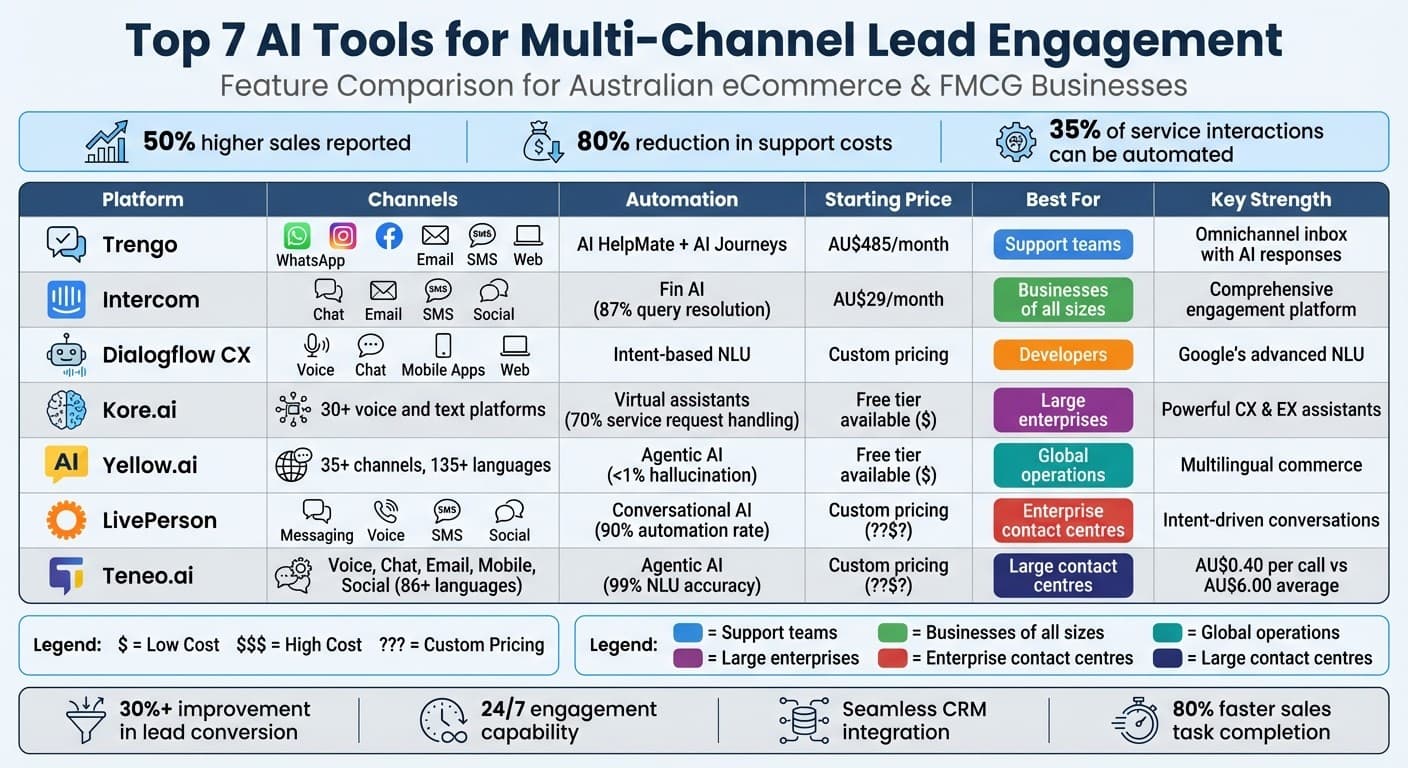
AI Tools for Multi-Channel Lead Engagement: Features and Pricing Comparison
1. Trengo
Channel Support
Trengo brings together a wide range of communication channels into a single, easy-to-manage inbox. It supports WhatsApp, Instagram, Facebook Messenger, email (Gmail/Outlook), live chat, SMS, voice/VoIP, and Telegram, giving businesses an all-in-one platform for customer interactions. As an official Meta Business Partner, Trengo offers access to the WhatsApp Business API, allowing businesses to send proactive template messages and use automated routing on a single number. Instagram DMs and story replies are also centralised, enabling AI to handle initial engagement before passing it over to a human team member.
The web chat widget, powered by Natural Language Understanding (NLU), can engage visitors based on their behaviour - like the time spent on a pricing page - and is available around the clock, whether through AI or human support. For instance, Alfrink Cosmetics saw a 70% improvement in response rates by switching to WhatsApp via Trengo, while also boosting processing speed by five times after moving away from manual Excel tracking.
Automation and AI Capabilities
Trengo doesn’t just unify channels; it also uses AI to simplify and speed up customer interactions. Its AI agents can handle over 80% of repetitive queries automatically. The AI HelpMate feature allows businesses to create chatbots by simply uploading documents, enabling these bots to address FAQs in more than 25 languages. Another standout feature, AI Journeys, is a no-code workflow builder that qualifies leads by asking key questions about budget, timelines, and needs, before directing them to the appropriate department. The system also captures lead details, calculates lead scores based on responses, and syncs seamlessly with CRMs like HubSpot and Salesforce.
"The automation saves us a lot of time because it asks a lot of simple but necessary questions for us. This way, we have a lot of information before we get in contact with customers." - Employee, BAS World
Ease of Integration and Scalability
Trengo integrates effortlessly with platforms like Shopify, WooCommerce, HubSpot, Salesforce, and Lightspeed, offering businesses a complete view of their customers. For example, Solar Concept used Trengo to connect with their existing CRM, automating lead assignments and routing tickets to shorten response times. The platform allows businesses to add more users or conversation blocks as they grow, making it a great fit for everything from small eCommerce stores to large enterprises. These scalable features are complemented by Trengo's competitive pricing plans, which are outlined below.
Pricing and Accessibility
Trengo’s pricing offers flexibility for businesses of varying sizes. The Boost Plan is priced at €299/month (approximately AU$485/month, billed annually) for 10 users and up to 6,000 conversations. The Pro Plan, which supports 20 users and 18,000 conversations, costs €499/month (approximately AU$810/month, billed annually). For larger organisations, custom Enterprise pricing is available, which includes options like white-labelling and tailored integrations. AI-enabled conversations come with an additional cost of around €0.25 per conversation on annual plans. With a 4.3/5 rating on G2 and a customer base of over 3,000 worldwide, Trengo has earned its place as a trusted solution.
2. Intercom
Channel Support
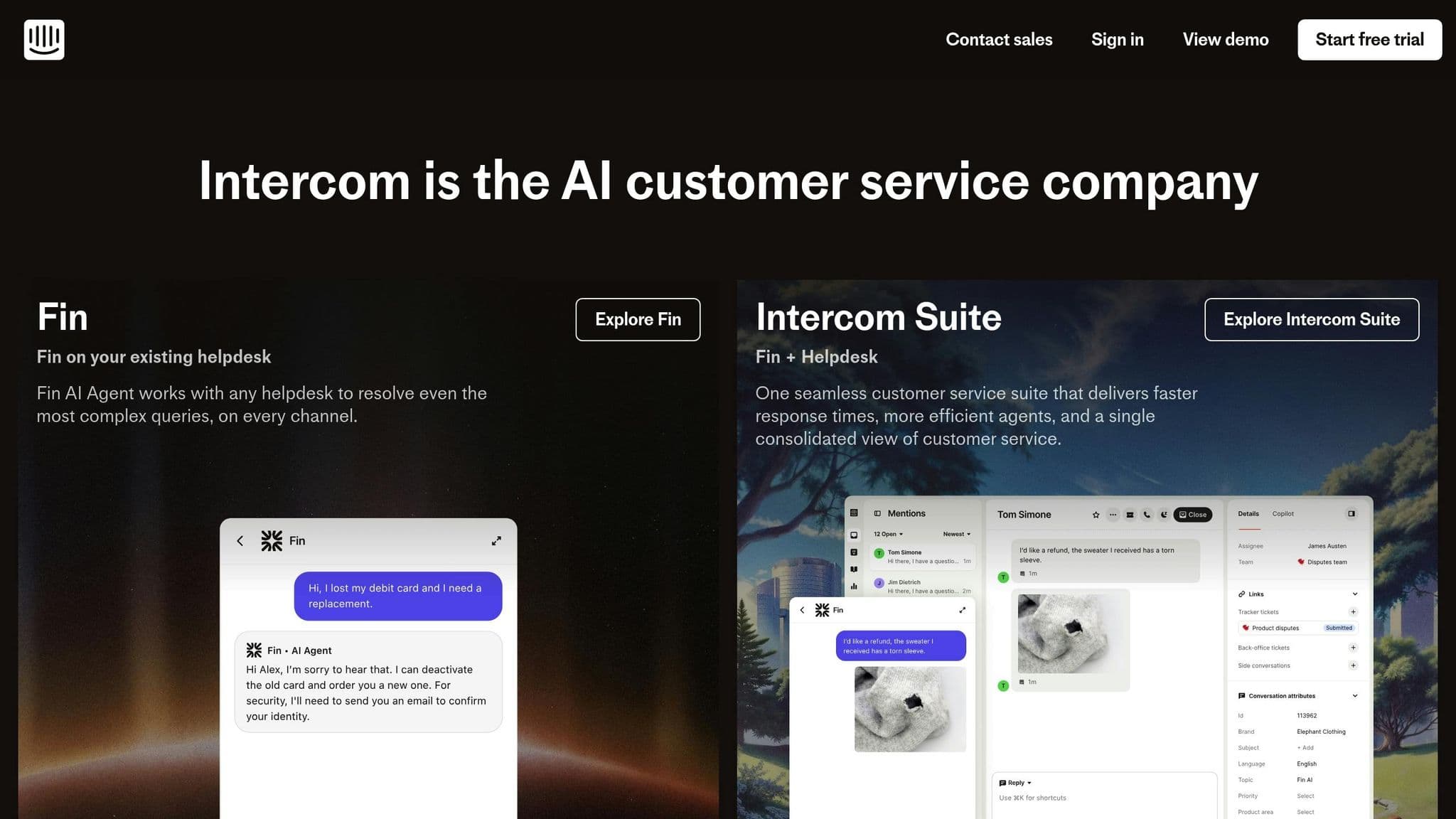
Intercom brings all customer conversations together in a single, unified Inbox. It supports a wide range of communication channels, including Messenger (for web and app), email, phone (both inbound and outbound), WhatsApp, SMS, Slack, Facebook, and Instagram. This setup allows businesses to manage everything - from Instagram DMs and story replies to phone calls and text messages - without juggling multiple tools. The Switch feature adds flexibility by letting customers transition from phone calls to Messenger chats, reducing hold times and enabling agents to manage multiple interactions at once. Additionally, Intercom's SMS functionality supports 45 languages, making it a good fit for businesses with diverse customer bases.
"Intercom has enhanced our communications tech stack and opened up more channels that we can use to communicate with our customers, like chat, SMS, and email." – Geronimo Chala, Chief Consumer Officer, Rebag
Intercom's strong channel integration is further complemented by its automation capabilities.
Automation and AI Capabilities
Intercom's Fin AI Agent can handle up to 87% of support queries instantly. It not only resolves issues but also collects vital data - like company size and industry - during chats, syncing this information directly with CRM systems like Salesforce. The Workflows feature serves as a no-code automation builder, allowing businesses to initiate conversations based on user behaviour, such as time spent on a webpage or specific referral sources. For instance, Wolt uses Intercom to manage over one million conversations per week while keeping response times under 60 seconds.
Intercom also boosts team productivity with tools like Copilot, which helps agents by generating instant AI-driven responses from internal knowledge bases, improving efficiency by up to 31%. Meanwhile, AI Compose aids agents by rephrasing or translating messages in real time.
Intercom’s automation tools are backed by extensive integration options, making it a scalable solution for growing businesses.
Ease of Integration and Scalability
Intercom connects seamlessly with over 450 apps, including Salesforce, HubSpot, Marketo, Shopify, Stripe, and Jira. For businesses with unique needs, the platform offers a REST API, enabling custom data - like information from contact forms - to flow directly into the Inbox. Trusted by over 25,000 brands worldwide, Intercom adapts easily to businesses of all sizes, from startups to large enterprises. However, its per-seat pricing may lead to higher costs as teams expand. For high-volume AI-powered conversations, note that resolutions handled by the Fin AI Agent come with an additional charge of AU$1.60 per resolution (approximately US$0.99).
"With Intercom, we have almost all of our support channels integrated into one system, making it easy for us to manage our support, as well as conduct analysis so we can take a data-driven approach." – Oda Wilhelmsen, Nordic Customer Service Manager, Godtlevert
Pricing and Accessibility
Intercom offers three main pricing tiers: Essential, Advanced, and Expert, with advanced automation features available in the higher-tier plans. The Advanced Plan is priced at approximately AU$160 per seat/month, and some plans include up to 20 free "Lite" seats. Intercom has earned high ratings, with a 4.5/5 score on both G2 (from over 3,500 reviews) and Capterra (from over 1,100 reviews), praised for its integration capabilities and knowledge base features. These pricing options make it a scalable choice for Australian businesses managing multi-channel customer interactions.
3. Dialogflow CX
Channel Support
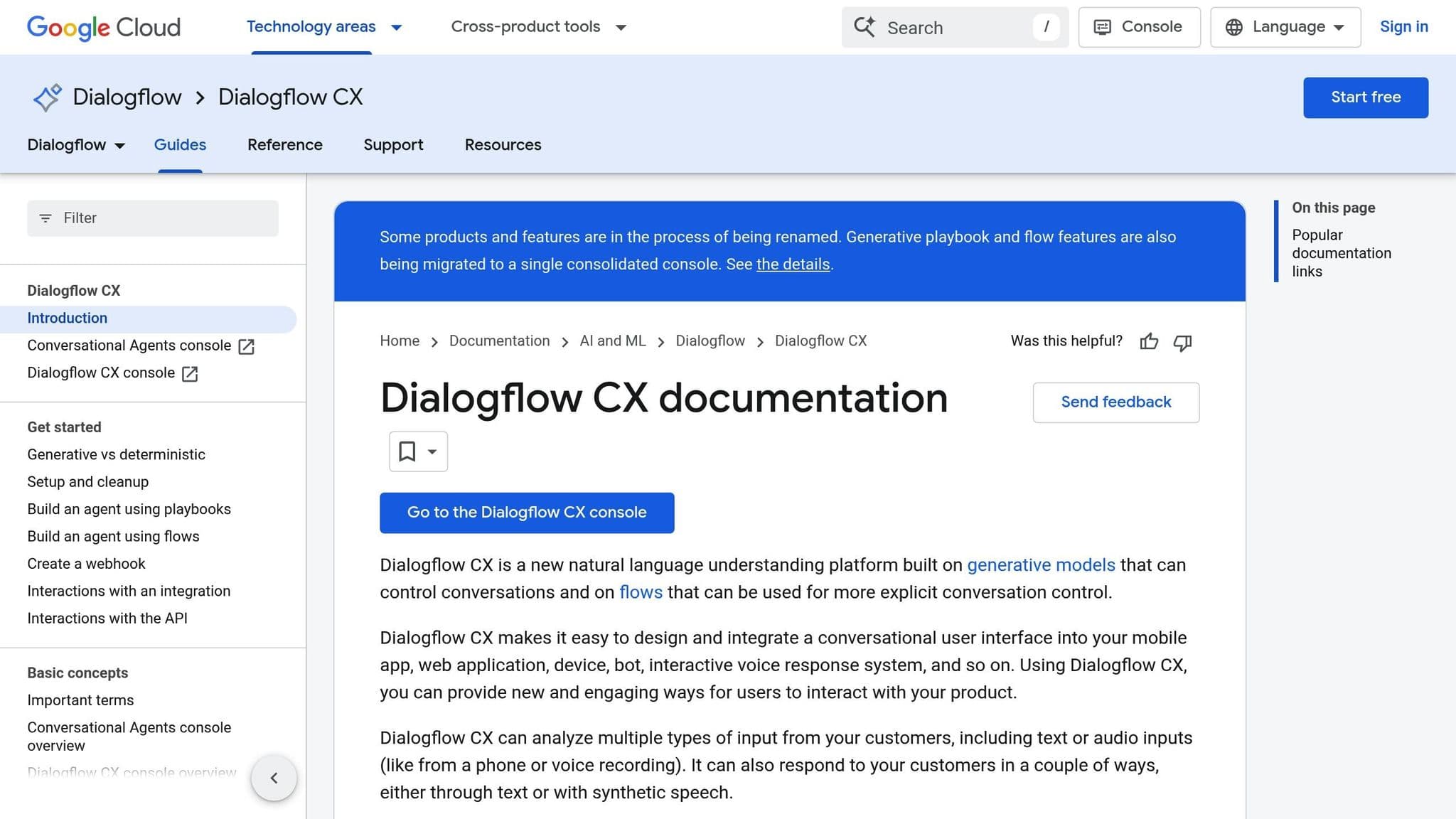
Dialogflow CX connects seamlessly with a variety of communication channels, offering both built-in integrations and support through partner services. It directly supports Dialogflow CX Messenger for web chat, along with popular platforms like Messenger and Workplace from Meta, LINE, Slack, and Google Chat. For platforms like WhatsApp, Telegram, and Microsoft Teams, Google provides open-source integrations that operate via partner telephony services, such as Twilio. Its omnichannel gateway ensures consistent user experiences, incorporating native features for tasks like product discovery and transactions. Beyond text messaging, Dialogflow CX also handles audio and image inputs. It supports natural-sounding voices in over 40 languages and offers real-time audio-to-audio translation in 10 core languages, designed to minimise latency.
Automation and AI Capabilities
Powered by Gemini, Dialogflow CX employs a flow-based state machine to manage complex, multi-step conversations. Its AI-driven Intent matching helps the platform understand various ways users might phrase their queries. For lead qualification, the automated form filling feature gathers structured information - such as names, email addresses, or product preferences - based on predefined parameters that need to be completed before moving forward in the conversation. The platform’s visual flow builder enables businesses to organise conversation topics into distinct paths (e.g., "Pricing" or "Technical Specs"), simplifying the management of specific logic by different team members. Additionally, dynamic fulfillment via webhooks allows real-time validation of lead data or triggers actions in CRM systems during ongoing interactions.
Ease of Integration and Scalability
Dialogflow CX is tailored for enterprise use, especially for handling intricate conversational scenarios. Its low-code visual builder (CX Agent Studio) speeds up deployment, reducing timelines from weeks to just a few days. The platform also offers 35 pre-built agent templates to streamline the setup process. Integration options include REST and RPC APIs for custom requirements, as well as ready-to-use connectors for backend systems and proprietary data sources. For global deployments, businesses can specify agent locations close to their end-users, ensuring faster performance and compliance with data storage regulations. Partner telephony integrations with providers like AudioCodes, Avaya, Twilio, and Voximplant further expand its capabilities for phone-based interactions. These features, combined with competitive enterprise pricing, make it a flexible choice for businesses.
Pricing and Accessibility
New users in Australia can access an AU$960 credit (around US$600) for a free trial. This credit allows businesses to explore the platform and test its integration capabilities without an upfront commitment. Enterprise access to CX Agent Studio, which leverages Gemini-powered AI, requires contacting Google Cloud sales. Additionally, the platform includes Agent Assist, a feature that provides live suggestions to human sales representatives during customer interactions, making it ideal for companies that blend AI automation with human-led support.
4. Kore.ai
Channel Support
Kore.ai takes multi-channel engagement to the next level with its advanced integrations and streamlined automation. The platform supports over 30 channels, including web chat, mobile apps, SMS, email, social platforms like Facebook Messenger, and voice assistants such as Google Assistant and Alexa. All these channels are unified under a single configuration, eliminating the need to rebuild conversation logic for each platform. This setup ensures a consistent brand voice across all interactions while allowing for channel-specific customisations to match the unique interface of each platform. When a conversation becomes too complex for the AI agent, the system seamlessly hands it off to a live agent, complete with full context, ensuring no leads are lost in the process. This cohesive channel support ensures smooth and efficient interactions across diverse platforms.
Automation and AI Capabilities
Kore.ai employs a multi-engine NLU approach, combining deterministic and probabilistic models to interpret user intent accurately, even in complex, multi-turn conversations. The platform also monitors real-time sentiment and emotional cues, adjusting responses dynamically for a more personalised user experience. Additionally, it integrates Agentic RAG (Retrieval-Augmented Generation), which retrieves data directly from enterprise systems like Salesforce and SAP, providing precise answers without requiring manual input. At Eli Lilly, this automation now handles 70% of service requests at their Tech@Lilly service desk, showcasing its efficiency.
"What I was really trying to solve was how to give 15–20 minutes back each day to our financial advisors. That extra time lets them reach out to customers more quickly, more effectively... and that's a real revenue driver for us." – Shailesh Gavankar, Head of AI Strategy + Execution, Morgan Stanley
Ease of Integration and Scalability
Kore.ai is designed to grow with businesses, offering tools that simplify integration and support scalability. Its Universal Connector Framework includes over 100 pre-built integrations with popular systems like Salesforce, SAP, ServiceNow, and Zendesk. The Integration Studio allows for one-click connections, making it easy to integrate with existing tech stacks. For instance, Pfizer successfully deployed 60 AI agents across multiple global markets and languages, highlighting the platform's scalability. Similarly, Autodoc achieved a 74% first-call resolution rate after implementing Kore.ai into their customer and employee support systems. The platform also supports hybrid deployment options, whether cloud-based or on-premise, and includes enterprise-grade security features like SOC Type 1 certification, role-based access control, and data masking.
Pricing and Accessibility
Kore.ai offers flexible pricing to cater to a variety of business needs. Startups and small businesses can take advantage of a Free Plan, which includes 5,000 monthly requests. The Standard Plan operates on a pay-as-you-go basis, starting at AU$160 (approximately US$100), and includes AU$800 worth of free credits valid for 90 days. For larger organisations, the Enterprise Plan provides custom pricing, 24/7 support, on-premise deployment options, and access to advanced features like Universal Bots. G2 reviewers frequently commend Kore.ai for its straightforward setup and administration, making it a cost-effective solution for businesses looking to enhance their multi-channel automation efforts. These pricing options make it an appealing choice for companies of all sizes aiming to optimise their customer engagement strategies.
5. Yellow.ai
Channel Support
Yellow.ai connects businesses with their audience across more than 35 channels, including WhatsApp, Instagram, Facebook Messenger, Slack, and web chat. Its WhatsApp integration is particularly noteworthy, offering features like in-chat commerce, automated reminders, and support for rich media such as carousels and dynamic list messages. On Instagram, the platform automates direct messages and comments while also enabling proactive product upselling. To enhance targeting, Yellow.ai’s User 360 Customer Data Platform consolidates information from all channels into unified customer profiles. Hyundai, for example, successfully used this multi-channel strategy to reduce reliance on third-party contact centres. Their General Manager highlighted how the platform allowed for more direct and efficient customer interactions. Let’s dive into how Yellow.ai’s AI capabilities make these interactions even more effective.
Automation and AI Capabilities
At the core of Yellow.ai’s automation is its DynamicNLP engine, which uses over 15 advanced LLM models to drive its "Agentic AI". This technology enables the platform to understand user intent and maintain context across different channels, supporting conversations in over 135 languages. Its Agentic RAG (Retrieval-Augmented Generation) system integrates data from websites, APIs, and third-party tools, ensuring accurate responses with a hallucination rate of less than 1%. The AI agents can handle up to 80% of customer queries independently, and automated lead qualification ensures only high-potential prospects enter the sales funnel. UnionBank of the Philippines experienced a 51% reduction in operating costs after implementing Yellow.ai’s low-code solution. Their AVP emphasised how easily the platform scaled their self-service capabilities. Businesses have also reported impressive results: a 20% boost in lead generation, a 30% cut in cost per lead, and a 50% increase in lead conversion rates. Equally impressive is how smoothly the platform integrates with existing systems.
Ease of Integration and Scalability
Yellow.ai is designed to work seamlessly with existing technology, offering over 150 pre-built integrations with platforms like Salesforce, HubSpot, and Zendesk. Its no-code AI agent builder lets users create workflows with simple prompts, enabling quick deployment. The platform also provides robust testing environments - Sandbox, Staging, and Production - before going live. A notable example is Sony India, which integrated Yellow.ai’s voice AI with their CRM to gather and analyse user information, delivering more tailored customer experiences. Yellow.ai supports over 16 billion customer conversations annually across 1,300 enterprises in 85+ countries. It achieves automation rates of up to 70%, maintaining smooth engagement across multiple channels.
Pricing and Accessibility
Yellow.ai offers flexible pricing to suit different business needs. The Free Tier includes 1 bot, 2 channels, and 100 MTU/month for basic testing. The Growth Plan uses a usage-based model, providing unlimited bots and channels, while the custom Enterprise plan unlocks all 150+ integrations and advanced security features. Many businesses have seen a 60% drop in operational costs, making Yellow.ai a cost-effective choice for scaling lead engagement without proportional increases in expenses. Additionally, the platform ensures enterprise-grade security with compliance certifications like HIPAA, ISO 27001, ISO 27701, and SOC 2 Type II.
6. LivePerson
Channel Support
LivePerson connects businesses with customers across a wide range of digital and voice channels. These include Web Messaging, App Messaging, SMS, WhatsApp, Apple Messages for Business, Facebook Messenger, Instagram, X (formerly Twitter), Google RCS, LINE, WeChat, Viber, and KakaoTalk. With over 1 billion conversational interactions handled each month, LivePerson stands out for its "Conversation Shifting" feature. This capability allows businesses to transition expensive voice calls to more cost-effective messaging channels, a feature that’s particularly appealing for Australian businesses aiming to cut contact centre costs.
Additionally, its Proactive Messaging feature lets businesses send two-way alerts, reminders, and promotions through SMS or WhatsApp. These channels often deliver much higher open rates compared to email. Considering that 8 out of 10 consumers prefer messaging over phone calls when engaging with brands, this functionality aligns well with customer preferences.
"LivePerson's omnichannel communication capabilities drive a better customer experience, while also improving agent efficiency".
This comprehensive channel support forms the backbone of LivePerson’s AI-driven automation tools.
Automation and AI Capabilities
At the heart of LivePerson’s technology is its Conversational Cloud® Platform, which leverages advanced tools like Natural Language Understanding (NLU), Natural Language Processing (NLP), and Large Language Models (LLMs) to manage interactions. Key AI-powered features include:
- KnowledgeAI™: Draws from CRM systems and documents to tackle complex customer questions.
- Routing AI: Uses generative AI to interpret customer intent without requiring extensive training.
- Data Collection AI: Engages customers to gather lead information conversationally.
For instance, Open Universities Australia implemented the Data Collection AI agent, achieving over double their previous lead qualification rate while significantly reducing abandonment rates. Another example: a publicly traded B2B SaaS company improved deflection and first-contact resolution rates by 30% each and boosted chatbot NPS from -25 to 50 within 18 months. Businesses using LivePerson have reported up to a 90% automation rate and 10x higher conversion rates compared to older digital methods.
To ensure accuracy, the platform offers Hallucination Detection, which keeps generative AI responses aligned with verified brand data.
Ease of Integration and Scalability
LivePerson’s Integration Hub simplifies connectivity with major CRMs like Salesforce, Microsoft Dynamics, NetSuite, SugarCRM, and Zendesk. Through its partnership with Workato, businesses gain access to thousands of additional connectors and pre-configured "recipes" for seamless integration. The platform also supports a "Bring Your Own LLM" model, letting companies integrate AI models from providers like OpenAI, Google, or Meta while maintaining control and compliance.
For custom needs, LivePerson Functions enables developers to deploy tailored code quickly. A European telecom company, for example, implemented LivePerson Copilot to assist agents, reducing conversation times by 7 minutes and improving NPS by 5 points. The platform’s scalability has helped enterprises achieve up to 60% cost savings and a 30% reduction in operating costs.
Pricing and Accessibility
LivePerson offers three pricing tiers tailored to different business needs:
- Bronze: Designed for messaging-focused workflows.
- Silver: Includes intelligent automation features.
- Gold: Adds advanced analytics, Generative AI, and enhanced personalisation options.
Pricing is customised for each business and does not include additional service fees. Companies using LivePerson have reported a 25% increase in customer satisfaction and a 30–45% boost in productivity.
Recognised as a Niche Player in the 2025 Gartner® Magic Quadrant™ for Conversational AI Platforms and a leader in The Forrester Wave™: Digital Customer Interaction Solutions (Q2 2024), LivePerson has been praised as the "best fit for traditional enterprises seeking a reliable and scalable digital transformation partner".
7. Teneo.ai
Channel Support
Teneo.ai provides omnichannel integration, covering voice, chat, email, mobile apps, and social media platforms. With its "Omnichannel Consistency" feature, businesses can manage all customer interactions through a single platform. This ensures that conversation history and context are preserved, whether the customer reaches out via WhatsApp, Instagram, web chat, or even a traditional phone call.
The platform supports 86 languages natively, and when paired with LLM integration, this extends to over 100 languages. This makes it particularly well-suited to Australia's diverse population. This extensive language support complements its advanced automation capabilities, providing seamless communication across various channels.
Automation and AI Capabilities
Teneo.ai combines its proprietary TLML™ with large language models (LLMs) like OpenAI GPT-4o and Google Gemini to achieve an impressive 99% NLU accuracy. This far exceeds the accuracy rates of competitors like Google Dialogflow (76%) and IBM Watson (74%). Its "Agentic AI" feature takes automation to the next level, handling 100% of Level 1 queries and 50% of Level 2 queries autonomously.
"Teneo.ai's platform consistently delivers 85% reduction in staffing costs and 73% transfer rate improvement while supporting future technology integration."
The platform has been shown to boost First Call Resolution (FCR) rates by 30% and achieve 60% call containment. It also significantly reduces costs, bringing the average handling cost down to under $0.40 per call, compared to the industry average of $6.00. Major companies like Telefónica, HelloFresh, Swisscom, and Volkswagen rely on Teneo.ai for their automation needs. Its intelligent automation features, combined with smooth integration capabilities, make it a powerful tool for businesses.
Ease of Integration and Scalability
Teneo.ai's cloud-agnostic architecture is designed to handle millions of interactions annually, with zero-downtime updates and automatic scaling. It connects effortlessly to CRMs, ERPs, and CCaaS platforms like Genesys Cloud and Amazon Connect through its Contact Centre Connector Framework and native Public APIs. The platform also features a low-code AI Agent Builder, enabling businesses to create and deploy agents across multiple channels without requiring extensive technical expertise.
Security and compliance are prioritised, with ISO 27001 certification, a GDPR-first architecture, and built-in PII redaction, ensuring the platform meets the strict requirements of Australian enterprises. Businesses can transition from a Proof of Concept (POC) to full production in just 60 days - 10 days for the POC and 30 days for the pilot phase. This makes Teneo.ai an attractive option for large contact centres and fast-growing companies looking to scale their operations efficiently.
All-in-One Lead Gen with Ads, AI Chatbots, and WhatsApp CRM | 🚀 YCloud Lead Generation Demo
Feature Comparison Table
Here's a quick breakdown of the platforms, focusing on their supported channels, automation capabilities, pricing, and scalability. This table highlights the main points discussed earlier.
| Platform | Supported Channels | Automation Type | Starting Price | Best For | Key Strength |
|---|---|---|---|---|---|
| Trengo | WhatsApp, Instagram, Facebook, Email, SMS, Web | AI HelpMate and AI Journeys | AU$695/month for 20 users + AU$0.29 per conversation | Support teams | Omnichannel inbox with AI-assisted responses |
| Intercom | Chat, Email, SMS, Social | Fin AI (automated support) | AU$29/month (basic) | Businesses of all sizes | Comprehensive engagement platform |
| Dialogflow CX | Voice, Chat, Mobile Apps, Web | Intent-based natural language understanding | Tailored pricing | Developers | Google’s advanced natural language understanding |
| Kore.ai | Voice and text-based channels | Virtual assistants for customer and employee experience | Tailored pricing | Large enterprises | Powerful virtual assistants for CX & EX |
| Yellow.ai | Voice and text; supports 100+ languages | CX automation | Tailored pricing | Global operations | Conversational commerce in 100+ languages |
| LivePerson | Messaging, Voice, SMS, Social | Conversational AI | Tailored pricing | Enterprise contact centres | Intent-driven customer conversations |
| Teneo.ai | Voice, Chat, Email, Mobile, Social (86+ languages) | Agentic AI delivering 99% NLU accuracy | Tailored pricing | Large contact centres | AU$0.40 per call handling cost vs. AU$6.00 industry average |
For smaller businesses, platforms like Intercom start at just AU$29/month, offering an affordable entry point. On the other hand, enterprise-level tools such as Trengo require a base investment of AU$695/month. Many enterprise-grade platforms use tailored pricing models that adjust based on the size and specific needs of a business.
These tools also provide flexibility, with features like native CRM integrations that make scaling up seamless while keeping lead context intact. Automation capabilities vary significantly, from simple rule-based systems to advanced AI that can independently handle Level 1 queries and even a portion of Level 2 tasks. Additionally, conversational AI has been shown to improve lead conversion rates by over 30% and enable round-the-clock engagement.
This comparison offers a solid foundation for Australian businesses to identify the platform that aligns best with their customer engagement goals.
Conclusion
Conversational AI is reshaping how Australian businesses engage with leads. By shifting from manual, fragmented interactions to automated, always-on systems, FMCG and eCommerce brands can now respond instantly across platforms like WhatsApp, Instagram, email, and SMS - all from a single interface. This seamless approach improves conversion rates and cuts operational costs.
The numbers make the case clear. AI has the potential to automate about 35% of all service interactions, and 75% of small and growing businesses are already investing in these tools. For brands juggling fast-moving product catalogues or seasonal campaigns, AI-powered automation can handle everyday sales tasks 80% faster, allowing teams to focus on more strategic goals.
Industry voices back up these trends. Marcie Nguyen from Havi Technology highlights the capabilities of AI in marketing automation:
"AI marketing automation uses machine learning, predictive analytics, and natural language processing to move beyond rule-based workflows and make real-time decisions that personalise campaigns, score leads, and optimise performance."
- Marcie Nguyen, Writer, Havi Technology
The tools discussed in this guide offer Australian businesses the flexibility to start small and scale as needed. Whether your focus is on predictive lead scoring, streamlining checkouts, or 24/7 multi-channel engagement, the right AI solutions reduce costs while meeting the personalised experiences that 71% of consumers now expect.
For FMCG and eCommerce brands, partnering with Uncommon Insights can help audit data quality, identify high-impact opportunities, and develop tailored AI strategies. By adopting unified conversational AI, businesses can not only automate service tasks but also scale customer engagement more effectively. However, clean and centralised data is key - without it, even the most advanced AI tools may fall short. This strategic approach ensures AI becomes a driving force for growth in Australia's FMCG and eCommerce sectors.
FAQs
How can AI tools enhance lead engagement across different channels?
AI tools make lead engagement faster and more personalised by facilitating real-time conversations across platforms like chat, email, SMS, and LinkedIn. Thanks to natural language processing and machine learning, these tools can instantly interpret messages and suggest appropriate responses or follow-ups. This means response times shrink from hours to mere seconds, significantly improving the chances of converting leads. Plus, they maintain consistency across channels, so leads don’t have to repeat themselves when switching between platforms.
These tools also go a step further by analysing lead behaviours - such as email opens, website visits, and social media interactions - to identify the most promising prospects. Automated workflows then deliver customised content at the best possible times, creating more meaningful interactions and increasing conversions. For Australian businesses, incorporating localised messaging, AUD-based reporting, and culturally relevant strategies can make these systems even more effective.
What should I look for when selecting an AI tool for multi-channel lead engagement?
When selecting an AI tool for lead engagement, it’s important to match its features with your specific business objectives. Are you aiming for quicker response times, improved data enrichment, or streamlined lead routing? The right tool should not only meet these needs but also integrate smoothly with your current systems, whether that’s your CRM, marketing automation software, or e-commerce platforms. Additionally, it should support the communication channels you rely on most - whether that’s chat, email, SMS, LinkedIn, or voice. A multi-channel platform can simplify your processes and enhance the customer experience.
Look for features like natural language processing (NLP) to understand and respond to customer inquiries effectively, scalable personalisation to cater to individual needs, and detailed analytics to track performance and ROI. Consider practical aspects too, such as pricing, scalability, and the level of vendor support - especially if you’re a smaller team looking for a tool that’s easy to implement. It’s also crucial that the tool complies with Australian data privacy regulations, such as the Privacy Act, and includes localisation features like Australian spelling, time zones, and formats.
If you’re in the FMCG, e-commerce, or SaaS sector and need tailored guidance, Uncommon Insights can help. They can assist in evaluating your requirements, testing potential solutions, and developing a rollout strategy to drive growth effectively.
Can these AI tools work with CRM systems like Salesforce?
Yes, the AI tools mentioned here can work with existing CRM systems, including Salesforce. Tools like Salesforce Einstein provide built-in integration, while others can connect using platforms like Zapier or dedicated CRM connectors.
These connections enable smooth data transfer, making it easier to manage leads across various channels and improve how you interact with customers.
Related Blog Posts
Top 7 Workflow Automation Tools for eCommerce
Top Tools for Analysing Local Consumer Feedback
The ultimate shopify tech stack for high growth ecommerce stores
AI Inventory Optimisation for FMCG: A Guide
Agentic Storefronts vs. Google Ads: Comparing Unit Economics of AI Discovery vs. Paid Search Channels
Ultimate Guide to Social Media Sentiment Monitoring
Newsletter
The Uncommon Insights Letter
Practical FMCG & eCommerce growth playbooks — margins, retention and scaling tactics, straight to your inbox.
Turn these ideas into profit you can see
Get a hands-on operator to turn the frameworks above into results — book a free audit call.