Why Shopify's AI Traffic Growth Breaks Traditional Attribution Models (And How to Fix Your CAC Calculation)
How AI referrals skew Shopify attribution and CAC — use multi-touch models, first-party tracking and incrementality tests to correct your numbers.
14 February 2026
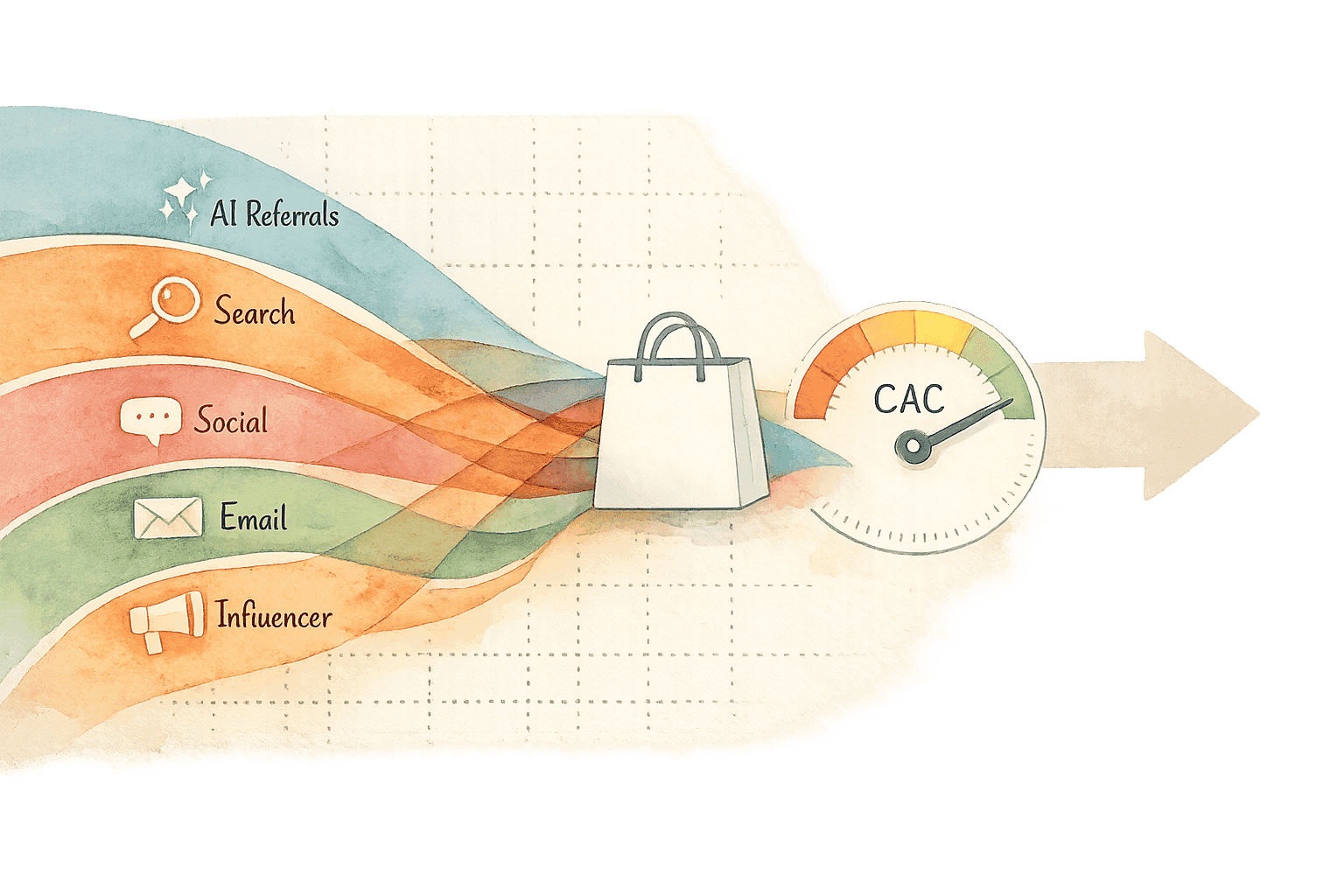
Your Shopify store's traffic may be climbing, but your customer acquisition cost (CAC) might be way off. The rise of AI tools like ChatGPT and Perplexity is reshaping how customers find and shop online. Here's the issue: when AI tools recommend your product and users manually type your URL, analytics log it as "Direct" traffic, not as AI-driven. This creates gaps in your data, making it harder to track what's really driving sales.
Key points:
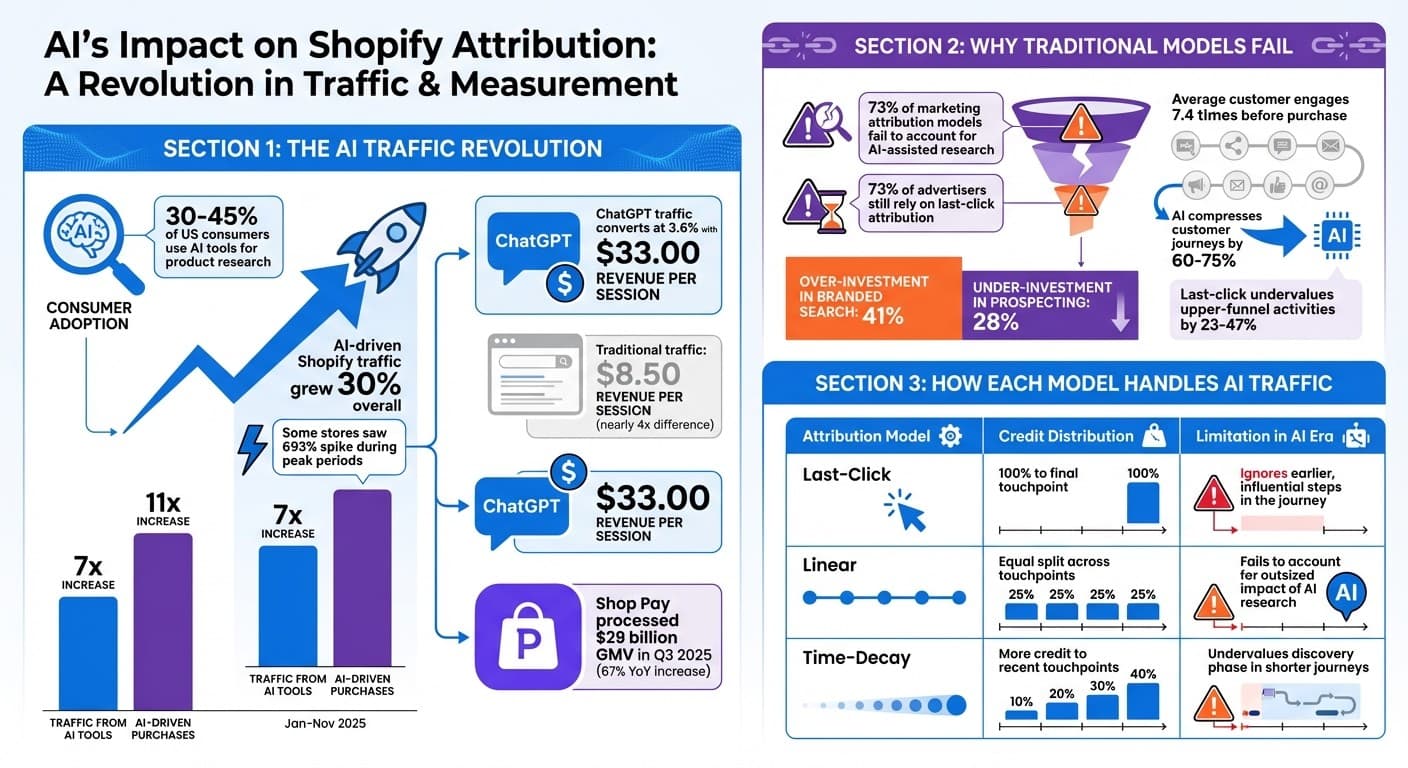
- 30–45% of US consumers use AI tools for product research.
- AI-driven Shopify traffic grew 30%, with some stores seeing a 693% spike during peak periods.
- ChatGPT traffic converts at 3.6%, with $33.00 revenue per session - nearly 4x the typical $8.50.
The problem? Traditional attribution models fail to account for AI's role in influencing purchases. This skews your CAC calculations, leaving you blind to the real cost of acquiring customers. To fix this, you need to:
- Switch to multi-touch attribution to credit all touchpoints, including AI.
- Use first-party data to track hidden AI-driven traffic.
- Run incrementality tests to measure the true impact of campaigns.
These steps will help recalibrate your CAC and give you a clearer picture of how AI is shaping your customer journey.
AI Traffic Impact on Shopify Stores: Key Statistics and Attribution Model Comparison
How Shopify's AI Traffic Growth Breaks Attribution

The Numbers Behind AI Traffic Growth
Traffic from AI tools to Shopify stores has skyrocketed. Between January and November 2025, traffic from AI-powered tools increased sevenfold, while purchases attributed to AI-driven search grew by an impressive 11x during the same period. What's more, AI-referred traffic stands out for its performance: it converts better, has lower bounce rates, and generates a higher average spend per order compared to traditional traffic sources.
In Q3 2025, Shopify's Shop Pay processed approximately $29 billion in Gross Merchandise Volume (GMV) - a massive 67% year-over-year increase - with AI discovery playing a key role in this growth.
Shopify's President, Harley Finkelstein, highlighted the company's AI advancements during a Q3 earnings call in November 2025. Shopify integrated its "commerce for agents" stack with major partners like OpenAI, Perplexity, and Microsoft Copilot. This integration allows AI tools to browse product catalogues and complete purchases seamlessly through Shop Pay. Finkelstein summarised Shopify's commitment to AI by stating:
"AI is not just a feature at Shopify. It is central to our engine that powers everything we build."
These numbers and developments highlight how AI is transforming e-commerce and complicating traditional tracking methods.
Why AI Traffic Makes Customer Journeys Harder to Track
The rise of AI-driven traffic creates a major challenge for tracking customer journeys. Traditional analytics are built around a linear path: click, browse, compare, decide, and purchase. But AI assistants completely disrupt this flow. Instead of following a step-by-step process, these tools condense discovery, research, and decision-making into a single, streamlined interaction. As Inter-Soft explains:
"Generative AI doesn't behave like a search engine, a social network, or an ad platform. It blends discovery, research, and decision-making into a single, fluid experience."
By the time a shopper lands on a retailer's site, most of the decision-making has already happened - outside the reach of conventional analytics. AI tools filter products, analyse reviews, and assess sentiment before presenting users with a curated shortlist. This leaves minimal data trails for attribution models to capture.
Adding to the complexity, many AI assistants don’t pass referral links. For example, a user might see a recommendation in an AI interface like ChatGPT, then manually type the brand name into their browser. That visit is logged as "Direct", crediting only the final touchpoint (like a direct visit or branded search) and ignoring the critical role the AI assistant played earlier. This misattribution skews metrics like customer acquisition cost (CAC), making it harder to accurately calculate the true cost of acquiring customers in an AI-driven landscape.
Reassessing CAC and attribution models is no longer optional - it's essential to align with how AI is reshaping the customer journey.
AI Search Traffic Explained: Tracking ChatGPT & Google AI on Shopify
Where Traditional Attribution Models Break Down
Traditional attribution models were designed for straightforward, step-by-step customer journeys. But when AI tools like ChatGPT or Perplexity enter the picture, they disrupt this simplicity. Customers now make critical decisions during an untracked "dark" research phase, long before they land on your Shopify store. By the time they arrive, much of their decision-making is already complete, leaving your attribution data blind to these early influences.
Here’s the kicker: 73% of marketing attribution models fail to account for AI-assisted research. They only capture visible clicks and sessions, missing the crucial early phase where AI tools compare vendors and shape purchase intent. As Chad Pollitt puts it:
"The models aren't broken. The customer behaviour they were built to measure no longer exists as it once did."
This gap creates a serious measurement problem. One company estimated A$2.1 million in annual losses due to outdated measurement systems and misallocated budgets. Without insight into where customers are actually making decisions, metrics like CAC become unreliable. This disconnect exposes why last-click, linear, and time-decay models fail in today’s AI-driven landscape.
Last-Click Attribution Gives AI Too Much Credit
Last-click attribution assigns all conversion credit to the final touchpoint. But what happens when a customer spends hours researching with AI tools, then clicks a single link to your store? That one click gets all the credit, even though earlier touchpoints - like social media or brand awareness campaigns - played a major role.
Shockingly, 73% of advertisers still rely on last-click attribution models. This outdated approach undervalues upper-funnel activities by 23–47%, leading to over-investment in branded search campaigns by 41% and under-investment in prospecting by 28%. The issue worsens when customers see a recommendation in ChatGPT, then open a new tab to search your brand directly. That visit gets logged as "Direct" traffic, erasing the AI’s influence. AI tools generate demand but don’t leave neat referral trails, and last-click models fail to account for this shift.
The average e-commerce customer engages with a brand 7.4 times before purchasing, but last-click attribution only acknowledges the final step. When AI condenses these interactions into an unseen research phase, last-click models become downright misleading.
Why Linear and Time-Decay Models Don't Work for AI
If last-click attribution overemphasises the final touchpoint, linear and time-decay models face their own challenges. Linear models distribute credit equally across all visible touchpoints. But this doesn’t work when an AI session drives 80% of purchase intent, yet gets treated the same as a random banner ad. By ignoring the weight of high-impact interactions, linear models fail to capture the full picture.
Time-decay models, on the other hand, prioritise recent touchpoints, assuming the final steps are the most influential. In AI-driven journeys, though, the last touchpoint - like a direct visit or branded search - often just formalises decisions made earlier during AI research. These models undervalue the discovery phase, which AI tools dominate.
Adding to the complexity, AI is compressing customer journeys by 60–75%. Models built for long, nurturing sales cycles fall apart when the entire journey shrinks to hours or days. As Chad Pollitt explains:
"Attribution modelling emerged from a time of data scarcity... Add invisible AI-assisted research decisions, and attribution doesn't just fail. It becomes actively misleading."
| Attribution Model | Credit Distribution | Limitation in AI Era |
|---|---|---|
| Last-Click | 100% to final touchpoint | Ignores earlier, influential steps in the journey |
| Linear | Equal split across touchpoints | Fails to account for the outsized impact of AI research |
| Time-Decay | More credit to recent touchpoints | Undervalues the discovery phase in shorter journeys |
To fix these gaps, businesses need to rethink attribution models entirely. Traditional approaches weren’t built for a world where critical decisions happen outside your tracking systems.
How to Fix Your CAC Calculations for AI Traffic
Traditional customer acquisition cost (CAC) models often fail to account for the subtle but significant role AI plays in influencing customer behaviour. To address this, you don't need to completely overhaul your analytics. Instead, incorporate three key strategies: multi-touch attribution, first-party tracking, and incrementality testing. These methods provide a clearer picture of how much you're truly spending to acquire customers in an AI-driven world.
Focus on causation, not just correlation. A customer clicking on an ad doesn't necessarily mean the ad caused the purchase. AI tools often shape decisions in ways that aren't immediately visible in your data. Your goal is to create a system that captures these hidden influences while still offering actionable insights for optimisation.
Switch to Multi-Touch Attribution Models
Multi-touch attribution (MTA) tracks every interaction a customer has with your brand, across all channels and devices, rather than crediting a single click for the sale. This approach corrects the misattribution where AI-driven traffic often appears as "Direct" traffic, ensuring early-stage AI touchpoints are recognised.
For Shopify brands, a U-shaped (position-based) model works well. It assigns 40% credit to the first interaction, 40% to the final touchpoint, and splits the remaining 20% among the steps in between. For businesses with more historical data and tech resources, algorithmic attribution models use machine learning to assign credit based on actual influence, accommodating the complexity of modern customer journeys.
"Multi-touch attribution is important because it shows you what's really happening with your marketing across multiple channels, helping you make better decisions about where to spend money." – Shopify Staff
This method is especially relevant when 72% of marketers globally plan to increase ad budgets in 2024, but only 38% feel confident in measuring ROI across channels. MTA helps pinpoint high-performing touchpoints that traditional models might overlook, improving the accuracy of your CAC calculations.
Use First-Party Data and Better Tracking Tools
As third-party cookies fade and privacy regulations tighten, traditional tracking methods are becoming less reliable. To properly attribute AI-driven traffic, you'll need server-side, first-party tracking that captures customer data directly from your store's server. Tools like Polar Pixel can bypass ad-blockers and privacy restrictions, ensuring no key touchpoints are missed.
Assigning a unique "Lifetime ID" to each visitor can unify fragmented touchpoints. For instance, if a customer discovers your brand through an AI chatbot and later visits directly, the Lifetime ID connects these sessions, ensuring AI's role is accounted for.
To get started, ensure all your external links - ads, emails, or social media - use consistent UTM parameters (e.g., source, medium, campaign, and Ad IDs). Avoid using UTMs on internal links, as they can overwrite the original acquisition source. Jason Kowal from Deducive explains:
"If UTMs are missing or messy, Shopify will under-attribute or misattribute. That's not Shopify lying. That's Shopify being literal." – Jason Kowal, Deducive
Additionally, integrate Conversions API (CAPI) to send event data directly to platforms like Meta and TikTok [34,35]. A strong first-party attribution rate for Shopify merchants is 85% or higher. Post-purchase surveys, using tools like Zigpoll, can also provide qualitative data, such as a customer noting, "I saw you recommended in ChatGPT", to validate your attribution models.
When paired with multi-touch attribution, first-party tracking offers a comprehensive view of AI's impact on your customer journey.
Apply Incrementality Testing to Recalibrate CAC
Incrementality testing helps uncover the true lift from your marketing campaigns, especially in AI-driven channels where platforms often over-report conversions. While traditional models show what happened, incrementality testing answers, "What happened because of our campaign?".
This involves creating test groups (exposed to ads) and control groups (not exposed) in specific regions, then measuring the difference in conversions. The goal is to isolate the "incremental lift" - revenue generated solely because of your ads [31,36].
For instance, if Meta reports a 4.0x ROAS but testing shows only 33% of that is incremental, the effective ROAS drops to 1.3x. Similarly, if Meta claims a CAC of A$20 and your correction factor is 0.5, your true CAC becomes A$40.
Incrementality testing also captures the halo effect of AI-driven traffic at the top of the funnel, such as influences from YouTube or TikTok, which traditional last-click models might miss [31,37].
"Incrementality testing closes this gap by shifting the focus from 'attribution credit' to causal impact. It asks the ultimate counterfactual question: What would have happened if we hadn't run this campaign at all?" – Toma Gulea, Polar Analytics
To run effective tests, ensure your ad spend is at least A$50,000 per month so the results stand out from the noise. Tests should last 2–4 weeks or 1.5 times your typical purchase cycle for high-value products. Advanced models can achieve up to 90% statistical power to detect a 10% lift and reduce confidence intervals by 20.4%.
For Shopify brands, frameworks like Uncommon Insights' Unit Economics Analysis can help apply correction factors to platform data, ensuring your CAC calculations reflect the real cost of acquiring customers - not just what ad platforms report.
Steps to Update Your Attribution for AI Traffic
Follow these steps to accurately track AI-driven traffic without overhauling your analytics setup. The aim isn't flawless attribution - because that's impossible. Instead, focus on what Jason Kowal from Deducive calls:
"Decision-grade attribution: reliable enough to allocate spend confidently and defend the story in a CFO meeting".
The goal is to create a practical system that informs budget decisions, not one that tries to capture every interaction perfectly. With that in mind, here’s how you can refine your tracking.
Step 1: Review Your Current Attribution Setup
Start by auditing your existing tracking systems, like Shopify Analytics and GA4, to identify gaps. Pay attention to three key areas: unexplained spikes in "Direct" or "Unassigned" traffic, broken session continuity, and internal UTM overwrites that disrupt attribution.
Check your "Direct" traffic. If more than 40% of your conversions fall under "Direct" or "Unassigned", you're likely missing AI-driven referrals. Use GA4's Path Exploration report to dig deeper. Look for sessions labelled as "Direct" that show mid-funnel activity, like multiple page views, time spent on product pages, or cart additions. These patterns often point to AI-influenced journeys.
Inspect session continuity issues. Services like PayPal or Shop Pay can disrupt your tracking by breaking the session chain, replacing the original AI referral with "Direct". Audit your checkout process and app integrations to ensure session continuity. Ideally, there should be a variance of no more than 10–15% when comparing Shopify’s net revenue to conversions reported by ad platforms.
Fix internal UTM overwrites. If your site’s banners, pop-ups, or email captures include UTM parameters, these can overwrite the original attribution source mid-session. This makes email or SMS appear as the primary driver instead of the actual source. Remove UTMs from all internal links immediately.
Finally, compare different attribution models in GA4 - like "First Click", "Last Click", and "Data-Driven Attribution" - to see if AI sources are being underrepresented. Make it a habit to reconcile Shopify order counts and revenue with ad platform reports weekly. Any discrepancies can highlight gaps in your attribution model. Once these gaps are clear, move on to standardising AI referral tracking.
Step 2: Create Custom Tags for AI Referrals
AI traffic won’t label itself, so you’ll need a consistent tagging system to track it effectively.
Develop a standard UTM structure. Use utm_source to identify the platform (e.g., chatgpt, perplexity, gemini), utm_medium for the traffic type (e.g., ai_referral, ai_search), and utm_campaign for specific content versions. For example:?utm_source=chatgpt&utm_medium=ai_referral&utm_campaign=product_recommendation_v1
Always include these UTM parameters when sharing content on AI platforms. Be precise - UTM parameters are case-sensitive, so inconsistencies like "Email" versus "email" will split your data in reports.
Set up regex filters in GA4. Create a custom exploration using the "Session Source / Medium" dimension, applying this regex:chat\.openai\.com|chatgpt\.com|perplexity\.ai|gemini\.google\.com|copilot\.microsoft\.com|claude\.ai.
This groups all AI referrals into one segment for easier analysis.
Enable User-ID stitching in GA4 and integrate your CRM to connect sessions across devices. Since AI research often happens on mobile while purchases occur on desktop, this step is essential for accurate tracking.
Once your tagging is in place, test its effectiveness through incrementality testing.
Step 3: Run Incrementality Tests
Attribution models can show patterns, but only incrementality testing proves whether AI traffic directly drives sales. Testing is crucial for recalibrating your true Customer Acquisition Cost (CAC).
Use Geo-Lift experiments. Adjust ad spend in 3–5 test regions while keeping 10–15 control regions steady. Measure conversion differences between these groups to isolate the impact of your campaigns.
For AI-driven channels, treat spend as a continuous variable rather than an on/off switch. This approach accounts for fluctuations in ad auctions and yields more reliable results. Tests should run for at least 2–4 weeks or 1.5 times your average purchase cycle for higher-value products.
Calculate your Correction Factor. Divide your incremental ROAS from the test by the platform-reported ROAS. For instance, if Meta reports a 4.0× ROAS but your test shows only 33% of that is incremental, your effective ROAS is closer to 1.3×. Use this factor to adjust your CAC calculations.
Before starting any test, define clear success criteria, such as a statistically significant result (p < 0.05) and a minimum detectable effect that would justify budget changes. Avoid altering creatives, targeting, or budgets during the test period, and ensure no exclusive promotions skew results in test regions.
Re-run these tests quarterly, especially after major AI updates or shifts in user behaviour. As Gabrielle Thomson from Customer Science notes:
"When a model contradicts a well-designed test, the test wins".
Conclusion
AI-driven traffic has reshaped how customers find and shop from Shopify stores, making traditional attribution models less effective. Methods like last-click attribution overemphasise bottom-funnel channels while overlooking the role of AI assistants in sparking initial interest. Similarly, linear and time-decay models fail to account for the hidden research phase where users discover brands through AI tools like ChatGPT or Perplexity before heading directly to a website.
This shift calls for a more refined approach to attribution. While perfect attribution is unrealistic, updating your models to reflect the entire customer journey is essential. Multi-touch models, such as U-shaped attribution, can help by assigning equal credit to AI-driven discovery (40%) and final conversions (40%). To make this work, you'll need to collect first-party data through post-purchase surveys (including "AI Assistant" as an option), use server-side tracking to navigate privacy challenges, and run incrementality tests to identify which channels genuinely drive sales.
Your customer acquisition cost (CAC) calculations also need revisiting. A blended CAC can mask underperforming channels, whereas channel-specific CAC provides clearer insights into where your unit economics hold up. Make sure to include all costs - like creative production, agency fees, and software expenses - when recalculating fully loaded CAC. Then, compare this against channel-specific lifetime value (LTV) to maintain a strong LTV:CAC ratio of at least 3:1, a key indicator of sustainable growth.
Improved attribution can also feed into the Channel Economics Framework, a structured method for recalibrating your marketing efforts. This framework divides channels into three categories: Foundation (low CAC options like SEO and email), Scale (moderate CAC channels like Meta and Google Ads), and Experimental (10–15% of your budget reserved for testing). This approach ensures you don’t over-invest in costly channels before solidifying your foundational ones.
Brands that adopt these updates often see a 15–20% improvement in budget efficiency. More importantly, they gain a clearer understanding of where to allocate their next marketing dollar. In a world shaped by AI, this clarity can be the difference between guesswork and profitable growth. Adjusting your attribution models and recalibrating CAC equips your brand to thrive in this evolving landscape with confidence and precision.
FAQs
How can I prove AI is driving my “Direct” traffic?
Tracking traffic influenced by AI can be tricky because traditional attribution models often fail to account for interactions shaped by AI tools. For instance, users might visit your site directly after engaging with AI-powered features like chatbots or recommendation engines, leaving their journey untracked. To better understand AI’s impact, consider using advanced attribution tools. These can help you link direct traffic spikes during AI campaigns to specific AI-driven activities. Additionally, analysing patterns in customer behaviour can reveal how AI tools contribute to their decision-making process.
What’s the simplest way to adjust CAC for AI-influenced sales?
The easiest way to refine your Customer Acquisition Cost (CAC) for AI-influenced sales is by leveraging AI-driven attribution tools. These tools bring together and analyse data on spending, conversions, and customer behaviour across multiple channels. By doing so, they automatically pinpoint the main factors affecting CAC, cutting down the time spent on manual analysis.
This approach ensures your CAC calculations account for the effects of AI-powered marketing. It also allows for precise, real-time adjustments, helping businesses fine-tune their campaigns based on predicted CAC patterns in the ever-changing world of eCommerce.
How do I tag and report AI referrals in GA4 and Shopify?
To monitor AI referrals in GA4 and Shopify, you can use UTM parameters such as source=perplexity and medium=ai_referral. This approach helps categorise traffic coming from AI sources. Additionally, setting up a dedicated AI Traffic channel in GA4 allows you to track engagement and conversions more effectively. This method ensures your AI-driven traffic is accurately recorded, helping align your analytics with current attribution practices.
Related Blog Posts
Agentic Storefronts Reality Check: How to Measure LTV for Customers Who Discover You Through ChatGPT
Shopify's 7x AI Traffic Surge: How to Calculate CAC When ChatGPT Sends You Customers
The Attribution Decay Problem: Why Your Last-Click Model Shows 40% Higher ROAS Than Reality
How to Measure ROI for Holiday Campaigns
Why Your Attribution Model Is Burning Marketing Budget
How to Map DTC Customer Touchpoints
Newsletter
The Uncommon Insights Letter
Practical FMCG & eCommerce growth playbooks — margins, retention and scaling tactics, straight to your inbox.
Turn these ideas into profit you can see
Get a hands-on operator to turn the frameworks above into results — book a free audit call.