Agentic Storefronts Reality Check: How to Measure LTV for Customers Who Discover You Through ChatGPT
How Australian FMCG and eCommerce brands can track and calculate LTV for customers who find them via ChatGPT using UTMs, surveys, cohort analysis and lift tests.
12 February 2026

- Standard LTV Formulas and ChatGPT Attribution Problems
- Are You Tracking ChatGPT Traffic and Monitoring Visitors?
- How to Track and Measure ChatGPT Customer LTV
- Maximising LTV from ChatGPT Customers in FMCG and eCommerce
- Tools and Services for LTV Tracking and Improvement
- Conclusion: Next Steps for Measuring ChatGPT Customer LTV
- FAQs
- Related Blog Posts
Measuring customer lifetime value (LTV) for ChatGPT-referred customers is tricky but essential for Australian FMCG and eCommerce brands. Here's the issue: ChatGPT often drives high-quality traffic that’s mislabelled as "Direct" or "Organic" in analytics tools. This makes it hard to track how these customers find you, let alone calculate their true value.
Why does this matter? ChatGPT users are informed buyers who convert at rates up to 23x higher than traditional organic search. But their non-linear journey - starting with AI recommendations, followed by Google searches or direct visits - breaks standard attribution models. Without accurate LTV data, you're flying blind on whether AI-specific investments deliver returns.
Key Takeaways:
- ChatGPT drove 800M weekly active users by late 2025, with 2.5B daily prompts, many involving product research.
- AI referrals convert at 11.4%, more than double traditional organic search rates.
- Tracking methods like UTM parameters, post-purchase surveys, and cohort analysis are essential to measure AI-driven LTV.
To calculate LTV for ChatGPT customers:
- Tag AI traffic: Use UTM parameters (
utm_source=chatgpt) and custom tracking in Google Analytics 4. - Survey customers: Ask, "Where did you first hear about us?" to capture AI influence.
- Analyse cohorts: Group ChatGPT-acquired customers by purchase date to track retention, revenue, and churn.
- Run tests: Use geo-lift or time-based experiments to isolate ChatGPT’s impact on revenue.
Understanding ChatGPT-driven LTV helps you decide if AI-focused strategies like real-time pricing updates or targeted product pages are worth the investment. With AI reshaping customer discovery, this insight is no longer optional - it's a must for staying competitive.
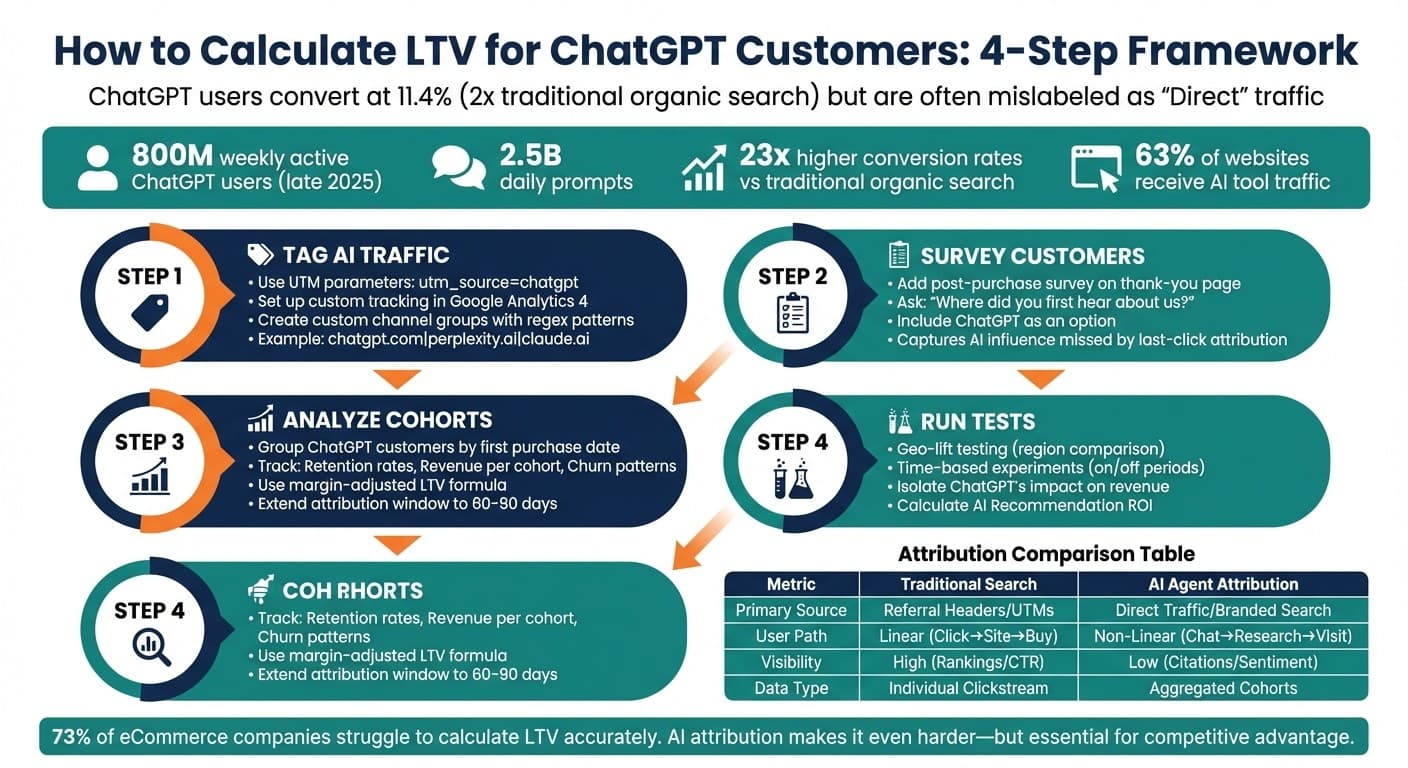
4-Step Framework to Calculate LTV for ChatGPT-Referred Customers
Standard LTV Formulas and ChatGPT Attribution Problems
Basic LTV Calculation Methods
Customer Lifetime Value (LTV) represents the net profit a customer brings to a business over the course of their relationship. The standard formula involves multiplying Average Order Value (AOV) by Purchase Frequency (PF) and Customer Lifespan (CL), then applying the Gross Margin to determine profitability.
Here’s an example: An Australian skincare brand’s customers spend $85 per order, purchase 3.5 times annually, and remain active for 2.8 years. With a 45% gross margin, the formula looks like this:
85 × 3.5 × 2.8 × 0.45 = $373.28 per customer.
This profit-focused approach is critical because revenue-only formulas can lead to overspending on customer acquisition.
LTV can be calculated in two ways:
- Historical LTV: Tracks actual revenue from past customer cohorts.
- Predictive LTV: Estimates future revenue based on trends.
For most businesses, a healthy LTV:CAC ratio (Customer Acquisition Cost) is 3:1 or higher. Yet, a staggering 73% of eCommerce companies struggle to calculate LTV accurately. This issue becomes even more complex for Australian FMCG brands when customers discover your business through ChatGPT. Traditional formulas assume clear attribution, which breaks down when customer origins are unclear.
Why Standard LTV Models Don't Work for ChatGPT Traffic
Let’s explore why traditional LTV models fail when it comes to ChatGPT traffic. The main issue lies in missing attribution. Platforms like ChatGPT often don’t pass referral headers, leaving analytics tools like GA4 to categorise traffic as "Direct" or "Organic". For example, if someone learns about your brand through ChatGPT and later searches for it, last-click attribution will credit the branded search, ignoring the AI interaction that started the journey.
"Traditional last-click attribution fails when AI agents research vendors behind closed doors."
- Liam Dunne, Growth Marketer and B2B Demand Specialist
Adding to the complexity, over 60% of searches now end without a click, as AI platforms provide detailed answers directly in their interface. This hides the initial research phase. OpenAI also withholds individual chat data, leaving businesses reliant on aggregate metrics.
For Australian FMCG brands, this creates a tricky scenario. Conversion rates for AI-referred visitors might be 23 times higher than traditional organic search, but analytics tools often fail to identify these customers as ChatGPT-originated. Standard LTV models assume a simple, linear funnel (click → site → buy), which doesn’t apply to customers who interact with an AI platform before visiting your site days later without trackable referral data.
| Metric | Traditional Search Attribution | AI Agent Attribution |
|---|---|---|
| Primary Source | Referral Headers / UTMs | Direct Traffic / Branded Search Spikes |
| User Path | Linear (Click → Site → Buy) | Non-Linear (Chat → Research → Direct Visit) |
| Visibility | High (Rankings/CTR) | Low (Citations/Sentiment) |
| Data Type | Individual Clickstream | Aggregated Cohorts / Incrementality |
This shift highlights the need to rethink how LTV calculations are approached for customers originating from ChatGPT. Addressing this measurement gap requires new tracking strategies, which will be explored in the next section.
Are You Tracking ChatGPT Traffic and Monitoring Visitors?
How to Track and Measure ChatGPT Customer LTV
Tracking customers acquired through ChatGPT requires a different approach compared to traditional methods. With 63% of websites receiving traffic from AI tools, the challenge lies in capturing this hidden audience since analytics platforms often misattribute these visitors. Here’s a breakdown of how to track and measure this revenue stream effectively.
Setting Up UTM Parameters for ChatGPT Attribution
UTM parameters are crucial for identifying AI-driven traffic. When users share links from ChatGPT, Google Analytics 4 (GA4) often categorises them as "Direct" traffic. To address this, add UTMs to any content shared on third-party platforms like guest blogs, Reddit, or forums. This ensures that even when ChatGPT cites your links, the traffic is traceable.
Stick to a consistent UTM structure: utm_source=chatgpt, utm_medium=ai, and utm_campaign=[intent_cluster]. For example, an Australian skincare company might use utm_campaign=best_moisturiser_dry_skin to categorise traffic by user intent, making analysis more straightforward.
| UTM Field | Recommended Value | Purpose |
|---|---|---|
| utm_source | chatgpt | Identifies the AI platform |
| utm_medium | ai or sponsored | Differentiates AI traffic from organic or referral traffic |
| utm_campaign | intent_[cluster_name] | Groups traffic by user intent (e.g., intent_skin_care_routine) |
| utm_content | [creative_version] | Tracks which response or citation style performs best |
Since some AI interfaces strip UTMs, consider using post-purchase surveys to ask customers how they discovered your brand, including options like ChatGPT. Additionally, in your CRM (e.g., HubSpot or Salesforce), create a custom property called "AI Platform Source" to track leads from citation to purchase.
For GA4, set up a custom JavaScript variable in Google Tag Manager to detect AI platforms via document.referrer. Push an ai_referral_detected event to the dataLayer and register UTM parameters as custom dimensions (e.g., ai_utm_source) for deeper LTV reporting. Cohort analysis can then help refine your insights.
Using Cohort Analysis for ChatGPT Customer Segments
ChatGPT users often follow non-linear purchase journeys, making cohort analysis essential. Once ChatGPT traffic is tagged, group customers by their first purchase month. Tools like Excel or Google Sheets can help - use the MINIFS function to identify the earliest purchase date for each Customer ID. Create a retention grid with cohort months as rows and sequential months as columns, converting active customer counts into retention percentages to map the churn curve.
Given the limited historical data for AI channels, use Excel’s LOGEST function to forecast retention trends, often stabilising at a 2–5% churn rate after two years. PivotTables can calculate Average Revenue Per User (ARPU) for ChatGPT-acquired customers. Multiply cumulative lifetime revenue by your gross margin percentage to estimate Margin-adjusted LTV.
"A simple, or blended, lifetime value (LTV) calculation takes all your customer revenue and divides it by your total customer count. The problem with this approach is that a single average can hide dangerous trends." - Glencoyne
Establish a 30-day baseline before implementing AI visibility strategies to create a control period for ROI comparisons. In GA4, use a custom channel group with the following regex to capture AI traffic:
^(chatgpt\.com|chat\.openai\.com|perplexity\.ai|claude\.ai|anthropic\.com|gemini\.google\.com|bard\.google\.com).
Calculating Incremental LTV for AI Referral Channels
To measure the specific impact of ChatGPT referrals, calculate incremental LTV, which isolates the additional value brought by these channels. Use the Citation-to-Revenue Framework, focusing on three layers: Citation Rate (visibility), AI-Referred MQLs (intent), and Pipeline Contribution (revenue). Compare the LTV of ChatGPT cohorts to a baseline, such as organic search or a period without AI optimisation.
AI-driven visitors can convert at rates up to 23 times higher than traditional search visitors, with some Australian brands achieving a 12.1% signup rate from just 0.5% of traffic. To quantify this, conduct geo-lift tests (comparing regions with and without AI strategies) or time-based tests (measuring performance during on/off periods). These methods reveal the difference in customer acquisition and revenue.
Focus on tracking metrics across four categories:
- Visibility: Citation Rate, Share of Voice
- Quality: AI-Referred MQL Conversion Rate
- Value: Pipeline Contribution, Average Order Value (AOV)
- Retention: 30/60-day Repeat Purchase Rate, Cohort LTV
Finally, calculate your AI Recommendation ROI with this formula:
(AI-attributed LTV - AI optimisation costs) / AI optimisation costs × 100.
With 65% of all search queries now ending in "zero clicks", brand citations in AI interfaces are becoming critical for top-of-funnel visibility. To track these leads, classify them in your CRM as AI-influenced when their conversion aligns with spikes in AI citation rates, even if the last click is labelled "Direct". Extend attribution windows to 60–90 days to account for the longer research phase typical of AI-influenced purchases.
Maximising LTV from ChatGPT Customers in FMCG and eCommerce
Once you've nailed accurate LTV tracking, the next step is to focus on increasing the profitability of ChatGPT-referred customers. For Australian FMCG and eCommerce brands, this can be a challenge - 67% report struggling to determine LTV by acquisition channel. This gap can lead to overspending on low-value customer segments while underinvesting in those that drive real growth.
Adjusting LTV Time Frames for AI-Referred Customer Behaviour
ChatGPT-referred customers often behave differently compared to those acquired through traditional search. They usually show strong initial intent but take non-linear purchase journeys, which may require a longer attribution window. To adapt, businesses should track these customers separately and extend the timeframe to capture their decision-making patterns.
For example, creating tailored landing pages like /chatgpt/best-for-sensitive-skin/ can help align the promises made in AI-driven content with product performance. As you monitor these cohorts, focus on refund rates, average order value (AOV), and repeat purchase rates to fine-tune your LTV calculations. From there, evaluate your unit economics to understand how these extended journeys affect overall profitability.
Unit Economics Analysis for Australian FMCG and eCommerce
Understanding unit economics is key to balancing acquisition costs and retention. For ChatGPT traffic, calculating your "True CAC" (Customer Acquisition Cost) means factoring in not just direct expenses but also broader attribution, including multiple touchpoints and discounts. If acquisition costs outweigh initial purchase values, retention efforts become critical to ensuring long-term profitability.
Using RFM (Recency, Frequency, Monetary) analysis can help identify high-value customers within your ChatGPT cohorts. For subscription-based brands, adjusting pricing tiers can also make a big difference. Take the case of 123BabyBox in 2024: founder Zarina Bahadur spotted a significant drop-off at the three-month mark. By shifting from monthly to annual subscriptions, the company extended the average subscription period and boosted CLV by 40%.
"We analysed our CLV and saw a major drop-off after three months. So, we reworked our pricing to reward commitment." - Zarina Bahadur, Founder, 123BabyBox
Example: Australian FMCG Brand Adapting LTV for ChatGPT Traffic
Let’s look at an Australian organic coffee subscription brand that used intent-based campaign tags to track ChatGPT referrals. Their data revealed that ChatGPT customers had a higher average order value but a lower repeat purchase rate. To dig deeper, they added a post-purchase survey on the thank-you page asking, "Where did you first hear about us?" This helped them capture ChatGPT's influence, which traditional last-click attribution had missed.
The brand then ran geo-lift testing by launching ChatGPT-specific campaigns in selected regions and holding another region as a control. This test showed a clear increase in branded search and a strong return on investment from their AI-focused efforts. With these insights, they adjusted their LTV model to reflect the extended customer journey and shifted more budget toward retention campaigns targeting ChatGPT customers. The result? A significant improvement in margin-adjusted LTV.
Accurate LTV measurement depends heavily on a unified data foundation. Research shows that 46% of customer lifetime value attribution is incorrect when data isn’t unified. Many Australian retailers still misidentify up to 25% of their customers due to fragmented data systems. Without a strong data foundation, your ChatGPT LTV calculations could be based on flawed assumptions. Unifying offline and digital data is essential to ensure you're making the right decisions.
Tools and Services for LTV Tracking and Improvement
Tracking tools are essential for accurately identifying ChatGPT-driven traffic and refining lifetime value (LTV) models. Without proper attribution, AI-referred customers often get lumped into "direct traffic", which can distort calculations and hide the growing potential of this channel.
Analytics and Tracking Tools for ChatGPT Traffic
For Australian eCommerce brands, Google Analytics 4 (GA4) is a key tool for tracking customer interactions originating from AI. By setting up custom channel groups with regex patterns, you can isolate traffic from sources like "chatgpt.com" and "perplexity.ai" for precise attribution. To avoid misclassification, prioritise the "AI Traffic" channel over "Referral" in GA4. Then, use GA4's "User lifetime" exploration template to compare LTV across different channels.
Matomo Analytics offers an "AI Assistant" channel type, available in Matomo Cloud and On-Premise v5.5.0+, which automatically segments traffic from ChatGPT, Claude, and Gemini. Additionally, prompt tracking tools like Peec.ai and Scrunch.ai help identify the specific queries that are driving customer engagement.
For monitoring brand mentions across AI models - even when users don’t click on your links - tools like Ahrefs Brand Radar or Rankshift can provide valuable insights. These tools ensure you're aware of how your brand is being discussed and perceived within these AI-driven ecosystems.
To take these insights further, consulting services can help integrate and optimise these analytics for your business.
Uncommon Insights Growth Operations Consulting

Advanced analytics are just the beginning - specialised consulting can help Australian FMCG and eCommerce brands refine their LTV frameworks. For businesses generating between $1 million and $10 million in revenue, Uncommon Insights offers growth operations consulting focused on eight key areas, including True CAC (Customer Acquisition Cost) analysis, CLV (Customer Lifetime Value) modelling, and cohort profitability analysis. This is especially important given that 67% of businesses struggle to accurately calculate LTV by acquisition channel.
Uncommon Insights tailors measurement frameworks to account for the unique behaviours of ChatGPT-referred customers. These customers often exhibit longer decision-making processes, higher purchase intent, and distinct engagement patterns. Through weekly deliverables, AI-assisted insights, and collaboration across teams, their approach ensures your LTV calculations align with actual customer behaviour. Combined with the analytics tools mentioned earlier, this creates a comprehensive system for understanding and maximising the value of ChatGPT-driven traffic.
Conclusion: Next Steps for Measuring ChatGPT Customer LTV
Measuring customer lifetime value (LTV) driven by ChatGPT requires moving beyond traditional attribution methods. Start by configuring Google Analytics 4 (GA4) with a Custom Channel Group. Use regex patterns (e.g., chatgpt.com, perplexity.ai, claude.ai) to properly segment traffic from AI platforms. This ensures AI-driven traffic isn’t misclassified under generic categories like "Direct" or "Other."
Another critical step is implementing a Citation-to-Revenue framework. This approach tracks three key layers:
- Citation Rate: How often your brand is mentioned in AI-generated responses.
- AI-Referred MQLs: Leads that can be directly tied to AI platforms.
- Pipeline Contribution: Revenue generated from opportunities sourced through AI.
To validate these metrics, combine them with post-purchase surveys asking, "Where did you first hear about us?" This is particularly important given that 65% of all search queries now result in zero clicks. Collecting this data helps refine your LTV calculations and ensures accuracy.
For Australian FMCG and eCommerce brands generating A$1–A$10 million in revenue, standardising UTM parameters (e.g., utm_source=chatgpt) is essential for clean cohort analysis. To further assess ChatGPT’s impact, run incrementality tests, such as geo-lift experiments or time-based holdouts, to determine if ChatGPT drives new demand or simply captures existing intent.
Finally, enhance your optimisation strategy by focusing on content improvements. Use Schema.org markup and create targeted FAQ clusters to increase visibility. Keep an eye on 404 errors from ChatGPT-generated URLs and redirect them to relevant product pages to capture potential LTV. With ChatGPT’s traffic share growing at 14.1% monthly while Google’s declines by 3.2%, these steps provide a solid foundation for accurately measuring and maximising the LTV of AI-referred customers.
FAQs
How can I tell if 'Direct' traffic actually came from ChatGPT?
When trying to figure out if 'Direct' traffic in your analytics comes from ChatGPT, UTM parameters are your best friend. Links shared in ChatGPT without these tags - or without referrer data - often show up as 'Direct' in GA4, making it tough to pinpoint their origin. By adding UTMs to your links, you can track ChatGPT referrals with much more precision.
What’s the simplest way to estimate LTV for ChatGPT-referred customers?
The easiest way to estimate the lifetime value (LTV) of customers referred by ChatGPT is to predict their future purchasing behaviour using statistical models. You can use tools like SQL and Excel to create forward-looking, non-contractual LTV calculations that align with their unique behavioural patterns.
How do I prove ChatGPT is driving incremental revenue, not just capturing demand?
To demonstrate that ChatGPT contributes to incremental revenue, you can rely on incrementality testing methods, such as holdout groups or geo-lift tests. These approaches help identify conversions that occur specifically because of AI interactions - conversions that wouldn’t happen otherwise. By comparing users referred by AI to a control group, you can measure the true impact.
Key metrics to monitor include referral traffic, conversion rates, and revenue directly linked to AI interactions. Using dedicated tracking tools is crucial here, as standard analytics platforms might overlook AI-driven activity. This ensures you can pinpoint causation, not just correlation, in your results.
Related Blog Posts
Shopify's 7x AI Traffic Surge: How to Calculate CAC When ChatGPT Sends You Customers
Why Shopify's AI Traffic Growth Breaks Traditional Attribution Models (And How to Fix Your CAC Calculation)
How To Measure Content Marketing ROI For eCommerce
How To Align Metrics For Influencer And Affiliate Campaigns
The $29 Problem: Why Your CLV Model Is Bleeding Money (And the Cohort Economics Protocol to Fix It)
Customer Lifetime Value (CLV) Modeling Framework
Newsletter
The Uncommon Insights Letter
Practical FMCG & eCommerce growth playbooks — margins, retention and scaling tactics, straight to your inbox.
Turn these ideas into profit you can see
Get a hands-on operator to turn the frameworks above into results — book a free audit call.