How To Align Metrics For Influencer And Affiliate Campaigns
Align influencer and affiliate metrics with shared KPIs, UTM and promo-code tracking to measure the full customer journey, improve ROAS and optimise campaigns.
1 December 2025
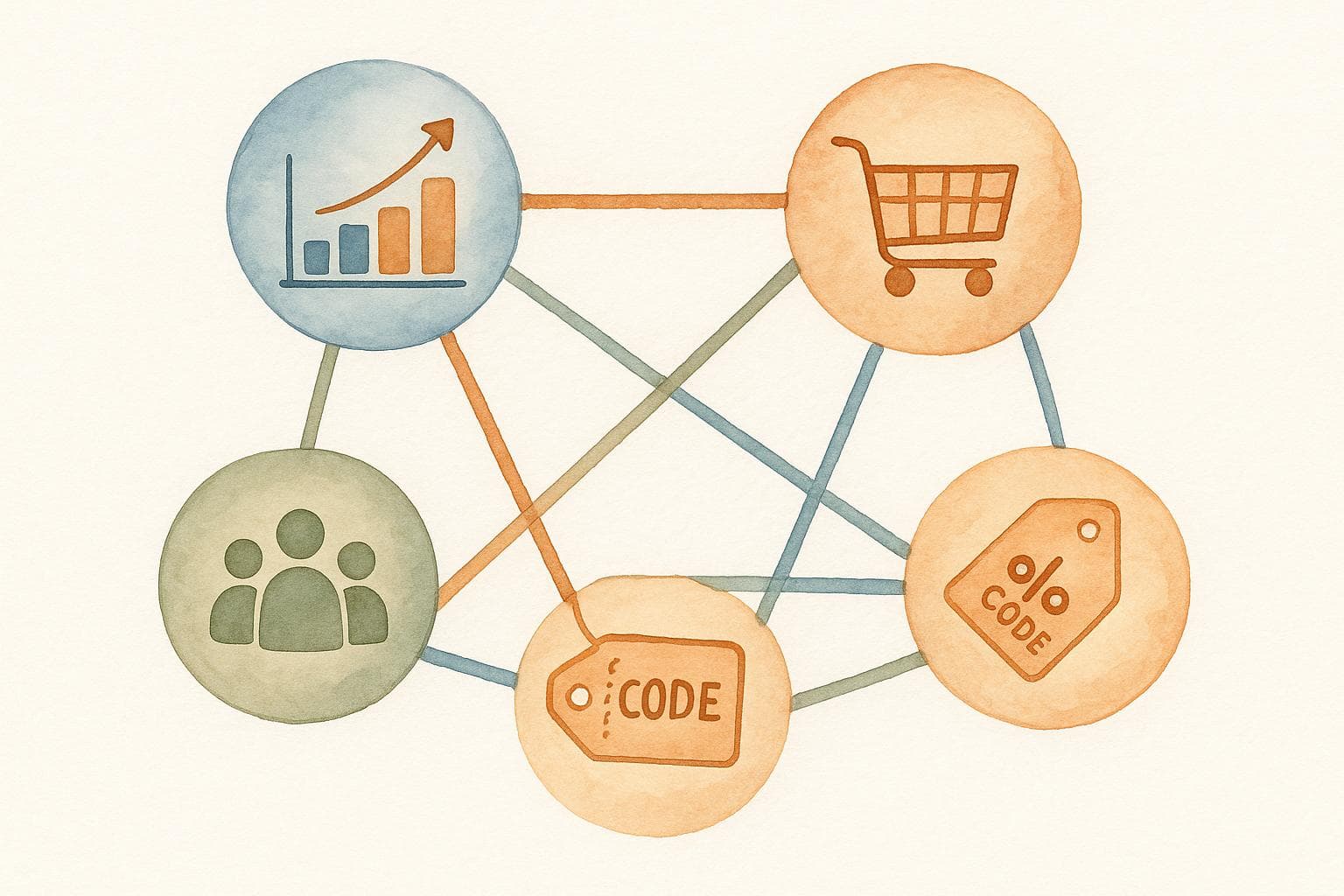
Pairing influencer and affiliate campaigns can boost sales, but measuring their combined impact is often challenging. Influencers focus on engagement and reach, while affiliates prioritise direct sales. This creates a gap in how success is measured, leading to missed opportunities. A unified approach bridges this divide, ensuring both teams work towards shared goals like Return on Ad Spend (ROAS), conversion rates, and customer acquisition cost.
Key Takeaways:
- Define clear objectives: Focus on one primary goal (e.g., revenue or awareness) and align metrics across both channels.
- Track the customer journey: Use tools like UTM parameters and promo codes to connect influencer-driven awareness with affiliate conversions.
- Use shared KPIs: Metrics like ROAS, conversion rates, and average order value keep teams aligned.
- Invest in tracking tools: A unified dashboard ensures consistent data and allows for better decision-making.
- Optimise regularly: Review data monthly, test new strategies, and document changes to improve performance.
Affiliate Marketing and Influencer Marketing: Key Differences and Benefits
Define Clear Campaign Objectives
Before diving into aligning metrics for influencer and affiliate campaigns, it’s crucial to pin down what you’re aiming to achieve. Skipping this step is a common mistake among Australian brands, often leading to conflicting priorities and muddled ROI tracking.
Clear objectives act as the foundation for aligning influencer and affiliate efforts. They shape every decision you make - whether it’s choosing the right influencers, identifying meaningful KPIs, or deciding how to split your budget across channels.
Setting a North Star Metric
A North Star Metric is your campaign’s ultimate measure of success. It’s the key result your team should focus on, whether that’s revenue, awareness, or lead generation. Picking one primary focus is non-negotiable. Trying to prioritise everything at once only creates confusion and misalignment.
For example, if revenue is your North Star Metric, both influencer and affiliate campaigns should be evaluated based on their impact on sales. That doesn’t mean influencers need to drive immediate purchases - they might focus on building awareness and trust, which later supports affiliate-driven conversions. On the other hand, if you’re launching a new product or entering a fresh market, brand awareness may take centre stage, with affiliates concentrating on driving engaged traffic rather than instant sales.
A helpful rule of thumb is the 70-20-10 approach: dedicate 70% of your efforts to the primary objective, 20% to progress indicators, and 10% to experimental metrics.
To ensure your North Star Metric ties back to real business value, connect it to key financial measures like product lifetime value (LTV), contribution margins, or cohort profitability. This way, you’re not just chasing top-line revenue but also keeping an eye on long-term sustainability.
Translating Business Goals into Campaign Objectives
Once your North Star Metric is set, translate it into specific, actionable campaign objectives. Vague goals like "boosting sales" won’t cut it - you need clear, measurable targets.
Use the SMART framework to define your objectives: Specific, Measurable, Achievable, Relevant, and Time-bound. For instance, instead of saying "increase sales", aim for something like: "Generate AUD $50,000 in affiliate revenue by Q1 2026, with a 2–3% conversion rate." This level of detail helps you select the right KPIs for each channel and keeps your teams aligned with the overarching goal.
Break these objectives down by channel. Let’s say your goal is to grow market share in the Australian skincare industry. You might set influencer targets for reach - like achieving 5 million impressions among women aged 25–45 in metro areas over three months - and affiliate targets for qualified traffic, such as 10,000 website visits with at least 90 seconds of average session duration.
Keep your product’s sales cycle in mind when defining objectives. For high-ticket or complex items, early-stage goals might focus on engagement and traffic, as these purchases often require longer consideration phases. Meanwhile, for fast-moving consumer goods, direct conversions could be the priority from day one. For example, if you’re promoting premium coffee subscriptions, influencers might focus on engagement metrics like saves, shares, and comments, while affiliates drive trial subscriptions using first-purchase discounts.
Demographics and local nuances also play a big role. For instance, Gen Z audiences (18–24 years old) may have high social media engagement but limited disposable income, so campaigns should prioritise awareness and consideration. In contrast, affluent professionals (35–55 years old) tend to research thoroughly before buying, making educational content and lead generation more effective. Ensure your influencers and affiliates have audiences that align with these characteristics - misaligned targeting is a major reason campaigns fall short.
If your business has multiple priorities, such as boosting brand awareness, generating leads, and driving revenue, take a hierarchical approach. For example, you might focus 60–70% of your efforts on the primary goal, like generating AUD $100,000 in revenue, while allocating 20–30% to secondary goals, such as increasing brand awareness by 25% or building a list of 5,000 qualified leads. Leave about 10% for experimental metrics to explore new opportunities.
Document how these objectives connect. For instance, clarify how influencer efforts to build awareness (measured by reach and engagement) feed into affiliate campaigns that drive conversions (measured by sales and ROI). This narrative ensures teams work cohesively rather than optimising in isolation.
Finally, involve key departments - marketing, sales, and finance - in finalising and validating your objectives. Communicate these goals clearly to all partners before launching the campaign, and revisit them regularly to adapt to changing market conditions and business needs.
With your objectives firmly in place, the next step is aligning these metrics across the customer journey to create a seamless campaign strategy.
Map Metrics Across the Customer Journey
Once your campaign objectives are clear, the next step is aligning your metrics with the customer journey. This ensures you capture accurate data at every stage, from initial awareness to final conversions.
Mapping metrics across each stage of the funnel is essential to connecting influencer-driven awareness with affiliate-powered conversions. Many Australian brands, however, tend to focus on easily trackable metrics like conversions while neglecting the earlier stages of awareness and consideration that lead to those results. This narrow focus can leave critical gaps in understanding the full effectiveness of a campaign.
Typically, influencer teams measure engagement without linking it to sales, while affiliate teams focus purely on conversions. This siloed approach makes it harder to optimise campaigns or demonstrate their overall value. Instead, a more holistic framework is needed - one that tracks performance across three key stages: awareness, consideration, and conversion. Each stage requires distinct metrics, and both influencer and affiliate channels play a role, albeit in different ways.
Upper-Funnel Metrics
Upper-funnel metrics gauge how well your campaigns introduce your brand to new audiences and build awareness. Influencer campaigns tend to excel here, but affiliates can also contribute through content placements and display ads.
For influencer campaigns, the key metrics include impressions, content reach, and engagement rates. Impressions reveal how often your content is displayed, while reach shows how many unique individuals have seen it. Engagement metrics - likes, comments, shares, and saves - offer insight into how well your content resonates. To calculate engagement rate, divide total engagements by reach, then multiply by 100.
For affiliate campaigns, upper-funnel metrics focus on clicks and click-through rates (CTR), which show how many people are interacting with affiliate placements. Another helpful metric is brand mentions, which can be tracked using social listening tools. An increase in organic mentions often signals growing interest in your brand beyond paid efforts.
Tracking total reach across both channels provides a comprehensive view of your audience exposure. Instead of directly comparing influencer engagement rates to affiliate CTR - since they measure different behaviours - it’s more productive to evaluate each set of metrics independently and see how they collectively expand your potential audience.
Once awareness is established, the focus shifts to how audiences engage during the consideration phase.
Mid-Funnel Metrics
Mid-funnel metrics measure how effectively your campaigns guide audiences from awareness to consideration. This stage evaluates how people interact with educational or persuasive content, bridging the gap between discovery and purchase decisions.
For influencer campaigns, important mid-funnel metrics include time spent on content, engagement with educational posts, and website traffic driven by influencer links. Analysing how visitors behave on your website - such as which pages they view and how long they stay - can reveal the effectiveness of your content.
Affiliate campaigns, on the other hand, focus on click-through rates, website traffic, and user behaviour on landing pages. Affiliates often drive direct traffic through clear calls-to-action, though the quality of that traffic varies.
To unify metrics across channels, use tracking systems that distinguish traffic sources. For example, UTM parameters can help you identify whether visitors came from an influencer or an affiliate campaign. Metrics like time on site and pages per session further illustrate audience interest. If an influencer campaign drives 5,000 unique visitors with an average session duration of 2 minutes, compared to 3,000 visitors with a 45-second average from an affiliate campaign, you can infer that influencer traffic may be more engaged mid-funnel.
For Australian campaigns, tools like Google Analytics are invaluable for tracking these metrics, provided UTM parameters are correctly implemented.
Once mid-funnel engagement is assessed, it’s time to analyse how these interactions convert into tangible sales.
Lower-Funnel Metrics
At the bottom of the funnel, the focus is on conversions - measuring the direct results of your campaigns in terms of sales and return on investment.
Both influencer and affiliate campaigns rely on key lower-funnel metrics like number of sales, conversion rate, average order value (AOV), and cost per acquisition (CPA). Conversion rates, which generally range from 1–5% depending on the industry, serve as a baseline for evaluation. Calculating these rates separately for each channel (by dividing conversions by total visitors and multiplying by 100) can reveal differences in purchase intent. For instance, if influencer traffic converts at 2.5% and affiliate traffic at 4%, this suggests that while affiliates drive more direct sales, influencers play a vital role in building awareness and trust.
Tracking tools are essential for attributing conversions to their sources. For affiliate campaigns, use unique promo codes, affiliate links, and UTM parameters to track sales. Similarly, influencers can be provided with exclusive discount codes or links to measure their impact.
Metrics like AOV provide insight into the quality of conversions by showing how much customers spend per transaction. Meanwhile, CPA - calculated by dividing total campaign spend by the number of conversions - offers a measure of efficiency. For example, if a campaign costs AUD $5,000 and generates 100 sales, the CPA is AUD $50. ROI can also be calculated by comparing revenue against campaign costs. For instance, if an affiliate campaign generates AUD $20,000 in revenue from AUD $4,000 in costs, the ROI is 400%.
Australian brands that combine influencer and affiliate strategies have reported 46% higher affiliate-driven sales as a share of total e-commerce revenue compared to those relying solely on affiliate partnerships. It’s important to report all financial metrics in AUD and comply with Australian Consumer Law by clearly disclosing affiliate relationships and avoiding misleading claims.
A unified dashboard displaying these metrics side-by-side can help you evaluate each channel’s performance and allocate budgets more effectively. Linking lower-funnel metrics to unit economics, such as Product LTV and contribution margins, can also provide a clearer picture of long-term profitability. Analysing the CPA/LTV ratio, for instance, gives insight into the sustainability of your campaigns beyond immediate sales.
Establish Unified KPIs for Both Channels
Defining metrics is just the start; the real challenge lies in creating shared KPIs that bring influencer and affiliate teams together to work toward the same business goals. Without a unified approach, influencer managers might prioritise engagement while affiliate teams focus on sales - leaving you with an incomplete picture of your campaign's success.
This disconnect can do more than just skew reporting. When teams optimise for different outcomes, they can unintentionally undermine one another. For instance, an influencer campaign might excel at building brand awareness, but if shared KPIs don't reflect that value, its impact may be overlooked. On the flip side, affiliate-driven conversions might look great on paper but could result in customers with lower lifetime value. These mismatched goals can obscure the true potential of your integrated strategy and complicate budget decisions.
So, how do you bridge this gap? Start by defining metrics that both teams can rally around.
Shared Success Metrics
The key to alignment is establishing metrics that both influencer and affiliate teams contribute to and are measured against. One of the most effective shared metrics is Return on Ad Spend (ROAS). Unlike channel-specific metrics like engagement or click-through rates, ROAS provides a clear view of your campaign's impact on revenue by showing how much money is generated for every dollar spent.
Here’s an example: if your combined influencer and affiliate campaign costs AUD $10,000 and generates AUD $40,000 in revenue, your ROAS is 4:1. This single metric encourages collaboration, with influencers driving awareness and demand while affiliates focus on optimising conversions.
Other important shared metrics include:
- Conversion rate: Tracks the percentage of visitors who make a purchase, regardless of how they arrived.
- Average order value (AOV): Reflects the quality of conversions by measuring the average spend per purchase.
- Customer acquisition cost (CAC): Evaluates how efficiently your combined efforts bring in new customers.
To organise these metrics effectively, structure your measurement framework in tiers. Place the most critical metrics - like revenue, ROAS, and customer lifetime value - at the top. Mid-level metrics, such as conversions and AOV, come next, while diagnostic metrics like clicks and engagement sit at the bottom. This hierarchy ensures that you focus on what truly drives growth, rather than getting distracted by vanity metrics.
Another powerful metric to consider is the demand creation to conversion ratio. This measures how influencer impressions and engagement translate into affiliate-driven conversions. For example, if an influencer campaign generates 100,000 impressions with a 2% engagement rate and 5% of those engaged users convert, you can quantify the influencer’s indirect contribution to revenue.
Cross-channel attribution is also essential. Use multi-touch attribution models to credit influencer content as a key part of the customer journey. For instance, a customer might discover your brand through an influencer’s Instagram post, research your products, and then make a purchase via an affiliate link. Both channels play a role, and your unified KPIs should reflect that.
When setting benchmarks, consider both industry standards and your business model. Affiliate marketing typically delivers a ROAS of 3:1 to 5:1. Analyse your performance over the last three to six months and aim for a realistic improvement of 10–20% over your baseline. Express all financial metrics in AUD, and make sure your tracking systems capture genuine engagement, filtering out suspicious activity like bots or fake conversions.
Unified KPIs not only promote collaboration but also prevent teams from over-prioritising individual goals.
Avoiding Channel-Specific Optimisation Traps
One common pitfall in integrated campaigns is over-optimising one channel at the expense of the other. For instance, focusing too heavily on influencer engagement might result in high visibility but minimal conversions, while prioritising affiliate conversions could lead to low-value, high-volume sales.
Unified KPIs help avoid these traps by ensuring both teams are measured against shared goals, like ROAS. This encourages collaboration. An influencer manager can’t claim success based solely on engagement if those users don’t convert, and an affiliate manager can’t ignore the brand awareness that feeds their conversion funnel.
Take, for example, a comparison between two influencers. Influencer A might generate more reach, but Influencer B could deliver higher ROAS. Without unified metrics, it’s easy to favour the wrong partnership. A multi-touch attribution model helps clarify each partner’s true contribution, combining metrics like reach, engagement, and brand lift with downstream conversions tracked through UTM parameters or unique codes.
To get a complete picture, use tracking tools that differentiate sources and measure combined outcomes. For instance:
- Assign unique promo codes to influencers.
- Use dedicated affiliate links for partners.
- Apply consistent UTM parameters.
This approach helps you answer key questions, such as: Which influencer-affiliate pairings drive the best ROAS? How do influencer campaigns impact affiliate conversions? Which partnerships excel in both engagement and conversion?
A performance matrix can further enhance your strategy by tracking each partnership’s contribution to shared KPIs. Focus on partnerships that deliver the highest ROAS and lowest CAC. Document these high-performing combinations to identify where to invest more resources.
Finally, ensure compliance is part of your KPI framework. Both influencers and affiliates must clearly disclose their relationship with your brand. Monitor this as a compliance metric to ensure all content includes proper disclosures. Under Australian Consumer Law and ACCC guidelines, transparent disclosure is mandatory. Implement systems to review marketing claims for accuracy before publication, protecting both consumer trust and your brand’s reputation.
Implement Effective Tracking Infrastructure
To make a unified KPI framework work, you need a tracking system that can measure performance accurately. Without it, KPIs are just numbers on a page. The real challenge isn’t deciding what to track - it’s building systems that gather data across all channels without relying on time-consuming manual processes.
Platform fragmentation often leads to disjointed views of campaign performance, making it hard to measure the true impact of influencer campaigns or attribute value across different channels. If your influencer data sits in one tool, affiliate conversions in another, and website analytics elsewhere, you’re left piecing together insights manually. This doesn’t just waste time - it results in incomplete reports and poor decisions.
Research highlights three common tech issues for marketing teams: misaligned reporting between internal and external data, inconsistent tracking across channels, and fragmented platforms that separate brand awareness efforts from performance marketing. Solving these problems requires a well-thought-out tracking system from the ground up. The next step? Implementing the right tools.
Setting Up Tracking Tools
Use UTM parameters, unique promo codes, and affiliate links. Together, these tools create a full picture of how customers interact with your campaigns.
Start with UTM parameters for every trackable URL. These tags capture details like campaign source, medium, and content, feeding directly into Google Analytics. To ensure consistency, establish a standard naming convention for your team and document it in a shared resource. For influencer campaigns, use a structure like: utm_source=influencer, utm_medium=social, utm_campaign=[campaign_name], and utm_content=[influencer_name]. For affiliate campaigns, try: utm_source=affiliate, utm_medium=affiliate_link, utm_campaign=[campaign_name], and utm_content=[affiliate_partner_name].
This consistent tagging makes it easier to filter data by channel while still seeing the big picture. Inconsistent naming, on the other hand, can corrupt your data and make analysis a nightmare.
Unique promo codes serve two purposes: they encourage purchases and provide clear attribution to specific creators. Keep them short and easy to remember - 10 to 15 characters max, using only uppercase letters and numbers. Avoid symbols like hyphens or underscores that might confuse users. For example, codes like SARAH20 or FITNESSJOE15 are more user-friendly than something overly complex. Always test codes in your e-commerce system before launch.
Affiliate links automate tracking through your affiliate management platform, generating unique URLs for each partner. To make these links more shareable, especially on social media, use a branded short URL service.
For Australian businesses, ensure your tracking tools are set to Australian Eastern Time (AEST/AEDT) and record all currency in AUD. This avoids confusion when comparing performance across time zones or analysing revenue figures.
Metrics like traffic, branded search, and engagement often spike during and right after a campaign. Set up automated alerts in Google Analytics to notify you when traffic or conversions exceed normal levels. This helps you quickly identify high-performing campaigns and adjust budgets accordingly.
Unified Dashboards and Attribution Models
Collecting data is just the start. The real value comes from consolidating it into a unified dashboard that offers both a broad overview and detailed breakdowns. After setting up standardised tools, bring the data together for a complete view.
Connect Google Analytics to a business intelligence tool like Data Studio, Tableau, or Looker. These tools can pull data from multiple sources into one visualisation. Configure your affiliate platform to export daily performance metrics - like sales, conversions, and click-through rates - into a centralised spreadsheet or BI tool. At the same time, gather social media insights from platforms where your influencers are active, focusing on reach, impressions, and engagement rates.
Organise your dashboard into four sections: overall campaign performance, channel-specific breakdowns (influencer vs. affiliate), performance by individual creators or affiliates, and customer journey metrics like awareness, consideration, purchase, and retention. Use colour coding to differentiate metrics - green for influencer data, blue for affiliate data. This setup allows stakeholders to see the big picture while also diving into specific details when needed.
For Australian teams, make sure your dashboard uses AUD for all monetary data and displays dates in the DD/MM/YYYY format to avoid confusion.
The key to a successful dashboard is its attribution model. Multi-touch attribution is crucial when customers interact with multiple channels before buying. Instead of giving all credit to the final touchpoint (which often favours affiliates), use a layered model that distributes credit across the customer journey.
A common approach is the 40-20-40 model: 40% of credit goes to the first touchpoint (like influencer content), 20% to middle interactions, and 40% to the final conversion (often an affiliate link). Alternatively, time-decay attribution gives more weight to interactions closer to the conversion while still recognising earlier steps.
Track the full customer journey using pixel-based tracking or UTM chains. For instance, if a customer sees an influencer’s Instagram post (tagged as utm_source=influencer) and clicks an affiliate link three days later (tagged as utm_source=affiliate), your system should record both touchpoints and share the credit. This prevents over-crediting one channel and gives a clearer picture of how different efforts work together to drive sales.
Document your attribution model clearly so everyone understands how credit is distributed. This transparency avoids disputes between teams and ensures consistent interpretation of performance data.
Data discrepancies between platforms are inevitable. For example, Google Analytics might show different conversion numbers than your affiliate platform due to timing or tracking variations. Set up a monthly reconciliation process to compare numbers and investigate significant differences (anything over 5%-10%). Use a master spreadsheet to cross-reference conversions by date, channel, and source. For affiliate-driven sales, prioritise your affiliate platform as the most reliable source. For influencer-driven conversions, rely on Google Analytics, supplemented by promo code data from your e-commerce system. Log all discrepancies and explanations in a shared document to maintain clarity.
Some brands use unified partnership platforms that integrate partner management, tracking, and analytics into one system. This simplifies operations and ensures accurate performance measurement across all channels.
Investing in strong tracking infrastructure pays off. Brands that combine influencer and affiliate efforts see 46% higher affiliate-based sales compared to those working with affiliates alone. But you can only achieve this if your tracking systems accurately measure contributions from both channels. A solid attribution framework strengthens your KPI strategy and helps teams work together toward shared goals.
Benchmark, Adjust, and Optimise
Turning raw data into actionable insights is what benchmarking is all about. Unified KPIs help align influencer and affiliate metrics, but the real key is keeping those benchmarks relevant through regular updates.
Too often, businesses set KPIs and then leave them untouched. But markets evolve, audience preferences shift, and strategies that worked a few months ago might not deliver today. The best campaigns adapt, using constant feedback to refine and improve.
Using Benchmarks and Industry Data
To define what "good" looks like, compare your current metrics with both historical data and industry standards.
In affiliate marketing, for instance, conversion rates typically fall between 1–5%, depending on the niche. However, benchmarks differ across sectors - what works for high-ticket FMCG items may not apply to impulse buys. Instead of treating industry averages as fixed targets, use them as a guide to set realistic goals tailored to your business.
Track your key metrics while keeping local conventions in mind, such as Australian currency and date formats. If you're launching a new campaign without historical data, start with industry benchmarks and tweak them as you gather insights. Begin with modest targets so you have room to refine your approach based on your audience and product.
A simple spreadsheet can help you track benchmarks. Include columns for the metric type, industry benchmark, historical average, current performance, and variance. Update this regularly - monthly for active campaigns and quarterly for long-term initiatives. For Australian businesses, focus on local benchmarks, as market trends like EOFY sales or Christmas shopping can differ significantly from global averages.
Don't just focus on conversion rates. For example, strong click-through rates paired with poor conversions might point to issues with your landing pages or checkout process. Regular audits can uncover these gaps and help you address them.
To get a clearer picture of long-term profitability, link campaign results to unit economics like product lifetime value (LTV), contribution margins, or customer cohorts. A campaign with a decent conversion rate might still underperform if the customers it brings in have a lower lifetime value than average.
Iterating Based on Insights
Once you've identified performance gaps, take specific, data-driven actions to address them. Continuous adjustment, informed by your benchmarks, is essential.
Review KPIs frequently - weekly for short-term campaigns and monthly for longer initiatives. For strategic shifts, conduct quarterly reviews. If a key metric suddenly drops - like conversion rates falling below 0.5% when you were aiming for 2–3% - act immediately. Investigate whether the issue is due to audience misalignment, tracking errors, or creative fatigue. On the flip side, a sudden spike in performance from a particular influencer or affiliate deserves a closer look to replicate their success.
Use real-time data from affiliate dashboards to monitor metrics like click-through rates, conversion rates, and earnings per click. If certain content strategies or channels perform better than others, adjust your creative briefs or reallocate budgets accordingly.
Keep testing and refining. Use social media analytics tools like Instagram Insights or TikTok Analytics to see what resonates most with your audience. Schedule posts based on when your audience is most active - weekday evenings, for instance, might maximise visibility and engagement.
Take note of which influencers or affiliates drive the most conversions and revenue. If one or two partners consistently outperform others, consider deepening your partnership with them. Conversely, if some channels underperform, it may be time to reallocate your budget or reassess those relationships.
When metrics fall short of expectations, dig deeper. If conversion rates are low, examine traffic quality, creative relevance, or audience targeting. High traffic with poor conversions might call for fresh creative approaches or landing page tweaks. If your average order value is lagging, consider promoting higher-margin products or bundling strategies.
Layered attribution models can provide a more comprehensive view of performance. Combine tracked data with surveys, page analytics, and qualitative insights instead of relying solely on last-click attribution. This approach helps you understand the full customer journey and prevents over-optimisation of a single channel. Remember, influencers are often better at building awareness and engagement, while affiliates excel at driving direct conversions.
Many brands use Return on Ad Spend (ROAS) to measure program success. For example, if you spend $10,000 on an influencer-affiliate campaign and generate $46,000 in revenue, your ROAS is 4.6:1. Tracking this metric across channels ensures fair performance comparisons.
Data shows that combining influencers and affiliates can boost affiliate-driven sales by 46% of total e-commerce revenue compared to relying solely on affiliates. But these results only come with ongoing optimisation and attention to performance data.
Maintain a detailed optimisation log to track changes and their outcomes. For example:
"15/03/2025 – Shifted 30% of budget from display affiliates to email affiliates. Hypothesis: Email converts better based on February data. Result: Conversion rate increased from 1.8% to 2.4%, and ROAS improved from 3.2:1 to 4.1:1."
This creates a feedback loop where each adjustment informs the next, ensuring your decisions are deliberate and effective.
Conclusion
Bringing metrics together is the key to understanding how influencers and affiliates work together to drive business results. Looking at these channels in isolation misses the bigger picture - while influencers are great at building awareness, affiliates excel at converting that interest into actual sales. Without a unified way to measure their impact, it’s tough to see their combined value or figure out the best way to allocate your budget.
The numbers tell the story. Brands that integrate influencers and affiliates see a 46% boost in affiliate-based sales compared to those that stick solely to affiliate partnerships. Consistent tracking across both channels is essential for this kind of success.
By using unified metrics and automated tracking systems, you gain the clarity needed to make smarter decisions. This approach helps you strengthen relationships with top-performing partners and cut ties with underperformers before they drain your resources.
It’s not just about performance - it’s also about trust and compliance. Following Australian disclosure guidelines builds credibility with your audience, and a unified tracking system ensures every partnership is properly documented, reducing the risk of compliance issues.
Aligned metrics also set the stage for long-term growth. As your campaigns expand and you bring in more influencers and affiliates, automated tracking keeps your data consistent. This frees your team to focus on strategy and optimisation instead of getting bogged down in spreadsheets and conflicting reports.
When you adopt this unified perspective, you can make confident decisions about budget allocation and refine your strategy with precision. These insights lay the groundwork for measurable and sustained growth.
Key Takeaways
- Focus on clear objectives tied to revenue, customer acquisition, or market share instead of vanity metrics.
- Use unified KPIs to measure success consistently across both channels. Metrics like conversion rates (typically 1–5%), average order value, click-through rates, and return on ad spend are crucial.
- Set up robust tracking tools, such as UTM parameters, promo codes, and affiliate links. Multi-touch attribution models can show how customers move from influencer awareness to affiliate conversions.
- Regularly review data - monthly for trends and quarterly for deeper analysis. If conversion rates drop below your benchmark for two straight weeks, act quickly to investigate.
- Keep an optimisation log to document changes, test hypotheses, and track results. This creates a feedback loop that helps refine your strategy over time.
Unified measurement doesn’t have to be complicated, but it does require discipline. Businesses that commit to this integrated approach consistently outperform those that track channels separately because they gain a full understanding of the customer journey and optimise for overall program success.
FAQs
How do I measure the success of combined influencer and affiliate campaigns?
To gauge how well your influencer and affiliate campaigns are working together, start by aligning your KPIs (Key Performance Indicators) with your overall business objectives. Look at metrics that reflect short-term wins, like sales and conversions, as well as those that show longer-term benefits, such as increased brand visibility and stronger customer engagement.
Leverage tracking tools to keep an eye on critical data points like referral traffic, conversion rates, and revenue. Make sure both types of campaigns are tracked using the same framework to allow for clear comparisons. For instance, using unique affiliate codes or UTM parameters can help you pinpoint the source of performance more accurately.
Lastly, assess the ROI (Return on Investment) by comparing what you’ve spent on the campaigns to the revenue and value they’ve brought in. Taking this comprehensive approach ensures you’re not only measuring success but also spotting areas where you can refine and improve.
How can I align objectives and metrics for influencer and affiliate campaigns?
To bring influencer and affiliate campaigns into alignment, begin by pinpointing shared objectives. These might include expanding brand awareness, driving sales, or enhancing customer engagement. Once the goals are set, establish key performance indicators (KPIs) that work for both campaigns. Metrics like revenue, conversion rates, or audience reach are great starting points.
Make sure you have reliable tracking tools to measure performance consistently across both channels. Use the data collected to fine-tune your strategies, honing in on what resonates most with your audience. Regularly evaluate the outcomes to confirm you're achieving a solid return on investment (ROI) and tweak your approach as needed to stay on track.
How can I set up a unified tracking system to measure the success of both influencer and affiliate campaigns?
To set up a unified tracking system for influencer and affiliate campaigns, start by identifying the key performance indicators (KPIs) that match your business objectives. These could include metrics like conversions, revenue, or engagement levels. Make sure these KPIs are both measurable and consistent across all campaigns.
Next, implement tools such as UTM parameters, affiliate tracking software, or influencer platforms to keep tabs on performance. Integrate these tools with your analytics platform so all your data is centralised, making it easier to compare and assess outcomes. It's also important to communicate clearly with influencers and affiliates about reporting expectations to ensure data accuracy.
Finally, review your tracking system regularly. This helps you stay aligned with your campaign goals and ensures the data provides meaningful insights for improving future strategies.
Related Blog Posts
10 Metrics to Track Scaled Influencer Campaigns
How To Build a Social Media ROI Dashboard
Common Pitfalls in Social Media ROI Analysis
How to Map DTC Customer Touchpoints
How To Measure Content Marketing ROI For eCommerce
5 Steps for Data-Driven Resource Allocation
Newsletter
The Uncommon Insights Letter
Practical FMCG & eCommerce growth playbooks — margins, retention and scaling tactics, straight to your inbox.
Turn these ideas into profit you can see
Get a hands-on operator to turn the frameworks above into results — book a free audit call.